

History of the Kaaba How the Young Muhammad ﷺ Prevented Civil War When Quraysh Rebuilt It (Ultimate UK Seerah Guide)
By Eaalim Institute on 4/27/2026 · 7 min read
The history of the Kaaba includes a remarkable moment in the Prophet Muhammad’s ﷺ early life: its rebuilding by Quraysh in 605 CE. The Ka’bah in Makkah is the holiest site in Islam, the direction of every daily prayer and the centre of Hajj. Ibrahim and Isma’il (peace be upon them) raised its foundations, and Quraysh rebuilt it about five years before revelation began. During that rebuilding, the young Muhammad ﷺ settled a dispute that almost led to war. This UK guide explores this chapter in the history of the Kaaba and its lessons for British Muslim families.
The original Ka'bah and its Quranic foundation
The Quran describes the prophet Ibrahim and his son Isma'il raising the Ka'bah's foundations (peace be upon them):
"And when Ibrahim was raising the foundations of the House and Isma'il, [saying], 'Our Lord, accept this from us. Indeed You are the Hearing, the Knowing.'" (Surah Al-Baqarah 2:127)
This construction was a simple stone structure dedicated to the worship of Allah alone. Over the centuries, however, the descendants of Isma'il gradually drifted into polytheism. They placed idols in and around the Ka'bah.
By the conquest of Makkah, 360 idols stood around it, as reported in Sahih al-Bukhari. Nevertheless, the Ka'bah remained the focal point of pre-Islamic Arabian religion.
The History of the Kaaba: Why Quraysh Rebuilt It in 605 CE
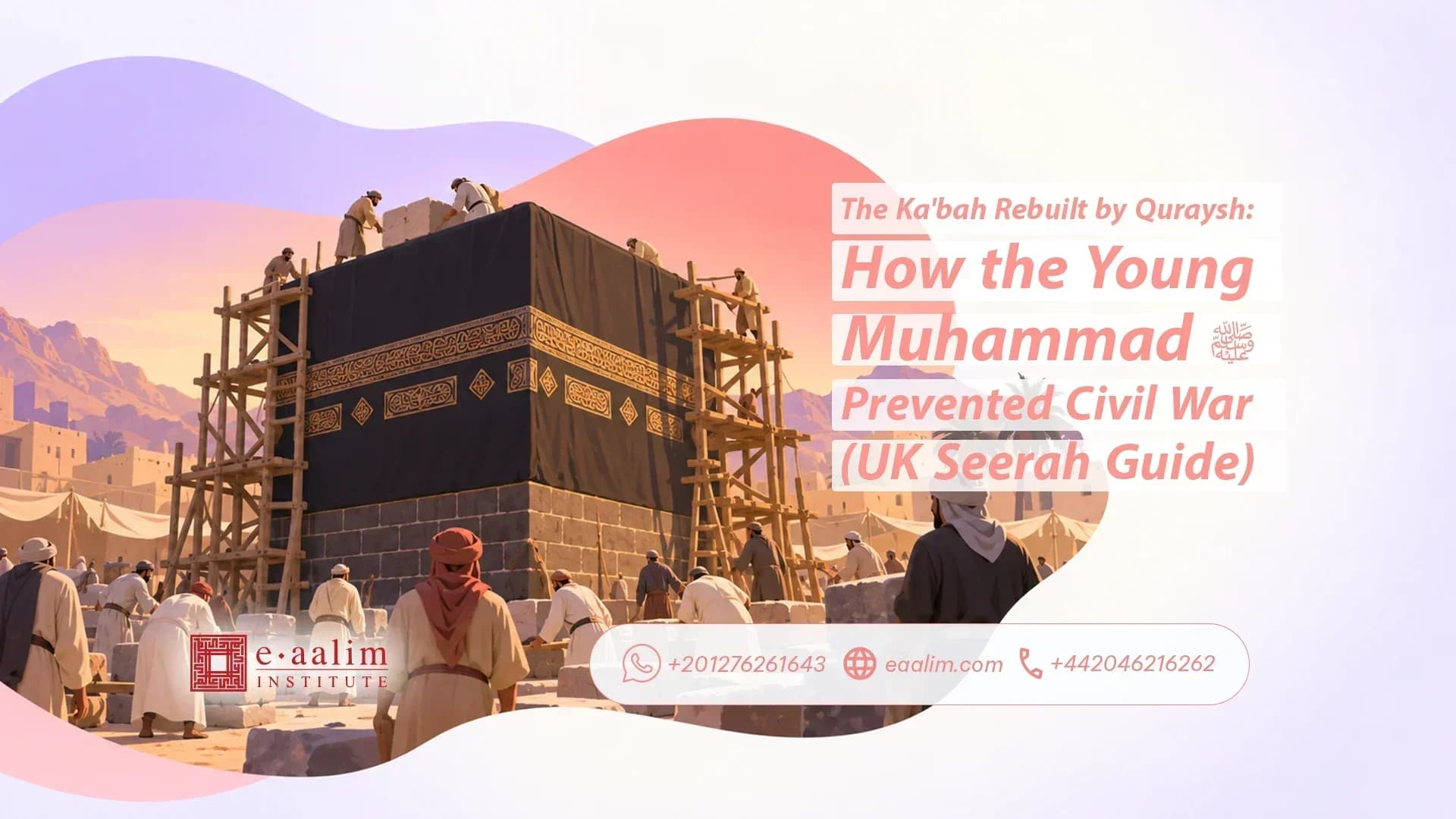
deteriorate. Then a flash flood, uncommon but destructive in the desert valley, damaged its foundation. As a result, Quraysh, the dominant tribal group in Makkah, agreed to rebuild it under three rules:
Use only halal money. They excluded money from prostitution, theft or unjust dealings.
Use only halal materials. They used local Makkan stone and timber from a Byzantine ship wrecked on the Red Sea coast.
Each tribe to handle one wall. The four main groups each took responsibility for one wall.
Construction went smoothly until the time came to return the Black Stone (al-Hajar al-Aswad) to the eastern wall. The Black Stone holds profound religious significance; according to Sunan al-Tirmidhi 877, it came down from Paradise. However, each Quraysh clan wanted the honour of placing it.
The dispute that nearly caused war
The argument over who would place the Black Stone lasted four or five days. Meanwhile, tensions rose, and some clans prepared for armed conflict.
For example, Banu Abd al-Dar and Banu Adi brought a basin filled with blood. They dipped their hands into it as a death pact. Through this act, they declared their willingness to die rather than surrender the honour.
Eventually, Abu Umayyah ibn al-Mughirah, the eldest man of Quraysh, proposed a solution. The next person to enter through the Sanctuary gate would judge between them. They agreed to accept that person's decision.
The young Muhammad ﷺ becomes the arbitrator
The next person through the gate was the 35-year-old Muhammad ﷺ. Revelation would not begin for another five years. Nevertheless, the Makkans already knew him as Al-Amin (the Trustworthy) and As-Sadiq (the Truthful). Indeed, his honesty in business and fairness in disputes had earned their confidence, so the clans gladly accepted his judgement.
After hearing the dispute, he asked for a cloak. Then he spread it on the ground, placed the Black Stone in its centre and asked the clan representatives to hold its edges. Together, they lifted it to the height of the wall, and he placed the stone with his own hands. As a result, every clan shared the honour, and the dispute ended without war.
Classical Seerah works by Ibn Ishaq, Ibn Hisham and al-Tabari recount this episode, one of the best-known in the history of the Kaaba and in the Prophet’s ﷺ life before revelation.
What this story teaches
1. Wisdom in conflict resolution
At first, the clans treated the honour as something only one group could claim. However, Muhammad's ﷺ solution allowed them to share it. Each group participated without losing dignity.
The episode therefore offers a valuable lesson in resolving conflict. Look for a solution that respects everyone involved. British Muslim community leaders can reflect on this approach when addressing mosque disputes, family disagreements, or workplace conflicts.
2. Trust earned before trust used
By the age of 35, Muhammad ﷺ had established a reputation for trustworthiness. In particular, his conduct in Makkah’s marketplace and private dealings had earned people’s respect.
Consequently, the clans accepted his judgement when he entered the Sanctuary. His reputation gave them a reason to trust him during a tense moment.
The lesson is practical: small, consistent acts of honesty build trust over time. That trust can then help people resolve much larger problems.
3. Pre-prophetic preparation
The Prophet ﷺ did not begin practising honesty when revelation came at the age of 40. His reputation for trustworthiness already preceded his prophetic mission.
This episode therefore invites reflection on how character develops before major responsibilities arrive. For British Muslim teenagers, the lesson applies to everyday choices. Honesty at school, at home, and among friends matters now, rather than at some imagined future turning point.
4. Hands-on leadership
Muhammad ﷺ did more than suggest a solution. He also took part in carrying it out, placing the Black Stone with his own hands.
The episode illustrates leadership through action. Similarly, British Muslim parents can reinforce their guidance by joining their children in good deeds. Praying together, helping people in need, and visiting relatives make those lessons tangible.
The Ka'bah's later rebuildings
The Quraysh rebuilding was only one stage in the long history of the Kaaba. Later, conflicts and restorations brought further changes:
Abdullah ibn al-Zubayr (RA), 64 AH (683 CE). After the Umayyad siege damaged the Ka’bah, Ibn al-Zubayr rebuilt it to include the Hijr, following the Ibrahimic dimensions the Prophet ﷺ had described.
Al-Hajjaj ibn Yusuf, 73 AH (692 CE). After Ibn al-Zubayr’s death, al-Hajjaj returned the Ka’bah to the smaller Quraysh dimensions, leaving the Hijr outside.
Ottoman and Saudi-era restorations. Later rulers restored the Ka’bah but kept its Quraysh footprint. Meanwhile, they enlarged the surrounding mosque and the Mas’a between Safa and Marwa.
The Black Stone has also suffered damage. In the 10th century, the Qarmatians took it and held it for about 22 years. Today, it consists of several fragments in a silver frame.
What British Muslim Families Can Learn from the History of the Kaaba
The Ka'bah's history shapes Muslim identity. Knowing its story can help children understand why they face Makkah during salah. This gives the direction of prayer a meaning beyond a simple compass instruction.
Pre-Islamic Quraysh actually got some things right. Their concern for acceptable funding and shared responsibility offers material for discussing ethical choices. Families can explore how Islam affirms good qualities while correcting wrongdoing.
The Prophet's ﷺ pre-prophetic life is a model. His reputation for honesty preceded revelation. British Muslim teenagers can learn from this example when making everyday decisions about trust and responsibility.
Visit Makkah when you can. Hajj and Umrah can deepen a family's connection to the Ka'bah. These visits also offer opportunities to reflect on the lives of Ibrahim and Muhammad (peace be upon them).
How Eaalim helps British Muslim children connect to the Ka'bah's history
Eaalim's one-to-one online lessons introduce children to Quranic passages and stories about Makkah and the Ka'bah.
For example, lessons explore Surah Al-Baqarah 2:127, which describes Ibrahim and Isma'il raising the foundations. They also cover Surah Al-Imran 3:96–97 and relevant Seerah stories. Together, these topics help children connect Quranic learning with Islamic history.
Lessons last 30 minutes, with shorter sessions of 15–20 minutes for children under seven. Scheduling follows UK time, including GMT and BST, and prices are in pounds. Families can also book a free trial lesson.
Book a free trial Quran lesson.
Start your journey with Eaalim today!
Start 2 Free Trials


 Share
Frequently Asked Questions
Quraysh rebuilt the Ka'bah around 605 CE, when the Prophet Muhammad ﷺ was approximately 35 years old. This was about five years before the first revelation. Seerah accounts describe flood damage as a reason for the rebuilding. During construction, the clans disputed who should place the Black Stone. Muhammad ﷺ resolved the disagreement through a solution that allowed them to share the honour.
Muhammad ﷺ resolved the dispute over who should place the Black Stone in the rebuilt Ka'bah. According to Seerah accounts, he placed the stone on a cloth and asked representatives of the clans to lift it together. He then placed it in position himself. This allowed the groups to share the honour and helped prevent bloodshed.
According to the Quran (Surah Al-Baqarah 2:127), the prophet Ibrahim and his son Isma'il (peace be upon them) raised the foundations of the Ka'bah as the first house of worship dedicated to Allah on Earth. The original structure was a simple cube of stones. Over centuries, the descendants of Isma'il drifted into polytheism and placed 360 idols in and around the Ka'bah, but the structure itself remained the focal point of Arabian religion until Islam came in the 7th century CE.
The Black Stone, or al-Hajar al-Aswad, holds a special place in Islamic tradition. Jami' al-Tirmidhi 877 reports that it descended from Paradise. During the Quraysh rebuilding, the clans regarded placing it as a great honour. Their competing claims caused a serious dispute, which Muhammad ﷺ resolved by involving representatives of the clans in lifting it together.
Yes. Abdullah ibn al-Zubayr rebuilt the Ka'bah after damage during the siege of Makkah in 683 CE. His rebuilding included the Hijr area within the structure. Later, al-Hajjaj altered it under the orders of the Umayyad caliph Abd al-Malik, returning the Hijr outside its walls. A major Ottoman rebuilding followed flood damage in 1630. Further restorations have taken place since then.
Al-Amin (الأمين) means “the trustworthy”. Seerah accounts describe Muhammad ﷺ as having earned this reputation before his prophetic mission. His honesty and dependable character helped establish trust among the people of Makkah. Consequently, when the clans needed an arbitrator during the Black Stone dispute, they welcomed him and accepted his judgement.
Families can draw four practical lessons from the account. First, seek solutions that preserve everyone's dignity. Second, build trust through consistent honesty. Third, develop good character before major responsibilities arrive. Finally, lead through action as well as words. Parents can explore these lessons with children through everyday examples of fairness, cooperation, and keeping promises.
Yes. Muslim families from the UK can visit Makkah for Hajj or Umrah, subject to current entry requirements and permits. Hajj takes place on specific dates, while Umrah offers greater flexibility, subject to seasonal restrictions. Before booking, check official Saudi guidance and the relevant Nusuk platform for current procedures, eligibility, and authorised services.
Muslims face the Ka'bah because Allah commanded them to turn towards al-Masjid al-Haram, as stated in Surah Al-Baqarah 2:144. This direction is called the qiblah. It provides a shared orientation for prayer wherever Muslims live. Muslims worship Allah alone; they do not worship the Ka'bah or the Black Stone.
Eaalim's one-to-one online lessons help children explore Quranic passages and Seerah stories connected with Makkah and the Ka'bah. Relevant passages include Surah Al-Baqarah 2:127 and Surah Al-Imran 3:96–97. Parents can discuss their child's age, knowledge, and learning goals with the team to find a suitable starting point. Visit https://eaalim.com/free-trial to enquire about a free trial lesson.
