

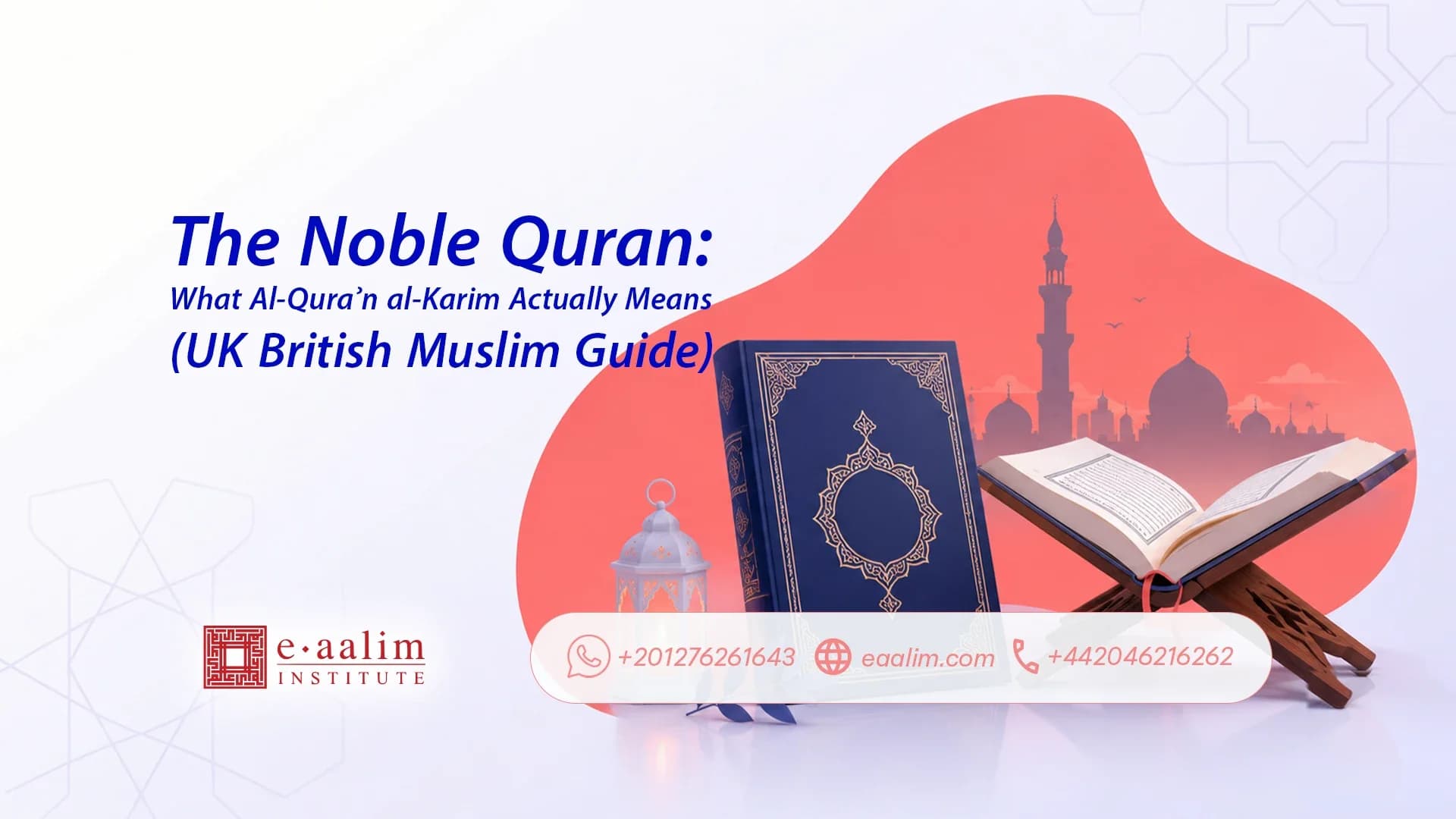
The Noble Quran: What Al-Quraʾn al-Karim Actually Means (UK British Muslim Guide)
By aburuqayyah on 12/22/2025 · 8 min read
What "the Noble Quran" actually means
The Noble Quran — known in Arabic as Al-Quran Al-Karim — is more than a sacred book for British Muslims. It is the speech of Allah, a source of guidance, worship and reflection, and a central part of Muslim life. But what does "Noble Quran" actually mean, and why is the Quran described as Karim?
Written for British Muslim families, converts new to the faith, and anyone who wants a clear, honest explanation of what the Quran actually is, this guide covers the technical definition, what it claims about itself, the qualities classical scholars use to describe it as karim (noble), the basic facts about its text, and how to begin reading it as a UK Muslim today.
The classical definition
Imam al-Suyuṭi, in his foundational work al-Itqan fī ʿUlum al-Qurʾan, gave the standard scholarly definition of the Quran. Compressed into modern English:
The Quran is the speech of Allah, miraculous in nature, revealed to Prophet Muhammad ﷺ, transmitted to us by mass narration (Tawatur), the recitation of which is itself an act of worship, beginning with Surah Al-Fatihah and ending with Surah An-Nas.
Each clause does work. Let's unpack them.
"The speech of Allah"
This excludes the speech of every other being — humans, jinn, angels. The Quran is not the Prophet ﷺ's words; it is not the Companions' words; it is not the inspired writing of a prophet. It is the direct speech of Allah, conveyed through angel Jibril, recited by the Prophet ﷺ exactly as received.
"Miraculous in nature"
The Quran is the eternal miracle of the Prophet ﷺ. Other prophets had time-bound miracles (Musa's staff, ʿIsa's healings) which existed at the moment they happened. The Quran is the miracle that persists across centuries because it can be read, recited, and challenged by every generation. The challenge: produce one chapter like it (Quran 2:23). Fourteen centuries on, the challenge stands unmet.
"Revealed to Prophet Muhammad ﷺ"
This excludes the Torah revealed to Musa, the Zabur to Dawud, the Injīl to ʿIsa, and the lost or inaccessible scriptures of other prophets. The Quran is specifically what was revealed to the Prophet of Islam.
"Transmitted by mass narration (Tawatur)"
Every verse of the Quran was memorised by hundreds of Companions during the Prophet's ﷺ lifetime, written down by his scribes in his presence, compiled into the standard Mushaf under the third caliph ʿUthman (RA), and transmitted in unbroken oral chains by tens of thousands of memorisers (huffaz) in every generation since. The transmission is so dense that fabrication or mass corruption is statistically impossible — this is what Tawatur means in classical Islamic scholarship. E-aalim is an online educational platform and institute. E-aalim teaches the holy Quran, Arabic and Islamic studies online.
"The recitation of which is itself an act of worship"
This is one of the Quran's most distinctive features. Unlike most religious texts, recitation of the Quran in its original Arabic — even by someone who does not understand the meaning — is rewarded by Allah. The Prophet ﷺ said: "Whoever recites a letter from the Book of Allah will be credited with a good deed, and a good deed gets a tenfold reward. I do not say that Alif-Lam-Mim is one letter, but Alif is a letter, Lam is a letter, and Mim is a letter" (Tirmidhi 2910).
"Beginning with Al-Fatihah and ending with An-Nas"
This excludes anything outside the standard 114-surah Mushaf — including the prophetic hadith, however authentic, and the qudsi hadith (sayings the Prophet ﷺ attributed directly to Allah). Hadith are revelation in meaning; only the Quran is revelation in both wording and meaning.
Why "Noble" (Karim)?
The adjective karim in Arabic carries multiple connotations: noble, generous, honourable, worthy, valuable. Classical scholars including al-Qurṭubī list several reasons the Quran is described this way:
Quality | What it means |
|---|---|
Noble in source | It comes from Allah, the most Honoured. |
Noble in messenger | It was brought by Jibril, the angel closest to Allah. |
Noble in recipient | It was revealed to Muhammad ﷺ, the most honoured of creation. |
Noble in language | Arabic at its highest literary register, unmatched in eloquence. |
Noble in content | Free from contradiction, error, falsehood or vanity. |
Noble in effect | It dignifies those who recite it and live by it. |
Noble in preservation | Allah has guaranteed its preservation in the Quran itself: "Indeed, it is We who sent down the Reminder, and indeed, We will be its guardian" (Quran). |
What the Quran says about itself
The Quran is unusually self-aware as a text. It describes its own character repeatedly:
Guidance: "This is the Book about which there is no doubt, a guidance for those conscious of Allah" (Quran 2:2).
Healing: "And We send down of the Quran that which is healing and mercy for the believers" (Quran 17:82).
Warning and good news: "A bringer of good news and a warner — but most of them turn away" (Quran 41:4).
Distinction between truth and falsehood: the very name al-Furqan ("the Criterion") is one of the Quran's titles.
Light: "There has come to you from Allah a light and a clear Book" (Quran 5:15). The online tutors and teachers at E-aalim are dedicated, highly qualified, experienced Arabic native speaker al-Azhar graduates.
The basic facts every British Muslim should know
Item | Detail |
|---|---|
Number of surahs | 114 |
Number of verses (Hafs reading) | 6,236 |
Number of pages in standard Madinah Mushaf | 604 |
Number of ajzaʾ | 30 (designed for monthly recitation) |
Period of revelation | 23 years (610–632 CE) |
Makkan vs Madinan surahs | 86 Makkan, 28 Madinan |
Longest surah | Al-Baqarah (2), 286 verses |
Shortest surah | Al-Kawthar (108), 3 verses |
Recitation tradition used in UK masajid | Hafs ʿan ʿAsim (the global standard) |
How British Muslims should approach the Noble Quran
1. Treat the physical Mushaf with respect
Wuduʾ before touching the Arabic text is the position of the four Sunni schools. Place the Mushaf above other books on the shelf. Do not bring it into the toilet. Do not write on its margins flippantly. These are not superstitions; they are practical expressions of karmaah — honour given to the noble.
2. Recite daily, even briefly
The Prophet ﷺ said: "The most beloved deeds to Allah are those done consistently, even if small" (Bukhari 6464). One page after Fajr, every day, beats half a juzʾ on Saturdays only. British Muslim adults working full-time should aim for one page; ambitious British Muslim families can aim for one juzʾ a day, completing the Quran each lunar month.
3. Recite with a teacher
The Quran was transmitted orally. A book without a teacher will produce a reader full of mispronunciations they don't know they have. Every Eaalim teacher is an Al-Azhar graduate trained in classical Tajweed, available one-on-one across UK time zones. Book a free 30-minute trial to begin properly.
4. Read the meaning alongside the recitation
Recitation is rewarded even without comprehension, but the Quran was sent to be reflected upon (Quran 38:29). Use a trusted English translation alongside — Saheeh International, Mufti Taqi Usmani, or Abdul Haleem (Oxford World's Classics) are all reliable for British readers.
5. Live what you recite
The Companion ʿAbdullah ibn ʿUmar (RA) said: "Verily a time will come on the people when they will recite the Quran, but it will not pass beyond their throats" (Bukhari 5058). The mark of someone reciting the Noble Quran is that the recitation reaches the heart and shows in conduct. If your Tarawih is beautiful but your speech towards your spouse is harsh, the Quran has not yet done its full work in you. The online learners and students at E-aalim are kid, adult, male and female Muslims living mainly in The USA and Europe.
The Noble Quran in modern Britain
Approximately 4 million Muslims in the UK have at least one Mushaf in their home. Around 250,000 British Muslim children attend weekend madrasahs each week, where reciting the Noble Quran is the central activity. Memorisation programmes (hifz) at British masajid produce hundreds of new huffaz each year. The Noble Quran is, by almost any measure, the single most-read text in the British Muslim community — read more than any newspaper, any novel, any other book.
This is the inheritance every British Muslim child is born into. The task of every British Muslim parent is to ensure that their child not only inherits the physical Mushaf but inherits the practice of reading it, the discipline of memorising part of it, and the habit of letting it shape who they become.
Where to go next
For more on the Quran, see our guides on Quran by the Numbers, Surah Al-Fatihah memorisation, Tajweed UK, and our 12-week Beginner Pathway. To begin one-on-one Quran lessons with an Al-Azhar-graduate teacher, book a free trial.
Start your journey with Eaalim today!
Start 2 Free Trials


 Share
ShareFrequently Asked Questions
The classical scholarly definition: the speech of Allah, miraculous in nature, revealed to the Prophet Muhammad ﷺ, transmitted to us by mass narration (tawātur), the recitation of which is itself an act of worship, beginning with Surah Al-Fātiḥah and ending with Surah An-Nās. Each clause does work — it excludes anything that is not the direct speech of Allah, anything not given to Muhammad ﷺ, and anything outside the standard 114-surah Mushaf.
The adjective karīm means noble, generous, honourable, valuable. Classical scholars including al-Qurṭubī list seven reasons: noble in source (from Allah), noble in messenger (brought by Jibril), noble in recipient (revealed to Muhammad ﷺ), noble in language (Arabic at its highest literary register), noble in content (free from contradiction or falsehood), noble in effect (it dignifies those who recite it), and noble in preservation (Allah Himself guaranteed its preservation in 15:9).
Through tawātur — mass oral transmission. Every verse was memorised by hundreds of Companions during the Prophet ﷺ's lifetime, written down by his scribes in his presence, compiled into the standard Mushaf under ʿUthmān (RA), and transmitted in unbroken oral chains by tens of thousands of huffāẓ in every generation since. The transmission is so dense that fabrication or mass corruption is statistically impossible.
Because the Quran is not just meaning — it is the divine speech in its specific Arabic form. The Prophet ﷺ said: "Whoever recites a letter from the Book of Allah will be credited with a good deed, and a good deed gets a tenfold reward. I do not say that Alif-Lām-Mīm is one letter, but Alif is a letter, Lām is a letter, and Mīm is a letter" (Tirmidhi 2910). Reward is granted for the recitation itself; understanding multiplies the benefit but is not a precondition of reward.
The Quran is the speech of Allah revealed to the Prophet ﷺ in both wording and meaning, transmitted by tawātur, recited as worship. The hadith are the prophetic narrations — the Prophet ﷺ's own words, actions and tacit approvals — preserved by his Companions and recorded in the great collections (Bukhari, Muslim, the Sunan). The hadith are revelation in meaning but not in wording; they are not recited as worship; they are not part of the Mushaf. Even the qudsī hadith (sayings the Prophet ﷺ attributed to Allah) are distinguished from the Quran by their non-recited status.
114 surahs and 6,236 verses in the standard Hafs ʿan ʿĀṣim recitation used in most UK masājid. The Quran was revealed over 23 years (610-632 CE) — 13 years in Makkah and 10 in Madinah. The standard Madinah Mushaf is 604 pages with 15 lines per page, designed so that page-breaks align with verse-breaks for ease of memorisation.
With wuduʾ before touching the Arabic text (the position of the four Sunni schools). Place it above other books on the shelf. Do not bring it into the toilet. Do not write on its margins flippantly. These are not superstitions — they are practical expressions of karāmah, the honour given to the noble.
Daily minimum: Surah Al-Fātiḥah in your prayers plus one short surah after Fajr (about 5 minutes). Standard: one page after Fajr or before bed (about 15 minutes). Ambitious: one juzʾ a day, finishing the entire Quran every 30 days (about 45 minutes). The Prophet ﷺ said: "The most beloved deeds to Allah are those done consistently, even if small" (Bukhari 6464).
For most UK Muslims, Saheeh International is the most reliable free translation. Mufti Taqi Usmani's translation is excellent for British Hanafi families and includes extensive tafsir notes. Abdul Haleem's Oxford World's Classics edition is the most natural English. Avoid older Victorian translations as a first read — they are accurate but the English is harder to follow.
Start with the Arabic alphabet (about 4 weeks), then the rules of joining letters and vowel marks (another 2-3 weeks), then begin memorising the shortest surahs while learning to read directly from the Mushaf. The most efficient approach is one fixed daily session with a qualified one-to-one teacher who can correct mispronunciations before they become habits. Eaalim teachers are Al-Azhar graduates available across UK time zones — book a free 30-minute trial at eaalim.com/free-trial.
