


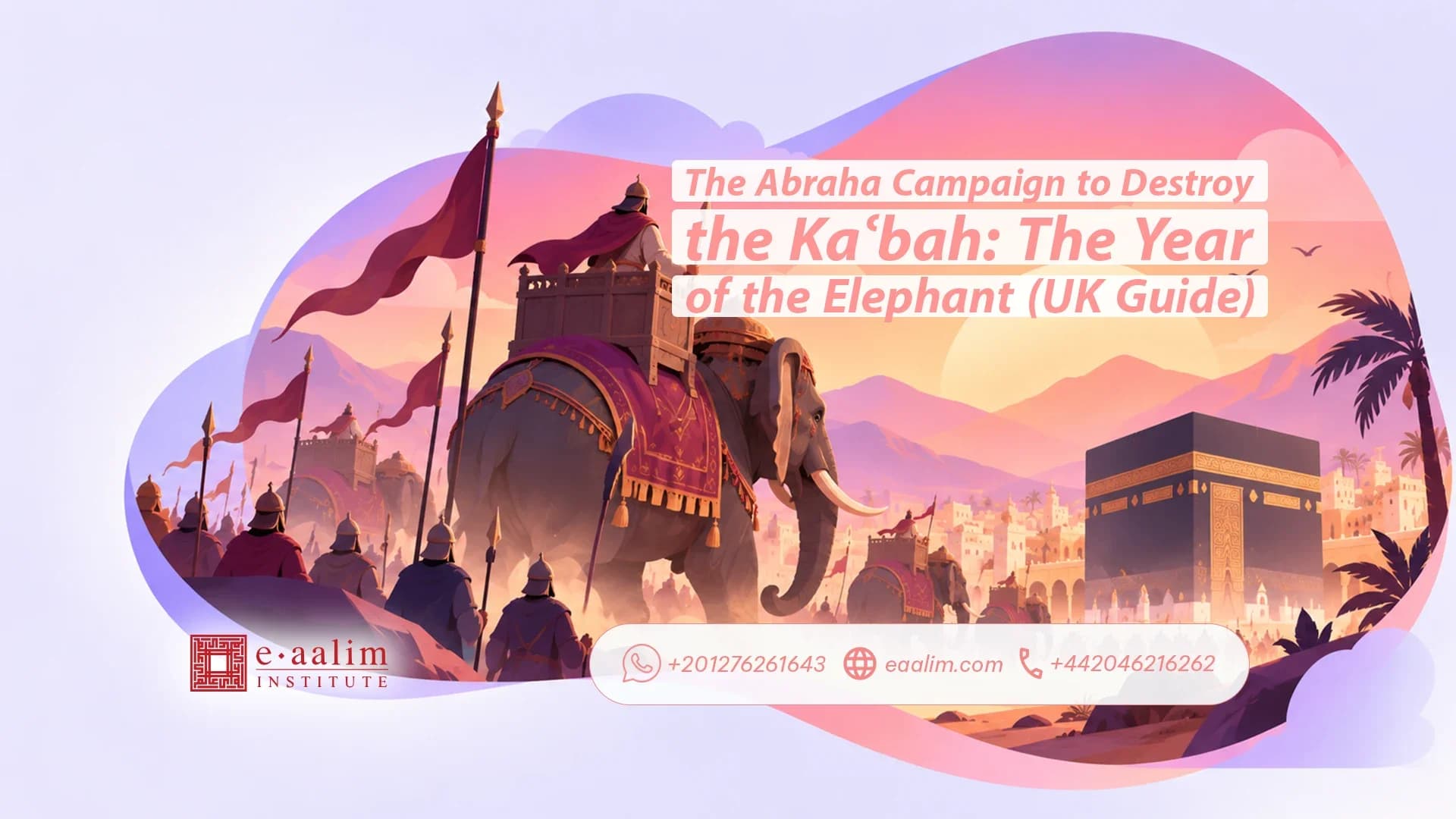
The Abraha Campaign to Destroy the Kaʿbah: The Year of the Elephant (UK Guide)
By Eaalim Institute on 4/28/2026 · 6 min read
The Year of the Elephant — when Allah destroyed an army to protect the Kaʿbah
In the Year of the Elephant, around 570 CE — the year the Prophet Muhammad ﷺ was born — Abrahah al-Ashram, the Christian Ethiopian governor of Yemen under the Aksumite kingdom, led a great army towards Makkah to destroy the Kaʿbah. Surah Al-Fīl (105) records how Allah sent flocks of birds carrying small stones that destroyed the army before it reached the Sacred House. This guide covers the historical event, the surah, its lessons for British Muslim children, and its link to the Prophet’s ﷺ birth.
The historical context of the Year of the Elephant
Abrahah al-Ashram governed Yemen for the Aksumite kingdom (modern Ethiopia), the Christian power that had taken southern Arabia from the Jewish Himyarite kingdom. He built a great cathedral at Sanaʿāʾ named al-Qullays, partly modelled on the Hagia Sophia in Constantinople. Moreover, he intended to redirect the annual Arabian pilgrimage from the Kaʿbah to his cathedral. When this failed — and after an Arab Bedouin, in classical accounts, polluted the cathedral — he led a punitive military expedition north to destroy the Kaʿbah itself.
The army included war elephants, so unfamiliar to the Hijazi Arabs that the event gave its name to the Year of the Elephant (ʿām al-Fīl). In addition, the lead elephant was named Maḥmūd. Moreover, by classical accounts the army numbered in the tens of thousands.
The encounter at Makkah
The army reached the outskirts of Makkah. ʿAbd al-Muṭṭalib — the grandfather of the future Prophet ﷺ and the leader of Quraysh at the time — went out to meet Abrahah. Abrahah\'s troops had seized 200 of ʿAbd al-Muṭṭalib\'s camels among other plunder. However, ʿAbd al-Muṭṭalib asked for his camels back.
As a result, the request surprised Abrahah — he had expected ʿAbd al-Muṭṭalib to plead for the Kaʿbah. ʿAbd al-Muṭṭalib replied with one of the most preserved single sentences of pre-Islamic Arab dignity:
"I am the lord of the camels. The House has its own Lord, who will protect it."
ʿAbd al-Muṭṭalib returned to Makkah and instructed Quraysh to retreat to the surrounding hills. He himself prayed at the Kaʿbah and left it to its divine Protector.
The destruction of the army
The next morning, as Abrahah\'s army advanced on Makkah, the lead elephant Maḥmūd refused to move forward.In fact, the soldiers could turn him in any direction except towards the Kaʿbah. Then flocks of birds appeared from the direction of the sea — described in Surah Al-Fīl as ṭayran abābīl, which classical commentators interpret as flocks coming in successive waves. Also, each bird carried small stones — ḥijārah min sijjīl. The stones struck the soldiers, and Surah Al-Fīl 105:5 describes the result vividly:
﴾فَجَعَلَهُمْ كَعَصْفٍ مَّأْكُولٍ﴿
"And He made them like eaten chaff."
As a result, the stones destroyed the army. The few survivors fled south. Abrahah himself died in Yemen shortly afterwards, by classical accounts of the same disease the stones had brought (likely a pestilential plague — the historical record of similar events suggests smallpox or a related infectious disease).
Surah Al-Fīl in full
بِسْمِ اللَّهِ الرَّحْمَٰنِ الرَّحِيمِ
أَلَمْ تَرَ كَيْفَ فَعَلَ رَبُّكَ بِأَصْحَابِ الْفِيلِ ﴿١﴾ أَلَمْ يَجْعَلْ كَيْدَهُمْ فِي تَضْلِيلٍ ﴿٢﴾ وَأَرْسَلَ عَلَيْهِمْ طَيْرًا أَبَابِيلَ ﴿٣﴾ تَرْمِيهِم بِحِجَارَةٍ مِّن سِجِّيلٍ ﴿٤﴾ فَجَعَلَهُمْ كَعَصْفٍ مَّأْكُولٍ ﴿٥﴾"Have you not seen how your Lord dealt with the companions of the elephant? Did He not make their plan into misguidance? And He sent against them birds in flocks, striking them with stones of hard clay, and He made them like eaten chaff."(Quran 105:1-5)
The connection to the birth of the Prophet ﷺ
The Prophet Muhammad ﷺ was born in Makkah in this same year, the Year of the Elephant — approximately fifty days after Abrahah’s defeat. The early sources deliberately preserve this chronological connection. The Kaʿbah, just protected by Allah from destruction, was about to receive the Messenger ﷺ who would purify it of idols, restore it as the qiblah of the Muslim community, and re-establish it as the centre of authentic monotheism.
Surah Quraysh (106), which immediately follows Surah Al-Fīl in the Mushaf, is connected to it by classical scholars: Allah destroyed the elephant army so that the Quraysh could continue their secure trade caravans. The two surahs together tell one continuous theological story — divine protection of the Sacred House, divine provision for its custodians, and the implicit demand that those custodians worship the Lord of the House.
Lessons for British Muslim families
1. The protection of sacred places is in Allah\'s hand
ʿAbd al-Muṭṭalib refused to plead for the Kaʿbah; he prayed and trusted. In an era when Muslim sacred sites — al-Aqṣā, the Prophet\'s Mosque, the Kaʿbah itself — face various threats and pressures, the lesson is direct. Therefore, pray, work, do your duty, and trust the protection to its rightful Protector.
2. Worldly power can be defeated by divine decree
Abrahah commanded the most advanced military force in the southern Arabian world of his day. However, birds and stones destroyed him. British Muslim teenagers who feel intimidated by the apparent power of secular forces — economic, cultural, political — should know: every superpower in history has eventually fallen.
3. Surah Al-Fīl is part of every Muslim child\'s memorisation
The five short verses are among the first surahs every British Muslim child memorises. Consequently, knowing the historical event behind them turns recitation from rote performance into genuine engagement with one of the great moments of pre-prophetic history.
4. The timing of historical events is rarely accidental
Allah destroyed the army the same year He sent the Messenger ﷺ. The timing was preparation — the Prophet ﷺ\'s mission would not have been possible if the Kaʿbah had been destroyed the year of his birth.
Frequently asked questions
Where to go next
For more on the early sirah, see our guides on The Prophet ﷺ in His Cradle, The Childhood of the Prophet ﷺ, and our guide to Surah Quraysh — the surah that immediately follows Surah Al-Fīl in the Mushaf and that Allah connected to the destruction of Abrahah\'s army. To memorise Surah Al-Fīl with proper tajweed under an Al-Azhar-graduate teacher, book a free trial lesson.
Start your journey with Eaalim today!
Start 2 Free Trials


 Share
ShareFrequently Asked Questions
Approximately 570 CE — the Year of the Elephant — the same year the Prophet Muhammad ﷺ was born in Makkah. The Quran preserves the divine response to the campaign in Surah Al-Fīl (105).
Abrahah's army included war elephants — animals so unfamiliar to the Hijazi Arabs that the year became known as ʿām al-Fīl (the Year of the Elephant). The lead elephant was named Maḥmūd.
The lead elephant Maḥmūd refused to advance towards the Kaʿbah. Then flocks of birds (ṭayran abābīl) appeared from the sea, each carrying small stones (ḥijārah min sijjīl). The stones struck the soldiers — Surah Al-Fīl 105:5 describes the result: "And He made them like eaten chaff."
Eaalim teachers can walk through Surah Al-Fīl, Surah Quraysh, and the historical context with classical tafsir. Book a free trial at eaalim.com/free-trial.
