


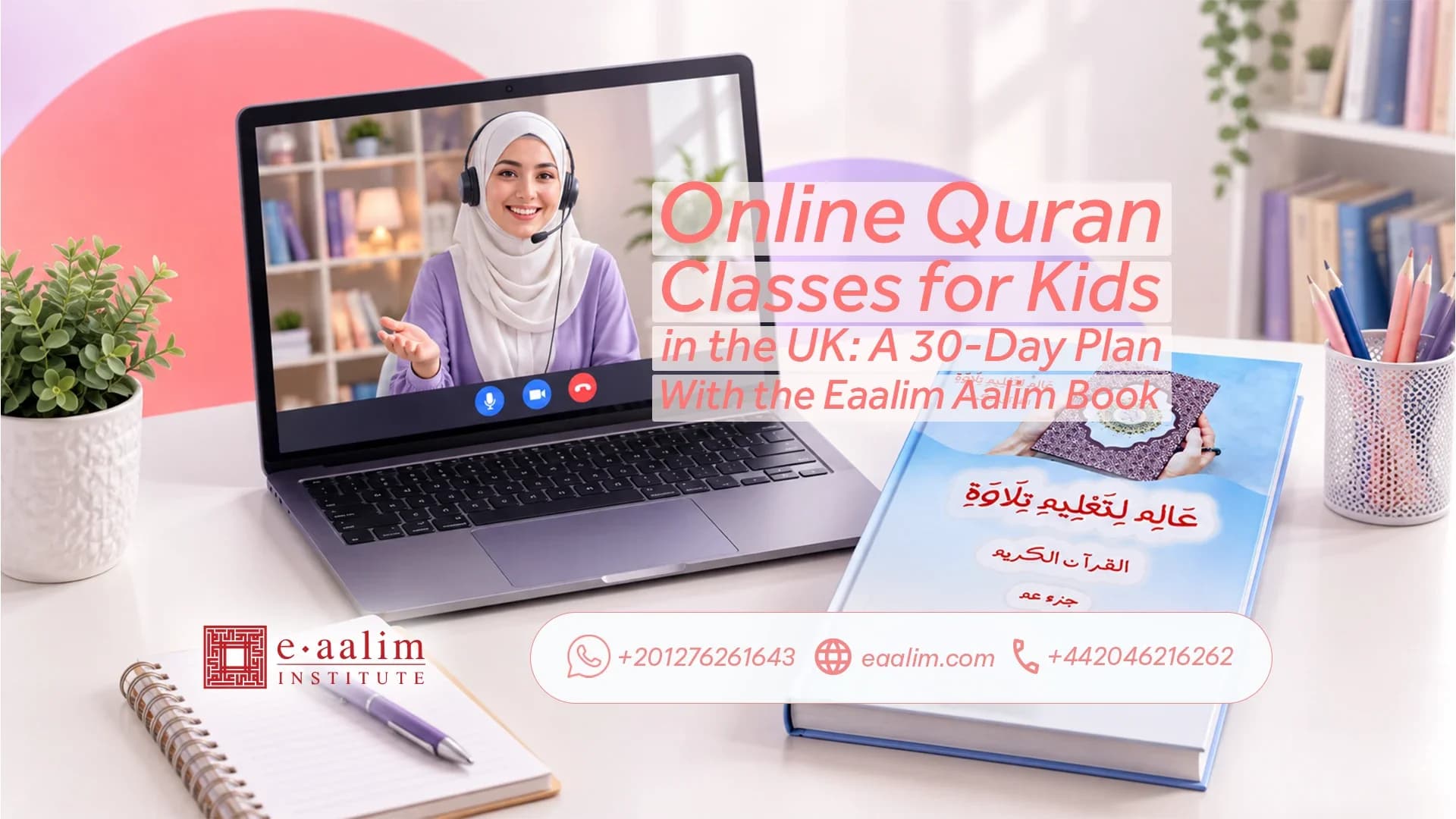
Online Quran Classes for Kids in the UK: A 30-Day Plan With the Eaalim Aalim Book
By Eaalim Institute on 5/8/2026 · 12 min read
Online Quran classes for kids UK: 30 days is enough to see real progress, if you follow a clear plan. Most pages promise live teachers and flexible schedules, but none tell you what your child will actually achieve in the first month. This guide gives you a concrete 30-day plan built around a free resource: the Eaalim Aalim Book — Introductory Chapter. By day 30, a beginner child will recognise every Arabic letter, read short words with vowels, and recite the opening verses of Surah Al-Fatihah from a printed mushaf.
Why 30 days is the right window for British Muslim children
Thirty days is not a marketing number. It maps onto three things that matter for British Muslim families:
A school half-term cycle. UK schools run in roughly six-week blocks. Thirty days fits inside one block, so you can start at the beginning of a half-term and assess progress before the next break disrupts the routine.
The habit-formation window. Behavioural studies consistently show that a daily ritual becomes "automatic" somewhere between 18 and 30 days. By day 30 a child is no longer thinking "do I have to do my Quran today?" — they expect it.
The free trial decision point. Most online Quran academies, including Eaalim, give one or two free trial lessons. Thirty days of structured work after the trial is the right length to know whether you want to commit for the long term.
If you commit to 15–20 minutes a day for 30 days, you will move your child from "knows the letters" to "reads the mushaf with help" — a transformation many British Muslim families struggle to deliver in a year of irregular weekend madrasah. Give online Quran classes for kids UK 30 days of steady effort, and you will see the difference.
What is the Eaalim Aalim Book — Introductory Chapter, and why use it?
The Introductory Chapter of the Aalim Book is the first chapter of Eaalim's structured reading curriculum, hosted free in our public library. It is designed as the foundation a child returns to every single day during their first month of Quran study, regardless of whether they take live online classes, attend a mosque madrasah, or learn primarily at home with a parent.
It does three things that a generic Qaida cannot:
Pairs reading practice with comprehension checks. The chapter is structured around questions and answers your child works through — so reading is not just decoding, it is understanding.
Connects directly to a live class. Each section has a "Go to training" pathway: when your child stumbles on a concept, the next online class begins exactly there.
Stays on a free, public URL. No login wall, no subscription. You can open it on any phone, tablet, school iPad or library computer in the UK.
In fact, that last point matters more than parents realise. UK Muslim families often share devices, travel for half-term, or have grandparents minding the children — a free public-URL chapter means the routine never breaks because of a forgotten login. E-aalim is an online platform and institute. The E-aalim onlie institute teaches the holy Quran, Arabic and Islamic studies online.
Online Quran Classes for Kids UK: 30 Days at a Glance
Week | Focus | Aalim Book role | Live class focus |
|---|---|---|---|
Week 1 (Days 1–7) | Recognise all 28 Arabic letters | Daily letter-recognition Q&A from the Introductory Chapter | Sound production: heavy vs light letters |
Week 2 (Days 8–14) | Letters with the three vowels (fatḥah, kasrah, ḍammah) | Vowel exercises in the chapter | Joining two letters with a vowel |
Week 3 (Days 15–21) | Three-letter words and the sukoon | Word-building drills + first short ayat | Reading whole words from the mushaf |
Week 4 (Days 22–30) | Surah Al-Fatihah reading + first Tajweed rule | Application section: reading from real mushaf pages | Recitation, correction, and a graduation ayah |
The daily 20-minute routine
The plan is built on a fixed daily structure that takes 15–20 minutes. In short, consistency beats length: a child who does 15 minutes every day for 30 days will outperform a child who does an hour every Saturday.
Minutes | Activity | Where it happens |
|---|---|---|
0–3 | Open the Aalim Book Introductory Chapter on phone or tablet. Recap yesterday's letters/words aloud. | Home, free public URL |
3–8 | Work through that day's Q&A in the chapter. Child reads the question, attempts the answer, parent confirms. | Home, parent-led |
8–18 | Live one-on-one online class with an Al-Azhar teacher (3–4 times a week). On non-class days, recitation practice with a recorded audio. | Eaalim live class room |
18–20 | Make duʿaʾ together, log the day's letters/words on a printed wall chart. | Home |
For a UK working parent, the most realistic time slots are 5–5:20 pm (after school, before tea) or 7:30–7:50 pm (after tea, before reading time). However, avoid late evenings — concentration drops sharply for children under 10 after 8 pm.
Week 1 (Days 1–7): The 28 letters
The single most important thing in the first week is that your child stops guessing. Many British Muslim children "kind of know" the alphabet because they have heard the dua at iftar or seen a poster on a madrasah wall, but they cannot identify a letter cleanly when it appears in the middle of a word.
Aalim Book role this week: open the Introductory Chapter daily and use the letter-recognition Q&A. Your child will see the letter, hear it pronounced, and be asked to identify it again in a different position. After all, repetition with variation is what fixes letter shapes in long-term memory.
Live class role: the teacher focuses on sound production. For example, many British-born children say "a" instead of "ع" or "k" instead of "ق" because they have never heard the back-of-the-throat sounds outside of a recitation context. The class fixes this in the first week, before bad habits set in.
End-of-week milestone: your child can name any of the 28 letters when shown out of order, and produce the correct sound for at least 24 of them.
Week 2 (Days 8–14): Letters with vowels
This is the week where most home-only learners stall. The three short vowels — fathah (a), kasrah (i), dammah (u) — feel simple to adults but require deliberate drilling for children. The Aalim Book chapter has dedicated vowel exercises that you walk through at the start of each session.
By day 10, your child should be reading letter + vowel combinations like ba, bi, bu — ta, ti, tu at a steady pace. The live teacher then introduces joining: how ba + ta becomes the syllable bata. This is when reading starts to feel like reading.
UK parent tip: if your child finds the vowels confusing because they're learning them at the same time as English short vowels at school, slow down. Of course, there is no prize for racing through Week 2. A child who finishes Week 2 confident on vowels will fly through Weeks 3 and 4. The online tutors and teachers at E-aalim are dedicated, experienced, highly qualified Arabic native speaker al-Azhar graduates.
Week 3 (Days 15–21): Three-letter words and sukoon
Halfway through the plan, your child meets the sukoon — the small circle that means "no vowel here, just stop the letter." This is the doorway from individual letters to actual Quranic words. By the end of Week 3, your child will read three-letter words from the mushaf without prompting.
The Aalim Book Introductory Chapter has word-building drills specifically for this stage. The chapter then bridges into first short ayat — short verses from the last juzʾ of the Quran. This is the first time your child is reading "real Quran" and not exercises. As a result, the emotional reward is significant; many children remember Day 17 or Day 18 as the day Quran "clicked."
Live class role: the teacher pairs the child's reading with a printed mushaf page on screen. The child sees the actual page they will use for the next ten years, not just an exercise sheet.
Week 4 (Days 22–30): Surah Al-Fatihah
The final week brings everything together. Your child reads Surah Al-Fatihah — the most important seven verses any Muslim recites — slowly, with the teacher correcting Tajweed in real time. The Introductory Chapter has an "application" section where the child sees how each rule learned in weeks 1–3 lives inside the Fatihah.
By Day 30, a child following this plan will be able to:
Identify all 28 Arabic letters in any position (start, middle, end of a word)
Read letter + vowel combinations smoothly
Read three-letter and four-letter Quranic words with sukoon
Recite the first 3–4 verses of Surah Al-Fatihah from a printed mushaf with adult help
Recognise the difference between heavy (mufakhkham) and light (muraqqaq) letters
This is not a marketing promise — it is what consistent 15-minute days produce when paired with structured live teaching. In contrast, children who skip days, or who only do the live class without daily Aalim Book practice, finish day 30 at a noticeably weaker level.
How online Quran classes for kids in the UK fit alongside the plan
The Aalim Book chapter is the daily routine; the live class is the weekly correction. They are designed to work together. A child doing only the chapter will plateau because no one corrects pronunciation in real time. A child doing only the live class will plateau because three lessons a week is not enough repetition for letters to stick. Most families who try online Quran classes for kids UK 30 days in a row see their child reading from the mushaf. If you would like to see exactly how the live element works for British families, we have a full breakdown in our Online Quran Classes UK Guide. For families weighing online classes against the local mosque madrasah, our honest comparison is Online Quran Classes UK vs Mosque Madrasah.
The course Eaalim built specifically for the UK — with British timing slots, GBP pricing, and Tajweed integrated from day one — is Online Quran Classes with Tajweed (UK). It is the natural next step after a child finishes the 30-day plan. The lonline learners and students at E-aalim are kid, adult, male and female Muslims living mainly in Europe and the USA.
Common pitfalls in the first 30 days (and how to avoid them)
Pitfall | What it looks like | How to fix it |
|---|---|---|
Skipping the daily 15 minutes | "We'll do double tomorrow" — but tomorrow never happens. | Anchor the routine to an existing fixed event: after school snack, or right after Maghrib. |
Live class only, no Aalim Book | Child enjoys the class but cannot read independently by Day 14. | Block out the 15-minute Aalim Book session as non-negotiable, even on class days. |
Letting the child guess | Parent reads the letters out loud "to help" — child memorises the parent's voice rather than the letter shape. | Stay silent for the first 5 seconds. Let the child attempt. Only then prompt. |
Comparing siblings | "Your sister learnt this in two weeks." Confidence collapses, progress stalls. | Track each child against their own Day 1 baseline only. Children pick up Quran at very different paces — both are normal. |
Stopping during half-term | One-week holiday breaks the habit; child resists when school resumes. | Drop to 10 minutes a day during half-term, but never zero. Habit > volume. |
What to do at Day 30
On day 30, give your child two assessments — one quiet, one celebratory.
The quiet assessment: open the Aalim Book Introductory Chapter and ask your child to read three random pages aloud. Note where they hesitate. These are the letters or rules to revisit in Month 2.
The celebratory assessment: have them recite Surah Al-Fatihah from a printed mushaf in front of two relatives. Record it. Watch it again on Day 60, Day 180 and Day 365. The growth from Day 30 to Day 365 is the single most powerful motivator you can give a Muslim child.
Then move into a structured Tajweed pathway. Our 50-hour structured route is Learn Tajweed Online in 50 Hours (UK), mapped onto British school terms.
How to start this week
Open the Aalim Book Introductory Chapter with your child today and read the first page together. This is Day 1.
Book a free trial lesson with an Al-Azhar certified teacher for sometime in the next 72 hours. The trial slots in for Day 2 or Day 3 of your plan.
Print a simple wall chart numbered 1 to 30. Tick each day after the routine. Children love the visual streak.
Re-read this guide on Day 7, Day 14 and Day 21 to keep yourself on track.
If your child is younger than seven, take it slower — extend the plan to 45 days and shorten the daily session to 10 minutes. If your child is older than twelve, you can compress it to 21 days with 25-minute daily sessions. The Aalim Book Introductory Chapter remains the daily anchor at every age.
A final word for British Muslim parents
The Quran was not memorised by genius — it was memorised by routine. The Companions and the early generations who carried this Book did not have apps or live video classes; they had a teacher, a small daily portion, and a community that expected them to show up tomorrow. The 21st-century equivalent for a British Muslim family is exactly that: a free public chapter you open every day, a qualified teacher on a screen three times a week, and a parent who refuses to skip Day 11 just because it is raining.
Thirty days from today, your child will be reading from the mushaf. Start tonight.
Start your journey with Eaalim today!
Start 2 Free Trials


 Share
ShareFrequently Asked Questions
Yes — provided two conditions are met: a daily 15-minute home routine using the Eaalim Aalim Book Introductory Chapter, and three live one-to-one classes a week with an Al-Azhar certified teacher. By day 30 a beginner child following this plan recognises every Arabic letter, reads short Quranic words, and recites the opening verses of Surah Al-Fatihah from a printed mushaf. They are not yet fluent — that takes longer — but the foundation is set.
No. The chapter is hosted on a free public URL inside the Eaalim library. Any UK family can open it on a phone, tablet, school device or library computer without an account. The free chapter is the daily home routine. The paid element is the live online class with an Al-Azhar teacher, which corrects pronunciation and applies the rules in real time.
Do not double up the next day. Children resent being made to do extra work, and the routine becomes a punishment. Instead, treat the missed day as a free day, and continue from where you left off. The plan still works — it just finishes on Day 31 or Day 32 instead of Day 30. Habit consistency matters more than calendar precision.
No. The plan is designed for parents who do not read Arabic. Your role is to open the Aalim Book chapter, sit with your child for 15 minutes, and tick the day on a wall chart. Pronunciation correction is the live teacher's job. You do not need to teach — you need to be present. Many British-born Muslim parents who could not read Quran themselves have raised confident reciters using exactly this division of labour.
