

Online Arabic Conversation Course UK: Speak Modern Standard Arabic with Confidence (British Muslim Families & Students, 2026)
Live one-to-one online Arabic conversation course for British Muslim families and UK students. Speak Modern Standard Arabic confidently with native Al-Azhar teachers, drawing on the proven Al-'Arabiyyah Bayna Yadayk communicative method (Levels 1-3). UK GMT/BST time slots. Free trial.
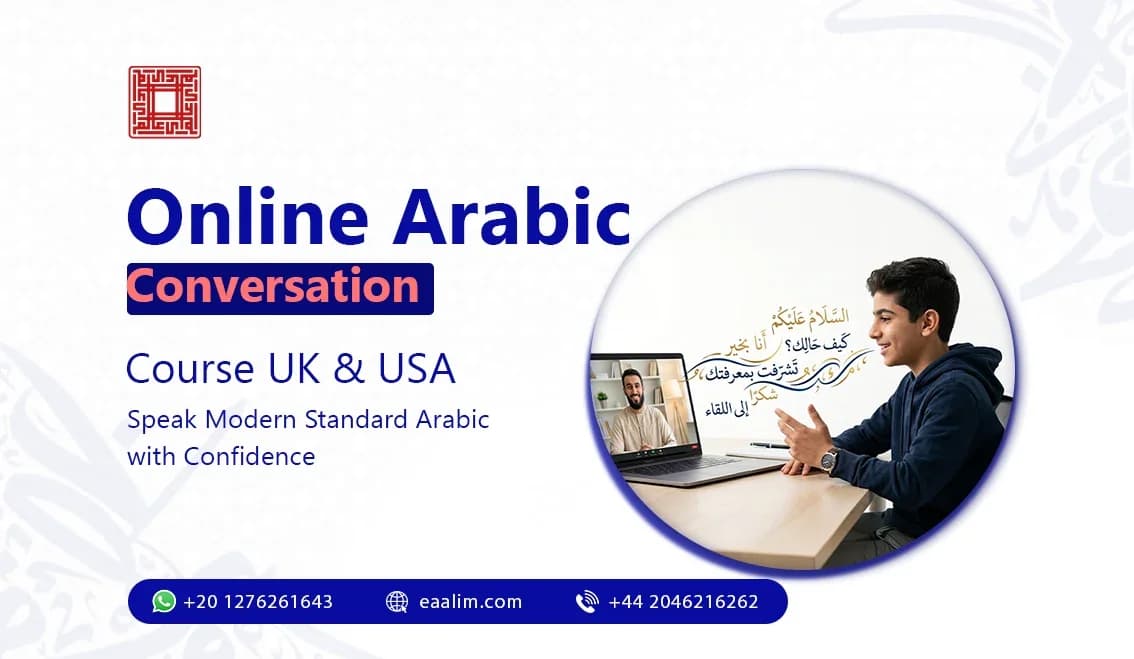
For British Muslim families, Arabic is the bridge to the Qur'an, to Friday khutbahs, to scholars at international Islamic conferences, and to over 400 million speakers across the Arab world. But there is a specific kind of Arabic British learners most often need yet rarely practise: conversational Modern Standard Arabic — the formal Fus'ha you would use to ask a Saudi imam a question after a lecture, to introduce yourself to an Egyptian scholar at a UK Islamic conference, to follow a discussion at SOAS or Edinburgh on Islamic history, or to write and speak in academic Arabic during your university studies.
Our online Arabic Conversation Course UK is built specifically for this — taught one-to-one by native Arabic-speaking Al-Azhar scholars on UK GMT/BST time slots. The curriculum is built around the proven Al-'Arabiyyah Bayna Yadayk series by Dr. Abdurrahman al-Fawzan and his team — the most widely used MSA textbook in serious Islamic universities globally (Madinah Islamic University, the International Islamic University, IIIT, and most respected London Arabic programmes). Its three-level pathway is communicative by design: every lesson teaches you to speak first, with grammar revealed in service of conversation, not as an end in itself.
Why Modern Standard Arabic conversation matters for British Muslim learners
British Muslim families often invest in colloquial Arabic (Egyptian, Levantine, Gulf) so they can speak with grandparents, cousins and shopkeepers in Cairo, Amman or Riyadh. That is the right choice for family connection — and we offer it as a separate K Spoken Arabic Course Ubuilt around Kallimni 'Arabi Bishweesh.
But colloquial Arabic does not give you what you need for religious, academic and formal settings:
• You cannot ask a thoughtful question to Sheikh Abdul Rahman Al-Sudais after a lecture in Egyptian colloquial — he would be polite, but the register is wrong.
• You cannot follow a Friday khutbah in Birmingham Central Mosque if you only know Levantine — the imam delivers in Fus'ha.
• You cannot read or discuss Tafsir Ibn Kathir, Bulugh al-Maram or the standard works of Islamic scholarship in colloquial — they are all in Modern Standard Arabic.
• You cannot write a formal email to an Egyptian university or a Saudi scholarship office in Masri — they expect MSA.
This course closes that specific gap. It teaches you to speak the same Arabic you read in the Qur'an and hear in scholarly lectures — confidently, in real-time conversation, on UK schedule.
Built on the three-level Al-'Arabiyyah Bayna Yadayk pathway:
The book's pedagogy is communicative — it does not ask you to memorise grammar tables for six months before speaking. From the first hour, students greet each other in Arabic, ask each other's names, describe their families, and gradually build vocabulary outward by topic. UK students consistently report that this is the method that finally got them speaking — after years of failed grammar-first attempts.
Level 1 — كتاب الطالب الأول (Foundation, 6–9 months): greetings (التحيّات), introducing yourself (التعريف بالنفس), the family (الأسرة), housing (السكن), daily life (الحياة اليومية), food and drink (الطعام والشراب), prayer (الصلاة), study and work (الدراسة والعمل), shopping (التسوّق), weather and seasons (الجو والفصول). By the end, students can hold a 10-minute MSA conversation about their British Muslim daily life.
Level 2 — كتاب الطالب الثاني (Intermediate, 9–12 months): travel (السفر), Hajj and Umrah (الحج والعمرة), health (الصحة), sports (الرياضة), our Islamic civilisation (حضارتنا الإسلامية), communication methods (وسائل الاتصال), the natural world (الطبيعة), holidays and celebrations (الأعياد والمناسبات). By the end, students can describe their Hajj experience, discuss Islamic history, and follow simplified khutbahs.
Level 3 — كتاب الطالب الثالث (Advanced, 12–18 months): introducing Islam to non-Muslims (التعريف بالإسلام), Muslims around the world (المسلمون في العالم), human rights in Islam (حقوق الإنسان في الإسلام), professions (المهن), science and technology (العلوم والتكنولوجيا), arts and literature (الفنون والآداب). By the end, students can give a 5-minute presentation in MSA, debate scholarly topics, and follow native-speaker discussions at near-full speed.
"اللغة العربية مفتاح فهم القرآن والسنة، وأساس كل علوم الإسلام." — A teaching maxim used in Madinah Islamic University.
Why British Muslim families and UK students choose Eaalim for Arabic Conversation
Four British audiences this Arabic Conversation course is for
(1) British Muslim adults attending UK Islamic conferences and lectures: the National Hajj Convention, IslamUK events, Cambridge Muslim College talks, MIHE seminars, Living Islam UK gatherings — all host Arabic-speaking scholars. UK Muslims who cannot follow Q&A in MSA miss the substantive part of these events.
(2) UK university students of Arabic, Middle East Studies or Islamic Studies: SOAS, Edinburgh, Oxford, Cambridge, Durham, Exeter and Manchester universities all teach Arabic conversation poorly (too few hours per week, too many students per class). One-to-one Eaalim lessons are the standard fix British students use to keep pace.
(3) British Muslim parents preparing for Hajj or 'Umrah: you can navigate Makkah and Madinah in English, but the experience is transformed when you can speak directly to Saudi guides, ask scholars at the Haram for clarification on a fiqh question, and chat with fellow pilgrims from Algeria, Indonesia, Nigeria. MSA is the lingua franca of international Islamic spaces.
(4) British reverts and Islamic Studies graduate students: if you are pursuing a serious path of Islamic study — perhaps eventual ijazah in a particular discipline, or graduate work at Cambridge Muslim College / MIHE / Markfield — you must be able to speak Arabic with your teachers, not just read it. This course gives you that skill.
Real worked dialogues from Al-'Arabiyyah Bayna Yadayk this course teaches:
Dialogue 1 — At the airport (Level 1):
— السلام عليكم. ما اسمك؟ (Peace be upon you. What is your name?)
— وعليكم السلام. اسمي خالد. وأنت؟ (And upon you peace. My name is Khalid. And you?)
— اسمي عبد الله. من أين أنت؟ (My name is Abdullah. Where are you from?)
— أنا من بريطانيا. وأنت؟ (I'm from Britain. And you?)
— أنا من مصر. أهلاً وسهلاً. (I'm from Egypt. Welcome.)
Dialogue 2 — At the mosque after Jumu'ah (Level 1):
— هل تستطيع أن تعرّفني على إمام المسجد؟ (Can you introduce me to the imam of the mosque?)
— بكل سرور. تفضّل، هذا الشيخ أحمد، وهو إمام المسجد منذ عشر سنوات. (With pleasure. Please, this is Sheikh Ahmad, the mosque's imam for ten years.)
— تشرفت بمعرفتك يا شيخ. أنا طالب جديد في لندن. (I'm honoured to meet you, Sheikh. I'm a new student in London.)
Dialogue 3 — Asking about Tafsir at a lecture (Level 2):
— عفواً يا شيخ، لي سؤال حول الآية الأخيرة من سورة الفاتحة. (Excuse me, Sheikh, I have a question about the last ayah of Surah Al-Fatihah.)
— تفضّل يا أخي، السؤال شرف للسائل والمسؤول. (Please, brother, asking is an honour for both the questioner and the asked.)
— ما الفرق بين "المغضوب عليهم" و"الضالين" في الآية؟ (What is the difference between "those who incurred wrath" and "those who went astray" in the ayah?)
Dialogue 4 — Hajj experience with a Saudi guide (Level 2):
— كم مرة طفنا حول الكعبة؟ (How many times have we circled the Ka'ba?)
— طفنا أربع مرات يا حاج. بقيت ثلاث مرات. هل أنت متعب؟ (We've circled four times, hajji. Three more remain. Are you tired?)
— الحمد لله، أنا بخير. سأكمل، لكن هل يمكنني شرب الماء أولاً؟ (Praise be to Allah, I'm fine. I'll continue, but may I drink some water first?)
Dialogue 5 — Discussing Islamic studies with a scholar (Level 3):
— أستاذي، أبحث عن مرجع موثوق في علم الحديث للمبتدئين البريطانيين. (Teacher, I'm looking for a reliable reference in hadith science for British beginners.)
— أنصحك بكتاب "الباعث الحثيث" لابن كثير، فهو مختصر ومفيد. هل تستطيع أن تقرأ النصوص العربية الكلاسيكية؟ (I recommend Al-Ba'ith al-Hathith by Ibn Kathir; it's concise and beneficial. Can you read classical Arabic texts?)
— أحاول، لكنني أحتاج إلى مساعدة في النحو. هل عندكم درس خاص؟ (I try, but I need help with grammar. Do you have a special class?)
What you'll be able to do by the end of the Conversation course
Hold a 30-minute MSA conversation on everyday topics
Engage with scholars, follow khutbahs, prepare for Hajj
Present in MSA at conferences, graduate seminars and academic settings
 Qualified teachers
- Chat directly with your teacher
- Private Zoom lessons
 Partial access to our online library
- No Islamic studies lessons
- No Ijaza certification
- No cancellations allowed (missed lessons are counted)
What Our Clients Say
Hear from those who have experienced the peace of learning with Eaalim.

⭐⭐⭐⭐⭐ "As a parent, I wanted my child to learn real Arabic, not just memorization. The interactive exercises and real-life role-plays make it easy for them to practice at home and at school."
⭐⭐⭐⭐⭐ "The two free trial lessons were a game-changer. I could try different teachers and choose the one who fits my learning style. Now I feel confident speaking Arabic in work meetings and social situations."
⭐⭐⭐⭐⭐ "I never thought I could speak Modern Standard Arabic fluently. The course is structured perfectly for UK students, and the practical dialogues help me use Arabic in everyday life."
⭐⭐⭐⭐⭐ "The live one-to-one lessons completely transformed my confidence. I can now hold conversations in Arabic at school and with family without hesitation. The teacher’s guidance makes learning natural and fun."
Related Articles
Ready to start the online Arabic Conversation course in the UK?
Book your free 30-minute trial today — a real first lesson with a native Arabic-speaking Al-Azhar scholar on a UK-time slot, not a sales call. Tell us your goal (Hajj preparation, university support, attending Islamic conferences in MSA, or graduate-level Islamic studies), your starting level, and we'll match you with the right teacher and confirm a weekly British schedule that fits around work, school and term time.
Frequently Asked Questions
Yes. You get 2 free trial lessons with different teachers and can choose the one that suits you best before enrolling in the full course.
Yes. Lessons are scheduled in UK GMT/BST and US time slots to accommodate school, work, and family commitments.
Absolutely. One-to-one lessons focus on practical speaking, listening, and role-play, ensuring you can communicate confidently in real-life situations.
Yes. The course starts from foundational Modern Standard Arabic and gradually builds conversational skills for everyday life, school, and professional settings.
