


The Mother of Prophet Mūsā: The Mother Who Placed Her Infant in the Nile (UK Guide)
By admin on 12/22/2025
The mother who placed her infant son in the Nile
The mother of Prophet Mūsā ﷺ — referred to in the Quran as "the mother of Mūsā" without being named — performed one of the most remarkable acts of trust in the prophetic narrative. By Allah\'s direct inspiration, she placed her infant son in a basket and floated him down the Nile, into the very palace of Pharaoh whose government was killing newborn Israelite boys. Surah Al-Qaṣaṣ 28:7-13 preserves the story in detail. For British Muslim mothers facing impossible decisions about their children, this narrative is foundational.
The historical setting
Mūsā ﷺ was born in Egypt at a moment of intense persecution. Pharaoh, fearing a prophecy that an Israelite boy would challenge his rule, had decreed the killing of every newborn Israelite male. Israelite mothers across Egypt were experiencing the systematic killing of their sons by the state. Mūsā\'s mother — newly delivered of a son — faced an immediate crisis: how to keep her infant alive in a regime committed to killing him.
The divine inspiration
Surah Al-Qaṣaṣ 28:7 preserves the moment: "And We inspired the mother of Mūsā: \'Suckle him; but when you fear for him, cast him into the river and do not fear and do not grieve. Indeed, We will return him to you and will make him [one] of the messengers.\'"
This is one of the few places in the Quran where Allah communicates directly with a non-prophet. The classical scholarly position: the inspiration was not formal prophetic revelation (waḥy) but a divine guidance (ilhām) that gave her the certainty to act.
The action
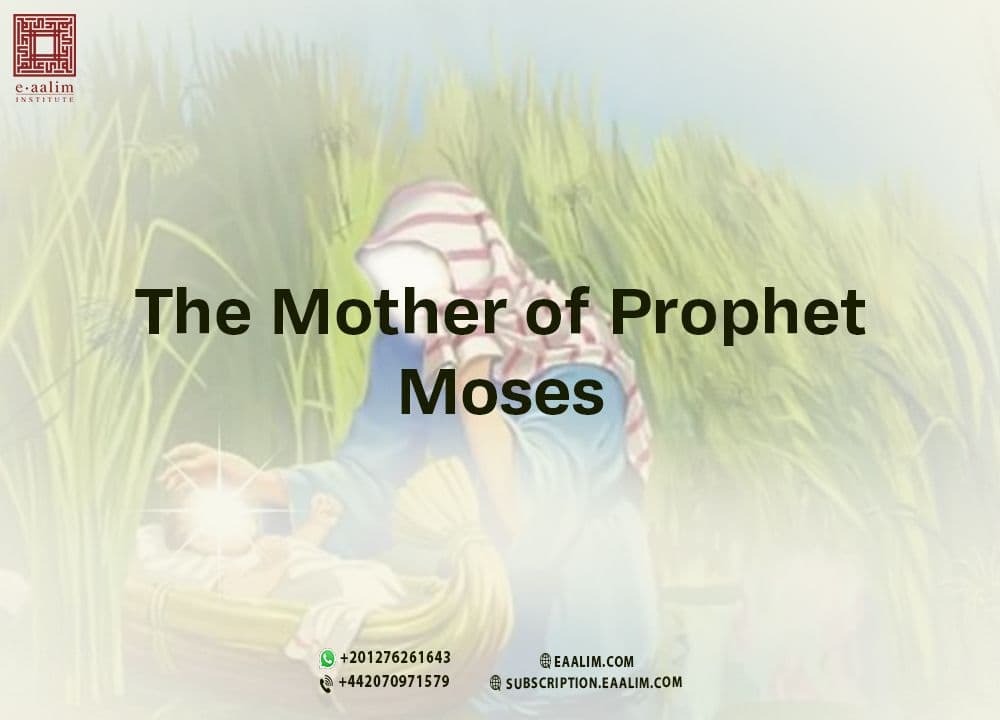
She placed Mūsā in a basket and floated him down the Nile. The basket was carried by the current to the palace of Pharaoh himself. There Āsiyah — the wife of Pharaoh, herself a believer (and identified by the Prophet ﷺ as one of the four most perfect women of all time) — found the basket. She loved the infant immediately. Pharaoh was prepared to kill him; Āsiyah pleaded for his life and the right to adopt him.
The Quranic irony is profound. The infant who was floated down the Nile to escape Pharaoh\'s killing decree was raised in Pharaoh\'s own palace, fed at his table, while the killing of other Israelite boys continued. The system that should have destroyed Mūsā became the means of his preservation.
The reunion
Mūsā would not nurse from any of the Egyptian wet nurses brought to the palace. The classical narration: he refused them all, until his sister — who had followed the basket along the Nile bank — appeared at the palace and said: "Shall I direct you to a household who will rear him for you and look after him faithfully?" They agreed. She brought their own mother. Mūsā nursed from his own mother, in the palace of Pharaoh, paid by Pharaoh\'s treasury for the privilege.
Surah Al-Qaṣaṣ 28:13 preserves the moment: "So We restored him to his mother that she might be content and not grieve and that she would know that the promise of Allah is true."
What the narrative teaches
1. Allah\'s plan operates through the very systems trying to destroy His servants
Mūsā was raised in Pharaoh\'s palace. The strongest enemy of the Israelite community became the means of preserving the prophet who would lead the community to liberation. British Muslim families navigating hostile environments — schools that mock their faith, workplaces that pressure their values, political climates that demonise their identity — should know that Allah\'s plan can operate through those very systems.
2. Mothers receive divine guidance
The mother of Mūsā received direct divine inspiration. The classical Sunni tradition treats this as divine guidance to a non-prophet, but the principle generalises: mothers in difficult circumstances often experience moments of clarity that exceed what their ordinary deliberation could produce. British Muslim mothers should trust the deepest convictions that come to them in crisis.
3. Trust is required even when the action makes no human sense
Floating an infant down the Nile, into the palace of the killer, is not a "rational" plan by any human metric. Mūsā\'s mother acted on divine inspiration despite the apparent impossibility. The lesson for British Muslim parents: when the divine guidance is clear, the human "rational" objections may be irrelevant.
4. The promised reunion comes
Allah promised the mother of Mūsā that He would return her son to her. He did. British Muslim mothers separated from their children — by divorce, by emigration, by tragedy, by other circumstances — can hold the same divine promise: what Allah has decreed will return to you in the form He decrees, in His timing.
5. The believing wife of Pharaoh played a crucial role
Āsiyah — the wife of Pharaoh — recognised the divine sign in the infant and protected him. Even within hostile systems, individual believing women can change the course of history. British Muslim women working in non-Muslim institutions should know — your individual conduct can alter outcomes in ways you may not fully see.
The connection to Mūsā\'s later mission
Mūsā grew up in Pharaoh\'s palace, learned the language of Egyptian power, knew the regime from inside. When Allah eventually called him to prophethood and sent him to confront Pharaoh, Mūsā was uniquely positioned — he knew the man, the court, the political system. His upbringing was preparation for his prophetic mission.
Frequently asked questions
Where to go next
For more on Mūsā ﷺ and his family, see our guides on Prophet Mūsā, our pillar on Lady Hājar (another mother in the prophetic line), Maryam bint ʿImrān, and The First Days in the Desert. To study the Quranic narrative of Mūsā with a qualified teacher, book a free trial lesson.
Commencez votre voyage avec Eaalim dès aujourd'hui !
Essai gratuit


 Share
ShareFrequently Asked Questions
An Israelite woman, not named in the Quran by personal name. She was the mother of Mūsā ﷺ, born during the period when Pharaoh's government was killing newborn Israelite boys.
Surah Al-Qaṣaṣ 28:7: "And We inspired the mother of Mūsā: 'Suckle him; but when you fear for him, cast him into the river and do not fear and do not grieve. Indeed, We will return him to you and will make him [one] of the messengers.'"
Carried by the Nile current to the palace of Pharaoh himself. Āsiyah, the wife of Pharaoh and herself a believer (and one of the four most perfect women according to the Prophet ﷺ), found the basket and pleaded with her husband to spare the child and adopt him.
Mūsā would not nurse from any of the Egyptian wet nurses brought to the palace. His sister, who had followed the basket along the Nile bank, appeared and said: "Shall I direct you to a household who will rear him for you and look after him faithfully?" They agreed. She brought their own mother. Mūsā nursed from his own mother in the palace of Pharaoh — Allah's promise to her fulfilled.
"So We restored him to his mother that she might be content and not grieve and that she would know that the promise of Allah is true" (Quran 28:13).
Allah's plan operates through the very systems trying to destroy His servants. Mothers receive divine guidance. Trust is required even when the action makes no human sense. The promised reunion comes — Allah's promises are always fulfilled.
No — the classical scholarly position is that the inspiration was not formal prophetic revelation (waḥy) but a divine guidance (ilhām) that gave her the certainty to act. This is one of the few places in the Quran where Allah communicates directly with a non-prophet.
She is identified by the Prophet ﷺ as one of the four most perfect women of all time. Her saving of the infant Mūsā in defiance of her husband's killing decree changed the course of prophetic history. British Muslim women working in non-Muslim institutions can take direct guidance from her example.
