


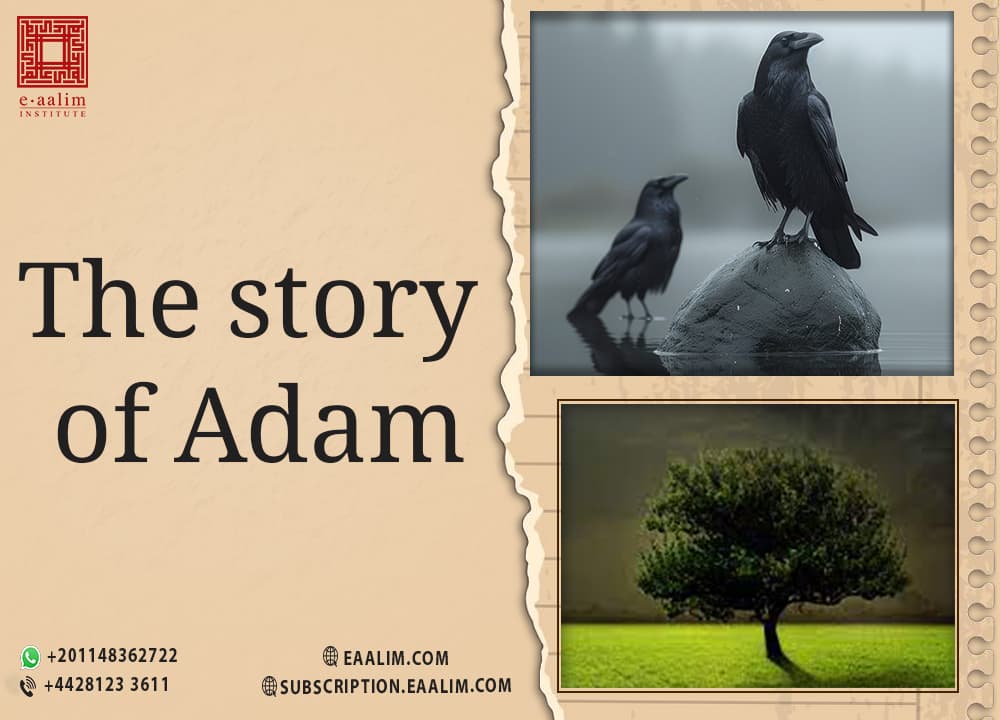
The story of adam
By admin on 12/22/2025
Introduction:
This blog is going to talk about the story of Adam. The Holy Quran tells us the story of Adam from day one. Jewish and Christian scholars think that the story of Adam was that of sin and punishment. In addition, they claim, Allah sent Isa ibn Maryam to sacrifice himself to redeem the sin of all humans. however, it is a different story in the Holy Quran. It is true that Adam committed the sin of disobeying the command of allah. However, Allah taught Adam some words which he said to repent. Adam did and Allah forgave him.
The creation of adam:
The Holy Quran states that Allah informed his angel about his intention to create a successor on earth. scholars say this successor would be the successor of the jinn on earth. The jinn had iced on earth long before the creation of Adam and his offspring. those jinn committed all atrocities and crimes on earth. They also spread bloodshed. Therefore, the angels wondered about the new creation. Consequently, Allah created Adam out of stinking mud. Allah created Adam in the human form which we know till today. Later, Adam felt lonely. That is why Allah created Hawwa ( Eve ) from Adam's rib. That was for Adam to live with Hawwa (Eve).
Pride, the first sin:
Allah taught Adam the names of everything. to test the angels and show them the wisdom of Allah, Allah asked his angels to name things. the angels replied that they didn’t know. At once, Adam told the angels what he knew. Then Allah commanded his honorable angels to fall prostration to Adam. all the angels did in obedience to the command of allah. However, the devil who lived among the angels, refused to obey the command of allah. Allah asked Satan why he did not do like the angels did. Satan replied in a challenging proud tone that he was created out of fire. Satan thought that fire was superior to clay or mud.
Descending from the garden:
Satan was too proud to obey. kids learn that Allah expelled Satan out of his mercy for this reason. On the other hand, Allah commanded Adam and Eve to dwell in the garden. Allah banned Adam and Eve from eating from a certain tree. Adam was naive. Satan was cunning and dishonest. the devil exploited Adam's naivety and insinuated him to disobey the command of allah. Al-Shaitan lied and swore by Allah that Adam would be eternal if he ate from the forbidden tree. As a result, Allah expelled Adam and Eve from the garden. Allah warned Adam and his offspring that Satan is their everlasting enemy. Allah warned Adam and his offspring not to obey the devil.

The children of Adam and Eve:
Scholars of the holy Quran say that Hawwa bore Adam forty children, twenty sons and twenty daughters. She gave birth twenty times. each time she gave birth to twins. Each pair of twins consisted of a boy and a girl. the girl of a given pair of twins married the boy of the following pair of twins. However, each girl was not allowed to marry her twin brother. This way, the children of Adam and Eve grew in number. Over time, they spread all over the world. they developed into tribes and peoples of different countries. Nevertheless, Satan remained the everlasting enemy of the offspring and children of Adam and eve.
The story of the two sons of adam:
The Holy Quran mentioned the story of the two sons of Adam in detail. Adam ordered able (Habeel) and his brother kain (Qabeel) to offer an offering to allah.kain was a farmer while abel was a shepherd. therefore, kain offered a bundle of a bad crop. on the other hand, abel offered a fat ram. Consequently, Allah accepted Abel's offering and rejected Cain's. Therefore, Kain envied his brother abel. Hence, Kain killed his brother Abel, committing the first murder in history. Muslims know that Kain did not know what to do with his brother’s dead body. That is why Allah sent two crows to teach Kain how to bury his brother's dead body. This was too much torment for Kain, who regretted his murder a lot.

Adam’s death and his will to his son Sheath:
Sheath meant the gift of allah. This was because Allah gave him to his parents after Abel's death. He was the most beautiful among Adam's sons. He was also a prophet who inherited prophethood after adam. It is said that all the current humans are the offspring of Sheath. He also built al-kaaba with mud and stones. When Adam died, he advised his son Sheath. Adam taught Sheath the hours of the day and night. Prophet Adam also taught him the worship to do in every hour of the day and night. Adam told Sheath about the great flood. At last, the first human died on friday. The angels came to condole Sheath, bringing a coffin from paradize to bury Adam in.
Commencez votre voyage avec Eaalim dès aujourd'hui !
Essai gratuit


 Share
Share