

The Isra and Mi'raj: The Prophet's ﷺ Night Journey to Jerusalem and Ascension Through the Heavens (UK Guide 2026)
By admin on 12/22/2025 · 6 د قراءة
The Isra and Mi'raj — the night journey of the Prophet Muhammad ﷺ from Makkah to Jerusalem (Isra) and his ascension through the heavens (Mi'raj) — took place around 11 BH (621 CE), about a year before the Hijrah. It is one of the most extraordinary events in the Prophet's life and is preserved in detailed authentic hadith collections. For British Muslim families, the Isra and Mi'raj teaches profound lessons about Allah's power, the Prophet's ﷺ unique station, the gift of the five daily prayers (which were given during this night), and the spiritual heights humans can reach. This UK guide presents the journey, its lessons, and how British Muslim families can teach it to children.
The Quranic foundation
"Glory be to Him who took His servant by night from al-Masjid al-Haram to al-Masjid al-Aqsa, whose surroundings We have blessed, to show him of Our signs. Indeed, He is the Hearing, the Seeing." (Surah Al-Isra 17:1)
The first ayah of Surah Al-Isra (chapter 17 of the Quran) describes the journey from Makkah to Jerusalem. Surah An-Najm (chapter 53) covers the heavenly ascension.
The Isra (the night journey to Jerusalem)
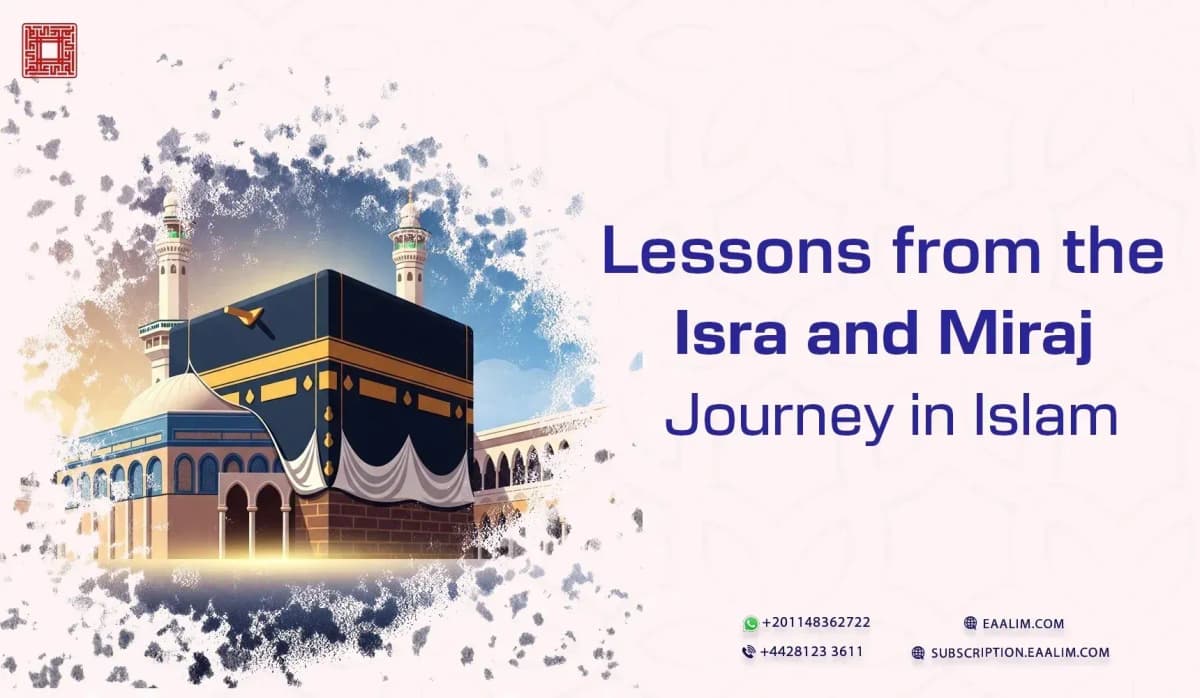
One night while the Prophet ﷺ was sleeping near the Ka'bah, the angel Jibreel (peace be upon him) came to him with a winged creature called al-Buraq (faster than lightning). The Prophet ﷺ mounted al-Buraq and travelled with Jibreel from Makkah to Jerusalem in a single night.
At the Masjid al-Aqsa in Jerusalem, the Prophet ﷺ led all the previous prophets (peace be upon them all) in prayer. Then Jibreel offered him a choice of three drinks: milk, wine, and water. The Prophet ﷺ chose milk, and Jibreel said: "You have been guided to the natural state (fitrah)."
The Mi'raj (the heavenly ascension)
From al-Aqsa, the Prophet ﷺ ascended through the seven heavens, meeting different prophets at each level:
- 1st heaven: Adam (peace be upon him)
- 2nd heaven: Yahya (John the Baptist) and Isa (Jesus) — peace be upon them
- 3rd heaven: Yusuf (Joseph) — peace be upon him
- 4th heaven: Idris (Enoch) — peace be upon him
- 5th heaven: Harun (Aaron) — peace be upon him
- 6th heaven: Musa (Moses) — peace be upon him
- 7th heaven: Ibrahim (Abraham) — peace be upon him, in al-Bayt al-Ma'mur (the Frequented House, the heavenly counterpart of the Ka'bah)
Beyond the seventh heaven, the Prophet ﷺ ascended through Sidrat al-Muntaha (the Lote Tree of the Furthest Boundary), into a station where no created being had ever reached. There Allah communicated directly with him.
The gift of the five daily prayers
During the Mi'raj, Allah commanded the Muslims to perform 50 prayers a day. As the Prophet ﷺ descended through the heavens, the prophet Musa (peace be upon him) advised him to ask for a reduction. The Prophet ﷺ went back to Allah multiple times. The number was reduced to 40, then 30, then 20, then 10, then 5. Allah then declared that the reward of 50 would still be given for these 5 prayers (Sahih al-Bukhari 3887, Sahih Muslim 162).
This is the origin of the 5 daily prayers — not legislated through revelation in the normal way, but given directly to the Prophet ﷺ in the heavens, with Musa's (peace be upon him) advocacy reducing the burden.
The Quraysh reaction
When the Prophet ﷺ told the Makkan Quraysh about the journey the next morning, the disbelievers ridiculed it. Many people who had been considering Islam turned away. Some Muslims wavered.
The companion Abu Bakr (RA) reacted differently. When asked: "Do you believe Muhammad travelled to Jerusalem and back in one night?" he replied: "If he said it, then it is true. I believe him in what is greater than this — the news from heaven." From that day, the Prophet ﷺ called him as-Siddiq (the Truthful). See our UK profile of Abu Bakr (RA).
The Quraysh test
The Quraysh demanded the Prophet ﷺ describe Jerusalem (which he had only seen at night). Allah caused Jerusalem's image to appear before him; he described it ayah by ayah, accurately. The Quraysh, whose own merchants had been to Jerusalem, confirmed the description.
They also demanded he describe a Quraysh caravan they knew was returning from Syria. He described it in detail, including the lead camel; the caravan arrived a few days later exactly as described.
What British Muslim families can take from the Isra and Mi'raj
- Allah's power transcends physical laws. Time and space were folded for the Prophet ﷺ. The same Allah can answer your du'a today.
- The five daily prayers are not a burden — they are a gift, with the reward of 50. Treasure them; do not skip them.
- Faith based on principle, not seeing, is the highest faith. Abu Bakr (RA) believed without needing proof. UK Muslim children inheriting this attitude resist scientific scepticism better.
- Jerusalem matters Islamically. The Masjid al-Aqsa is the third holiest site in Islam (after Makkah and Madinah) precisely because of this journey.
- The brotherhood of prophets is real. The Prophet ﷺ met Adam, Musa, Isa, Ibrahim, Yahya, and others in the heavens. Islam is not separate from earlier prophetic traditions; it is their completion.
How Eaalim teaches the Isra and Mi'raj
Surah Al-Isra (chapter 17) and Surah An-Najm (chapter 53) are part of the standard Quran curriculum. Eaalim's online lessons integrate the Isra and Mi'raj story with the relevant Quranic verses for British Muslim children. Lessons are 30 minutes (15-20 for under-7s), GMT/BST, in pounds, free real trial. Start here.
Frequently asked questions
ابدأ رحلتك مع إي عاليم اليوم!
ابدأ تجربتك المجانية


 Share
Shareمقالات ذات صلة

The Historical Journey of Tajweed: From the Prophet ﷺ to Today (UK Guide)
How the rules of Quranic recitation developed across fourteen centuries — from the Prophet ﷺ's oral teaching, through the Companions, the seven canonical qirāʾāt, Imam Ibn al-Jazarī's synthesis, to the modern era of online one-to-one teaching.
Mawlid an-Nabawi: A British Muslim Family's Guide to the Prophet's ﷺ Birth Date (UK 2026)
A British Muslim guide to Mawlid an-Nabawi al-Sharif — the day of the Prophet's ﷺ birth. The three legitimate Sunni scholarly positions on observing it (permissible, bid'ah, nuanced middle), what authentic Sunnah says about Monday fasting, what to do and what to avoid on the day, presented neutrally for UK families.
Frequently Asked Questions
The Isra is the Prophet Muhammad's (peace be upon him) night journey from al-Masjid al-Haram in Makkah to al-Masjid al-Aqsa in Jerusalem, riding the heavenly creature al-Buraq with the angel Jibreel. The Mi'raj is his subsequent ascension through the seven heavens, meeting the prophets at each level (Adam, Isa, Musa, Ibrahim, etc.), reaching Sidrat al-Muntaha and a direct encounter with Allah. It took place around 11 BH (621 CE), about a year before the Hijrah. Surah Al-Isra 17:1 and Surah An-Najm 53 cover the journey.
The five daily prayers. Originally Allah commanded 50 prayers a day. Musa (peace be upon him) advised the Prophet (peace be upon him) to ask for reduction. After multiple returns to Allah, the number was reduced to 5, but with the reward of 50 still given (Sahih al-Bukhari 3887, Sahih Muslim 162). The five daily prayers are therefore not legislated through normal revelation but given directly to the Prophet during the Mi'raj — a gift, not a burden.
Al-Buraq is the heavenly creature that carried the Prophet (peace be upon him) from Makkah to Jerusalem during the Isra. It is described in hadith as 'a white animal, smaller than a mule and bigger than a donkey, whose stride extends as far as its sight reaches' — i.e., faster than lightning. The name al-Buraq means 'lightning'. It is unique to this journey; the Prophet (peace be upon him) is the only human to have ridden it.
In the seven heavens, in order: 1st heaven — Adam; 2nd heaven — Yahya (John the Baptist) and Isa (Jesus); 3rd heaven — Yusuf (Joseph); 4th heaven — Idris (Enoch); 5th heaven — Harun (Aaron); 6th heaven — Musa (Moses); 7th heaven — Ibrahim (Abraham), in al-Bayt al-Ma'mur. He led all the prophets in prayer at Masjid al-Aqsa before the ascension. The encounters demonstrate the brotherhood of prophets and Islam's continuity with earlier prophetic traditions.
When the Quraysh ridiculed the Prophet (peace be upon him)'s claim of travelling to Jerusalem and back in one night, they came to Abu Bakr to mock. Abu Bakr asked: 'Did he say it?' They said yes. He replied: 'Then it is true. I believe him in what is greater than this — the news from heaven.' From that day, the Prophet (peace be upon him) called him as-Siddiq ('the Truthful, the Verifier') — meaning he believed without needing additional proof. See our UK profile of Abu Bakr (RA) for more on his character.
Three reasons. (1) The Isra: the Prophet (peace be upon him) was taken there during the night journey. (2) The first qiblah: early Muslims faced Jerusalem in prayer for the first 16 months of the Madinan period before the qiblah was changed to Makkah (Surah Al-Baqarah 2:144). (3) Prophetic legacy: the area is associated with many earlier prophets, especially Sulayman (Solomon) who built the original Bayt al-Maqdis. Masjid al-Aqsa is the third holiest site in Islam after Makkah and Madinah.
Mainstream Sunni scholarship holds it was a real physical journey — the Prophet (peace be upon him) travelled in body and soul, not just in dream or vision. Evidence: the Quran says Allah 'took His servant' (Surah Al-Isra 17:1), implying the body; the Prophet (peace be upon him) described physical features of Jerusalem afterwards; al-Buraq carried him physically. Some early scholars held it was a vision, but the dominant Sunni position is real physical travel — a miracle that bypasses normal physical laws.
Around the year 11 BH (621 CE), about a year before the Hijrah. The exact date is debated; many traditions place it on the night of 27 Rajab. Some Muslim communities (especially South Asian and Turkish Sufi traditions) commemorate this date with special prayers and lectures. Other Sunni traditions (especially Salafi-leaning) do not specially commemorate the night, citing absence of explicit prophetic instruction. Both are valid Sunni positions.
Five lessons. (1) Allah's power transcends physical laws — time and space were folded; this same Allah answers du'a today. (2) The five daily prayers are a gift, not a burden — pray them sincerely. (3) Faith based on principle (Abu Bakr's response) is the highest faith. (4) Jerusalem and Masjid al-Aqsa matter Islamically — connect children to its significance. (5) Islam continues earlier prophetic traditions — the Prophet (peace be upon him) led Adam, Musa, Isa, Ibrahim in prayer at Aqsa.
Memorise Surah Al-Isra 17:1 (the foundational verse) and read Surah An-Najm chapter 53 with translation. Read the Seerah account in The Sealed Nectar (Mubarakpuri). For children, Mariam Beyazid's Seerah series and several illustrated children's books cover the story age-appropriately. Eaalim teachers integrate the Isra and Mi'raj into Quran lessons when teaching the relevant surahs. Free 30-minute trial: https://eaalim.com/free-trial
