

Conditions of the Shahadah: Iqrar and Ilm (Complete UK Muslim Guide 2026)
By Eaalim Institute on 5/13/2026 · 15 min read
Understanding the conditions of the Shahadah is the first step for every new Muslim. For British Muslim families. Whether you are raising children in Manchester, supporting a new revert in Birmingham. Or studying the foundations of your own faith as an adult in the UK. Also, the Shahadah is the doorway into Islam. La ilaha illa Allah, Muhammadun rasul Allah. Eight Arabic words. The most important sentence a human being can ever utter.
But the classical scholars of Islam were clear that the Shahadah is not a magic phrase. A person can pronounce the words and still not enter Islam. Moreover, a person can know the words and still not have the faith they describe. The early scholars therefore identified a set of conditions of the Shahadah (shuruṭ al-shahadah). The requirements that must be present for the testimony to be valid in the sight of Allah.
This guide is a UK-focused British Muslim explainer of the first two of those conditions. Iqrar (the verbal pronouncement) and ʿIlm (knowledge). It is written for British Muslim parents teaching their children. For reverts in the UK who want to understand what they actually said when they entered Islam. Furthermore, and for any adult learner who wants to anchor their faith on the foundations the early scholars described.
The Conditions of the Shahadah: What "Condition" Means.
The scholars of usul al-fiqh (the principles of Islamic jurisprudence) define a condition (sharṭ) precisely. A condition is something whose presence makes a matter possible, and whose absence makes the matter invalid. But the condition alone is not enough. Every condition required for the matter must be present together.
Indeed, an everyday British analogy makes this clear. To drive legally on UK roads, you need a valid licence. Valid insurance, a roadworthy vehicle, and to be sober. The licence is a condition. Importantly, without it, you cannot legally drive. But having a licence alone is not enough. If any of the other conditions are missing, the act of driving is still not lawful. The conditions of the Shahadah work the same way. Each one must be present for the testimony to be valid.
Clearly, classical scholars. Including Imam al-Nawawi, Ibn Taymiyyah, and Shaykh Muhammad ibn ʿAbd al-Wahhab in his short treatise on the topic. Typically count seven conditions of the Shahadah. Al-ʿilm (knowledge), al-yaqin (certainty), al-qabūl (acceptance), al-inqiyād (submission), al-ṣidq (truthfulness), al-ikhlāṣ (sincerity), and al-maḥabbah (love). Pronouncing the words verbally — the focus of this article's first half. Is also treated as a foundational requirement by all the classical schools. Even when it is not numbered among the seven. E-aalim is an online educational platform and institute. E-aalim teaches the holy Quran, Arabic and Islamic studies online.
The first requirement: Iqrar — pronouncing the words aloud.
Additionally, anyone claiming Islam must pronounce the Shahadah verbally. This is a unanimous position of the four Sunni schools and the entire Sunni scholarly tradition. Internal belief alone, without the verbal declaration. Is not sufficient for a person who has the physical ability to speak.
Besides, the most powerful evidence for this comes from the deathbed scene of the Prophet's uncle, Abu Ṭalib. The Prophet ﷺ had loved his uncle deeply. Abu Ṭalib had raised him after his grandfather's death, protected him for years during the Makkan persecution. And stood by him publicly when the rest of Quraysh boycotted the Muslims. Certainly, when Abu Ṭalib was dying, the Prophet ﷺ leaned over him and pleaded:
"O uncle, say La ilaha illa Allah. A word with which I will testify on your behalf before Allah."
Abu Ṭalib hesitated. The chiefs of Quraysh standing around the deathbed pressed him to die on the religion of his forefathers. He did. And then Allah revealed to the Prophet ﷺ:
"It is not for the Prophet and those who believed to ask forgiveness for the polytheists. Even if they were relatives." (Qur'an 9:113)
The lesson is severe. Consequently, the Prophet ﷺ could not save his beloved uncle without that verbal declaration. Because Allah Himself made the verbal testimony a requirement. Whatever internal sympathy Abu Ṭalib may have had for the Prophet's message, the public. Verbal commitment to La ilaha illa Allah was the line that separated Islam from non-Islam.
The Prophet ﷺ stated, in a hadith narrated in both Bukhari and Muslim:
What about those who cannot speak?
Ibn Taymiyyah, in Majmuʿ al-Fatawa (vol. 7), summarised the position of the classical schools:
"Whoever is capable of pronouncing the two testimonies but does not. He is a disbeliever by unanimous Muslim agreement."
The phrase "capable of pronouncing" is critical. Those who are unable to speak — through muteness, severe illness, or a coma — are excused. In addition, british sign language interpretation. Or the Arabic and other deaf-community sign equivalents. Is accepted by all the classical schools as a valid substitute for someone who is permanently unable to produce vocal speech. For British Muslim families with a deaf child, this is important pastoral information. As a result, the door of Islam is open in every form of communication a person can authentically use.
Two historical theological errors.
For completeness, two early sects took extreme positions that the mainstream tradition firmly rejected:
The middle path of ahl al-sunnah wa al-jamaʿah. The path followed by the four schools and by the overwhelming majority of British Muslims today. Is that faith requires both the inner conviction of the heart and the verbal declaration of the tongue, together, in agreement. The online teachers and tutors at E-aalim are dedicated, efficient and experienced Arabic native speaker al-Azhar graduates.
Can prayer substitute for the verbal Shahadah?
Also, this is a question of real practical importance for British Muslim families who encounter people on the path to Islam. Imam al-Qurtubī, the great Andalusian commentator, wrote:
"Nothing among actions or statements can be equal to the declaration that there is no god but Allah. Except prayer."
Isḥaq ibn Rahawayh, the teacher of Imam al-Bukhari, noted a unanimous position among the early scholars. If a person previously known as a disbeliever is observed performing the obligatory prayer regularly and at its proper times. Moreover, that person is judged to be a Muslim. Even if no one heard him pronounce the Shahadah aloud. The Prophet ﷺ himself stated:
"Whoever prays our prayer, faces our qiblah, and eats from our slaughtered meat. He is a Muslim, and he has the protection of Allah and the protection of His Messenger." (Bukhārī)
This is a comforting and practical position. Furthermore, a British Muslim revert who, for cultural or family reasons. Has not yet been able to make a formal public declaration but who prays the five daily prayers correctly and consistently is. By the agreement of the classical scholars, a Muslim in the sight of Allah.
The grave warning against Takfir.
Because the Shahadah marks the boundary of Islam. The classical scholars warned with unusual severity against declaring a Muslim to be a non-Muslim (the act called Takfir). The Prophet ﷺ said:
"If a man says to his brother, 'O disbeliever!'. One of the two has returned with it." (Bukharī and Muslim)
Indeed, qaḍī ʿIyaḍ, the great Maliki scholar, wrote starkly:
"To declare the blood of a Muslim lawful is one of the gravest matters. Missing a thousand disbelievers is easier than spilling the blood of a single Muslim."
For British Muslim communities navigating debates online and in social media. This classical caution is more relevant than ever. Disagreement on legal or theological matters is normal within Islam. Importantly, declaring fellow Muslims to be outside the fold of Islam over those disagreements is a different and far more serious matter. Which the classical tradition reserved for very narrow and well-defined circumstances. The online learners and students at E-aalim are kid, adult, male and female Muslims who study the holy Quran, Arabic and Islamic studies online.
The second requirement: ʿIlm — knowledge of what you are saying.
The second condition of the Shahadah is ʿilm: knowledge. A person must understand the meaning of what he is declaring. The Qur'an states directly:
"So know that there is no god but Allah, and ask forgiveness for your sin." (Qur'an 47:19)
Clearly, the word know in this verse is an instruction. Allah is not merely informing the believer of a fact; He is commanding the believer to actively understand. The classical scholars derived from this verse that the verbal declaration of the Shahadah without any understanding of its meaning is not a complete entry into Islam.
This does not mean a new Muslim needs to memorise a theology textbook before saying the Shahadah. It means that the declarant must understand, in clear plain terms, what the words mean. Additionally, that only Allah is worthy of worship, that He has no partner. And that Muḥammad ﷺ is His final Messenger. A British revert who says the Shahadah with this minimum understanding has entered Islam fully. The deeper layers of knowledge come afterwards, across a lifetime of learning.
Knowledge precedes action.
The Companion ʿAbdullah ibn Masʿud (RA) used to say:
"Learn, learn! And once you have learnt, act."
Besides, the order matters. The classical scholars taught that knowledge of tawhid — the oneness of Allah. Must come before the secondary acts of worship like prayer, fasting and zakah. This is why the Prophet ﷺ, when he sent Muʿadh ibn Jabal to Yemen, instructed him explicitly:
"You are going to a people from the People of the Book. Let the first thing you call them to be the testimony that there is no god but Allah and that I am the Messenger of Allah. If they obey you in that. Then teach them that Allah has made five prayers obligatory upon them in each day and night. If they obey you in that, then teach them that Allah has made zakāh obligatory upon them. Taken from their wealthy and given to their poor." (Bukhari and Muslim)
This pedagogical sequence — tawhid first, then prayer, then zakah. Certainly, is the methodology of the Prophet ﷺ himself. It is also a precise template for how British Muslim parents should teach Islam to their children. Teach the meaning of La ilaha illa Allah first and most thoroughly. Then teach prayer. Then teach giving. The order is not arbitrary. E-aalim have their own online courses of Islamic studies. The E-aalim online courses of Islamic studies include Quran Tajweed, Tafseer, Seerah, Hadith and Fiqh. Join the E-aalim online courses and learn more about Islam and the Islamic faith.
Knowledge without practice.
The classical scholars warned repeatedly that knowing the Shahadah's meaning intellectually. Without acting on it, is not the knowledge Allah requires. Consequently, the early scholar al-Fudayl ibn ʿIyaḍ said:
"The scholar continues to be ignorant of what he has learnt — until he acts upon it. When he acts upon it, then he becomes one who knows."
The Qur'an itself gives sober historical examples of those who had knowledge but rejected its consequences:
Iblis knew with absolute certainty that Allah was his Lord. He had been in the presence of the angels. His refusal to bow to Adam was not from ignorance but from arrogance. And his knowledge gave him no benefit.
The scholars among the People of the Book in the Prophet's time were described in the Qur'an as recognising the Prophet ﷺ "as they recognise their own sons" (Qur'an 2:146). And yet many of them refused to follow him.
Undoubtedly, ibn Taymiyyah distinguished between two kinds of disbelief. The disbelief of denial (where one rejects that something is true) and the disbelief of refusal (where one accepts that something is true but refuses to submit to it). The lesson for British Muslims is uncomfortable but clarifying. It is possible to know perfectly well that Islam is true, even to defend it intellectually online. And still not be living the Shahadah you have declared.
How much knowledge is a must of the new Muslim?
This is the most common question we receive from British reverts. Notably, the classical answer is reassuring. The knowledge required for valid entry into Islam is the meaning of the Shahadah itself. That only Allah is worthy of worship, that He has no partner. And that Muhammad ﷺ is His final Messenger. In addition, a new Muslim does not need to have studied the books of usul al-fiqh before saying the Shahadah.
What the classical scholars then required. After the Shahadah is taken, is that the new Muslim begin actively learning the obligations of the religion. Beginning with the five daily prayers, the conditions of Taharah (purity), the basics of fasting in Ramadan. And the meaning of the surahs being recited in prayer. As a result, this is exactly the curriculum we structure our beginner courses around. E-aalim have their own online library of PDF books on all branches of Islamic studies. Join the E-aalim online library and learn more about Islam and the Islamic faith.
What this means for British Muslim families in 2026.
The conditions of the Shahadah are not abstract theology. They have direct, practical consequences for how a British Muslim household lives, teaches and worships.
For parents, the order is clear. For this reason, teach your children the meaning of La ilaha illa Allah before you drill them on the rules of wuduʾ. A child who can recite the Shahadah in Arabic but has no idea what it means is in a different place from a child who can explain in plain English that "only Allah deserves to be worshipped. And Muhammad is His Messenger." The second child has begun Islam from the inside out.
For reverts, the order is equally clear. Say the Shahadah as soon as you have understood its meaning. Even if you have not yet mastered prayer. The Prophet ﷺ accepted many reverts who said the Shahadah on the spot and went away to learn prayer afterwards. The most important step is the one Abu Ṭalib could not bring himself to take.
In short, for adult learners deepening their faith, the lesson is the most subtle. Ask yourself whether the Shahadah you have said a thousand times in your life is actually shaping how you live. Knowledge that does not move from the head to the limbs. Said al-Fudayl ibn ʿIyaḍ, is not the knowledge Allah honoured.
A new course: the Pillars of Islam, explained for British Muslim families.
Also, the conditions of the Shahadah are only the beginning. The full structure of Islamic practice rests on the five pillars. The Shahadah itself, the five daily prayers, zakah, fasting Ramadan, and Hajj. Each pillar has conditions, rulings, sunan. Moreover, and practical applications that British Muslim families need to understand in plain, accurate terms.
For families who want to study these foundations properly. Eaalim is opening a brand-new course in our Islamic Studies section. The Online Pillars of Islam Course UK.
Furthermore, the course is a structured live one-on-one programme covering all five pillars. Taught in English by Al-Azhar certified teachers on UK GMT/BST time slots. And designed for British Muslim families and adult learners. The curriculum includes:
The Shahadah. Indeed, its meaning, its seven classical conditions, the things that nullify it, and how to teach it to children.
Ṣalah (prayer). The conditions, pillars and obligations of the prayer, common British Muslim mistakes, prayer at school and work. And how to teach the prayer to children step by step.
Zakah. Who pays, how to calculate it on a UK salary or savings account, eligible recipients. Importantly, and the relationship between zakāh and UK tax.
Ṣawm (fasting Ramadan). The conditions, what breaks the fast, fasting through long UK summer days, accommodations for ill or pregnant Muslims. And teaching young children to fast safely.
Ḥajj. Clearly, the obligation, the rites, the practical realities of travelling for Hajj from the UK. And the lifelong preparation that goes into a single pilgrimage.
The course pairs particularly well with our online Aqeedah Course UK for families who want to combine practical pillars with the underlying Islamic creed. Many British Muslim families take both, in sequence or together. So that the outward acts of worship are anchored in the inward conviction that gives them meaning.
Additionally, to register your interest. Or to book a free trial lesson with one of our Al-Azhar certified teachers. Fill in the booking form on our site and mention "Pillars of Islam course" in the message. We will confirm a UK time slot. Send the lesson plan for the first four weeks, and pair your child. Besides, or you, if you are an adult learner or a new revert. With the right teacher for your level.
Until the course opens for general enrolment in the coming weeks. We encourage British Muslim families to use this article as a starting point. Certainly, the Shahadah is the most important sentence you will ever say. Make sure you understand exactly what you are saying when you say it. And then, with the help of Allah. Let it shape every other part of your life as a British Muslim.
Start your journey with Eaalim today!
Start 2 Free Trials


 Share
ShareRelated Blogs
The Five Pillars of Islam: A British Muslim Family's Guide (UK 2026)
The Five Pillars of Islam — shahāda, ṣalāh, zakat, ṣawm and Hajj. The structural foundation of Muslim daily life, with the practical UK realities for each pillar and how to teach them to British Muslim children at each age.
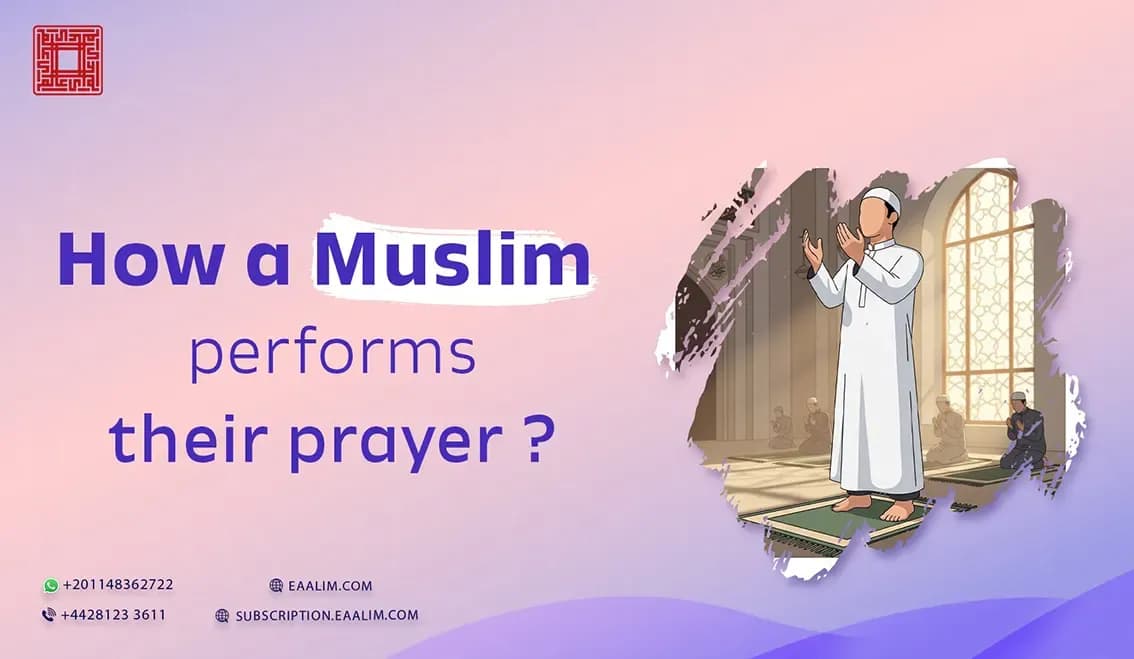
How to Perform Prayer Step by Step Guide for Beginners
Learn how to perform prayer step by step with clear guidance. This simple guide helps beginners pray correctly and confidently.
Frequently Asked Questions
In usul al-fiqh a condition (shart) is something whose presence makes a matter possible and whose absence makes it invalid, though the condition alone is not enough — every required condition must be present together. The blog compares it to driving legally in the UK, which requires a licence, insurance, a roadworthy vehicle and being sober. Classical scholars including al-Nawawi, Ibn Taymiyyah and Muhammad ibn Abd al-Wahhab typically count seven conditions: knowledge, certainty, acceptance, submission, truthfulness, sincerity and love.
Yes, for anyone physically able to speak — this is the unanimous position of the four Sunni schools. The blog cites the deathbed of Abu Talib, where the Prophet ﷺ could not save his beloved uncle because Abu Talib refused to pronounce the words, and the hadith that the Prophet ﷺ was commanded to fight people until they testify. Those genuinely unable to speak, through muteness or coma, are excused, and sign language is accepted as a valid substitute for the permanently mute.
The blog gives a reassuring classical answer: the knowledge required is the meaning of the Shahadah itself — that only Allah is worthy of worship, that He has no partner, and that Muhammad ﷺ is His final Messenger. A new Muslim does not need to have studied books of usul al-fiqh first. After taking the Shahadah, the convert begins actively learning the obligations of the religion, starting with the five daily prayers, the conditions of purity, and the basics of fasting.
Yes, according to the position the blog cites from Imam al-Qurtubi and Ishaq ibn Rahawayh: if a person previously known as a disbeliever is observed performing the obligatory prayer regularly and at its proper times, they are judged to be Muslim even if no one heard them pronounce the Shahadah aloud. This rests on the Prophet's statement that whoever prays our prayer, faces our qiblah and eats from our slaughtered meat is a Muslim under the protection of Allah and His Messenger.
