


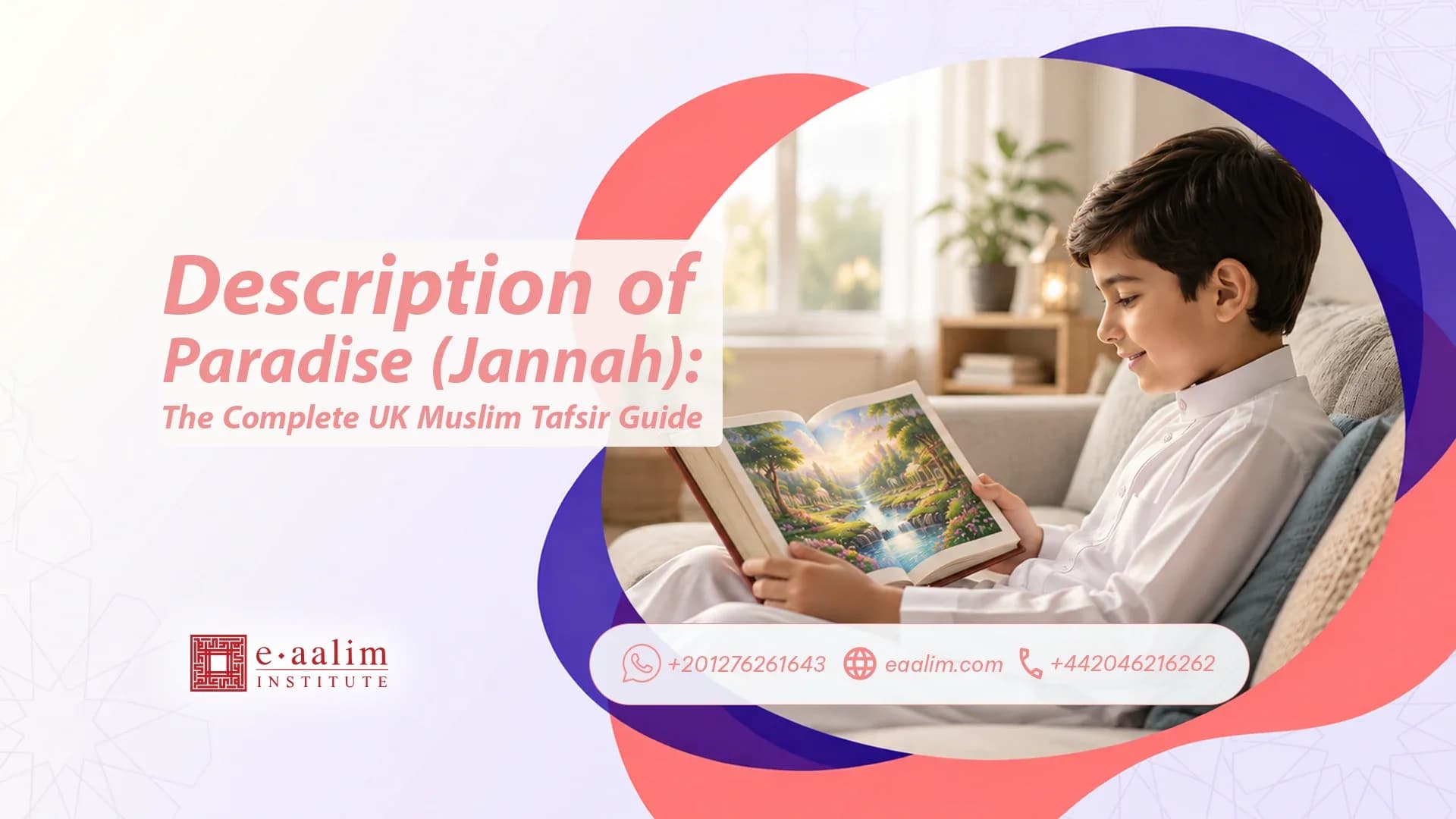
Description of Paradise (Jannah): The Complete UK Muslim Tafsir Guide
By Eaalim Institute on 5/13/2026 · 12 min read
No book matches the sustained beauty of the Qur'an's description of Paradise and the gardens of Jannah. The Arabic word is al-Jannah — "the Garden" — and the Qur'an names dozens of its features across hundreds of verses, while the Prophet ﷺ added hundreds more in the hadith literature. The great Damascene scholar Ibn al-Qayyim al-Jawziyyah (d. 1350 CE) collected nearly all of this material in Ḥādī al-Arwāḥ. This guide offers a structured Qur'anic and prophetic tour of Paradise, and shows how studying its tafsir transforms a British Muslim family's daily life.
The ground, the soil and the building materials of Paradise: Description Of Paradise.
Ibn al-Qayyim devotes a chapter to the question almost every Muslim child asks: what is the ground of Paradise actually made of? The Prophet ﷺ answered it directly in a hadith preserved by al-Tirmidhī:
"Its bricks are of gold and silver, its mortar is fragrant musk, its pebbles are pearls and rubies, and its soil is saffron." (Jāmiʿ al-Tirmidhī 2526)
No inferior material appears anywhere in the description. Every component comes from the most precious substances the human imagination knows, so even the soil carries a fragrance.
The classical scholars explained that these materials were not chosen for their commercial value. Rather, Allah chose them because they are the substances people naturally describe as beautiful. In other words, He used the categories of beauty His servants already recognise to give them a taste of a beauty they have not yet seen.
The trees, the fruits and the leaves.
The Qur'an describes the gardens of Paradise in some of its most lyrical passages. Of the foremost believers, Allah says in Surah al-Wāqiʿah:
"And fruit of whatever they select, and the flesh of fowl, from whatever they desire." (Qur'an 56:20–21)
The Prophet ﷺ said that every tree in Paradise has a trunk of gold (Jāmiʿ al-Tirmidhī 2525), and early reports collected by Ibn al-Qayyim describe fruit softer than butter and sweeter than honey. The Qur'an adds that its fruit hangs within easy reach (69:23) and resembles what believers knew on earth (2:25), yet tastes far better.
Above all, the Prophet ﷺ said that a single tree of Paradise is so vast that a rider could travel in its shade for a hundred years without crossing it (Sahih al-Bukhārī 3251, Muslim 2826). Pause on that image: a hundred years beneath one tree.
The four rivers.
Also, allah describes four categories of rivers in Paradise in Surah Muḥammad:
"The likeness of Paradise which the righteous are promised. Rivers of water unaltered, rivers of milk the taste of which does not change. Rivers of wine delicious to those who drink. And rivers of purified honey. And for them therein are fruits of every kind, and forgiveness from their Lord..." (Qur'an 47:15)
Notice the precision of the descriptions. Moreover, the water does not stagnate. Likewise, the milk does not sour. Furthermore, the wine does not intoxicate. Finally, the honey is pure — without the wax or impurities that mark earthly honey. Indeed, the classical commentators noted that each of these descriptions corrects a feature of earthly pleasure that diminishes its enjoyment. The Paradise version is each pleasure perfected.
The vessels, the cushions and the thrones.
Importantly, the Qur'an describes the seating of Paradise in Surah al-Ghāshiyah:
"In an elevated garden — wherein they will hear no idle talk. Within it is a flowing spring. Within it are couches raised high, and cups put in place. And cushions lined up, and carpets spread around." (Qur'an 88:10–16)
And in Surah al-Raḥmān:
"Reclining on green cushions and beautiful fine carpets. So which of the favours of your Lord will you deny?" (Qur'an 55:76–77)
Clearly, the classical scholars noted the deliberate sensory layering. In other words, Allah describes what the eye sees, what the body feels, what the ear hears, what the tongue tastes. Additionally, he does not describe Paradise as an abstract spiritual state. He describes it in the full vocabulary of human bodily delight. And then He says, in Surah al-Sajdah. "No soul knows what has been hidden for them of joy as a reward for what they used to do" (Qur'an 32:17).
The companions and the inhabitants.
The Prophet ﷺ said the people of Paradise will be created in the form of Adam (AS), sixty cubits tall (Sahih al-Bukhārī 3327, Muslim 2834), and will appear thirty-three years old, never ageing (Jāmiʿ al-Tirmidhī 2545). They will not relieve themselves, their sweat will be musk (Muslim 2835), and they will never grow weary or sad. The Qur'an describes their clothing of silk and brocade and their bracelets of gold, silver and pearl (18:31), (76:21).
Believing wives will be restored to youth and beauty, and the men will also have the ḥūr al-ʿīn, the maidens of Paradise described in Surah al-Wāqiʿah and al-Raḥmān. For women, the scholars highlighted perfected beauty, freedom from pain and fatigue, and reunion with righteous husbands and children. Those who had no righteous spouse in this life will be given one, for the Prophet ﷺ said: "There is no one in Paradise without a spouse" (Muslim 2834).
The vision of Allah — the supreme reward.
For this reason, above every physical pleasure, every garden, every river, every palace. The Qur'an names a single transcendent reward that the classical scholars unanimously identified as the supreme delight of Paradise. In short, allah says in Surah al-Qiyāmah:
"Some faces that Day will be radiant, looking at their Lord." (Qur'an 75:22–23)
Indeed, this is the ruʾyat Allāh — the vision of Allah. The Prophet ﷺ confirmed in multiple authentic hadiths that the people of Paradise will see Allah directly. "as you see the full moon on a clear night". Also, without crowding, without obstacle, with each believer seeing his Lord in a way that satisfies him entirely.
Ibn al-Qayyim wrote that everything else described in Paradise. Moreover, the gardens, the rivers, the palaces, the food, the companions — is a setting. The actual supreme gift is the direct vision of Allah Himself. Furthermore, the Companions described this gift as the moment for which a believer's entire earthly life was preparation. Everything else in Paradise is the wedding hall; the vision of Allah is the meeting itself.
The levels of Paradise.
Indeed, paradise is not flat. The Prophet ﷺ described it as having a hundred levels (darajāt). Each one as far above the next as the distance between heaven and earth. Importantly, the highest level, called al-Firdaws al-Aʿlā, is described in the hadith narrated by Bukhārī:
"When you ask Allah for Paradise, ask Him for al-Firdaws. For it is the middle of Paradise and the highest part of Paradise. Above it is the Throne of the Most Merciful, and from it gush forth the rivers of Paradise."
The level a believer attains depends on the quality of their faith and the quality of their deeds. Clearly, a British Muslim who maintains the obligatory prayers and avoids the major sins will. By Allah's mercy, enter Paradise. Additionally, a British Muslim who adds to that the voluntary prayers, regular Qur'an, charity. And the pursuit of knowledge ascends to higher levels. Besides, a British Muslim who lives the entire Sunnah in its outward and inward dimensions has the possibility of reaching al-Firdaws al-Aʿlā itself.
What the descriptions of Paradise are for.
The scholars stressed that the Qur'an's descriptions of Paradise are not literary entertainment; they are motivation. Allah revealed them so that when the heart is asked to give up an immediate pleasure for the sake of obedience, it can feel the weight of what awaits.
The teenager tempted by a haram relationship at university needs to feel the reward of Paradise that patience will bring. The professional weighing a dishonest deal needs to feel the palaces of gold and the rivers of milk and honey at stake. The exhausted parent tempted to skip ʿIshāʾ after a late shift needs to feel the levels of al-Firdaws won by such acts.
This is what tafsir of the Paradise verses does. It does not only inform the believer about Paradise; it awakens the heart's longing for it. In other words, without that longing, worship feels heavy. With it, the same act becomes a willing investment.
Paradise in everyday British Muslim life.
For British Muslim families wanting to make the descriptions of Paradise a real part of daily home life. In addition, here is a practical pattern that has worked in many UK households:
Frequency — Practice.
As a result,
Daily, after Maghrib: Read aloud one short ayah about Paradise (e.g. from al-Wāqiʿah, al-Raḥmān, al-Ghāshiyah)
.
Weekly, Friday evenings: Read one passage from Ibn al-Qayyim's Ḥādī al-Arwāḥ (English translation available) with the family
.
For this reason,
Monthly: Memorise one description of Paradise — verse or hadith — together as a family
.
Yearly: Devote one full evening in Ramadan to reading the Paradise material in Surah al-Raḥmān aloud
.
In every duʿāʾ: Ask Allah specifically for al-Firdaws al-Aʿlā, by name, as the Prophet ﷺ instructed
.
In short, done consistently for a year. This transforms a British Muslim home far more than the most ambitious one-off Islamic seminars. Also, the descriptions of Paradise become familiar; the longing for it becomes a daily companion. The obedience that earns it becomes natural.
What the Qur'an asks in return.
Allah describes Paradise in such detail because He wants His servants to want it. But the Qur'an is consistently clear that wanting it alone is not the price of admission. Moreover, surah al-Naḥl says:
"Whoever does righteousness, whether male or female, while being a believer. We will surely cause him to live a good life. And We will surely give them their reward according to the best of what they used to do." (Qur'an 16:97)
The condition is faith plus righteous action. Furthermore, the Paradise descriptions are the destination. The obligatory prayers, the fasting, the zakāh, the avoidance of the haram. Indeed, the kindness to parents and neighbours, the truthfulness in business, the patience under hardship. These are the journey. The Qur'an describes both ends of the equation so that the believer cannot mistake one for the other.
A new module: the Tafsir of Paradise with Eaalim.
The Qur'anic descriptions of Paradise are scattered across dozens of surahs. Al-Baqarah, Āl ʿImrān, al-Nisāʾ, al-Tawbah, al-Raʿd, al-Naḥl, al-Kahf, al-Furqān, al-Sajdah, al-Aḥzāb, Yāsīn, al-Ṣāffāt, al-Zumar, al-Mu'min, al-Zukhruf, al-Dukhān, al-Aḥqāf. Muḥammad, al-Ṭūr, al-Najm, al-Raḥmān, al-Wāqiʿah, al-Mujādilah, al-Ḥashr, al-Ṣaff, al-Taḥrīm, al-Mulk, al-Insān, al-Mursalāt, al-Naba', al-Muṭaffifīn, al-Ghāshiyah, and others. Therefore, to study them properly is to do tafsir. Verse by verse, in their context, with the classical commentators.
For British Muslim families and adult learners who want to study these passages properly. Eaalim is opening a brand-new module within our Islamic Studies series. A structured deep-dive on the tafsir of Paradise, taught as part of our online Tafsir Course UK. Specifically, the course is a structured live one-to-one programme taught in English by Al-Azhar certified teachers on UK GMT/BST time slots. The Paradise tafsir module includes:
The descriptive surahs. Al-Wāqiʿah, al-Raḥmān, al-Insān and al-Ghāshiyah read in full, with classical tafsir commentary verse by verse.
The Paradise verses across the Qur'an. Gathered, organised by theme (ground, trees, rivers, dwellings, companions, vision of Allah). And explained with the major mufassirūn (al-Ṭabarī, Ibn Kathīr, al-Qurṭubī, al-Saʿdī).
Selected passages from Ibn al-Qayyim's Ḥādī al-Arwāḥ — read alongside the Qur'anic material to enrich understanding.
The hadith literature on Paradise. Selected ṣaḥīḥ hadiths from Bukhārī, Muslim and al-Tirmidhī, with isnād and matn explanation.
The levels of Paradise and how to reach them. Practical UK application: which acts of worship raise a believer's level the most, in the prophetic ranking.
The supreme reward — the vision of Allah. Its evidences in Qur'an and Sunnah, its scholarly explanation, and its practical effect on the believer's heart.
How to teach Paradise to British Muslim children. Age-appropriate verses, the right amount of detail, and the connection to motivation for daily prayer and Qur'an study.
The course pairs particularly well with our other Islamic Studies offerings. The online Aqeedah Course UK, the online Hadith Course, and the online Islamic Etiquette (Adab) Course UK. In fact, many British Muslim families take Tafsir alongside Aqeedah. Since the descriptions of Paradise are the practical proof of what aqeedah teaches in the abstract.
To register your interest. Or to book a free trial lesson with one of our Al-Azhar certified teachers. Fill in the booking form on our site and mention "Tafsir of Paradise course" in the message. We will confirm a UK time slot. Send you the lesson plan for the first four weeks, and pair your child. Or you, if you are an adult learner — with the right teacher for your level.
Until the course opens for general enrolment, the practice can begin tonight. First, open your Mushaf to Surah al-Raḥmān after Maghrib. Then read aloud — even just the first thirty verses. Let the rhythm of "so which of the favours of your Lord will you deny?" settle into your home. The British Muslim family that hears Paradise described in Allah's own words each week. Across years, develops a longing that no amount of UK material distraction can shake. And, by Allah's promise in His own Book, that longing — combined with faith and action. Is what He has prepared the most beautiful Garden for.
Start your journey with Eaalim today!
Start 2 Free Trials


 Share
ShareRelated Blogs
The Ten Promised Paradise (al-ʿAsharah al-Mubashsharah): A British Muslim Guide
The ten Companions of the Prophet ﷺ guaranteed Paradise during their lifetimes — Abu Bakr, Umar, Uthman, Ali, Talhah, al-Zubayr, Abd al-Rahman ibn Awf, Saʿd ibn Abī Waqqāṣ, Saʿīd ibn Zayd, Abū ʿUbaydah ibn al-Jarrāḥ. UK guide.
The Isra and Mi'raj: The Prophet's ﷺ Night Journey to Jerusalem and Ascension Through the Heavens (UK Guide 2026)
British Muslim guide to the Isra and Mi'raj — the Prophet's ﷺ night journey from Makkah to Jerusalem on al-Buraq, ascension through the seven heavens meeting the prophets, the gift of the five daily prayers (originally 50, reduced through Musa's advocacy), Abu Bakr's faith, and what UK Muslim families teach children.
Frequently Asked Questions
The guide cites a hadith preserved by al-Tirmidhī in which the Prophet said the earth of Paradise is of musk and saffron. It adds that the walls of its dwellings are built of bricks of gold and silver, the mortar between them is fragrant musk, and the pebbles on its paths are pearls and rubies. The scholars explained these precious materials are chosen not for commercial value but because they are the substances humans naturally describe as beautiful.
The guide cites Surah Muḥammad (47:15), which describes rivers of water that never stagnates, rivers of milk whose taste never changes, rivers of wine delicious to drink, and rivers of purified honey. It notes the precision of each description: the water does not stagnate, the milk does not sour, the wine does not intoxicate, and the honey is pure without wax or impurities, so that each is an earthly pleasure perfected.
The guide explains that above every physical pleasure, the supreme reward is the vision of Allah (ruʾyat Allāh), citing Surah al-Qiyāmah (75:22-23): some faces that Day will be radiant, looking at their Lord. The Prophet confirmed in authentic hadiths that the people of Paradise will see Allah directly, as one sees the full moon on a clear night. Ibn al-Qayyim wrote that everything else in Paradise is the setting, while the vision of Allah is the meeting itself.
The guide explains Paradise has a hundred levels, each as far above the next as the distance between heaven and earth, with the highest called al-Firdaws al-Aʿlā. It cites a hadith in al-Bukhārī advising believers to ask Allah specifically for al-Firdaws, since it is the highest part of Paradise and above it is the Throne of the Most Merciful. The level attained depends on the quality of one's faith and deeds, with voluntary prayers, regular Qur'an, charity and seeking knowledge raising a believer higher.
