


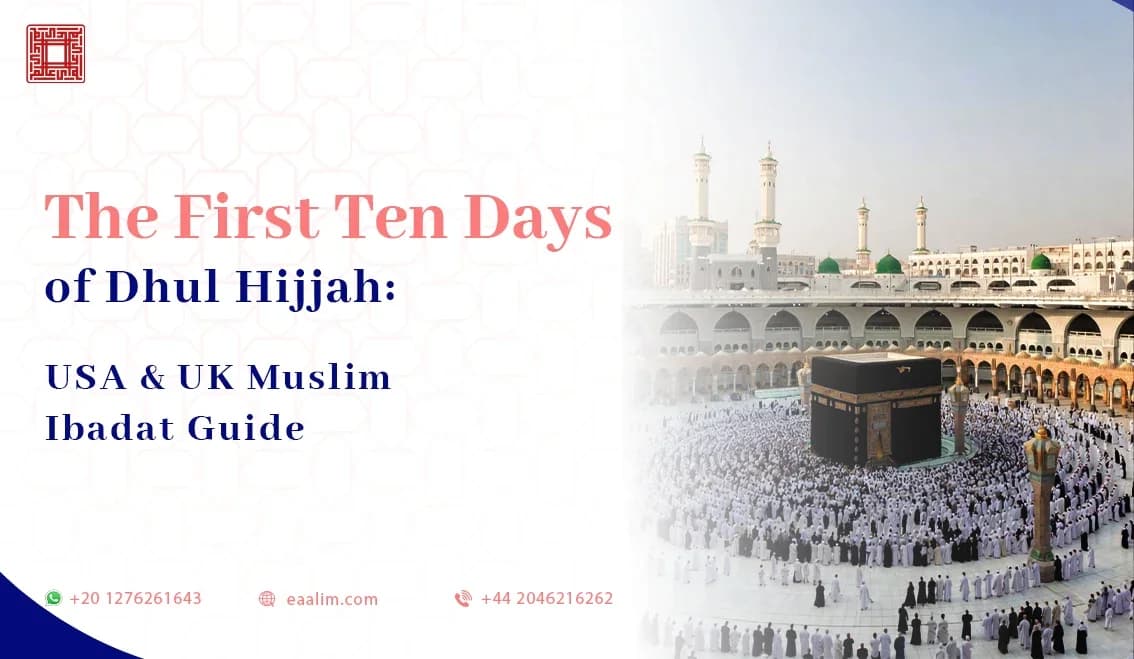
The First Ten Days of Dhul Hijjah: A US + UK Muslim Ibadat Guide
By Eaalim Institute on 5/20/2026 · 22 min read
An American and British Muslim Ibadah guide to the most spiritually rewarding ten days of the year — the first ten days of Dhul Hijjah. The Qur'anic foundations (Surah al-Fajr 89:1–3, Surah al-Ḥajj 22:28, Surah al-Mā'idah 5:3), the Prophetic warnings that no deeds are more beloved to Allah ﷻ in any other period, the recommended acts of worship (fasting, dhikr, takbīr, qurbānī, Day of ‘Arafah), the practical 2026 US and UK weekly schedule, and how Eaalim's ‘Ibādāt (Worship) Course for American and British Muslim families builds the structured engagement these days deserve.
The annual American and British Muslim opportunity most under-engaged
Every year, between the 1st and 10th of Dhul Ḥijjah — the final month of the Islamic lunar calendar — Allah ﷻ opens a ten-day window of worship-reward that the Prophet ﷺ described as the most beloved to Allah ﷻ of any ten-day period in the year. Greater than the first ten days of Ramadan. Greater than the last ten nights of Ramadan in some dimensions. Greater than any other concentrated worship-opportunity Allah ﷻ has placed in the Islamic year.
And yet — across American and British Muslim communities in 2026 — these days are typically the most under-engaged of all the major Islamic seasons. Ramadan attracts the full community engagement. Hajj season highlights the ceremonial pilgrims abroad. But the first ten days of Dhul Ḥijjah — for the 99% of American and British Muslims who are not on Hajj — pass largely unmarked. School and work routines continue. The Prophetic emphasis is barely communicated. The classical recommended worship is barely practiced.
This article walks American and British Muslim families through the precise classical Sunni framework for the first ten days of Dhul Ḥijjah — the Qur'anic foundations, the Prophetic warnings about their unique status, the recommended acts of worship, the Day of ‘Arafah specifically, the qurbānī (sacrifice) framework, the practical 2026 US and UK daily schedule, and how Eaalim's ‘Ibādāt Course is built to give American and British Muslim families the structured curriculum to actually engage these days the way the dīn invites.
The foundational Prophetic hadith — no days more beloved
The Prophet ﷺ established the unique status of these days in a hadith preserved by Sahih al-Bukhārī:
Ibn ‘Abbās (RA) reported: The Prophet ﷺ said: "There are no days during which righteous deeds are more beloved to Allah than these days [i.e., the first ten days of Dhul Ḥijjah]." The Companions said: "Not even jihād in the way of Allah?" The Prophet ﷺ said: "Not even jihād in the way of Allah, except for a man who went out [for jihād] with himself and his wealth and returned with none of that [i.e., was martyred]."
— Sahih al-Bukhārī 969.
The hadith is extraordinary in two dimensions. First: the Prophet ﷺ named these ten days as the most beloved-deed-period of the entire year. Second: he raised the bar deliberately — even jihād, normally one of the highest-reward categories of worship, is exceeded in these days except for the highest specific case (the martyred mujāhid who died on the path). The 2026 American or British Muslim engaging ordinary deeds during these ten days is, by Prophetic promise, in a higher reward category than they would be doing the same deeds in any other ten-day period of the year.
The Qur'anic foundations
The Qur'an itself names these days in four distinct references American and British Muslim families should know:
1. The divine oath — Surah al-Fajr 89:1–3
وَالْفَجْرِ وَلَيَالٍ عَشْرٍ
"By the dawn, and by the ten nights..." (Surah al-Fajr 89:1–2)
The classical mufassirūn (Ibn Kathīr, al-Ṭabarī, al-Saʿdī) unanimously read "the ten nights" as the first ten nights of Dhul Ḥijjah. The Qur'anic principle: when Allah ﷻ swears by something, He is drawing the believer's attention to its importance. Allah ﷻ swearing by these ten nights specifically is itself a Qur'anic indicator of their spiritual weight.
2. The dhikr command — Surah al-Ḥajj 22:28
وَيَذْكُرُوا اسْمَ اللَّهِ فِي أَيَّامٍ مَّعْلُومَاتٍ
"And mention the name of Allah on appointed days..." (Surah al-Ḥajj 22:28)
The classical mufassirūn read "the appointed days" (ayyām ma‘lūmāt) as the first ten days of Dhul Ḥijjah. The verse is a direct command for increased dhikr during this period — a command Allah ﷻ specifically named these days for.
3. The Mūsā parallel — Surah al-A‘rāf 7:142
وَوَاعَدْنَا مُوسَىٰ ثَلَاثِينَ لَيْلَةً وَأَتْمَمْنَاهَا بِعَشْرٍ
"And We made an appointment with Mūsā for thirty nights and completed them with ten..." (Surah al-A‘rāf 7:142)
The classical scholars (Ibn Kathīr, al-Qurṭubī) read the "completing ten" as the first ten of Dhul Ḥijjah — these days complete the spiritual completion that began with Mūsā's appointment on Mount Sinai. The Qur'anic narrative provides parallel structure: these ten days carry completion-of-spiritual-mission significance.
4. The completion of religion — Surah al-Mā'idah 5:3
الْيَوْمَ أَكْمَلْتُ لَكُمْ دِينَكُمْ وَأَتْمَمْتُ عَلَيْكُمْ نِعْمَتِي وَرَضِيتُ لَكُمُ الْإِسْلَامَ دِينًا
"This day I have perfected for you your religion and completed My favor upon you and have approved for you Islam as religion." (Surah al-Mā'idah 5:3)
This verse — perhaps the most consequential single revelation in Islamic history — was revealed to the Prophet ﷺ on the Day of ‘Arafah (9th of Dhul Ḥijjah) during the Farewell Pilgrimage in 10 AH. ‘Umar ibn al-Khaṭṭāb (RA) confirmed this in a famous narration. The day on which Allah ﷻ declared the dīn complete falls within the ten days of Dhul Ḥijjah — making this period the literal anniversary of the completion of revelation itself.
The Day of ‘Arafah — the spiritual peak
The 9th of Dhul Ḥijjah — the Day of ‘Arafah — is the spiritual peak of the ten days. Multiple authenticated hadiths establish its unique status:
The fasting reward
The Prophet ﷺ said about fasting on the Day of ‘Arafah (for those not performing Hajj): "I hope from Allah that it will expiate the sins of the year before and the year after."
— Sahih Muslim 1162.
The hadith establishes the unique reward of fasting on the 9th of Dhul Ḥijjah for those not at ‘Arafah themselves. Two years of minor sins expiated — past year and following year — through a single day's fast. The 2026 American or British Muslim who fasts this single day potentially has the spiritual equivalent of fasting Ramadan-level fasts for two years' worth of sin-expiation.
Avoiding the torture of the Fire
The Prophet ﷺ said: "There is no day on which Allah frees more of His slaves from the Fire than the Day of ‘Arafah. And He comes near and boasts of them before the angels, saying: ‘What do these people want?'"
— Sahih Muslim 1348.
The Day of ‘Arafah is the day Allah ﷻ frees more believers from Hell than any other day. The 2026 American or British Muslim engaging this day with sincere worship — even from their home in Houston or Birmingham, not at ‘Arafah itself — is engaging a day with extraordinary Hell-liberation potential.
The best supplication
The Prophet ﷺ said: "The best supplication is the supplication of the Day of ‘Arafah, and the best thing that I and the Prophets before me have said is: ‘Lā ilāha illā Allāhu waḥdahu lā sharīka lah, lahu al-mulk wa lahu al-ḥamd, wa Huwa ‘alā kulli shay'in qadīr' (There is no god but Allah alone, without partner; to Him belongs all dominion and to Him belongs all praise, and He is over all things competent)."
— Sunan al-Tirmidhī 3585, classed ḥasan.
The Prophet ﷺ specified the precise du‘ā' for the Day of ‘Arafah. American and British Muslim families should repeat this formula extensively during the day — alongside personal du‘ā' for their families, their dīn, their parents, their children, and the broader Ummah.
The 10 categories of recommended worship across the ten days
Drawing from the classical Sunni framework, the recommended acts of worship across the first ten days of Dhul Ḥijjah:
1. Increased dhikr
Allah ﷻ specifically commanded this (Surah al-Ḥajj 22:28). The Prophet ﷺ specified the formulas: "increase in these days the tasbīḥ (Subḥān Allāh), tahlīl (Lā ilāha illā Allāh), and takbīr (Allāhu akbar)" (Musnad Aḥmad 5446, classed authentic).
2. Voluntary fasting
Many classical scholars recommend fasting all nine days (the 10th being Eid, fasting is not permitted). The Prophet ﷺ said: "There are no days in which righteous deeds are more beloved to Allah than in these days." Fasting is a foundational righteous deed.
3. The Day of ‘Arafah fast specifically
For those not performing Hajj, fasting the 9th of Dhul Ḥijjah carries the Prophetic promise of two-year sin-expiation (Sahih Muslim 1162). This is the single most rewarded fast of the year outside Ramadan.
4. Increased Qur'an recitation
The Prophet ﷺ established the Qur'an as a primary worship-act. Increased recitation during these days multiplies the reward.
5. The takbīr
The Sunnah is to engage in audible takbīr during these days — particularly between the Fajr of the 9th (Day of ‘Arafah) and the ‘Aṣr of the 13th of Dhul Ḥijjah (the last of the Days of Tashrīq). The takbīr formula: "Allāhu akbar, Allāhu akbar, Lā ilāha illā Allāh, wa Allāhu akbar, Allāhu akbar wa lillāhi al-ḥamd."
6. Qurbānī (sacrifice)
The sacrifice of an animal on the 10th of Dhul Ḥijjah (Eid al-Aḍḥā), commemorating Ibrāhīm's ‘alayhi al-salām offering. American and British Muslim families typically arrange qurbānī through trusted charities (Islamic Relief, Muslim Hands, etc.) who slaughter on behalf of the family in countries of need.
7. Sadaqah (charity)
Increased charity during these days, sharing in the spirit of qurbānī's commemoration of Ibrāhīm's sacrifice.
8. Voluntary salah
Night prayer (tahajjud, qiyām al-layl), duhā (mid-morning prayer), and the sunnah rak‘ahs around the obligatory prayers — all multiplied in reward during these days.
9. Repentance and istighfār
The reward-multiplication extends to istighfār. The Day of ‘Arafah's Hell-liberation hadith implies that sincere repentance during these days produces extraordinary forgiveness outcomes.
10. Refraining from cutting hair and nails (for those intending qurbānī)
The Prophet ﷺ specifically instructed those who intend to perform qurbānī to refrain from cutting their hair, nails, or skin from the start of Dhul Ḥijjah until they perform the sacrifice (Sahih Muslim 1977). The classical scholars debated the exact ruling (wājib vs mustaḥabb); the safer position is to follow the Prophetic instruction.
The classical Sunni scholarly emphasis
Classical Sunni scholars consistently emphasized the unique opportunity of these ten days:
Ibn Rajab al-Ḥanbalī
In Laṭā'if al-Ma‘ārif — his classical work on the Islamic religious calendar — Ibn Rajab devoted extensive discussion to Dhul Ḥijjah. His key insight: the first ten days of Dhul Ḥijjah are the daytime equivalent of the last ten nights of Ramadan in terms of spiritual peak — the same way Ramadan's last ten nights are the nighttime spiritual peak, Dhul Ḥijjah's first ten days are the daytime spiritual peak.
Ibn Ḥajar al-‘Asqalānī
In Fatḥ al-Bārī — his foundational commentary on Sahih al-Bukhārī — Ibn Ḥajar emphasized that the Prophet ﷺ's choice to mention these days specifically as the most-beloved-deed period is itself a divine directive. The believer should not pass them as ordinary days.
Imām al-Nawawī
In al-Majmū‘ and his other works, al-Nawawī codified the recommended acts of worship for these days. The Shāfi‘ī jurisprudential framework explicitly includes Dhul Ḥijjah's ten days in the highest-priority voluntary worship periods.
Shaykh ‘Abdullāh ibn Bāz
The contemporary Saudi grand mufti emphasized in multiple fatwas that contemporary Muslims have largely neglected these days compared to Ramadan — and that this neglect is itself a spiritual problem requiring restoration of the proper Prophetic emphasis.
The qurbānī framework — for American and British Muslim families
The qurbānī (animal sacrifice on Eid al-Aḍḥā) is one of the most significant Sunnah acts of these days. The classical Sunni framework for American and British Muslim families:
The Qur'anic foundation
فَصَلِّ لِرَبِّكَ وَانْحَرْ
"So pray to your Lord and sacrifice." (Surah al-Kawthar 108:2)
The verse pairs salah and sacrifice — establishing both as foundational Eid al-Aḍḥā acts.
The Ibrāhīm connection
The qurbānī commemorates Ibrāhīm's ‘alayhi al-salām willing offering of his son Ismā‘īl ‘alayhi al-salām — and Allah ﷻ's mercy in providing a ram as substitute. The story is preserved in Surah al-Ṣāffāt 37:100–113. The qurbānī every year is the lived re-enactment of Ibrāhīm's submission.
The practical American and British Muslim approach
American and British Muslim families typically do not slaughter animals personally — both because of regulatory frameworks (US and UK slaughter laws require licensed facilities) and because most families lack the capacity or inclination. Instead, the universal practice is:
Arrange the qurbānī through a trusted Muslim charity — Islamic Relief, Muslim Hands, Penny Appeal, National Zakat Foundation, Zakat Foundation of America, Helping Hand USA.
The charity arranges the slaughter (typically in countries of need where the meat is distributed to the poor).
Pay per share or per animal — the price varies by country and by year.
Receive confirmation that the slaughter has been performed.
The classical Sunni position: this delegation through a trusted charity fulfills the qurbānī obligation/recommendation, with the meat reaching those who need it more than the American or British Muslim family.
Who is required to perform qurbānī?
The Sunni schools differ slightly:
Ḥanafī school: Wājib (obligatory) on those who possess the niṣāb of wealth.
Majority (Mālikī, Shāfi‘ī, Ḥanbalī): Sunnah mu'akkadah (strongly recommended sunnah) for those able.
The contemporary American and British Muslim consensus, regardless of madhab affiliation, treats qurbānī as a fundamental component of proper Eid al-Aḍḥā observance for those able.
The practical 2026 American and British Muslim ten-day schedule
A concrete daily schedule for the first ten days of Dhul Ḥijjah:
Days 1–8 (1st through 8th of Dhul Ḥijjah)
Daily fasting (where capacity permits) — these are voluntary fasts with elevated reward.
Increased dhikr — particularly Subḥān Allāh, Alḥamdu lillāh, Lā ilāha illā Allāh, Allāhu akbar.
Daily Qur'an reading — increased from the normal portion.
Voluntary night prayer (tahajjud) where possible.
Sadaqah — daily small charity, especially through trusted Muslim charities serving the global Ummah.
Refraining from hair and nail cutting (for those intending qurbānī).
Family Qur'an time — particularly engaging Surah al-Kahf, Surah al-Mulk, and other Friday-Sunnah recitations.
Day 9 — The Day of ‘Arafah
Fasting — the most rewarded voluntary fast of the year (Sahih Muslim 1162).
The Day of ‘Arafah du‘ā' — "Lā ilāha illā Allāhu waḥdahu..." repeated extensively (Sunan al-Tirmidhī 3585).
Personal du‘ā' — for parents, children, spouse, dīn, the Ummah.
Repentance and istighfār — abundant throughout the day.
Family time around iftar — sharing the Day of ‘Arafah's spiritual weight.
Reading Surah al-Mā'idah 5:3 — the completion of religion verse revealed on this day.
Day 10 — Eid al-Aḍḥā
Eid prayer in congregation at the masjid.
Qurbānī performed (or already arranged through trusted charity).
Family Eid celebration — meal, gift-giving, family gathering.
Continued takbīr through the Days of Tashrīq (11th-13th).
Visiting Muslim relatives and neighbors.
Giving Eid gifts within the classical Sunni framework (covered in the Eaalim Eid Gifts article).
The takbīr during these days
The classical Sunni framework distinguishes two types of takbīr during this period:
1. The unrestricted takbīr (al-takbīr al-muṭlaq)
Recited from the 1st of Dhul Ḥijjah until the end of the Days of Tashrīq (13th of Dhul Ḥijjah). May be said at any time — while walking, in markets, at home. The Companion ‘Umar (RA) used to do this audibly in the streets of Madinah.
2. The restricted takbīr (al-takbīr al-muqayyad)
Recited specifically after each of the five obligatory prayers, from the Fajr of the 9th of Dhul Ḥijjah (Day of ‘Arafah) until the ‘Aṣr of the 13th of Dhul Ḥijjah. The Companion practice was to immediately begin the takbīr after the conclusion of each obligatory salah.
The classical takbīr formula
"Allāhu akbar, Allāhu akbar, Lā ilāha illā Allāh, wa Allāhu akbar, Allāhu akbar wa lillāhi al-ḥamd."
The 2026 American or British Muslim should integrate the audible takbīr into the daily rhythm of these days — in the car, walking through the supermarket, at home, between work tasks. The Prophetic and Companion model is unmistakable: these days should be saturated with takbīr.
The contemporary American and British Muslim obstacles
Several factors explain why these ten days are typically under-engaged in 2026 American and British Muslim communities:
1. Work and school schedules
Dhul Ḥijjah falls during ordinary working months for most American and British Muslim families. Unlike Ramadan — which receives some workplace and school accommodation — Dhul Ḥijjah typically does not. The believer must engage the days within the ordinary workweek.
2. Lack of community emphasis
Many American and British Muslim mosques do not emphasize these days the way they emphasize Ramadan. Sermons may be brief; community programming is limited. Individual believers must take initiative.
3. The Hajj-pilgrim focus
Much of the broader Muslim community attention during Dhul Ḥijjah focuses on those performing Hajj. The believers staying home can feel their own engagement is somehow secondary. The classical Sunni framework explicitly rejects this — the home-believer engaging these days is in a high reward category, not a peripheral one.
4. The "this is just for the Hajj people" misconception
Some American and British Muslims assume the special acts of worship are primarily for those at Hajj. The classical Sunni framework explicitly establishes that the non-Hajj believer has their own structured opportunity — particularly fasting the Day of ‘Arafah, which the pilgrims are typically not doing (they are in the standing-place).
5. The lack of structured Islamic education
American and British Muslim adults who have not received structured Islamic education through Eaalim or similar courses often lack the precise classical framework. They know "Ramadan is special" but do not know "Dhul Ḥijjah's first ten days are the most beloved-deed period of the entire year." The literacy gap perpetuates the engagement gap.
The reframing — Dhul Ḥijjah as the "second Ramadan"
The classical Sunni framework can be reframed for the 2026 American or British Muslim adult: Dhul Ḥijjah's first ten days are the "second Ramadan" of the Islamic year. Not equal to Ramadan in every dimension, but similar in spiritual potential, in concentrated reward, in the call to elevated worship.
The American or British Muslim who builds a structured Dhul Ḥijjah engagement — comparable in intensity to their Ramadan engagement — operates with two full spiritual peaks per year rather than one. The classical scholars consistently emphasized this; the contemporary American and British Muslim Ummah has often forgotten it.
How to teach American and British Muslim children about Dhul Ḥijjah
A developmental scaffold:
Ages 5–8
Simple framing. "There are special ten days every year when good things we do count even more in Allah's record. They happen right before Eid al-Aḍḥā. We try to do more good and remember Allah more during these days."
Ages 8–12
Introduce the Prophetic hadith (Sahih al-Bukhārī 969). Discuss the story of Ibrāhīm and Ismā‘īl (Surah al-Ṣāffāt). Teach the takbīr formula. Engage the Day of ‘Arafah fast for the older children.
Ages 12–16
The full Qur'anic and Prophetic framework. The classical scholarly emphasis. The ten recommended categories of worship. The qurbānī fiqh.
Age 16+
The complete framework with classical and contemporary applications. The reframing of Dhul Ḥijjah as the "second Ramadan." Personal commitment to a structured ten-day schedule.
By age 18, the American or British Muslim teenager has internalized the framework and engages these days with the same intentionality they bring to Ramadan.
How Eaalim's ‘Ibādāt (Worship) Course for American and British Muslim families builds Dhul Ḥijjah engagement
Eaalim's ‘Ibādāt Course for American and British Muslim families is a structured, English-medium program covering all aspects of Sunni worship — salah, ṣawm, zakāh, ḥajj, and the broader worship calendar. It uses the classical Sunni fiqh canon — Ibn Qudāmah's al-Mughnī, al-Nawawī's al-Majmū‘, Ibn Rajab's Laṭā'if al-Ma‘ārif, and contemporary works — and applies them to lived 2026 American and British Muslim family life.
Modules in the ‘Ibādāt Course directly relevant to this article:
The Prophetic hadith on these ten days — Sahih al-Bukhārī 969 unpacked classically.
The four Qur'anic foundations — Surah al-Fajr 89:1–3, Surah al-Ḥajj 22:28, Surah al-A‘rāf 7:142, Surah al-Mā'idah 5:3.
The Day of ‘Arafah specifically — Sahih Muslim 1162, Sahih Muslim 1348, Sunan al-Tirmidhī 3585.
The ten categories of recommended worship — fasting, dhikr, takbīr, Qur'an, qurbānī, sadaqah, voluntary salah, repentance, hair/nail discipline, family engagement.
The qurbānī framework — Qur'anic foundation, Ibrāhīm narrative, four-madhāhib positions, contemporary delegation through charity.
The takbīr — unrestricted and restricted — classical Sunni timing and the practical formula.
The practical 2026 ten-day schedule — day-by-day American and British Muslim family rhythm.
Reframing Dhul Ḥijjah as the second Ramadan — restoring the classical emphasis.
Teaching children about Dhul Ḥijjah — developmental scaffold from age 5 to age 16.
The broader worship calendar — Ramadan, Sha‘bān, the Sacred Months, ‘Āshūrā, the white days, and how the Sunni worship year is structured.
Sessions are delivered live, one-to-one or small-group, on Eaalim's secure online platform. Female teachers are available for sisters and children. Scheduling covers both UK GMT/BST and American EST, CST, MST, PST. The course is open to American and British Muslim families across both countries.
Eaalim is now enrolling American and British Muslim families into the ‘Ibādāt Course. A free 15-minute consultation and a free trial lesson are offered to every new family. To enroll, visit eaalim.com.
Frequently asked questions — the first ten days of Dhul Ḥijjah for 2026 American and British Muslims
Why are these days so important?
The Prophet ﷺ explicitly named them as the most beloved-deed period of the entire year (Sahih al-Bukhārī 969). Allah ﷻ swore by them in Surah al-Fajr 89:1–3. The Day of ‘Arafah within them was the day the religion was completed (Surah al-Mā'idah 5:3). They are, by Prophetic and Qur'anic standards, the spiritual peak of the year for non-Hajj-performing believers.
What should I actually do during these days?
Fast as many days as you can. Make abundant dhikr (Subḥān Allāh, Alḥamdu lillāh, Lā ilāha illā Allāh, Allāhu akbar). Recite more Qur'an. Give sadaqah daily. Increase voluntary night prayer where possible. On the Day of ‘Arafah (9th), fast and make extensive du‘ā'. Arrange qurbānī through a trusted charity.
Is fasting all nine days required?
It is highly recommended but not obligatory. Fasting the Day of ‘Arafah specifically is the most rewarded single fast of the year outside Ramadan. The other days are voluntary fasts with elevated reward but not required.
Can I fast on the 10th (Eid)?
No. Fasting on Eid al-Aḍḥā (10th of Dhul Ḥijjah) is haram. The day is for celebration, qurbānī, and feasting.
What about hair and nails?
For those who intend to perform qurbānī, the Prophet ﷺ instructed refraining from cutting hair, nails, and skin from the start of Dhul Ḥijjah until the qurbānī is performed (Sahih Muslim 1977). The classical scholars debated the exact ruling; the safer position is to follow the Prophetic instruction.
Is qurbānī obligatory or recommended?
The Ḥanafī position is wājib (obligatory) for those above the niṣāb. The majority of Sunni schools (Mālikī, Shāfi‘ī, Ḥanbalī) hold it is sunnah mu'akkadah (strongly recommended). Contemporary American and British Muslim consensus, regardless of madhab, treats it as fundamental for those able.
How should I make my qurbānī arrangement?
Through trusted Muslim charities — Islamic Relief, Muslim Hands, Penny Appeal, NZF UK, Zakat Foundation of America. Pay per share or per animal. The charity slaughters in countries of need and distributes the meat to the poor.
What is the Day of ‘Arafah du‘ā'?
"Lā ilāha illā Allāhu waḥdahu lā sharīka lah, lahu al-mulk wa lahu al-ḥamd, wa Huwa ‘alā kulli shay'in qadīr" — repeated extensively (Sunan al-Tirmidhī 3585).
Does Eaalim teach this in its courses?
Yes. The ‘Ibādāt Course for American and British Muslim families includes dedicated modules on the first ten days of Dhul Ḥijjah, the Qur'anic and Prophetic foundations, the recommended acts of worship, the qurbānī framework, and the children's developmental scaffold.
How do I structure these days when I have a full-time job?
Schedule the worship around your work rhythm — extra dhikr during commute, voluntary fasting on the days you can manage, Qur'an reading during breaks, extra night prayer when possible. The Day of ‘Arafah specifically should be prioritized — even if you can only fast one day, this should be the day.
Conclusion — restore the second peak of the year
Allah ﷻ swore by these days in the Qur'an. The Prophet ﷺ named them as the most beloved-deed period of the year. The Day of ‘Arafah within them was the day religion was completed. The classical Sunni scholars across centuries emphasized them. The contemporary American and British Muslim Ummah has typically forgotten them.
The fix is structural literacy. Once the American or British Muslim adult knows the precise framework — the Prophetic hadith, the four Qur'anic foundations, the Day of ‘Arafah specifically, the ten categories of recommended worship, the qurbānī framework, the takbīr practice — the engagement follows. The believer who is told "Allah considers your deeds these ten days more beloved than at any other time of year" responds accordingly.
Eaalim's ‘Ibādāt Course is built to give American and British Muslim families this structured literacy. The classical sources unpacked. The contemporary applications detailed. The 2026 lived schedule provided. The children's developmental scaffold. Twelve months of structured study — and the family emerges with both Ramadan and Dhul Ḥijjah engaged at full spiritual intensity, doubling the annual spiritual peaks.
May Allah ﷻ grant every American and British Muslim reading this article the structured engagement of the first ten days of Dhul Ḥijjah — and may He accept their fasting on the Day of ‘Arafah, their qurbānī on Eid al-Aḍḥā, their dhikr across the ten days, and their families together in the celebration that completes the Islamic year.
"There are no days during which righteous deeds are more beloved to Allah than these days." — Sahih al-Bukhārī 969. The Prophetic emphasis. The American and British Muslim family's annual opportunity. The second peak of the Islamic year that the dīn invites every household to engage.
Start your journey with Eaalim today!
Start 2 Free Trials


 Share
ShareFrequently Asked Questions
The article explains that the Prophet described these as the days in which righteous deeds are most beloved to Allah, more so than any other period of the year - even greater than jihad, except for the one who is martyred (Sahih al-Bukhari 969). It adds that Allah swore by these ten nights in Surah al-Fajr 89:1-2, and that the Day of 'Arafah within them was when the religion was completed (Surah al-Ma'idah 5:3).
According to the article, the Prophet said about fasting on the Day of 'Arafah, for those not performing Hajj, that he hoped it would expiate the sins of the year before and the year after (Sahih Muslim 1162). It describes this as the single most rewarded fast of the year outside Ramadan, noting that the 9th of Dhul Hijjah is also the day Allah frees more people from the Fire than any other.
The article explains that the Hanafi school regards qurbani as wajib (obligatory) for those above the nisab, while the majority of Sunni schools hold it is sunnah mu'akkadah (strongly recommended) for those able. It notes that American and British Muslim families typically arrange it through trusted charities such as Islamic Relief or Muslim Hands, who slaughter on their behalf in countries of need and distribute the meat to the poor.
The article lists increased dhikr (tasbih, tahlil and takbir, as commanded in Surah al-Hajj 22:28), voluntary fasting, the Day of 'Arafah fast specifically, more Qur'an recitation, the takbir, qurbani, sadaqah, voluntary prayers and abundant repentance. It also mentions that those intending qurbani should refrain from cutting their hair and nails from the start of Dhul Hijjah until the sacrifice is performed.
