

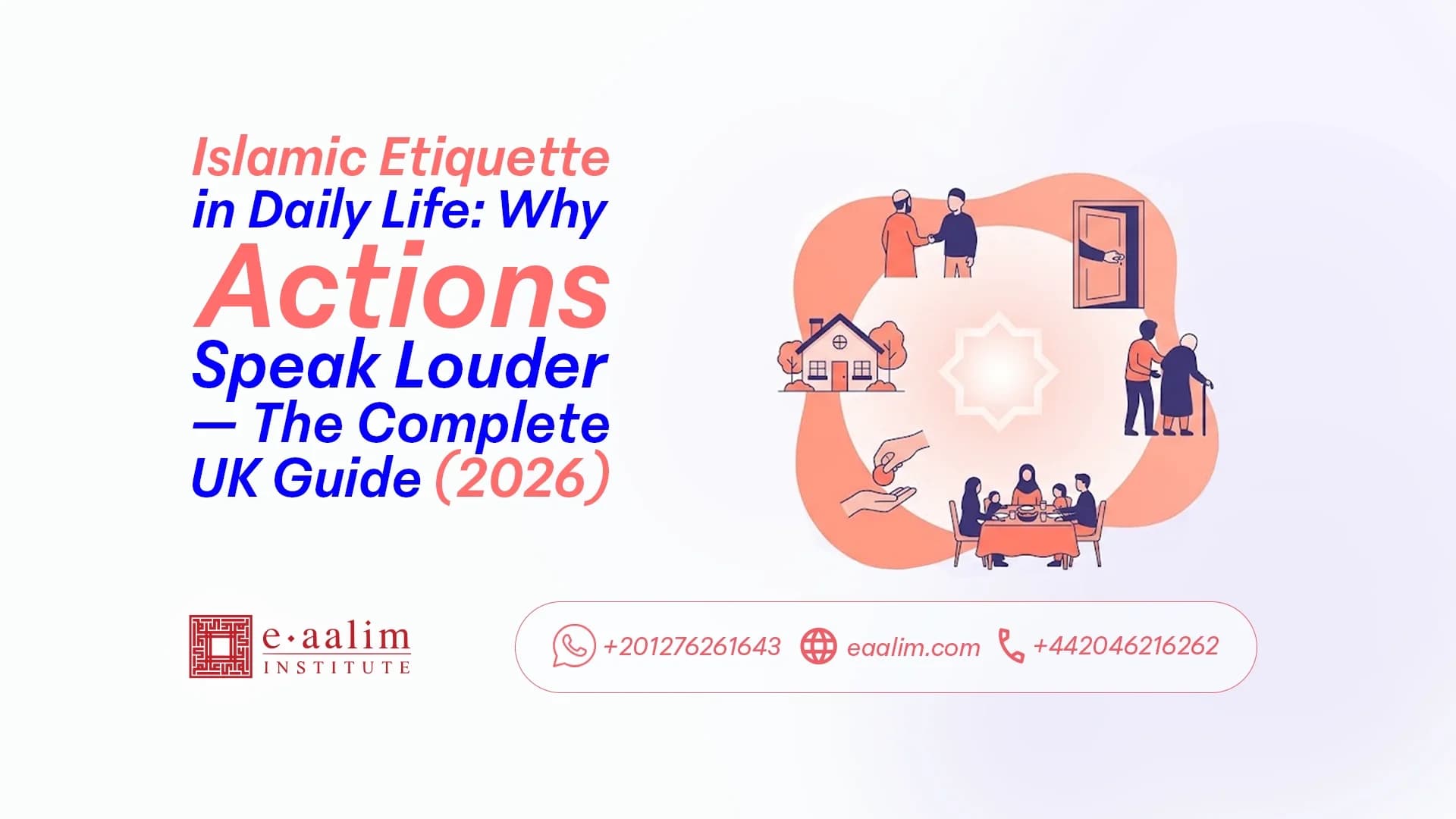
Islamic Etiquette in Daily Life: Why Actions Speak Louder — The Complete UK Guide (2026)
By Eaalim Institute on 5/13/2026 · 14 min read
Islamic etiquette — adab. Also, is the quiet force that turns private belief into a life other people can actually see. When a Companion asked to describe the character of the Prophet ﷺ in a single phrase. Moreover, her answer became one of the most quoted lines in Islamic literature. She said, simply: "His character was the Qur'an." The Prophet ﷺ did not preach Islam on a podium and then return home to a private life that contradicted it. He was Islam — walking, greeting, eating, sleeping, negotiating, and trading in the streets of Madinah. His actions were so consistent with his words that those who watched him from a distance often embraced Islam before he had spoken a single sentence to them.
Furthermore, for British Muslims in 2026. Surrounded by colleagues at work, neighbours on the street, school-gate parents, customers, classmates. And a quiet but constant audience of people who have never knowingly met a practising Muslim. Indeed, this principle has become the most important single lesson of the prophetic example. In the UK today, Islam is judged not by the lectures we share on Instagram but by how we behave at the office printer. How we drive on the M6, how we treat the cashier at Tesco. Importantly, and how we speak about our spouses in public.
This is the discipline the classical scholars called adab — Islamic etiquette. Clearly, this guide explains why Islamic etiquette is the single most powerful da'wah a British Muslim can perform. And offers seven practical pillars of adab that a British Muslim family can put into practice this week.
What is adab in classical Islam?
Additionally, the Arabic word adab is broader than the English "etiquette." Adab refers to the right way of doing every act of life. The right way of eating, of speaking, of entering a home, of greeting a stranger. Besides, of disagreeing with a neighbour, of treating an employee. The classical Islamic tradition produced entire books devoted to it. Certainly, imam al-Bukhari compiled al-Adab al-Mufrad, a stand-alone collection of hundreds of hadiths exclusively on character and conduct. Ibn Muflih wrote the multi-volume al-Ādab al-Sharʿiyyah. Consequently, al-Ghazali devoted a major section of Iḥyaʾ ʿUloom al-Deen to adab. And contemporary Muslim scholars in the UK and beyond continue to teach these books because they form the practical operating system of the believer.
The Qur'an itself frames the principle of integrity between word and action in deceptively simple language. Undoubtedly, Allah addresses the believers directly in Surah al-Ṣaff:
"O you who believe, why do you say what you do not do? It is greatly hateful in the sight of Allah that you say what you do not do." (Qur'an 61:2–3)
These two verses are the foundation of adab. Notably, the believer is not asked to be perfect. He or she is asked to ensure that what is being said with the tongue is being applied with the limbs.
Why adab is the most effective da'wah a British Muslim can offer.
The classical scholars consistently observed that the strongest invitations to Islam in history were not the most elaborate sermons but the most quietly excellent characters. Yemen entered Islam not through warfare but largely through the trade of Muslim merchants whose honesty in the marketplace amazed their customers. In addition, Indonesia, the country with the largest Muslim population on earth today. Entered Islam in significant part through the patient and gentle conduct of Muslim traders who arrived from the Arabian peninsula and India. As a result, modern British history echoes the same pattern. Many of the most committed British converts to Islam describe being drawn not by a public lecture but by a particular Muslim colleague, neighbour. Or shopkeeper whose conduct stood out.
For this reason, the reverse is equally true, and more sobering. A single hostile British Muslim driver shouting at a fellow motorist on the school run. In short, a single Muslim landlord cheating a tenant on a deposit. A single Muslim doctor speaking rudely to NHS receptionists. Also, these will be remembered by their witnesses long after any number of polite Islamic posters at the local mosque. The Prophet ﷺ understood this asymmetry. He told the Companions, in a hadith narrated by al-Tirmidhī. "The believer is not the slanderer, nor the abuser, nor the obscene, nor the foul-mouthed."
Moreover, below are seven practical pillars of adab that British Muslim families can use as a daily self-check.
1. Gentleness in every interaction.
The Prophet ﷺ said, in a hadith narrated by Imam Muslim:
"Indeed Allah is gentle, and He loves gentleness in all matters. He gives for gentleness what He does not give for harshness. And what He does not give for anything else."
Furthermore, gentleness covers tone, volume, word choice, eye contact, and physical demeanour. The British Muslim who walks up to the Tesco checkout, smiles at the cashier, makes eye contact. Indeed, and says "thank you" warmly is performing adab. The Muslim who scrolls his phone, mumbles. Importantly, and walks off without acknowledgement is missing one of the simplest opportunities the Prophet ﷺ ever recommended. He even said, in another hadith preserved by al-Tirmidhi: "Smiling at your brother is a charity."
Clearly, for British Muslim parents, gentleness toward children is itself the strongest teaching tool. A father who corrects his son's tajweed with patience and warmth has taught the son both the rule and the manner of teaching it. Additionally, a father who corrects the same mistake with sharpness has taught the son how to humiliate a future student.
2. Cleanliness, neatness, and appropriate dress.
The Prophet ﷺ said: "Cleanliness is half of faith" (Muslim). Besides, for British Muslims, this is not merely about ritual purity. It includes the physical presentation a Muslim offers to the public. Certainly, clean clothes, brushed hair, fresh breath, a tidy car, a presentable house when guests arrive. The Prophet ﷺ himself was meticulous about his appearance, his perfume, his hair-care. Consequently, and the cleanliness of his clothing.
For British Muslim men in offices, this means turning up to meetings dressed appropriately rather than carelessly. Undoubtedly, for British Muslim women in any public setting. Modesty and neatness together produce the image the Qur'an describes when it speaks of the wives of the believers and the daughters of the believers in Surah al-Ahzab. A Muslim whose external presentation is neglected reflects poorly on the religion he or she claims. Notably, regardless of the inner sincerity. Adab demands that the outside match the inside.
3. Reading your audience with wisdom.
The Companion ʿAli ibn Abi Talib(RA) appears to have said. "Speak to people according to the level of their understanding." The Prophet ﷺ himself was the master of this. In addition, with Bedouins he spoke in plain Arabic of the desert. With senior tribal chiefs he negotiated with diplomatic precision; with children he sat down to their eye level. As a result, he did not deliver the same message in the same register to every audience.
For British Muslim parents at the school gate. For this reason, this means recognising that the right way to invite a non-Muslim parent to Islam is not by quoting Arabic terms unfamiliar to them. But by living the values of honesty, kindness, and steady decency in front of them across school years. For British Muslim professionals, this means recognising that workplace conversations about Islam are best held only when invited. In short, and best framed in the language and references that the listener already shares. Reading the audience is not compromise. Also, it is the Sunnah of the Prophet ﷺ himself.
4. Neighbour relations.
Allah commands in Surah al-Nisaʾ:
"Worship Allah and associate nothing with Him, and to parents do good. And to relatives, orphans, the needy, the near neighbour, the neighbour farther away..." (Qur'an 4:36)
The Prophet ﷺ said, in a hadith narrated by Bukhari and Muslim. "Jibrīeel kept urging me about the neighbour until I thought he would inherit from him." The classical scholars derived from this hadith that the rights of the neighbour are second only to the rights of the immediate family.
Moreover, for British Muslim families in a UK terrace house, a Manchester semi-detached. Or a London flat, the neighbour is a daily test. Furthermore, the neighbour hears your music; the neighbour sees your bins. The neighbour notices when you visit and when you do not. Indeed, the British Muslim who knows the names of every neighbour on the street. Who takes a small Eid sweet around to each door. Importantly, who shovels their elderly neighbour's path during a winter storm. Thisi s performing one of the most consistent forms of da'wah the Prophet ﷺ ever taught. The Muslim whose neighbours do not even know they live next door to a Muslim is missing the prophetic standard entirely.
5. Small physical acts of kindness.
The Prophet ﷺ said, in a hadith narrated by Bukhari and Muslim. "Even removing a harmful object from the path is charity." The Islamic ethic of small physical kindness. Clearly, holding a door, offering a seat to an elderly passenger on the Tube. Helping a stranger lift a pram up the stairs at a UK railway station. Additionally, is not optional spiritual decoration. It is the daily fabric of adab.
Besides, these small acts, accumulated across a British Muslim's lifetime, are visible. They are remembered. The non-Muslim colleague who sees a Muslim coworker quietly help an injured stranger on the way to the bus stop will form an impression of Islam that ten Friday khutbahs delivered to a different audience would not have achieved. Certainly, adab, said the classical scholars, is the silent sermon of the believer.
6. Sustainable effort over burst enthusiasm.
The Prophet ﷺ said, in a hadith narrated by Bukhari and Muslim. "The most beloved deeds to Allah are the most consistent ones. Consequently, even if they are small." Adab is not a one-off performance. It is a daily, weekly, monthly habit that grows over decades. The British Muslim who is exquisitely well-behaved for a fortnight after Ramadan and then quietly returns to harshness and impatience for the rest of the year has misunderstood the principle.
Undoubtedly, the Companions of the Prophet ﷺ established adab as a routine. They did not exhaust themselves with bursts of effort. Notably, they lived gentle, kind, and honest lives steadily, across years, without burnout. For British Muslim parents teaching adab to children, this is the most important model. In addition, a calm, consistent example performed every day in front of children outweighs every dramatic lecture given to them once a year.
7. Living what you preach.
The seventh and most foundational pillar returns to the Qur'anic verse with which this article began. The British Muslim who calls others to Islamic punctuality but is consistently late. Who calls others to financial honesty but cuts corners on his own VAT return. Who calls others to prayer but does not pray ʿAṣr because of work. As a result, that British Muslim is failing the seventh pillar of adab. The Prophet ﷺ described the punishment of such a person in stark terms in a hadith narrated by Bukhari and Muslim:
"A man will be brought on the Day of Judgment and cast into the Fire. His intestines will pour out, and he will be made to circle around them. The people of the Fire will say to him, 'O so-and-so, what is wrong with you? Did you not used to command good and forbid evil?' He will say. 'Yes, I used to command good and not do it. And forbid evil and do it.'"
For this reason, the remedy is not to stop calling to good. The remedy is to start living it. In short, for British Muslims, this means a quiet weekly self-audit. Have I, this week, said anything to my spouse, my children, my colleagues. Also, or my online audience that I myself have not lived?
A British Muslim weekly adab self-audit.
For British Muslim families who want a structured weekly check. Moreover, here is a table that has worked for many UK households as a Friday-evening review:
Pillar — Question to ask yourself.
Furthermore,
Gentleness: Was there a person this week I spoke to harshly when gentleness would have worked?
Cleanliness: Did I represent Islam well in my physical appearance and personal hygiene this week?
Indeed,
Audience: Did I speak to anyone in a register inappropriate for their level. Too jargon-heavy, too abrupt, too dismissive?
Importantly,
Neighbours: Did I greet my neighbours this week? Did I notice any need I could meet?
Clearly,
Small acts: Did I perform at least one unprompted small act of kindness for a stranger?
Sustainability: Am I running on burst effort or steady habit?
Additionally,
Living it: Is there a single piece of advice I gave this week that I am not personally living?
Done consistently for a year. Besides, this simple seven-line audit changes a British Muslim household more deeply than almost any other single discipline available in modern UK Islamic education.
A new course: the classical Book of Islamic Etiquette for British Muslim families.
This article has covered seven practical pillars of adab. Certainly, the classical Islamic tradition has hundreds more. And rather than learning them piecemeal from social media. Consequently, the proper way to study them is through the structured books that the early scholars compiled exactly for this purpose. The two most accessible and authoritative are Imam al-Bukhari's al-Adab al-Mufrad ("The Book of Singular Manners") and Ibn Muflih's al-Ādab al-Sharʿiyyah. Together, they form the most complete map of Islamic etiquette ever assembled.
For British Muslim families who want to study these books properly. Eaalim is opening a brand-new course in our Islamic Studies section. The Online Book of Islamic Etiquette Course UK. The course is a structured live one-on-one programme taught in English by Al-Azhar certified teachers on UK GMT/BST time slots. Walking British Muslim families and adult learners through the classical adab literature chapter by chapter. The curriculum includes:
Selected chapters from al-Adab al-Mufrad. Bukhari's hadith collection on character, with English-language explanation of each hadith and its modern UK application.
The adab of the tongue. Speech, silence, listening, disagreement, and the etiquette of online communication for British Muslims.
The adab of relationships. Parents, spouses, children, neighbours, employers and employees, with case studies drawn from UK workplace and family life.
The adab of food, dress and the home. Entering and leaving, hosting guests, eating with the right hand, dressing appropriately for UK contexts.
The adab of public life. Driving on UK roads, queuing, paying taxes, voting, and the broader Islamic etiquette of being a British citizen.
A weekly self-audit, like the one above, that students can use for life.
The course pairs particularly well with our existing online Islamic Etiquette (Adab) Course UK. Which provides the broader practical introduction. Many British Muslim families take both. The introductory course first, and then the deep-dive Book of Islamic Etiquette course afterwards. Building a complete classical curriculum across nine to twelve months.
To register your interest. Or to book a free trial lesson with one of our Al-Azhar certified teachers. Fill in the booking form on our site and mention "Book of Islamic Etiquette course" in the message. We will confirm a UK time slot. Send the lesson plan for the first four weeks, and pair your child or yourself, if you are an adult learner — with the right teacher for your level.
Until the course opens for public enrolment. We encourage British Muslim families to use this article as a starting point. Print the seven pillars on a small card. Put it on the kitchen fridge. Read it together as a family every Friday evening. The Prophet ﷺ did not need to preach Islam onto the British map. He needed to live it. Fourteen centuries later, the same is still true.
Start your journey with Eaalim today!
Start 2 Free Trials


 Share
Frequently Asked Questions
Adab is broader than the English word "etiquette." It refers to the right way of doing every act of life — eating, speaking, entering a home, greeting a stranger, disagreeing with a neighbour, treating an employee. The blog notes the classical tradition produced whole books on it, including Imam al-Bukhari's al-Adab al-Mufrad and Ibn Muflih's al-Adab al-Shar'iyyah. It describes adab as the practical operating system of the believer, rooted in the Qur'anic command (Surah al-Saff 61:2–3) against saying what you do not do.
The blog explains that throughout history the strongest invitations to Islam were not elaborate sermons but quietly excellent characters — Yemen and Indonesia entered Islam largely through the honesty of Muslim traders, and many British converts describe being drawn by a particular Muslim colleague or neighbour. When Aisha (RA) was asked to describe the Prophet ﷺ, she said "His character was the Qur'an." The reverse is also true: a single hostile or dishonest Muslim is remembered long after any number of posters at the mosque.
The blog sets out seven: gentleness in every interaction (the Prophet ﷺ said Allah loves gentleness and gives for it what He gives for nothing else); cleanliness and appropriate dress; reading your audience with wisdom; good neighbour relations (Jibril urged the Prophet ﷺ about the neighbour until he thought he would inherit); small physical acts of kindness; sustainable effort over burst enthusiasm; and living what you preach. It frames these as a weekly Friday-evening self-check for families.
The blog cites a hadith in Bukhari and Muslim in which a man is cast into the Fire and his intestines pour out as he circles them; when asked, he admits he used to command good without doing it and forbid evil while doing it. The lesson is that the remedy is not to stop calling to good, but to start living it. The blog recommends a quiet weekly self-audit asking whether you have said anything to family, colleagues or an online audience that you have not personally lived.
