


Islamic Studies Classes for Children with Assessment and Support
By Eaalim Institute on 11/4/2026 · 13 min read
For Islamic studies classes for children, lesson length depends on the programme. One course format is designed around lessons of 10 to 20 minutes, giving children a focused introduction without making each session feel too long.
It’s understandable to want Islamic studies classes for children that fit around school, family life and a child’s attention span, while leaving room for questions and steady progress. A focused lesson can be a helpful starting point, but the teacher’s explanations and individual support matter just as much.
This guide explains how lesson length, teaching approach, assessment, homework and parental involvement shape a child’s learning experience in the UK. You’ll also find practical ways to think about inclusive support, so lessons can feel manageable and meaningful at home as well as in class.
Key Takeaways
Lesson length varies by programme; one children’s course is designed around sessions of 10 to 20 minutes, offering a useful example of a focused lesson.
Regular feedback can help parents understand a child’s progress and support learning at home; one programme shares performance feedback every five weeks.
Stories and practical activities can make topics such as the Five Pillars easier for children to explore and remember.
Inclusive teaching starts with attention to each child’s needs, learning pace and comfort asking questions.
When considering a class, look for clear information about teaching, assessment and safeguarding, so you can understand how your child will be supported.
Table of Contents
Accessible Quran and Islamic studies teaching
Accessible teaching gives each idea a clear starting point, then builds learning through explanation, practice and review. A short Quran exercise can begin a study routine; one example uses 10 minutes for focused Quran practice. Another online Islamic studies course is designed for lessons of 10 to 20 minutes, showing how a compact session can leave space for one topic and a recap.
Academic skills can grow alongside religious learning. A teacher might introduce the Arabic word salah, explain its meaning in English, then invite a child to use it in a sentence. This supports vocabulary, listening and comprehension. A short recap helps children remember how the term connects with Islamic values, while drawing a key idea or retelling it in their own words offers another way to show understanding.
Quranic recitation can progress from listening to careful repetition. A child might first hear a short passage, follow the written Arabic, then practise a phrase at a manageable pace. The teacher can model pronunciation and invite another attempt instead of expecting unfamiliar sounds to be mastered immediately. Practising short sections makes letter sounds and rhythm easier to notice, while repetition builds confidence without turning recitation into a race.
Lesson structure matters, too. A teacher can introduce one concept, give a practical example, then ask the child to explain it back. A lesson about kindness, for instance, might connect the idea to sharing a toy or helping a sibling. Linking religious teaching to familiar experiences helps children understand how values guide everyday choices. A brief question at the end can show which points need further explanation.
To enrol, choose a suitable class and complete the enrolment process with details such as your child’s age, previous learning, preferred language and learning support needs. Materials depend on the course. A Quran, notebook and pencil may be useful, and online lessons require a suitable device and internet connection.
Before the first lesson, gather any materials in one place and agree on a quiet study routine. With a Quran, notebook and pencil, a child can practise reading, note new vocabulary and write down questions for the next session. Starting with one small task, such as revisiting a phrase, gives the teacher a clear basis for adjusting the pace and supporting progress.
Assessment, homework and parental involvement
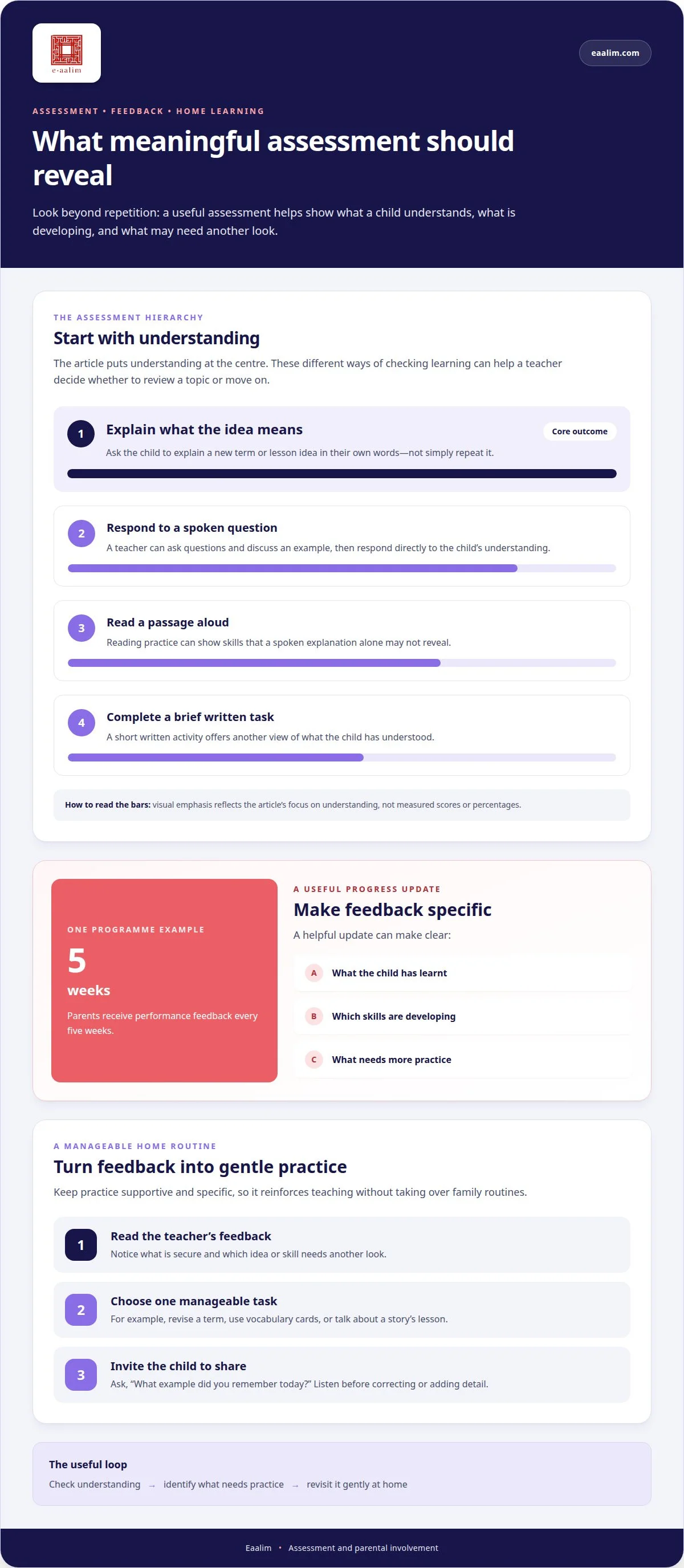
Assessment is most useful when it shows what a child understands, not just what they can repeat. In an Islamic studies course, a teacher might ask a child to explain a new term, then revisit it in the next lesson. Spoken questions, reading practice and a brief written task each reveal different skills. Together, they help the teacher decide whether to review a topic or move on.
Clear interaction matters in online lessons. A child can read a passage aloud, answer a question and discuss an example with the teacher in a live session. The teacher can respond directly to pronunciation or understanding, rather than relying only on a worksheet. A simple follow-up, such as explaining one lesson idea to a parent, can make remote learning more engaging and connect it with home life.
Feedback gives parents a useful view of progress. In one course format, parents receive performance feedback every five weeks. A helpful update can describe what the child has learnt, which skills are developing and what needs more practice. For example, if a child understands a story’s values but struggles to recall its key terms, parents can reinforce those words in everyday conversation.
Practice between lessons should reinforce teaching without taking over family routines. A short review, a few vocabulary cards or a discussion about kindness can keep learning active. Parents can ask, “What example did you remember today?” and listen before correcting or adding detail. This gives the child room to explain and helps adults notice when an idea remains unclear.
Weekend madrasa classes often follow a set timetable and offer face-to-face learning. Mosque or community centre programmes can bring children together in a shared setting. Online programmes avoid the journey and can fit more easily around school and family routines. Formats also differ in teacher contact, group size and assessment, so consider which setting best suits your child’s needs.
Parents can support progress with a simple routine: read the teacher’s feedback, agree on one manageable practice task, then ask the child to share what they learnt. Keep the task specific, such as revising a term or explaining a story’s lesson. If science features in schoolwork that week, invite the child to compare how observation and reflection support learning, while keeping religious ideas distinct and accurately taught.
Islamic Studies curriculum and sunnah pedagogy
A well-sequenced curriculum moves from familiar ideas towards more detailed understanding. A lesson about the Prophet might begin with a story, then explore a central value such as patience or kindness. Children can connect that value to family or community life. This step-by-step approach helps them see how religious ideas relate to everyday choices.
Practical activities can make abstract topics easier to remember. For a Five Pillars craft, label five pillars: Shahadah, Salah, Zakah, Sawm and Hajj. Children can name each pillar, discuss its meaning and put them in sequence. The activity combines speaking, listening and recall, while helping the teacher spot which terms need revisiting.
Arabic learning can accompany Islamic studies without requiring children to understand every word at once. A teacher might introduce an Arabic term, explain its meaning in English, then use it in a familiar example. A Dua Jar activity can prompt practice by adding a new dua each day. Families and teachers can revisit earlier duas as new ones are added.
Sunnah-inspired teaching can connect values with everyday actions rather than leaving them as definitions in a book. For example, a kindness chart can invite children to record a good deed each day for a week. They can then choose one example to describe and discuss how it helped someone. This links reflection with behaviour and gives children a practical way to talk about what they have learnt.
For a child with special educational needs and disabilities, a curriculum may need adjustments to its pace, language or activities. A teacher could break a longer topic into smaller steps, use picture prompts for a key word, or allow an oral answer instead of written work. In a SEND madrasah or other setting, a tailored plan can make expectations clearer by identifying the child’s strengths, support needs and meaningful next steps.
Progression should build on understanding, not simply add more material. A child might first recognise the names of the Five Pillars, then explain their meanings, then connect one pillar with a real-life example. Teachers can review familiar content before introducing a new idea, helping children see how lessons fit the wider curriculum. After a lesson, parents can ask one focused question, such as which value the child would like to practise.
Inclusive and specialist Islamic classes in the UK
Inclusive teaching starts with the individual child, rather than expecting everyone to learn in the same way. A child who finds spoken instructions difficult might benefit from a visual timetable, while another may need more time to answer. These adjustments support a foundation in Islamic learning without diminishing the subject or the child’s place in the class.
For a child with additional learning needs, useful support can be practical and specific. A teacher might divide a lesson about prayer into smaller steps, use picture prompts for each action and revisit the steps calmly. Short spoken answers, drawing or supported reading give children different ways to show understanding. Parents can share what helps at home or school, such as clear routines or reduced background noise.
Language also shapes participation. A child most comfortable speaking English may need unfamiliar Arabic terms explained clearly and repeated in context. A teacher can introduce a term, explain its meaning and invite the child to use it in a sentence. This supports understanding without assuming Arabic fluency is necessary to begin learning about Islam.
Lessons about the Prophet Muhammad can connect stories with values children recognise, such as patience, kindness and honesty. An inclusive teacher can invite children to reflect by speaking, writing or drawing. For example, a child might describe one way to show kindness to a classmate. This encourages thoughtful participation without asking children to share personal beliefs or experiences they prefer to keep private.
Parents should expect a clear safeguarding approach and understand how staff are checked, supervised and supported when teaching children. DBS means Disclosure and Barring Service. Find out whether relevant staff have appropriate DBS checks, how concerns are reported and who handles them. A check is one part of safeguarding, not a substitute for clear boundaries, suitable supervision and a process for responding to concerns.
Practical arrangements can make an inclusive lesson feel more predictable. Before class, explain what the child will study, who will teach it and how they can ask for help or a break. A familiar opening routine, such as a short reflection before a topic on prayer, can ease the transition. If the child uses communication aids or other learning support, agree how the teacher can include them in activities.
A supportive class does not ask every child to show learning in one way. It combines clear teaching, respect for individual needs and thoughtful safeguarding, helping Muslim children and their classmates explore religious ideas with care. Parents can look for specific examples in the class’s approach: accessible explanations, respectful discussion and a clear route for raising a concern.
How can I check whether a UK Islamic studies teacher or class is qualified and safe?
Look for evidence of subject knowledge and teaching ability. A teacher should be able to explain how they teach Quranic recitation, Islamic beliefs and children’s questions. For example, they might describe how a learner listens to a short passage, practises it and receives correction. Clear explanations help parents understand what their child will study and how learning is supported.
Relevant qualifications may relate to Islamic studies, Quran teaching, Arabic or education, depending on the teacher’s role and course content. A teacher leading recitation needs suitable Quran knowledge; someone teaching Islamic history should explain sources and context clearly. Practical teaching experience matters too, particularly the ability to adapt explanations to a child’s age, language and learning needs.
Safeguarding involves more than a single check. A DBS check is one part of a wider approach; clear conduct rules, appropriate supervision and a way to raise concerns matter too. For online lessons, parents should understand how the teacher communicates with a child, how lessons are arranged and how to share concerns. A straightforward policy explains boundaries in plain language.
Consider the lesson structure as well as the teacher’s credentials. A useful introduction explains the format, curriculum, assessment and practice expectations. For example, a teacher might describe how they respond when a child struggles with an Arabic term or needs a topic explained differently. This gives parents a clearer picture of teaching than a list of qualifications alone.
A practical review can focus on a few areas:
Teaching: Can the teacher explain a topic in child-friendly language and give a relevant example?
Safeguarding: Are conduct expectations, supervision arrangements and reporting routes explained?
Learning: Is there a clear way to discuss progress, questions or a child’s support needs?
Communication: Do parents know how lesson arrangements and updates are handled?
Pay attention to how these details are explained. Clear, consistent information about lesson structure and safeguarding makes expectations easier to understand. Parents should know whom to contact with a concern and how learning feedback is shared. Keep these details together so your family can refer to them as the course progresses.
For families seeking structured online learning, explore online Islamic studies learning as one option. A well-organised course should make its teaching approach and learning support understandable, helping parents follow their child’s experience with confidence.
Eaalim: Online Islamic studies courses
Eaalim offers one-to-one online Islamic studies classes for children, with live lessons tailored to each learner. This can suit families looking for individual teaching that responds to a child’s needs rather than a group setting. Eaalim also offers online Quran courses and Arabic classes for families whose goals include Quran study or Arabic alongside Islamic studies.
Consider these courses if you want your child to learn online with an instructor in an individual lesson. The right starting point depends on what your child is ready to study and which subject matters most to your family. Explore Eaalim’s online classes to find a suitable focus for your child.
Choose a learning rhythm that can grow with your child
A child’s interests and confidence can change as they encounter new ideas, so choose a learning routine that feels sustainable for your family. Consider when your child is most ready to listen, what helps them ask questions and how learning can fit alongside school and home life. These practical choices can make Islamic studies classes for children a steady part of the week, rather than another pressure on a busy schedule.
You do not need to have every detail settled before exploring an option. Start with the subject your child is curious about, then consider how individual online teaching could support learning at home. Eaalim offers online study for children and families looking for a personal approach to Islamic learning.
Contact Eaalim about children’s classes to discuss a suitable next step for your family. With a clear aim and a gentle routine, your child can approach their learning with curiosity and care.
Start your journey with Eaalim today!
Start 2 Free Trials


 Share
Frequently Asked Questions
Lesson length depends on the course and its teaching format. A focused session might cover a reading passage, a new concept or guided practice, with time to review before finishing. A useful pace depends on the topic, the child’s age and how long they can stay engaged. Ask how the course structures lessons and supports a child who needs more time with a particular skill.
Eaalim offers individual online tuition in Quran, Arabic and Islamic studies for children and adults. For a child, one-to-one teaching gives space to focus on their questions and current learning needs. A parent might choose Quran lessons for recitation or Islamic studies to develop understanding of beliefs and practice. Choose the subject that best matches the learner’s goals.
Children can study Islamic beliefs, history and practice through online tuition, with Quran and Arabic available as separate subjects. Eaalim provides Islamic studies lessons individually online, not in group classes. A family interested in Islamic history can choose that subject, while a child developing Quran reading can focus on Quran tuition. The right course depends on the child’s learning aim.
Eaalim’s online classes serve families across the UK, so learning does not depend on living near a teaching centre. A child can join a lesson from home using a suitable device and internet connection. This can help families fit learning around school and other routines. Lessons are delivered remotely, not in person.
Eaalim’s courses are available to learners aged five and up, including children, teenagers and adults. A child’s starting point depends on familiarity with the subject, reading ability and learning goals, not age alone. One child may want introductory Islamic studies, while another is ready to focus on Quran recitation. Consider which subject best matches your child’s current interests.
Subjects include Quran recitation, Tajweed, memorisation, Arabic language and Islamic studies, including Islamic history. Quran lessons focus on reading and recitation, while Arabic classes develop language skills. Islamic studies can cover religious principles, history and practice. Since these have distinct aims, choose the relevant course for your family’s interests rather than expecting every topic in one lesson.
Eaalim delivers individual live lessons online and does not provide in-person classes. Children can learn remotely with an instructor without travelling to a classroom. Have a suitable device and internet connection ready for the session. Online tuition may suit families seeking lessons at home, with teaching focused on one learner rather than a group.
