



Learn Arabic Reading Online with a Trial Class
By Eaalim Institute on 11/13/2026 · 15 min read
You can try an Arabic reading lesson before paying, so you can experience the pace and teaching approach before deciding whether to continue. Learning to read begins with recognising Arabic letters and their sounds, then understanding how their shapes change when joined. If you want to learn Arabic reading online, a trial can show you how these first steps are taught.
It’s natural to wonder whether the script will feel unfamiliar at first or whether lessons will move too quickly. A calm, structured approach gives you time to practise each skill gradually, from identifying letters to reading words aloud, with explanations suited to your starting point.
This guide explains what Arabic lessons may cover, how reading skills develop, and how Classical or Quranic Arabic differs from Modern Standard Arabic. It also looks at how online lessons can support children and adults, and what to notice in a trial so you can decide whether the teaching style and pace suit you.
Key Takeaways
- See how a beginner curriculum can move from recognising letters towards reading, and why learning in a clear sequence helps each step build on the last.
- Find out how a 22-lesson Arabic alphabet course can give learners a structured starting point for script and pronunciation.
- Understand the distinction between Classical (Quranic) Arabic and Modern Standard Arabic, so you can consider which variety best suits your learning aims.
- Explore how reading, writing, listening and speaking exercises can support a more rounded understanding of Arabic.
- Learn what to look for in a trial class, including whether the tutor’s explanations and pace feel comfortable for you or your child.
Can children learn Arabic with you?
Yes. Children can start Arabic as complete beginners, learning the alphabet and its sounds before moving on to joined letters and simple words. Live, one-to-one online lessons let the tutor focus on a learner’s reading rather than divide attention across a group. The same format can suit adults who prefer individual guidance.
For children, a parent can choose lesson times and sit in during the class. That can help make the lesson part of a familiar routine, perhaps after school or at a quieter point in the day. A tutor can introduce one new sound, model it, then invite the child to recognise it in a word. Adults can follow the same sequence at a pace suited to their prior experience.
Lesson titles in English alongside Arabic examples can make a course easier to follow. An English title such as “Joining letters” tells a beginner what to expect, while an Arabic example shows the script being studied. Pairing the two connects familiar instructions with the letter shapes on screen, which is especially useful when a child is still learning to recognise Arabic characters.
Short lessons and quizzes can break practice into manageable steps. A learner might review a small set of letters, match each one to its sound, then complete a brief quiz before moving on. This gives children a clear task and lets adults revisit a difficult sound without restarting a whole unit. A structured alphabet course may divide the work into 22 detailed lessons.
Media-based activities can give each skill a practical example. A short audio clip helps a learner hear a sound, while a labelled picture can connect an Arabic word with its meaning. Captions can support reading along, and a simple recording exercise lets a child practise saying a word. These activities can complement tutor feedback, but they do not replace a live lesson.
Online tutors and self-study apps offer different kinds of support. An app can provide repeatable drills and quizzes, while a live tutor can listen to a learner read and address a specific mistake. Combining the two can give children or adults independent practice between lessons and guided correction during class.
Free apps and websites offer introductory Arabic reading practice, including alphabet charts, audio examples and simple quizzes. They can help learners explore letter shapes before a class, while a live tutor adds interaction that self-study materials cannot provide. For adults in the UK, a suitable course starts at their level, teaches reading in a clear sequence and offers online one-to-one lessons.
For a live online Arabic lesson, use a phone, tablet or computer with internet access. A microphone and speakers or headphones help the learner hear and respond. A camera can support face-to-face interaction, while paper and a pencil are useful for practising letter forms. Any additional software depends on the lesson platform.
Arabic alphabet and pronunciation
Beginners should first recognise each Arabic letter and connect it with its sound, then practise how letters join in words. This sequence helps learners read unfamiliar words without trying to memorise whole sentences at once.
Arabic letters and their forms
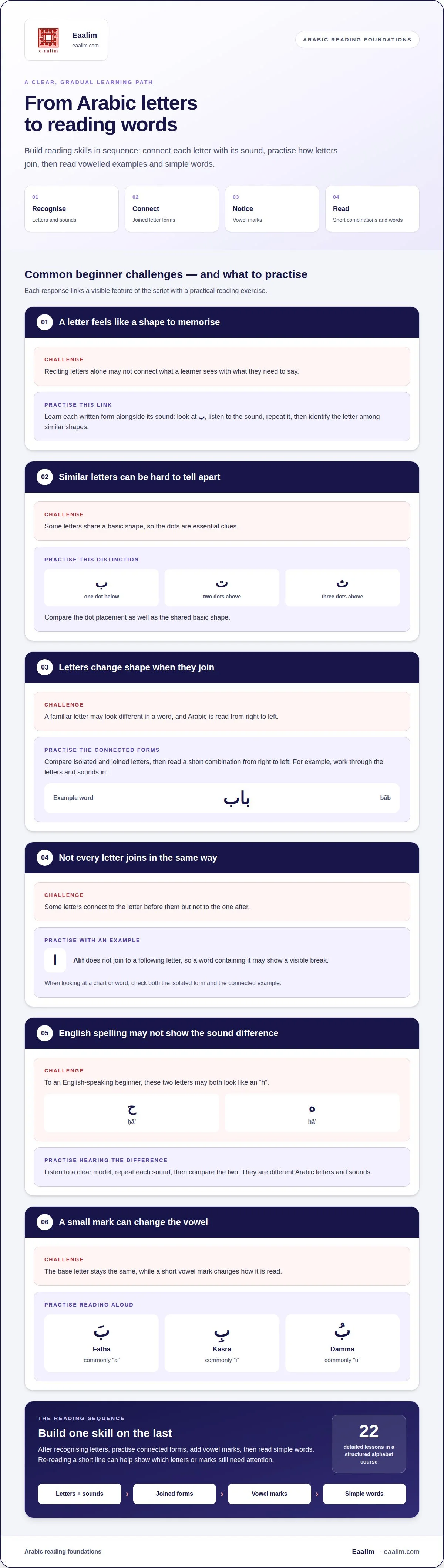
Arabic is written from right to left, and a letter’s shape can change according to its position in a word. A beginner might first meet ب (bā’), then compare how it appears alone and joined to neighbouring letters. Dots matter too: ب, ت and ث share a basic shape, but their dots distinguish them.
Some letters connect to the letter before them but not to the one after. For example, ا (alif) does not join to a following letter, so a word containing it may show a visible break. When studying a chart or lesson, look for isolated and connected forms, clear dot placement, and examples within complete words.
Starting with alphabet instruction
A well-structured first lesson introduces a letter’s written form and sound together. The learner can look at ب, listen to its sound, repeat it, then identify it among similar shapes. This links visual recognition with pronunciation instead of treating the alphabet as a list to recite from memory.
Next, practise joining familiar letters and reading short combinations from right to left. A tutor or course can introduce a word such as باب (bāb), then guide the learner through its letters and sounds. A useful test is whether the learner can recognise the same letters in a new example.
Pronunciation practice should focus on sounds that English spelling cannot represent neatly. For instance, ح (ḥā’) and ه (hā’) are different Arabic letters and sounds, though both may look like an “h” to an English-speaking beginner. Listening to a clear model, repeating each sound, and comparing the two helps build careful habits.
Short vowel marks add another layer. Fatḥa is commonly taught with an “a” sound, kasra with an “i” sound, and ḍamma with a “u” sound. A learner can practise reading بَ, بِ and بُ aloud, noticing how the small mark changes the vowel while the base letter stays the same.
After learning to recognise letters, practise connected forms, then add vowel marks and simple words. This gradual sequence also introduces basic grammar through written examples, without asking beginners to analyse complex sentences too soon. Re-reading a short line can reveal which letters or marks still need attention.
For online practice, ask the tutor to show each letter clearly and model its sound before asking you to read it. A screen-shared alphabet chart can make dots and changing forms easier to inspect. Guided Arabic reading practice can help learners work through these foundations with live instruction.
Do you teach Modern Standard Arabic or Classical (Quranic) Arabic?
Classical Arabic and Modern Standard Arabic are related but distinct varieties. The best fit depends on whether you want to read the Quran and Islamic texts or build broader contemporary language skills.
Classical Arabic is the language used in the Quran and many Islamic texts. Lessons in this variety can connect reading practice with the vocabulary and grammar found in those works. For example, a learner might study a word in a Quranic passage, then examine its form and meaning. This gives reading a purpose beyond recognising individual letters.
Modern Standard Arabic is used in formal communication across Arabic-speaking contexts, including writing and broadcasts. It shares foundations with Classical Arabic, such as the Arabic script and elements of grammar, but vocabulary and conventions differ. A learner who begins with Classical Arabic can carry foundational knowledge into Modern Standard Arabic, while still needing to study its particular usage.
“Quranic Arabic” commonly refers to the Classical Arabic of the Quran. The terms are closely connected, although a course may focus on Quran reading, broader Classical texts, or both. Consider what you want to read: a Quranic verse calls for attention to its wording and recitation, while another Classical text may bring different vocabulary into focus.
Classical logic is another area learners may encounter alongside grammar. It concerns how ideas and arguments are structured, rather than how Arabic letters are pronounced. A lesson might distinguish a definition from a claim, then consider how each part supports an argument. This is separate from beginner reading, so the course level and learning aim should determine when it belongs.
Private lessons and in-company group classes are different teaching formats. In a private lesson, the tutor can focus on one learner’s reading goals and explain a point at an individual pace. Group classes bring learners together for discussion, but participants need compatible aims and levels for the lesson to remain useful. These formats are not interchangeable.
Before choosing a course, match its variety to the reading you want to do. A learner focused on Quranic texts should look for Classical Arabic and relevant Quran vocabulary. Someone aiming to read formal contemporary material may prefer Modern Standard Arabic. If both matter, a clear sequence can establish shared foundations first, then introduce differences in usage and vocabulary.
A tutor can make this distinction practical with a short example from each variety. Compare a Classical passage with a Modern Standard Arabic news sentence, noticing the script, vocabulary and purpose. This comparison helps you understand the course’s focus before committing to a longer learning path.
Reading, writing, listening and speaking exercises
Online lessons can connect four skills through a single Arabic example. A learner might hear a word, read it, copy it, then say it aloud.
Arabic reading and writing instruction
Reading and writing instruction works best when learners can compare what they see with what they write. A tutor can display a short Arabic word, guide the learner through its letters, then ask them to copy it from right to left. This brings letter recognition and handwriting together in one exercise.
For example, a learner could read باب, identify its letters, and practise writing the word on paper. The tutor can point out where each letter joins and where its shape changes. Look for courses that progress from copying familiar forms to writing a word from memory, with time to correct letter placement.
Pronunciation and reading aloud practice
To practise pronunciation online, learners can listen to a tutor model a word, repeat it, then read the same word aloud. The tutor can hear which sound needs attention and model it again. This helps distinguish similar sounds, such as ح and ه, which English spelling may represent in similar ways.
A short passage can bring listening and reading together. First, follow the tutor’s spoken example while looking at the Arabic text. Then read the line aloud, pausing at word boundaries and repeating any difficult phrase. This gives the learner a clear sequence to follow instead of asking them to tackle an unfamiliar passage without support.
Listening exercises can use a recorded word or phrase followed by a simple recognition task. For instance, hear a word, find it among several written choices, then say it aloud. Replaying the audio lets learners notice how one sound differs from another, while the written options connect listening with script recognition.
Speaking practice can begin with a greeting or a familiar classroom phrase. The tutor says the expression, the learner repeats it, then answers a simple prompt using the same words. This supports spoken confidence without taking attention away from reading. It also lets the tutor hear whether the learner can pronounce the words they have just studied.
Short exercises are easier to revisit between lessons. A learner might copy one line, listen to its audio, and read it aloud before the next session. The tutor can then use that example to review letter forms, pronunciation or reading flow. Combining these steps helps learners connect writing with the words they hear and read.
When reviewing an online lesson, notice whether each task has a clear purpose. A useful sequence might move from listening to a word, recognising it in text, copying it, and reading it aloud. This makes progress easier to discuss and gives each exercise a practical place in the learning routine.
Arabic learning curriculum and levels
A clear curriculum takes beginners from recognising written forms towards reading connected text, with each stage building on earlier skills. A 22-lesson Arabic alphabet course offers one example of a structured starting point, although lesson count alone doesn’t show how much practice each learner needs.
At the starting level, learners work on identifying letters, distinguishing similar shapes, and connecting each letter with its sound. They then practise joined forms and short combinations before reading words with vowel marks. For example, a lesson can move from recognising ب to reading it within a word, then identifying it in a new example.
How long does it take to learn to read Arabic? There’s no single timeframe: progress depends on prior familiarity with the script, regular practice, and how quickly a learner recognises letters in connected words. Reading a short, vowelled word is an early milestone; reading unfamiliar text without vowel marks takes further practice.
After the alphabet, a curriculum can introduce short words and sentences, then gradually increase their length and complexity. A useful next step is to read a short passage, identify unfamiliar forms, and revisit any sounds or marks that caused difficulty. Grammar and vocabulary can be introduced through examples, helping learners see how words work in a sentence rather than studying rules in isolation.
Intermediate work may include longer passages and fewer vowel marks. Learners can practise reading a sentence aloud, tracing each word’s letters, then checking whether its meaning fits the surrounding text. This develops attention to context as well as recognition. In Classical Arabic, a course may use Quranic or other Classical examples; Modern Standard Arabic study can use contemporary formal texts.
Levels should describe the skills a learner can practise, not just use labels such as beginner or intermediate. One beginner may recognise letters but need help joining them; another may read familiar words but pause over new vocabulary. A tutor can use a short reading exercise to identify the next useful step, then choose practice suited to that skill. To learn Arabic reading online, look for a sequence that connects each new task to skills already practised.
In a trial class, notice how the teacher responds when you meet an unfamiliar word. A helpful sequence is to identify the letters, sound out the word, and use the surrounding sentence for clues. You can also ask about the next learning milestone, such as moving from vowelled words to a short passage. If you want to learn Arabic reading online, this is a practical way to assess whether the course progression suits your aims.
Eaalim: Online Arabic classes
Eaalim offers online Arabic classes for learners seeking structured support with reading, from first steps in the script to practising connected text. Lessons take place live online, one-to-one, so the tutor can focus on the learner’s level and aims.
If you’re choosing between self-study and tutor guidance, online lessons give you a chance to work through questions as they arise. Eaalim also offers online Quran courses and Islamic studies courses for learners interested in those subjects.
To explore whether online Arabic classes suit your learning goals, contact Eaalim and discuss the next step.
Take your next step with confidence
Bring one clear aim to a trial lesson, such as recognising new words, reading a short passage, or improving pronunciation. This gives you a practical way to experience the teaching approach and consider whether its pace suits your routine. If you’re helping a child begin, think about how Arabic practice might fit into the family’s week.
Choosing to learn Arabic reading online is a personal commitment, and it needn’t begin with a perfect plan. Start with the skill you most want to develop, then use the trial to discuss how lessons could support that goal. Eaalim also offers online Quran courses and online Islamic studies courses for learners whose interests include those areas.
Contact Eaalim to ask about a trial class, and take the first step towards a learning routine that feels right for you.
Start your journey with Eaalim today!
Start 2 Free Trials


 Share
Frequently Asked Questions
Yes, Eaalim offers two free trial lessons before you purchase a subscription, and attendance is required. The first lesson is with one teacher and the second with a different teacher, giving you an opportunity to experience two teaching styles. Use the sessions to discuss your reading aims and notice which explanations help you follow Arabic comfortably before deciding whether to continue.
Yes, complete beginners can start with Arabic letters and progress towards reading words. You don’t need to know the script in advance; a useful first goal is to recognise some letters and distinguish their sounds. For a child or adult who already knows some Arabic, an initial reading exercise can show which forms or combinations need more attention, so lessons start at a suitable level.
The most useful resources combine clear examples of Arabic script with audio and opportunities to practise. Alphabet guides and short quizzes can support independent review, while a live tutor can listen as you read and respond to your pronunciation. Eaalim’s online Arabic classes provide one-to-one tuition in reading, writing and language comprehension. Choose materials that help you revisit unfamiliar letters and words, rather than only memorising translations.
