


Makharij Lessons for Children: How Arabic Letters Are Pronounced
By Eaalim Institute on 10/23/2026 · 14 min read
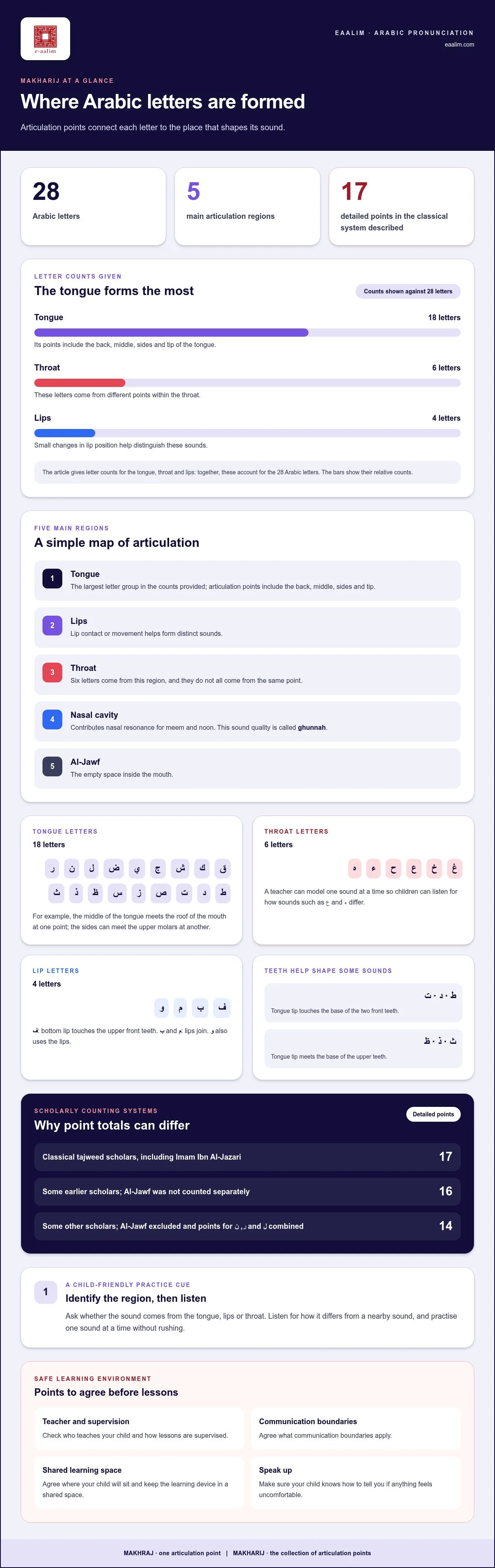
Clear Arabic pronunciation begins with knowing where each sound is formed. In Makharij lessons for children, makharij means the points of articulation used to produce letters: Arabic has 28 letters, with five main articulation regions and 17 detailed points. These include the throat, tongue, lips, nasal cavity and the empty space in the mouth.
It’s natural to want your child to pronounce each letter clearly while keeping practice calm and encouraging. This guide explains how articulation points shape Arabic sounds, why similar-looking letters can sound different, and how children can practise at a manageable pace. A qualified teacher can listen closely, demonstrate a sound and gently guide your child towards the right tongue, lip or throat position. You’ll also learn how individual online Arabic classes can support that learning without making each practice session feel like a test.
Key Takeaways
- Understand the difference between a letter’s makhraj, its point of articulation, and makharij, the collection of those points.
- Learn how changing the position of the lips helps form distinct Arabic sounds.
- Recognise the role of the nasal passage in the sound quality of meem and noon.
- Explore a simple practice approach using a sukoon and a preceding vowel to make a letter’s articulation easier to hear.
- See how a qualified teacher can listen, model sounds and guide a child’s practice at an individual pace.
Which articulation region produces the most letters?
Arabic has five main articulation regions and 17 detailed articulation points. The tongue produces the most letters: 18 of the 28 Arabic letters.
For safety and safeguarding, check who teaches your child, how lessons are supervised and what communication boundaries apply. Before lessons begin, agree where your child will sit, keep the learning device in a shared space, and make sure they know how to tell you if anything feels uncomfortable.
Tongue and lip articulation points
Tongue and lip articulation points are places where these parts meet or move to form particular Arabic letters. They matter because a small change in position can produce a different sound. Children benefit from noticing which part moves.
The tongue articulates 18 letters, including ق, ك, ش, ج, ي, ض, ل, ن, ر, ط, د, ت, ص, ز, س, ظ, ذ and ث. Its points include the back, middle, sides and tip. For example, the middle of the tongue meets the roof of the mouth for one articulation, whilst the sides can meet the upper molars for another.
The lips articulate four letters: ف, ب, م and و. For ف, the bottom lip touches the upper front teeth; for ب and م, the lips join. The sound of و also uses the lips. These positions give children a practical way to compare the letters rather than treating them as interchangeable sounds.
Some tongue positions involve the teeth, too. For ط, د and ت, the tip of the tongue touches the base of the two front teeth. For ث, ذ and ظ, the tongue tip meets the base of the upper teeth. In tajweed, learning these points helps children focus on where a letter begins, not just how it sounds in a familiar word.
Throat articulation
Throat articulation means producing a letter from a specific area of the throat. Six Arabic letters come from this region: غ, خ, ع, ح, ء and ه. Recognising the throat as a separate articulation region helps children distinguish these sounds from letters formed by the tongue or lips.
These six letters don’t all come from the same point. A teacher can model the differences, then invite a child to listen and repeat one sound at a time. For example, comparing ع with ء focuses attention on how each sound is formed, rather than asking a child to memorise a list without hearing the contrasts.
Counting systems explain why descriptions of articulation points can vary. Classical tajweed scholars, including Imam Ibn Al-Jazari, established 17 detailed points, whilst some earlier scholars counted 16 by not treating Al-Jawf as separate. Some other Arabic-language scholars counted 14, excluding Al-Jawf and combining the points for ر, ن and ل.
A useful starting point for a child is to identify the region and sound being practised. Ask them whether a letter comes from the tongue, lips or throat, then listen for how it differs from a nearby sound. This simple comparison links articulation with careful tajweed practice.
The nasal cavity and ghunnah
The nasal cavity has a distinct role in Arabic pronunciation: the letters meem and noon rely on it. In tajweed, the nasal resonance associated with these letters is called ghunnah, a sound quality learners can listen for during recitation.
Nasal resonance and ghunnah
Ghunnah is a nasal sound, not a separate letter or another throat articulation point. Its resonance comes through the nasal cavity, giving meem and noon a quality children can hear when comparing sounds. This distinction matters because the mouth helps shape each letter, while the nose contributes to its nasal resonance.
It can help children to listen for the difference between a nasal sound and one formed elsewhere. Meem and noon are familiar examples: each uses the nasal passage as part of its pronunciation. A teacher can model a sound, then invite the child to repeat it and notice where its resonance seems to carry. The aim is attentive listening, not forcing the sound or making the lesson feel like a test.
Ghunnah is also taught in levels. Tajweed describes five levels of ghunnah, helping learners understand that nasal resonance can vary during recitation. Children can listen to examples, compare them and practise noticing the quality of each sound. The five levels help a teacher organise listening and feedback, rather than treating every meem or noon as identical.
Articulation points work together with a sound’s characteristics. The throat, tongue and lips shape other parts of Arabic pronunciation, while the nasal cavity contributes to meem and noon. Keeping these roles distinct gives a child a clear listening task: identify the letter, attend to its nasal quality, then compare the sound with the teacher’s model.
At home, support practice by asking your child to listen to a short recitation example, identify meem or noon, and describe the sound. Focus on one example at a time, then let them repeat it without rushing. A qualified teacher can help distinguish the letter’s articulation from its ghunnah and guide practice through the five levels.
For children developing Quran recitation, online Quran courses can provide a setting to practise listening to letter sounds with a teacher.
Meaning of makharij and makhraj
Makhraj means the articulation point from which a letter’s sound emerges; makharij is the plural. For Arabic pronunciation, this distinction helps children connect a written letter with the place and manner used to produce its sound.
Arabic has 28 letters, and their production is described through five main articulation regions and 17 detailed points. These regions include the throat, tongue, lips, nasal cavity and Al-Jawf, the empty space inside the mouth. Learning the terms gives a child a simple framework: identify a letter, locate its makhraj, then listen to how the sound differs from another letter.
Descriptions of the detailed points can vary between scholarly systems. Classical tajweed scholars, including Imam Ibn Al-Jazari, established 17 points. Some earlier scholars counted 16 because they did not count Al-Jawf separately. Some other scholars of Arabic language counted 14, excluding Al-Jawf and treating ر, ن and ل as sharing one makhraj.
Al-Jawf is associated with three madd letters: alif madd, wow madd and ya madd. These lengthened sounds come from the empty space in the mouth, rather than from one precise contact point. This helps explain why some descriptions refer to an approximate point for lengthened letters produced through the mouth and throat.
Knowing a makhraj is part of accurate pronunciation, but it is not the whole picture. Correct pronunciation involves makharij together with sifaat, the qualities that further describe how a letter is pronounced. Tajweed brings these elements together: the makhraj identifies where the sound begins, while sifaat describe its characteristics.
Live online lessons can teach makharij effectively when a qualified teacher hears a child’s recitation, models a sound and gives individual feedback. In-person lessons offer face-to-face interaction, while online teaching makes the same listening and correction possible remotely. Lesson quality depends on clear demonstration and attentive practice.
There isn’t one fixed starting age for makharij lessons. A child can begin when they can listen to a short example, repeat a sound and follow gentle guidance. The teacher can adapt the pace to their attention and experience with reading Arabic.
Pronunciation slips often happen when children use the wrong articulation point or treat similar-sounding letters as identical. For example, they may place the tongue incorrectly for ث, ذ and ظ, or confuse a throat letter such as ح with ه. A teacher can isolate the sound, demonstrate the mouth position, then help the child compare and repeat each letter.
Make the idea concrete by asking your child to name the makhraj region for a practised letter, then listen again for its qualities. Comparing one example at a time, such as ح and ه, links terminology with recitation and makes the relevant tajweed rules easier to understand.
Practising Arabic letter sounds
Makharij lessons for children work best when practice links listening with the mouth’s movement. Your child can focus on one letter at a time, using its makhraj as a foundation for clear pronunciation. For example, compare the lip movement for ب with the tongue position for ت, rather than practising both as an undifferentiated pair.
A useful tajweed exercise makes a sound easier to hear. Place a sukoon on the letter being practised, then precede it with an alif or a hamzah carrying a kasrah. The resulting sound can help a child focus on the letter itself. A teacher can model the sound first, listen as the child repeats it and gently adjust their articulation.
Keep listening active. Say a letter, such as ف, and ask your child to identify the parts involved: the bottom lip meeting the upper front teeth. Then contrast it with ب, where the lips join. This small observation task helps children link what they hear with what their mouth does.
Child-friendly activities can make articulation points easier to remember. Try one activity at a time, giving your child space to listen, copy and describe the sound:
- Letter detective: Say ب, م or ف, then ask which lip movement the child noticed.
- Sound sorting: Group example letters by whether they use the tongue, lips or throat.
- Listen and match: Say two sounds, such as ت and د, and let the child point to the matching letter.
- Mirror practice: Let the child observe their lips for و and compare them with the position for م.
There isn’t one daily practice duration that suits every child. Keep each session short enough for your child to listen carefully, and adjust it to their attention, familiarity with Arabic letters and ability to repeat a sound without strain. One carefully heard example is more useful than rushing through a long sequence.
Make repetition purposeful. Choose a single pair, such as ث and س, and listen for the tongue position that distinguishes them. Your child can say each sound, pause, then try again after hearing a clear model. If the difference is difficult to hear, return to one letter and practise its articulation point before comparing the pair again.
Makharij lessons for children can end with a simple reflection: ask your child to explain one thing they noticed, such as which part of the mouth formed ف. This links listening, movement and pronunciation. As familiarity grows, a teacher can build from individual Arabic letters to sounds in words, keeping each new practice step clear and manageable.
Learning makharij with a qualified teacher
A qualified teacher helps a child connect each Arabic sound with its articulation point, then listens to see whether they can reproduce it correctly. This matters because hearing a sound and forming it are different tasks: a child may recognise ث but still need guidance to place the tongue.
Children can learn makharij step by step: first listen to a teacher’s model, then identify the letter’s point, practise the sound alone, and finally hear it within a word or recitation. Moving from one letter to a pair, such as س and ث, gives the child a clear comparison.
A teacher can adapt this sequence to the child’s reading and listening skills, without expecting every letter to become familiar at once. Arabic has 28 letters, while classical tajweed teaching describes 17 detailed articulation points, so a clear order helps children focus on manageable groups.
- Listen: The teacher says one target letter, such as ق, and the child listens before repeating.
- Locate: The child identifies the tongue, lips or throat as the main region involved.
- Practise: The teacher models the sound again, then gives feedback on the child’s attempt.
- Compare: The child listens to a related letter and notices what changes in articulation.
For example, a child working on ح and ه can hear both sounds separately, then practise distinguishing them. An explanation in English may clarify where to place the tongue or how to shape the sound, while a spoken Arabic model lets the child hear the target pronunciation directly.
Assess progress by listening for specific changes rather than judging a whole recitation at once. Ask whether your child can identify a letter’s articulation region, repeat its sound after a model and distinguish it from a similar letter, such as ت and د.
Keep a simple note of the letters practised and the teacher’s focus for the next lesson. For instance, record that your child is working on a tongue point or listening for the difference between two sounds. Comparing these notes over time helps you notice which points feel familiar and where the teacher is directing practice.
Correct pronunciation also involves sifaat, the qualities that describe how a letter sounds alongside its makhraj. A teacher can help your child attend to both, using one example at a time. You can support this by asking what they noticed instead of correcting every sound yourself.
For calm, individual guidance as your child practises Arabic sounds, begin teacher-guided learning.
Eaalim: Online Quran courses
Eaalim offers online Quran courses and online Arabic classes for children learning to recognise and pronounce Arabic letters. A qualified teacher can listen to your child’s recitation, demonstrate sounds and guide practice in a way that suits their individual learning needs. Online Islamic studies courses are also available for families seeking broader learning.
If your child would benefit from teacher-led practice after learning about makharij, an online Arabic class can support their Arabic learning alongside Quran study. Practice can focus on listening carefully, working on letter sounds and building familiarity at a comfortable pace.
Contact Eaalim to discuss your child’s learning needs and the courses available.
Make your child’s next step a steady one
As your child grows more familiar with Arabic sounds, gentle, regular guidance can help make practice part of a calm learning routine. Makharij lessons for children are most useful when your child has room to listen, try and ask questions without feeling rushed. Notice what interests them and share those observations with their teacher.
Eaalim offers online Quran courses, online Islamic studies courses and online Arabic classes, with individual online lessons tailored to children and adults. To explore guided learning for your child, choose a course that fits what they want to learn and the support they need.
Contact Eaalim about children’s lessons and take the next step at a pace that feels comfortable for your family. With patient support, each new sound can become an encouraging part of your child’s learning.
Start your journey with Eaalim today!
Start 2 Free Trials


 Share
Frequently Asked Questions
Articulation is how the speech organs shape a sound as it is produced. In Arabic, a child can notice the difference between a lip sound and one made with the tongue by watching and listening carefully. Ask them to say ب, then ت, and describe what moved. This makes articulation practical: it links a letter’s sound with the mouth movement used to form it.
Listen for the quality of each sound: ء begins with a brief, firm closure, while هـ is softer and breathier. Your child can practise hearing the contrast by saying each letter separately after a clear model, then pausing to compare. Avoid adding an extra vowel or turning the sound into a familiar English equivalent. A teacher can model the difference slowly and correct the child’s attempt.
Makharij al-huruf are the articulation points used to produce Arabic letters during tajweed recitation. The term helps learners discuss where a sound is formed, rather than relying only on how a letter looks on the page. A child can identify a letter, listen to a teacher’s model, then focus on the mouth position needed to reproduce it. Tajweed also considers each letter’s sound qualities.
Qaf ق and kaf ك are different letters because their articulation positions differ, even though both involve the back of the tongue. Qaf is formed farther back, while kaf is produced slightly nearer the front of the mouth. A child who substitutes one for the other can listen as a teacher says the pair slowly, then repeat each separately before comparing them in a short recitation passage.
Al-Jawf is called taqdeeri, or estimated, because its articulation is not identified by one precise point of contact. With alif madd, wow madd and ya madd, the sound flows through the open space of the mouth rather than beginning where the tongue or lips touch another surface. A useful listening exercise is to compare a lengthened madd sound with a consonant formed by clear contact.
In Quran recitation, makharij refers to the places from which Arabic letters are articulated. The term guides readers to notice how each letter begins, helping distinguish sounds that may otherwise be confused. A learner can pause at a difficult letter, listen to a teacher’s model and practise the sound before returning to the full phrase. This keeps the focus on clear recitation.
The five main regions are Al-Jawf, the empty space of the mouth; Al-Halq, the throat; Al-Lisaan, the tongue; Ash-Shafatain, the lips; and Al-Khayshum, the nasal cavity. Each region contains more detailed articulation points, giving 17 in the classical tajweed system. For a child, it can be easier to learn the regional names first, then connect an individual letter with its specific point.
Choose lessons with a teacher who can hear your child recite, demonstrate sounds and give individual feedback. Eaalim connects learners with certified instructors through individual online lessons, and its online Quran courses include recitation and tajweed teaching. Share your child’s current reading experience and learning aims, then follow how the instructor models a sound and responds to your child’s practice during lessons.
