


Memorising Surah Al-Ikhlas: The Seven-Link Method
By Eaalim Institute on 6/3/2026 · 21 min read
Looking for the best way of memorising Surah Al-Ikhlas? This guide explains a proven method for memorising Surah Al-Ikhlas step by step. This guide breaks down the Seven-Link Method. We designed this system specifically for UK adult learners who want to retain Quranic verses effortlessly.
Memorising Surah Al-Ikhlas becomes much easier when you use structured memory links instead of relying on repetition alone.
Memorizing Surah Al-Ikhlas: The Seven-Link Method
Surah Al-Ikhlas is four verses long. It takes less than thirty seconds to recite. Yet Prophet Muhammad ﷺ described it as equivalent to one-third of the entire Qur'an — a description so striking that the Companions asked him about it repeatedly until it was confirmed beyond doubt. A Muslim who recites it three times in a single sitting has, in terms of reward, completed the Qur'an. A Muslim who recites it morning and evening has covered one of the most essential acts of daily dhikr.
Most Muslims who grew up in Muslim households memorised Surah Al-Ikhlas in childhood and have never forgotten it. But adult learners — British Muslims who came to Islam later in life, or who were raised with limited Quranic education — sometimes find that even four short verses present a challenge: the order of the verses, the exact phrasing of verse four, and the distinction between the two uses of the word ahad in verses one and four can blur without a systematic method for fixing them.
This article presents the Seven-Link Method applied to Surah Al-Ikhlas: a structured approach to memorisation that uses seven distinct types of mental connection — verbal, phonetic, thematic, narrative, visual, numerical, and similar-verse links — to build a multi-layered memory of the surah that does not depend on rote repetition alone. The method was developed for Quranic memorisation more broadly and applies with particular elegance to Surah Al-Ikhlas, where the surah's own architecture mirrors the method's categories in almost every verse.
Seven Memory Links for Memorising Surah Al-Ikhlas
Before applying the method to the surah, it helps to understand what each type of link does and why it aids memorisation. Human memory is associative — we remember things not in isolation but in relation to other things. The Seven-Link Method exploits this by giving each verse and each transition between verses multiple types of anchor, so that forgetting requires forgetting all of them simultaneously.
Verbal links (1) are connections formed by the repetition or derivation of actual words across verses. When the same word appears in verse one and verse four, or when two words in the same verse share the same root, the language itself creates a bridge between them. Verbal links are among the most reliable because they are intrinsic to the text — they cannot be removed or altered.
Phonetic links (2) are connections formed by sound: rhyme, rhythm, or the repetition of distinctive sounds at the ends or beginnings of verses. The Qur'an uses phonetic architecture extensively, and Surah Al-Ikhlas provides one of the clearest examples in the entire Qur'an. Phonetic links are particularly valuable for recitation, because the ear confirms the connection even when the mind is uncertain.
Thematic links (3) are connections formed by meaning — the logical or theological relationship between ideas across verses. In Surah Al-Ikhlas, the movement from affirmation to negation is a thematic structure that provides a conceptual backbone for the surah's four verses. If you know the thematic movement, you know the order of the verses even if you momentarily forget the exact words.
Narrative or contextual links (4) are connections formed by the story or occasion of revelation — the historical or dramatic context in which a verse was revealed. Knowing that Surah Al-Ikhlas was revealed as a direct reply to the polytheists' demand that the Prophet ﷺ describe his Lord's lineage gives the surah's opening word — "Say" — a dramatic, situational anchor that makes it virtually impossible to forget.
Visual links (5) are connections formed by mental imagery — pictures, scenes, or spatial arrangements that encode the verse's meaning in a form that is easier for the visual memory to retain. The visual film technique, described at length below, builds a four-scene mental movie of the surah that can be replayed when the verbal memory is uncertain.
Numerical links (6) are connections formed by numbers — the number of verses, the frequency of key words, or the surah's rank or significance in terms of a specific numerical tradition. Knowing that Surah Al-Ikhlas has exactly four verses, and that the Prophet ﷺ said it equals one-third of the Qur'an, gives the learner a numerical framework that confirms when the surah is complete and establishes its importance.
Similar-verse links (7) are connections formed by noting unique or distinctive features of a verse — elements that do not occur elsewhere in the Qur'an and therefore cannot be confused with anything else. These are particularly valuable for fixing unusual words or expressions that might otherwise feel arbitrary. E-aalim is an online educational platform and institute. E-aalim teaches the holy Quran, Arabic and Islamic studies.
Before memorising Surah Al-Ikhlas, read the entire surah aloud several times to become familiar with its rhythm and structure.
The Text of the Surah
{Say, "He is Allah, [who is] One — Allah, the Eternal Refuge — He neither begets nor is born — Nor is there to Him any equivalent."}
(Al-Ikhlas 112:1–4)
Four verses. Thirty words in Arabic. And within them, one of the most concentrated theological statements ever delivered to humanity — the complete definition of divine oneness, covering positive attributes (He is One; He is the Eternal Refuge) and negative attributes (He does not beget; He is not born; He has no equal) in a package so compact that the whole surah can be held in a single breath.
The Occasion of Revelation: Narrative Link (4) for the Whole Surah
One of the most powerful memory anchors for Surah Al-Ikhlas is the story of why it was revealed. The polytheists of Mecca, or according to some narrations a group from among the People of the Book, came to the Prophet ﷺ with a challenge: describe your Lord's lineage to us. Tell us His ancestry — who was He born from, and who does He beget?
This was not an innocent theological question. It was a challenge shaped by the questioners' own framework: their gods had parents, siblings, children, and genealogies. They assumed that any divine being worthy of the name would have a similar structure. The question was designed to force the Prophet ﷺ into either providing an answer in those terms (which would have been false) or admitting he could not answer (which they would have taken as a concession).
Allah's response was Surah Al-Ikhlas — and its opening word tells you everything about how to understand it. Qul — "Say." Not "explain," not "argue," not "reason with them." Simply: say. The divine answer was so complete, so precise, and so beyond the questioners' framework that it required no argument, only proclamation.
This narrative context fixes the opening of the surah in a way that rote repetition cannot. You are answering a question. The surah begins with "Say" because there is a questioner. Whenever you begin Al-Ikhlas, you are the Prophet ﷺ receiving a revelation and being commanded to deliver it. The drama of the occasion is built into the first word.
Overall Structure: The Two Halves
Before examining the verses one by one, the most important structural feature of Surah Al-Ikhlas needs to be established as a thematic link (3) that governs everything else.
The surah divides into two perfectly balanced halves:
Verses 1–2 (Affirmation of perfection): He is Allah, One. He is the Eternal Refuge.
Verses 3–4 (Negation of deficiency): He does not beget. He is not born. He has no equal.
This structure — first affirm the positive, then deny the negative — is the classical Islamic theological method for describing Allah. It is used throughout the Qur'an and throughout the tradition of Islamic theology (kalaam). In Surah Al-Ikhlas, it is compressed into four verses: two verses that state what Allah is, followed by two verses that state what Allah is not.
If you lose your place in the surah, the single question that restores your orientation is: Am I in the affirmation or the negation? If you are before verse three, you are in the affirmation. If you are at verse three or four, you are in the negation. This structural landmark removes the possibility of scrambling the order of the verses once it is internalised.
The Phonetic Frame: All Verse-Endings on "–d"
Surah Al-Ikhlas has one of the most unified sound schemes of any surah in the Qur'an. Every single verse ends with the same sound — the "-d" (dal) consonant:
Verse 1: ahad (One)
Verse 2: al-samad (the Eternal Refuge)
Verse 3: yulad (is born)
Verse 4: ahad (any / one)
The "-d" sound is like a seal that stamps each verse as belonging to this surah and to no other. This phonetic link (2) means that when you recite, your ear is listening for the "-d" at the end of each verse and will immediately signal something is wrong if a verse ends differently. Phonetic memory in Quranic recitation is often the most durable — it operates below conscious attention and catches errors before the mind has time to notice them.
The additional phonetic detail worth noting is the quality of these rhyme words. Ahad and al-samad are both stressed, weighty words — monosyllabic and disyllabic respectively, landing with emphasis at the end of each verse. Yulad (the passive form "is born") brings the same "-d" ending in a different morphological pattern, which gives the rhyme scheme a subtle variety within its unity.
Verse 1: "Say, He is Allah, [who is] One"
Narrative link (4): The word "Say" is the marker of the occasion of revelation — the command to answer the questioners. This fixes the opening of the surah situationally. You are being commanded to deliver an answer. The situation is the memory anchor for the first word.
Phonetic link (2): The verse ends with ahad — the first "-d" ending, opening the rhyme scheme.
Thematic link (3): This verse introduces the first pillar of Islamic monotheism — uniqueness. Ahad is not simply a number ("one" in a series); it is a qualitative statement of absolute uniqueness — there is nothing of its kind, no peer, no partner, no comparable. The first verse places this at the centre of the answer to the questioners' challenge about lineage: the answer to "who is He related to?" begins with "He is absolutely unique."
Transition to verse 2: After establishing His uniqueness, the surah immediately provides His second attribute: what kind of thing is He? He is al-Samad — the Eternal Refuge. The transition is logical: having said He is uniquely One, the surah now says what His unique oneness means in relation to creation.
Verse 2: "Allah, the Eternal Refuge"
Verbal link (1): The Divine Name "Allah" is repeated — connecting directly to verse one ("Allah is One / Allah is the Eternal Refuge"). This verbal repetition is the surah's way of building the definition: the subject ("Allah") is mentioned again, and a second predicate is attached. The repetition of the Name reinforces it rather than being redundant — it carries weight each time it appears.
Similar-verse link (7): The word al-Samad is one of the most distinctive in the entire Qur'an. It appears only here — nowhere else in the Qur'an uses this word. This makes it one of the most secure memory anchors possible: you cannot confuse it with anything else because there is nothing to confuse it with. When you remember Al-Ikhlas, you remember al-Samad, and when you remember al-Samad, you know you are in verse two of Al-Ikhlas.
Phonetic link (2): Al-Samad ends on "-d," continuing the rhyme scheme.
The word al-Samad itself deserves brief attention for thematic purposes. The classical scholars of Arabic defined it as: the one to whom all things turn in their needs, who is self-sufficient and needs nothing from anyone. It describes the asymmetrical relationship between Allah and creation: creation is utterly dependent on Allah for everything, while Allah is utterly independent of creation for anything. This is the second pillar of the affirmation section — after uniqueness, self-sufficiency.
Transition to verse 3: The affirmation is complete (verses 1–2). The surah now pivots to the negation — addressing the specific content of the questioners' challenge about lineage.
Verse 3: "He neither begets nor is born"
Verbal link (1): The Arabic verse uses two forms of the same root — w-l-d — in the same verse: yalid (begets, active) and yulad (is born, passive). This paronomasia — the use of two different grammatical forms of the same root in a single sentence — is one of the most prominent verbal links in the surah. The root echoes itself: beget / born from the same source. In Arabic, this creates an auditory symmetry that English translation can only approximate.
Visual link (5): This is the verse most aided by visual memory. Picture a family tree — an arrow pointing downward (offspring, those who are begotten) and an arrow pointing upward (a parent, the source of birth). Then draw two red lines crossing both arrows out simultaneously. No downward branch from Allah, no upward origin to Allah. The tree is erased. What remains is the single point — the Unique, the Self-Sufficient — with no genealogical connections in any direction. The visual is striking precisely because the questioners were asking for a family tree and the answer is: there is no tree.
Thematic link (3): This verse begins the negation section with its most specific content — the denial of the lineage the questioners were demanding. It is not a general philosophical negation but a targeted answer: you asked about offspring and origin; the answer is that these categories do not apply.
Phonetic link (2): The verse ends with yulad (is born) — the third "-d" ending.
Transition to verse 4: Having negated lineage (parent and offspring), the surah moves to the ultimate negation — no peer, no equivalent of any kind. The online teachers and tutors at E-aalim are dedicated, efficient, experienced, highly qualified Arabic native speaker al-Azhar graduates.
Verse 4: "Nor is there to Him any equivalent"
Verbal link (1): The word ahad returns — the same word that opened the surah in verse one. The surah began with ahad and ends with ahad. This is one of the most elegant verbal frames in the Qur'an: the surah opens and closes with the same word, creating a circular structure in which the beginning and the end confirm each other. The "one-ness" proclaimed in verse one is the same uniqueness that makes any peer impossible in verse four.
Similar-verse link (7): The phrase kufuwan aḥad — the exact combination of "equivalent" followed by "one" — appears in this specific order in no other verse of the Qur'an. Learners sometimes transpose the two words, placing ahad before kufuwan. The similar-verse link fixes the order: the Arabic says "nor is there to Him any equivalent, any one" — kufuwan first, ahad second. The word kufuwan itself is rare, and its combination with ahad in this final position is unique.
Phonetic link (2): Aḥad repeats the very first rhyme sound, sealing the surah with the same "-d" ending with which it opened.
Thematic link (3): This verse closes the negation section — after denying lineage, it denies any peer at all. The surah's negation is now complete: no offspring, no origin, no equal. Combined with the affirmation of verses 1–2 (He is uniquely One; He is the Eternal Refuge), the full statement of divine uniqueness is complete.
Links That Span the Whole Surah
Numerical link (6): The surah has exactly four verses. This is a number worth fixing in memory because the surah's brevity is sometimes a source of confusion — some learners wonder if they have completed it or if they have omitted a verse. Four verses. The hadith that it equals one-third of the Qur'an is authenticated in multiple narrations (including Sahih Bukhari 5013 and Sahih Muslim 811) and provides the numerical anchor: this four-verse surah, which can be recited in under thirty seconds, carries the reward of a third of the entire Book.
Verbal frame (1): The complete verbal frame of the surah is: aḥad (verse 1) … Allāh / Allāh (verses 1–2) … aḥad (verse 4). The surah begins with divine uniqueness, moves through double naming of Allah, and closes with uniqueness again. The verbal architecture is tight and intentional: the same three anchors are distributed across the surah's four verses in a pattern that the mind can hold.
Thematic method (3): The golden rule for recovering orientation if you lose your place: Am I in the affirmation (verses 1–2) or the negation (verses 3–4)? If you are in the affirmation, you are stating what Allah is. If you are in the negation, you are stating what Allah is not. You cannot be in both simultaneously, so this question always produces a clear answer.
The Visual Film: Four Scenes for the Whole Surah
Visual memory is often more durable than verbal memory for adult learners. The following four-scene mental film encodes the entire surah in imagery that can be replayed when the verbal memory is uncertain. A note on method: the imagery here is entirely symbolic. It depicts ideas — uniqueness, self-sufficiency, the negation of lineage, the negation of a peer — not the Divine Essence itself, which cannot be represented in any image.
Scene 1 — Verse 1: You are standing before a questioner who demands to know about your Lord's lineage. You are commanded: "Say." As you speak, the meaning takes visual form: a single point of light in the middle of a vast, dark expanse. Everything around it dims and fades until only "One" remains — a single luminous point, incomparable, uncontestable.
Key image: The number 1, shining alone in darkness.
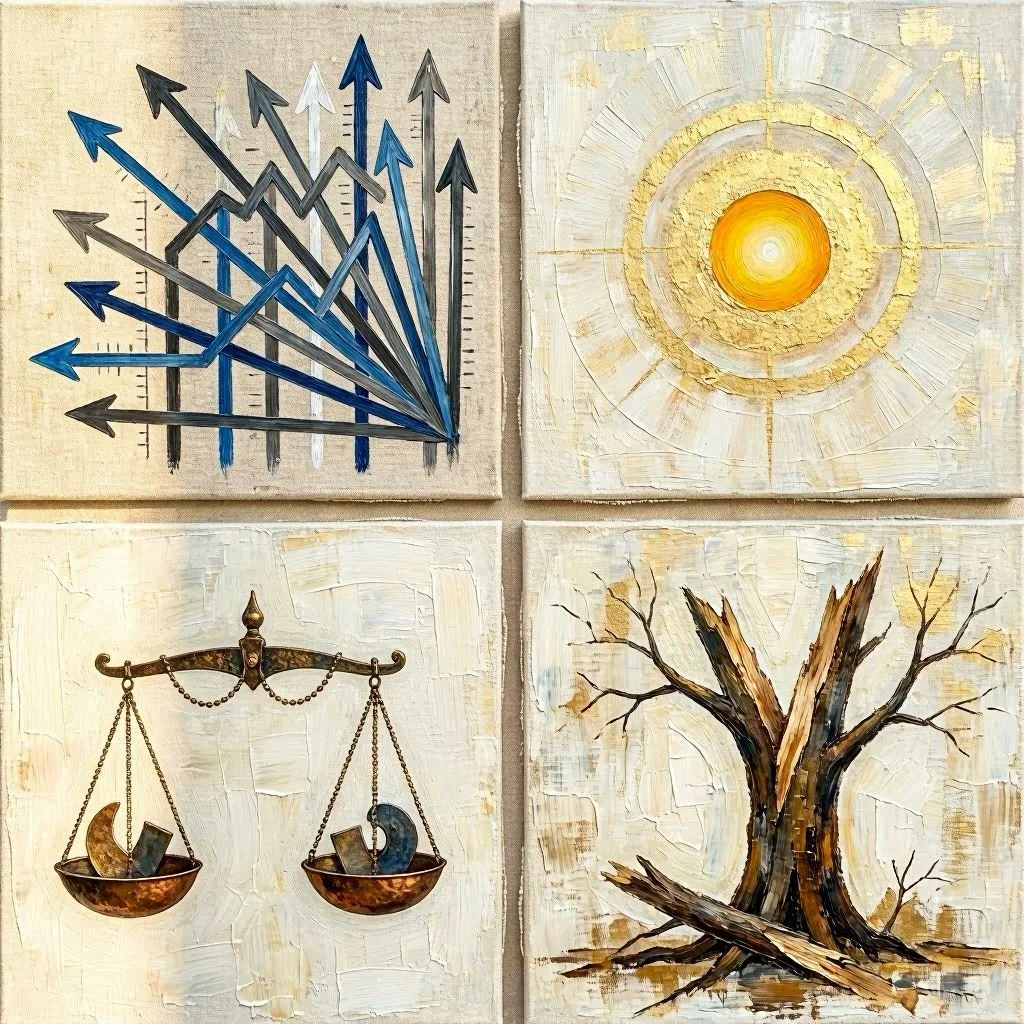
Scene 2 — Verse 2: From the point of light, arrows come flying in from every direction — from the edges of the dark expanse, from below, from above. All of creation is turning toward the single centre, seeking, depending, reaching. But no arrow goes outward from the centre: the point of light gives but does not need, sustains but is not sustained by anything. Imagine a pillar that all things lean against while it stands perfectly free.
Key image: All arrows point inward toward the light. No arrow points outward from it.
Scene 3 — Verse 3: A family tree appears before you — the kind drawn in a genealogy chart. One arrow points downward (offspring, those begotten from above) and one arrow points upward (a parent, an origin). Then two red lines cross out both arrows simultaneously, with force and finality. No branch below. No origin above. The tree vanishes. The point of light remains, alone, unconnected to any genealogical chain.
Key image: A lineage chart erased, top and bottom, simultaneously.
Scene 4 — Verse 4: A set of scales appears — two pans, perfectly balanced. The point of light is placed in one pan. The other pan is empty. The camera moves outward, searching the entire universe for something to place in the opposite pan — something of equivalent weight, equivalent nature, equivalent dignity. It searches and finds nothing. The pan remains empty. The scale tips. The camera returns to the luminous point, which glows with the same intensity as scene one: aḥad.
Key image: An empty pan on a scale, opposite the light — no peer found.
The overall visual movement: Light appears (1) → all things turn to it (2) → lineage erased above and below (3) → the search for a peer finds nothing (4). Notice the circular frame: the surah begins with the light and ends with the light — aḥad opens the film and aḥad closes it.
Practical Steps for Memorising Surah Al-Ikhlas Successfully
Combining all seven links, here is the complete memorisation toolkit for Surah Al-Ikhlas:
Before you begin: Remember the occasion of revelation. The polytheists asked about lineage. This surah is the answer. "Say" begins the reply.
Phonetically: All four verse-endings land on "-d": ahad / al-samad / yulad / ahad. Listen for the "-d" after each verse. If it is absent, something is wrong.
Structurally: The first two verses affirm (One; Eternal Refuge). The last two verses negate (no offspring; no peer). The dividing line is between verse 2 and verse 3. Ask yourself: am I affirming or negating?
Verbally: "Allah" appears in verses 1 and 2 (linking them). Ahad appears in verses 1 and 4 (framing them). The root w-l-d appears twice in verse 3 (linking within it).
Visually: Run the four-scene film: light alone → arrows inward → lineage erased → empty pan → light returns.
Uniquely: Al-Ṣamad appears nowhere else in the Qur'an. Kufuwan aḥad appears nowhere else in the Qur'an. These two phrases are unique identifiers of their verses.
Numerically: Four verses. One-third of the Qur'an's reward.
Why This Method Works for Adult Learners in the UK
Adult learners — Muslims who are memorising the Qur'an later in life, or who are returning to Quranic study after years away — face memorisation challenges that children in traditional settings do not face in the same way. Children memorise through intensive repetition in an environment saturated with Quranic sound. Adult learners in British contexts often have thirty or sixty minutes per day, a quieter environment, and a mind that has been trained for years to learn through understanding rather than through pure repetition.
The Seven-Link Method is particularly suited to this profile. It works with the adult learner's strength — the ability to understand meaning, to construct mental frameworks, to use visual imagination, and to make logical connections — rather than against their limitation — the comparative difficulty of pure rote repetition without a scaffold of meaning. When a British adult memoriser understands why verse four ends with ahad, why the root w-l-d appears twice in verse three, and what the occasion of revelation means for the word "Say," they are building a web of meaning around the text that makes it far more resistant to forgetting than repetition alone could achieve.
This is the underlying insight of structured Quranic memorisation: the Qur'an is not arbitrary. Every word, every ending, every structural feature was chosen. Understanding the choice is not just intellectually satisfying — it is the most powerful memorisation tool available.
Deepen Your Hifz with Eaalim's Qur'an Memorisation Course
Surah Al-Ikhlas is four verses. Juz 'Amma alone contains thirty-seven surahs. A systematic memorisation of the Qur'an — or even of the short surahs most commonly recited in prayer — requires not only the will to memorise but a method, a teacher, and a structure that holds you accountable and guides you through the text with the depth it deserves.
Eaalim Institute's Hifz Course provides English-speaking Muslims in the United Kingdom with exactly this: a one-on-one, live online memorisation course with qualified scholars who guide each student through the Qur'an at their own pace, using structured techniques that address the specific challenges adult learners face. The course covers not only the memorisation itself but the revision methods and recitation standards that ensure what you have memorised is retained correctly over time.
Whether you are beginning with the short surahs of Juz 'Amma or continuing a memorisation that has stalled, the Hifz Course meets you where you are and takes you further.
Enrol in Eaalim's Hifz Course →
Conclusion
Surah Al-Ikhlas is four verses long — and yet it contains the complete theology of Islamic monotheism. It was revealed as a direct answer to those who asked about Allah's lineage, and its answer demolished the question's premise entirely: Allah does not beget and was not born, He has no origin and no offspring, and there is nothing in existence that comes close to equivalence with Him.
The Seven-Link Method gives the adult learner in the UK a set of tools that make memorising and retaining these four verses a structured, meaningful experience rather than a matter of bare repetition. The phonetic frame (all endings on "-d") confirms the end of each verse. The thematic structure (affirmation then negation) provides orientation at every moment. The verbal frame (ahad … ahad) seals the surah at both ends. The visual film runs through four images that encode the meaning in a form the visual memory holds firmly. And the unique features of al-Samad and kufuwan ahad mark their verses with signatures that cannot be confused with anything else.
Memorising Surah Al-Ikhlas becomes much easier when every verse is connected through meaning, sound, structure, and visual memory. Understand what you are memorising. And let the method serve the meaning.
Start memorising Surah Al-Ikhlas with a qualified Quran teacher at Eaalim and continue your Hifz journey.
Start your journey with Eaalim today!
Start 2 Free Trials


 Share
ShareFrequently Asked Questions
The scholars of Islam have offered several explanations for the hadith (authenticated in Sahih Bukhari 5013 and Sahih Muslim 811) that Surah Al-Ikhlas equals one-third of the Qur'an. The most widely accepted explanation is that the Qur'an addresses three main categories of knowledge: matters of divine attributes ( tawhid ), narratives and history, and rulings and legal matters. Surah Al-Ikhlas addresses the first category — the knowledge of Allah — with such completeness that it is equivalent to a third of the Qur'an by subject matter. This does not mean reciting it three times literally replaces reading the whole Qur'an; it means its reward, in terms of the importance of what it conveys, is equivalent to a third.
Al-Ṣamad is one of the most debated words in Quranic lexicography. The classical scholars described its core meaning as: the one to whom all things turn in their needs, who is entirely self-sufficient and has no needs of His own. Ibn 'Abbas (may Allah be pleased with him) described al-Ṣamad as "the master who is perfect in His mastery, the noble who is perfect in His nobility, the great who is perfect in His greatness, the forbearing who is perfect in His forbearance" — a description of the totality of divine perfection combined with the dependence of all creation upon Him. Its appearance only in this verse, nowhere else in the Qur'an, makes it the most distinctive single word in Surah Al-Ikhlas.
In verse 1, aḥad is a predicate of Allah: "He is One" — a positive declaration of uniqueness. In verse 4, aḥad functions as part of the negation: "Nor is there to Him any equivalent, any one [ aḥad ]" — the same word used to deny that anything shares in His uniqueness. The verbal link is intentional: the surah opens by affirming His oneness and closes by denying that any other oneness can match it. The frame holds them together: aḥad opens and closes the surah, and the content of the frame explains why both uses of the word are necessary.
Yes — the method was designed for exactly this purpose. It applies to any surah and was originally demonstrated on surahs of Juz 'Amma such as Al-Buruj. Each surah has its own phonetic frame, its own verbal links between verses, its own thematic structure, and its own unique features that serve as similar-verse links. Once you have learned to apply the seven link-types to Surah Al-Ikhlas, you have the complete toolkit for every surah you memorise. The method is particularly powerful for Juz 'Amma, where the surahs are short enough that the links can be mapped across the entire text in a single study session.
