

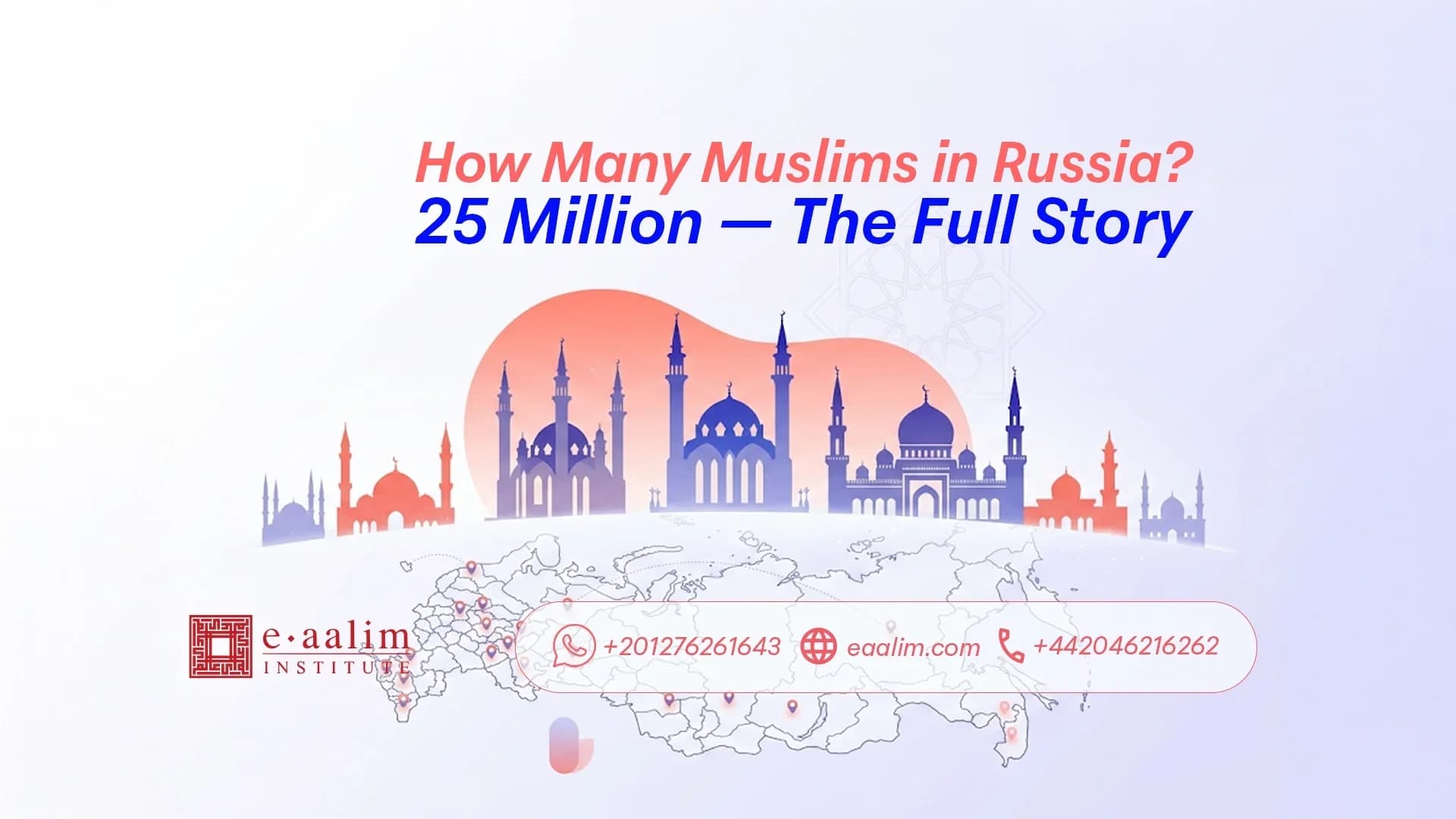
How Many Muslims in Russia? 25 Million — The Full Story
By aburuqayyah on 12/22/2025 · 9 min read
Russia is home to one of the largest Muslim populations in Europe. In fact, most estimates put the number of Russian Muslims between 20 and 25 million. That is around 14% to 17% of the country's population. However, they are not recent migrants. Instead, they are indigenous peoples: Tatars, Bashkirs, Chechens, Avars, Ingush, Kumyks, Karachays, Balkars and Nogais, among dozens of smaller groups. Their ancestors have been Muslim for over a thousand years. This guide is an introduction for British Muslim families curious about their global ummah. It is especially relevant for families with Tatar, Chechen, Azerbaijani or Central Asian heritage. At Eaalim Institute, we teach Quran and Islamic studies to Muslim families across the UK and beyond — wherever in the ummah your roots lie.
Population and geography
Indicator | Figure |
|---|---|
Estimated Muslim population of Russia | 20–25 million |
Percentage of Russian population | 14–17% |
Largest Muslim ethnic groups | Tatars (~5.3m), Bashkirs (~1.6m), Chechens (~1.7m), Avars (~1m), and dozens of smaller groups |
Republics with Muslim majorities | Chechnya (~95%), Ingushetia (~98%), Dagestan (~83%), Kabardino-Balkaria (~70%), Karachay-Cherkessia (~65%), Tatarstan (~54%), Bashkortostan (~38%) |
Largest Muslim cities | Moscow (est. 2–2.5 million Muslims, mostly migrant), Kazan (~600,000), Ufa, Makhachkala, Grozny |
Registered mosques | ~8,000 |
Madhhab | Predominantly Hanafi (Tatars, Bashkirs, Central Asian migrants); Shafi'i in the North Caucasus (Dagestan, Chechnya, Ingushetia) |
The two main Muslim regions of Russia
The Volga-Ural region
The Volga-Ural region includes the modern republics of Tatarstan and Bashkortostan. It is home to the Tatars and Bashkirs, the two largest indigenous Muslim ethnic groups in Russia. Their ancestors embraced Islam in the 10th century. Specifically, Almish ibn Yiltawar, king of the Volga Bulghars, formally converted in 922 CE. Before that, he had sent an embassy to the Abbasid caliph al-Muqtadir in Baghdad. The famous Arab traveller Ibn Fadlan accompanied that embassy. As a result, we have one of the most detailed early accounts of the Volga peoples. Indeed, historians still study his document today. A thousand years later, families still pass on that same knowledge. Today, many do so through structured online Fiqh courses with Al-Azhar scholars.
Meanwhile, Kazan, the modern capital of Tatarstan, has been an Islamic centre for over a thousand years. The Qol Sharif Mosque stands inside the Kazan Kremlin. It was rebuilt in 2005 on the site of the original 16th-century mosque. That first mosque was destroyed during Ivan the Terrible's conquest of Kazan in 1552. Consequently, that conquest began the long, complex history of Russian Muslims under Russian state authority. To explore more Islamic history, visit the Eaalim library.
The North Caucasus
The North Caucasus includes Dagestan, Chechnya, Ingushetia, Kabardino-Balkaria and Karachay-Cherkessia. North Ossetia also belongs here, with both Muslim and Christian populations. Together, these republics are home to several million Muslims. Their Islamic history reaches back to the Arab conquests of the 7th and 8th centuries. During that period, Derbent in Dagestan became one of the earliest Islamic outposts in the Caucasus. In fact, Derbent's Juma Mosque was built in 734 CE. Therefore, it is the oldest mosque in Russia. It is also one of the oldest still in use anywhere in the former Soviet space.
Moreover, the North Caucasus has a distinctive Sufi tradition, particularly the Naqshbandi and Qadiri tariqahs. For centuries, these orders have shaped religious life and political resistance in the region. For example, Imam Shamil led the great 19th-century Caucasian resistance to Russian imperial expansion. He was also a Naqshbandi shaykh. Today, he remains a foundational figure for Dagestani and Chechen Muslims. To study the life of the Prophet ﷺ in depth, see our one-to-one online Seerah course taught by Al-Azhar scholars on UK time slots.
Russian Muslims under three regimes
The Tsarist period (1552–1917)
From the conquest of Kazan in 1552 to the 1917 Revolution, Russian Muslims lived under the Tsarist state. However, their experience varied dramatically across the centuries. At first, they faced intense forced-conversion campaigns. Later, in 1788, Catherine the Great established the Orenburg Spiritual Assembly. This was the first official Russian state body for managing Muslim religious affairs. Then came the cultural revival of the late 19th century: the Tatar Jadidist reform movement. It was led by figures like Ismail Gasprinski and Musa Bigiev. The Jadidists built networks of modernised Islamic schools across the Russian empire. As a result, they became the intellectual ancestors of much later Tatar and Central Asian Islamic thought. Indeed, the Jadidists proved that serious Islamic education can adapt to its time. The same principle stands behind Eaalim's live online Quran classes for UK families.
The Soviet period (1917–1991)
The Soviet period was the most brutal in Russian Muslim history. Stalinist anti-religious campaigns closed the overwhelming majority of mosques. For example, the Russian Empire had roughly 26,000 mosques in 1917. By the 1980s, however, fewer than 200 remained. Religious scholars were executed or sent to Gulag camps. Meanwhile, pilgrimage to Makkah became effectively impossible for ordinary Muslims. Yet underground religious life continued. It survived through Sufi tariqah networks, especially in the North Caucasus. It also survived through quiet teaching of children at home and basic ritual practice in private houses. In short, the survival of Russian Islam through the Soviet century is one of the great untold stories of modern Muslim history.
The post-Soviet period (1991–present)
Since 1991, Russian Islam has gone through a substantial revival. Thousands of mosques have been rebuilt or built anew. Likewise, Islamic publishing, education and pilgrimage have all resumed. For instance, the Moscow Cathedral Mosque was massively rebuilt and reopened in 2015 with a capacity of 10,000. Major Islamic universities now operate in Kazan and Makhachkala. In addition, over 25,000 Russian Muslims perform Hajj each year. Russian Muslim media, including major TV channels and online outlets, serve a substantial audience.
However, this revival has not been uncomplicated. The two Chechen wars of the 1990s and 2000s left deep scars. So did the conflicts in Dagestan. Furthermore, tension continues between Russian state security policy and certain forms of Islamic practice, particularly Salafi-leaning interpretations. All of this shapes the lived experience of Russian Muslims in the 21st century.
Tatar Muslims in Britain
The British Tatar community is small but established. Primarily, it descends from Tatar Muslims who came to the UK after the Russian Revolution and after WWII. More recent arrivals have come from Tatarstan since 1991. Most are concentrated in London. Historically, the community has gathered around the South Lodge Mosque on Wilbury Way. It has also organised through groups like the Tatar-Bashkir Cultural Society of Great Britain.
For British Muslim families with Tatar or Bashkir heritage, knowing this background is part of knowing who you are. After all, the Volga Bulghars embraced Islam in 922 CE. That was before Christianity had even reached some corners of England. In other words, if you have Tatar or Bashkir roots, your family's Islam is older than much of Europe's Christianity. And if reconnecting with that heritage means finally learning Arabic, our conversational Arabic course covers both Modern Standard and regional dialects.
Chechen, Dagestani and other Caucasian communities in Britain
Smaller but significant Caucasian Muslim communities also exist in the UK. Primarily, they arrived as refugees and asylum-seekers from the Chechen wars. More recent migration has added to their numbers. Most live in London, particularly West London. Meanwhile, smaller communities exist in Manchester and Birmingham. In general, Caucasian Muslims in Britain gather around mosques serving broader Sunni communities. As a result, they rarely maintain ethnically-specific institutions.
What British Muslim families can learn from Russian Muslims
Islam can survive seventy years of state hostility. The Soviet experience proves that Islam does not need state support to survive. Instead, it needs dedicated families who teach their children quietly. Therefore, British Muslim families worried about secular pressures should take heart. After all, Russian Muslim families kept Islam alive through far worse.
Islamic identity can be both ethnic and religious. A Tatar Muslim is both Tatar and Muslim. Clearly, the two are not in tension or contradiction. Likewise, British Muslim families can hold their dual identities — British and Muslim, or British-Pakistani-Muslim — with the same integration.
Reform movements within Islam have a long history. For example, the Jadidist movement flourished in the late 19th century. It shows that thoughtful engagement with modernity is not a 21st-century invention. In fact, Russian Muslim scholars were practicing it 130 years ago.
The ummah is geographically larger than Saudi Arabia and South Asia. British Muslim children in Bradford or Birmingham often grow up with a Pakistan-shaped or Arab-shaped picture of the global ummah. However, Russian Muslims are a useful corrective. There are 25 million Muslims in the world's largest country. Yet they remain mostly invisible in British Muslim discourse.
Give your children the same gift those families gave theirs.
Russian Muslim parents kept Islam alive through seventy years of Soviet rule. They did it with nothing but quiet, consistent teaching at home. Today, it is easier. Eaalim's Al-Azhar certified teachers deliver one-to-one online Quran classes in UK time slots. The programmes cover Tajweed, Hifz, and Islamic studies for kids and adults.
Frequently asked questions
How many Muslims are there in Russia? Most estimates put the figure at 20–25 million. That is around 14% to 17% of the population. Consequently, Russia has one of the largest Muslim populations in Europe.
Are Russia's Muslims immigrants? Mostly no. In fact, the large majority are indigenous peoples — Tatars, Bashkirs, Chechens, Avars and dozens of smaller groups. Their ancestors have been Muslim for over a thousand years. However, Moscow does also have a large migrant Muslim population.
Which parts of Russia are Muslim-majority? Several republics are. For example: Ingushetia (~98%), Chechnya (~95%), Dagestan (~83%), Kabardino-Balkaria (~70%), Karachay-Cherkessia (~65%) and Tatarstan (~54%).
What is the oldest mosque in Russia? The Juma Mosque in Derbent, Dagestan, built in 734 CE. It is one of the oldest mosques still in use anywhere in the former Soviet space.
How did Islam survive the Soviet era? The number of mosques fell from around 26,000 in 1917 to fewer than 200 by the 1980s. However, Islam survived. Families taught their children at home, and Sufi networks endured in the North Caucasus. In other words, everything rested on quiet, consistent teaching within the family.
Start your journey with Eaalim today!
Start 2 Free Trials


 Share
ShareFrequently Asked Questions
Islam reached Russia very early. Derbent in Dagestan became an Islamic outpost during the Arab conquests of the 7th–8th centuries, and the Volga Bulghars converted in 922 CE — long before Islam is often assumed to have reached the region.
Around 8,000 registered mosques today. Before the Soviet era there were roughly 26,000; that number collapsed to under 200 by the 1980s before the post-1991 revival.
Moscow has the most Muslims — an estimated 2–2.5 million, mostly migrants. Kazan, the historic Tatar capital, has around 600,000.
