

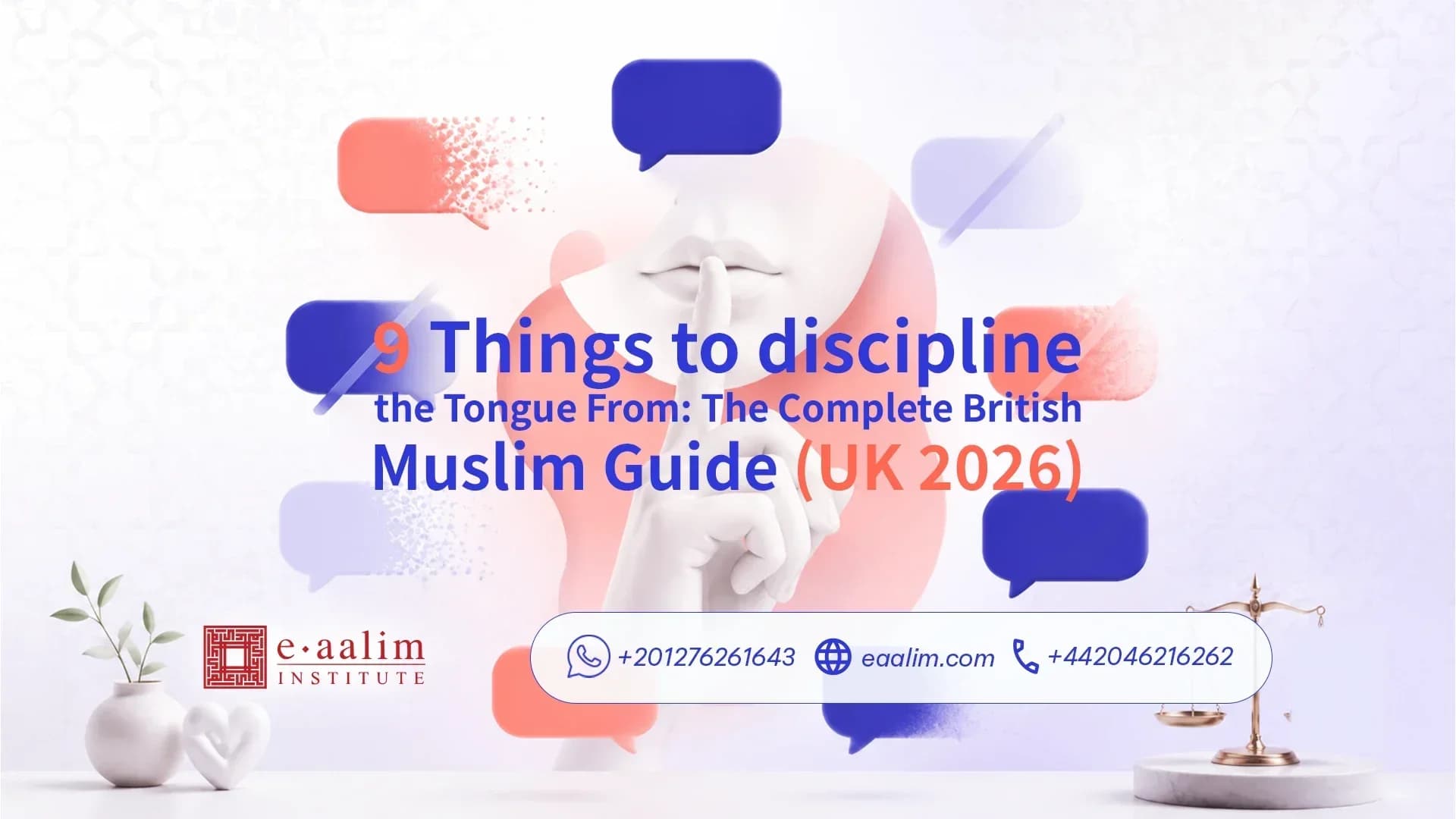
9 Things to discipline the Tongue From: The Complete British Muslim Guide (UK 2026)
By Eaalim Institute on 5/13/2026 · 16 min read
Discipline the Tongue is a virtue that the classical scholars taught. Also, the hardest and most rewarding discipline a believer takes on. Of all the parts of the human body. Moreover, the one the classical scholars warned about most insistently was the smallest organ, the tongue. The most flexible and the easiest to move: the tongue. Furthermore, imam al-Ghazali devoted a chapter of Ihyaʾ ʿUloom al-Deen almost entirely to its dangers. Ibn al-Qayyim listed the tongue's diseases as the gateways through which most of the heart's sicknesses enter and leave. Indeed, and the Prophet ﷺ himself, in a sober and famous hadith. Told his Companion Muʿadh ibn Jabal (RA) that this small organ would decide whether a Muslim was thrown into the Hellfire on his face on the Day of Judgment.
For British Muslim families navigating life in the UK in 2026. Importantly, where the average adult sends thousands of WhatsApp messages a month. Scrolls past hundreds of social media posts a day. Clearly, and speaks at home and at work in three or four registers between school, mosque and office. Discipline of the tongue is not a medieval theological topic. Additionally, it is a survival skill. This guide explains nine specific things the classical scholars said every Muslim should discipline the tongue about. Besides, and shows British Muslim parents, professionals and adult learners how to apply each one in daily life.
What the prophetic literature says about the tongue: Discipline The Tongue.
The strongest opening evidence for the discipline of the tongue comes from a hadith preserved through Abu Bakr al-Siddeeq (RA). Certainly, in which the Prophet ﷺ said:
"There is not a single limb of the human body that does not complain to Allah about the harm of the tongue."
Every other limb has a single role to play. Consequently, the eye sees, the ear hears, the hand grasps. But the tongue interacts with all of them. Narrating what the eye saw, repeating what the ear heard, justifying what the hand did. Because it touches everything, it is uniquely positioned to compound every other sin into a worse one.
Undoubtedly, the Prophet ﷺ said, in a hadeeth narrated by al-Tirmidhī and graded ḥasan:
"A servant's faith will not be straight until their heart is straight. And their heart will not be straight until their tongue is straight."
And when his Companion Muʿadh ibn Jabal (RA) asked him, "O Messenger of Allah. Notably, are we held to account for what we say?", the Prophet ﷺ replied:
"May your mother lose you, Muʿādh. And is there anything that drops people on their faces into the Fire other than the harvests of their tongues?" (al-Tirmidhi, saḥeeḥ)
ʿAbdullah ibn Masʿud (RA), one of the senior Companions, summarised the classical attitude in a single sentence. "There is nothing on earth more in need of long imprisonment than the tongue."
Below are the nine specific things the classical scholars said the British Muslim. In addition, like every Muslim — should discipline the tongue from.
1. Speech empty of the remembrance of Allah.
The first and most foundational discipline is to ensure that the tongue is not used for hours on end without a single mention of Allah. The Prophet ﷺ warned:
"Do not engage in excessive speech without the remembrance of Allah. For excessive speech without His remembrance hardens the heart. And the furthest of people from Allah is the one with a hardened heart." (al-Tirmidhī)
As a result, for British Muslims, this is one of the most practical challenges of modern life. A typical UK weekday can include hours of commuting on the train with podcasts. For this reason, hours at work with conversations that never touch the sacred. And hours in the evening with Netflix or social media. In short, by the time the day ends. The tongue may have produced thousands of words without saying Bismillah or Alḥamdulillah once.
Also, the practical antidote is the prophetic morning and evening adhkar (the adhkar al-ṣabaḥ wa al-masaʾ). The small tasbīḥāt after each prayer. And the deliberate use of phrases such as SubḥānAllah when something amazes you, Alḥamdulillah when something pleases you. Moreover, and Astaghfirullah when you slip. The Prophet ﷺ did not legislate these phrases as decoration. Furthermore, he legislated them as the heartbeat of the believer's tongue throughout the British working day.
2. Speaking out of place — or staying silent when speech is a must.
The second discipline is the placement of speech. The classical scholars were emphatic that timing and context matter as much as content. Indeed, speech that is correct in its own right can become wrong if delivered at the wrong moment. Interrupting a khutbah, offering unsolicited advice to a grieving family. Importantly, sharing a personal opinion in a meeting that has already concluded.
The opposite failure is just as serious: silence where speech is a must. Clearly, the Prophet ﷺ said:
"Whoever among you sees a wrong, let them change it with their hand. If they are unable, then with their tongue; if they are unable, then with their heart. And that is the weakest of faith." (Muslim)
For British Muslims, the application is both ways. A British Muslim parent who stays silent when their teenage child casually mocks a classmate is failing the second discipline. So is a British Muslim colleague who lectures a co-worker about Islamic ethics at a moment when the co-worker is in tears about an unrelated loss. Additionally, the mature Muslim tongue speaks when speech is essential and stays silent when silence is essential.
3. Excessive verbosity (al-hashw).
The third discipline is to keep speech proportionate to its purpose. Imam al-Ghazali wrote that anyone who can complete a thought in three sentences and chooses to use ten is misusing the gift of speech.
The Prophet ﷺ warned in particular about a category of speakers he called al-mutashaddiqoon. Besides, those who deliberately stretch and embellish their words to sound impressive. He said:
"The most beloved of you to me. And the closest to me in seating on the Day of Judgment. Will be those of you with the best character. And the most disliked of you to me. And the furthest from me in seating on the Day of Judgment, will be the talkative, the verbose. And the pompous (al-mutashaddiqoon)." (al-Tirmidhī)
For British Muslim professionals working in fields that reward verbal performance. Certainly, law, consulting, academia, media — this is a daily test. The cultural pressure in London board rooms or Manchester conference panels is to speak more, more confidently, more impressively. Consequently, the prophetic instruction is the opposite: speak the amount needed, no more.
4. Frivolous and unweighed speech.
The fourth discipline is closely related but distinct: it is the discipline of weighing words before uttering them. The Qur'an describes the believers as: "And those who turn away from idle speech" (al-Muʾminoon 23:3).
Undoubtedly, the Prophet ﷺ said:
"Indeed a servant may speak a word that is pleasing to Allah. Paying no attention to it, by which Allah raises them in degrees. And indeed a servant may speak a word that is displeasing to Allah. Paying no attention to it, by which they fall into the Hellfire." (al-Bukharī)
The phrase "paying no attention to it" is the heart of this discipline. Notably, a British Muslim who has not paused to consider whether a sentence is true, kind. And useful before sending it on WhatsApp is. In addition, in the prophetic warning. Risking ranks in Paradise or descent into the Fire over words he or she has not even bothered to weigh.
The classical advice, attributed to several early scholars, was to ask three questions before speaking: is it true? is it beneficial? is it the right moment? If the answer to any one of the three is no. As a result, the disciplined tongue stays still.
5. Excessive praise (al-madh).
The fifth discipline is to restrain praise — particularly excessive, unwarranted, or strategic praise. For this reason, the Prophet ﷺ saw a man praising another effusively and said:
"Woe to you, you have cut off your companion's neck!" (al-Bukharī)
His meaning: excessive praise tempts the praised one toward arrogance, tempts the praising one toward exaggeration. In short, and corrupts the relationship between them. The Companions disliked being praised. ʿUmar (RA) used to throw dust in the faces of those who praised him to his face.
Also, for British Muslims, the modern application is direct. The social media culture that rewards effusive online flattery. Comments such as "you are an absolute queen," "the most inspirational sister I have ever seen," and the like. Moreover, would have made the classical scholars deeply uncomfortable. Praise is permissible when honest, measured, said in the absence of the person rather than to the face. Furthermore, and free from the risk of inducing pride. Otherwise, the prophetic warning is to keep it controled.
6. People-pleasing at the cost of Allah's pleasure.
The sixth discipline is to refuse to say things that please other people but displease Allah. Indeed, the Prophet ﷺ said:
"Whoever seeks the pleasure of Allah at the displeasure of people. Allah will be pleased with them and will make the people pleased with them. And whoever seeks the pleasure of people at the displeasure of Allah, Allah will be displeased with them. And the people will also be displeased with them." (Ibn Ḥibban. saḥeeḥ)
For British Muslims navigating workplace conversations about controversial moral topics, family conversations with non-practising relatives. Importantly, or social media discussions where peer pressure pulls hard, this discipline is one of the most practically tested. The disciplined tongue does not say "yes. I agree" to something the speaker knows to be wrong in Allah's sight just because the cost of disagreement is social discomfort.
Clearly, this does not mean rudeness. British Muslim Companions of the modern era. Additionally, the schoolteachers, GPs, lawyers, and entrepreneurs who hold the line politely without compromising it. Are doing precisely what the sixth discipline asks.
7. Unfulfilled commitments and over-promising.
Besides, the seventh discipline is to refuse to promise what one cannot deliver. The Qur'an addresses the believers directly in Surah al-Ṣaff:
"يَا أَيُّهَا الَّذِينَ آمَنُوا لِمَ تَقُولُونَ مَا لَا تَفْعَلُونَ (2) كَبُرَ مَقْتًا عِندَ اللَّهِ أَن تَقُولُوا مَا لَا تَفْعَلُونَ (3)." (Qur'an 61:2–3)
Certainly, the hadith of the three signs of the hypocrite. Narrated in Bukhari and Muslim, names broken promises as one of the three. "when he promises, he breaks his promise." The seventh discipline is therefore not about avoiding promises altogether but about being honest with yourself. Before you speak, about what you can actually deliver.
For British Muslim parents, this includes the small daily promises. "we'll go to the park on Saturday" — as much as the large life ones. Consequently, for British Muslim professionals, this includes project deadlines, billable commitments. And the casual "I'll send it over by Friday" that becomes a Monday email two months later. Undoubtedly, the disciplined tongue under-promises; the actions over-deliver.
8. Hypocrisy — saying what you do not live.
The eighth discipline overlaps with the seventh but is more spiritually serious. It is the discipline of refusing to advocate from the tongue what one is not living from the limbs. Notably, the Qur'anic verse just cited above. "why do you say what you do not do?" — is the foundation. The Prophet ﷺ described the most painful punishment of a hypocrite as exactly this:
"A man will be brought on the Day of Judgment and cast into the Fire. Their intestines will pour out. And they will be made to circle around them like a donkey at a millstone. The people of the Fire will say to them, 'O so-and-so, what is wrong with you? Did you not used to enjoin the good and forbid the evil?' They will say. 'Yes, I used to enjoin the good and not do it. And forbid the evil and do it.'" (al-Bukhari and Muslim)
For British Muslim parents lecturing children on prayer while not praying themselves. British Muslim social media personalities posting daily inspirational quotes while their private lives contradict every one of them. In addition, and British Muslim community leaders demanding standards they do not personally hold to. This discipline is the most uncomfortable in the entire list. As a result, the classical answer is not to stop calling to good — it is to start living it.
9. Speech with arrogance — even unintentional.
The ninth and final discipline is the avoidance of arrogant speech. For this reason, the Prophet ﷺ said:
"No one with even an atom's weight of arrogance in his heart will enter Paradise." (Muslim)
When asked what arrogance meant, he replied. "It is the rejection of truth and the contempt of people." Arrogance lives in tone of voice as much as content. Speech that condescends to the listener. The brusque "actually, you'll find that...", the dismissive "well, obviously...". In short, the public correction of a colleague when a private one would do. Falls inside this discipline even when the speaker means no harm.
Also, for British Muslims with formal Islamic knowledge engaging with less practising relatives. Friends or colleagues, this is one of the most subtle pitfalls. The young brother newly returned from a hifz programme who corrects his uncle's recitation at a family gathering may be technically right and yet failing the ninth discipline more severely than the uncle is failing in his recitation. Moreover, the disciplined Muslim tongue respects every listener, regardless of the speaker's relative knowledge or status.
A British Muslim weekly self-audit for the tongue.
One pattern British Muslim families have found powerful is to use the nine disciplines as a weekly Friday-evening review. Furthermore, after Maghrib, take ten quiet minutes and check yourself:
Discipline — Question to ask yourself this week.
Indeed,
Remembrance of Allah: Did I go a whole day this week without a single dhikr from the tongue?
Placement of speech: Did I speak out of turn — or stay silent when I should have spoken?
Importantly,
Verbosity: Did I use ten sentences where three would have done?
Frivolous speech: Did I send a WhatsApp message without weighing whether it was true, kind and useful?
Clearly,
Excessive praise: Did I praise someone to their face in a way that could grow their arrogance?
People-pleasing: Did I say "yes" to something I knew was displeasing to Allah?
Additionally,
Unfulfilled commitments: Did I promise something I have not delivered? Can I either deliver or apologise this week?
Besides,
Hypocrisy: Did I advocate something from my tongue that I am not living from my limbs?
Arrogance: Did I speak to anyone in a tone that suggested I was above them?
Certainly, this is a serious audit. Done consistently for a year. Consequently, it remakes the inner life of a British Muslim home far more deeply than any large external change.
The classical principle: silence as worship.
The Prophet ﷺ summarised the entire discipline of the tongue in a single sentence preserved by Bukhari and Muslim. "Whoever believes in Allah and the Last Day, let them say what is good. Or let them remain silent."
Undoubtedly, silence is not the absence of speech. It is, in the classical Islamic tradition, an active form of worship. The deliberate restraint of the tongue when speech would not have been to Allah's pleasure. Imam al-Shafiʿī used to say. "If you wish to speak, then before you do, let your words pass three gates. The gate of truth, the gate of necessity, and the gate of kindness. If the words pass all three, say them. If they fail at any one, do not."
For British Muslim families in 2026, where speech is more frequent, more recorded. And more permanently traceable than at any point in human history, the nine disciplines are not optional refinements. They are the survival kit of the believing tongue.
A new course: the Pillars of Islam for British Muslim families.
The discipline of the tongue begins with the Shahadah. The testimony the tongue itself first pronounces when a person enters Islam. Tongue discipline is, in this sense, the first practical expression of the first pillar. A tongue that says La ilaha illa Allah and then spends the rest of the day in idle. Harmful or hypocritical speech has not fully understood what it said.
For British Muslim families who want to study the Pillars of Islam properly. The Shahadah and its conditions, the five daily prayers, zakah, fasting Ramadan, and Hajj. Eaalim is opening a brand-new course in our Islamic Studies section: the Online Pillars of Islam Course UK.
The course is a structured live one-on-one programme covering all five pillars. Taught in English by Al-Azhar certified teachers on UK GMT/BST time slots. And designed for British Muslim families and adult learners. The curriculum includes:
The Shahadah. Its meaning, its seven classical conditions, the nullifiers. And the disciplines of the tongue that flow from it (including the nine disciplines covered in this article).
Ṣalah (prayer). The conditions, pillars and obligations of the prayer; common British Muslim mistakes. Prayer at school and in the workplace; teaching children step by step.
Zakah. Calculation on a UK salary or savings account, eligible recipients, and the relationship between zakah and UK tax.
Sawm. Fasting through long UK summer days, accommodations for ill or pregnant Muslims. And teaching young children to fast safely.
Ḥajj. The rites, the practical realities of travelling for Hajj from the UK, and the lifelong preparation it requires.
The course pairs particularly well with our online Aqeedah Course UK for families who want to anchor the outward acts of worship in the inward creed that gives them meaning. Many families take both, in sequence or together.
To register your interest. Or to book a free trial lesson with one of our Al-Azhar certified teachers. Fill in the booking form on our site and mention "Pillars of Islam course" in the message. We will confirm a UK time slot. Send the lesson plan for the first four weeks, and pair your child. Or you, if you are an adult learner — with the suitable teacher for your level.
Until the course opens for general enrolment. We encourage British Muslim families to use this article as a starting point. Print the nine disciplines on a small card. Put it next to the kitchen fridge or the front door. Where you see it as you leave the house each morning. The tongue you control today, said the Prophet ﷺ, is the tongue that decides where you stand tomorrow.
Start your journey with Eaalim today!
Start 2 Free Trials


 Share
Frequently Asked Questions
The blog explains that the tongue is the smallest and most flexible organ yet the easiest to move into sin, and because it narrates what the eye saw and repeats what the ear heard, it compounds every other sin into a worse one. The Prophet ﷺ warned Mu'adh ibn Jabal (RA) that the harvests of the tongue are what throw people on their faces into the Fire. Abdullah ibn Mas'ud (RA) said there is nothing on earth more in need of long imprisonment than the tongue.
The blog cites classical advice, attributed to several early scholars and echoed by Imam al-Shafi'i, to pass words through three gates before uttering them: is it true, is it beneficial (or necessary), and is it the right moment (or kind)? If the answer to any one is no, the disciplined tongue stays silent. The Prophet ﷺ summarised the whole discipline in a hadith in Bukhari and Muslim: "Whoever believes in Allah and the Last Day, let him say what is good, or let him remain silent."
Yes. The blog recounts that the Prophet ﷺ saw a man praising another effusively and said, "Woe to you, you have cut off your companion's neck," meaning excessive praise tempts the praised one toward arrogance and the praising one toward exaggeration. The Companions disliked being praised, and Umar (RA) used to throw dust in the faces of those who praised him to his face. Praise is permissible when honest, measured, said behind the person rather than to the face, and free from inducing pride.
The blog lists: speech empty of the remembrance of Allah; speaking out of place or staying silent when speech is required; excessive verbosity; frivolous and unweighed speech; excessive praise; people-pleasing at the cost of Allah's pleasure; over-promising and unfulfilled commitments; hypocrisy (saying what you do not live); and arrogant speech, even unintentional. It presents these as a weekly Friday-evening self-audit, framing silence itself as an active form of worship.
