



One-to-One Islamic Studies Online with Qualified Scholars
By Eaalim Institute on 11/2/2026 · 14 min read
Yes, English can be used in online Islamic studies: course videos may be in English, while the language of live lessons depends on the teaching programme. When choosing one-to-one Islamic studies online, distinguish between the language of study materials and the language used for direct teaching, so the learner can follow both comfortably.
It’s natural to want more than a simple yes or no, especially when lessons need to fit around family routines and the learner’s starting point. A suitable study path should build on what they already know, address what they want to learn next, and make room for Quran learning alongside wider Islamic subjects.
This guide covers what to consider about English-language teaching, how lessons can suit different levels, and how Quran study can connect with subjects such as Islamic belief, worship and manners. It will help you understand the options and choose a steady, manageable way to learn.
Key Takeaways
Understand how English-language materials and live teaching can differ, so you can consider what will help a learner follow lessons comfortably.
See how one-to-one tuition can make space for Quran learning alongside Islamic studies.
Identify how a learner’s existing knowledge and goals can shape a suitable study path.
Explore the roles of Aqidah, Fiqh, Hadith, Tafseer and Seerah in building Islamic knowledge.
Discover how beliefs, worship, manners and morals can connect Islamic learning with everyday life.
Table of Contents
Can I study Islamic studies and Quran together?
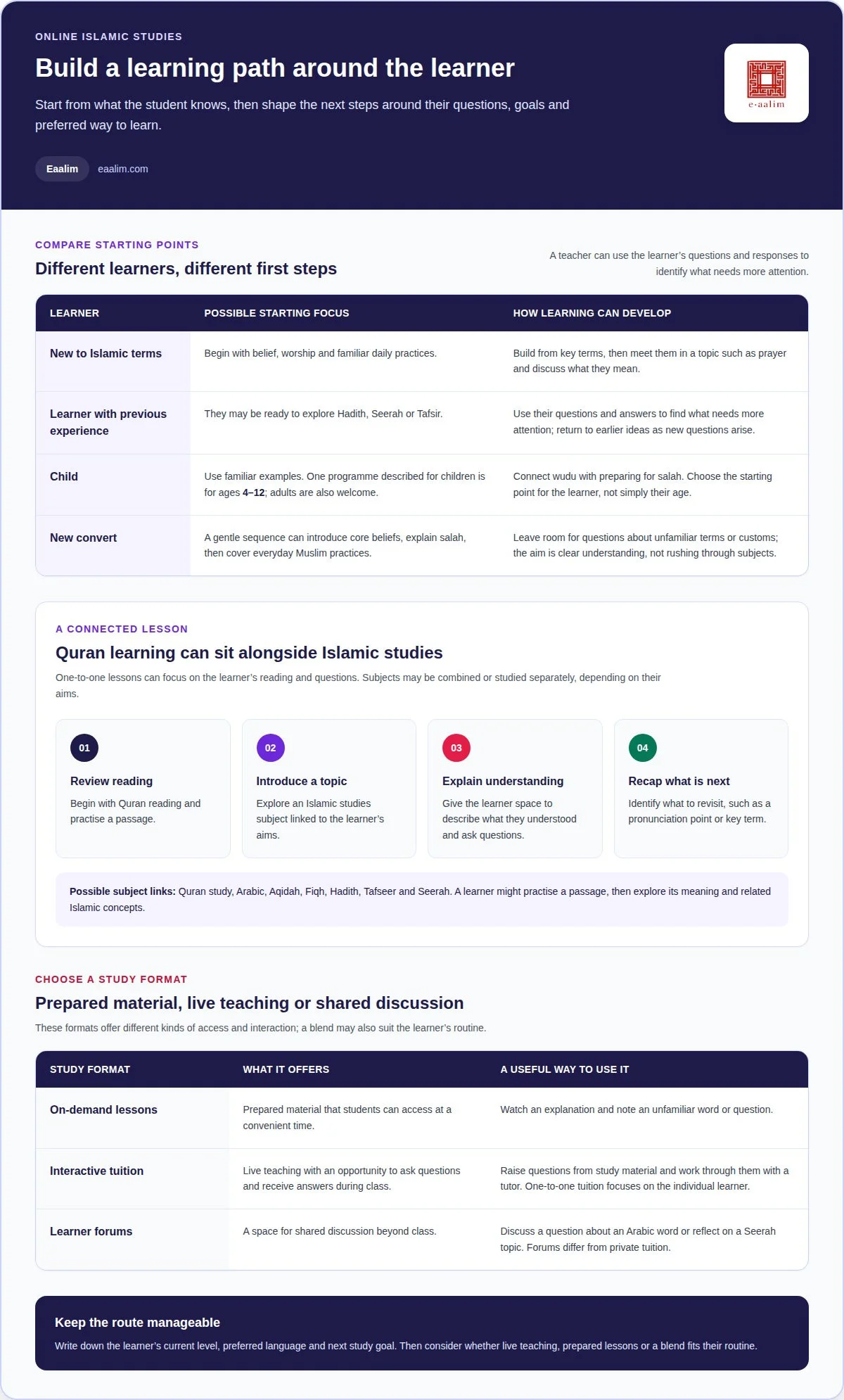
Yes, Quran learning and Islamic studies can form part of a connected online study plan. In a one-to-one lesson, a learner works individually with a teacher, so the session can focus on their reading and questions. For example, they might practise a Quran passage, then explore its meaning and related Islamic concepts.
Online Islamic studies courses in the UK can cover Aqidah, Fiqh, Hadith, Tafseer and Seerah, alongside Quran study and Arabic classes. Subjects may be approached together or in separate lessons, depending on the learner’s aims. English-language course videos can also support study, particularly when a student is becoming familiar with a new topic.
One-to-one online Islamic studies lessons are taught by qualified teachers, with male and female teachers available. The individual format gives students room to ask questions, revisit a concept and work through a reading at a manageable pace. A child learning about salah, for instance, might need a different explanation from an adult studying the same subject.
A useful lesson structure links each session to a clear learning step. The teacher might begin by reviewing Quran reading, introduce an Islamic studies topic, then ask the learner to explain what they understood. A brief recap can identify what to revisit next time, such as a pronunciation point or the meaning of a key term.
Quran analysis can start with careful reading, followed by attention to vocabulary, themes and context. A learner might notice a repeated word, ask what it means, then discuss how the passage relates to a broader theme. This approach treats interpretation thoughtfully rather than presenting a quick personal opinion as the Quran’s meaning.
An introduction to Tafsir helps learners understand how explanations of Quranic verses are developed. A teacher can distinguish reading a translation from studying commentary, then guide the student through a passage and its key themes. After reading a translated verse, for example, the learner can identify unfamiliar terms and consider how Tafsir adds further explanation.
Core Islamic studies topics are often covered through regular lessons over time. A learner might begin with belief and worship, then move on to Hadith, Seerah or Tafsir as their understanding develops. The sequence can reflect their reading level and questions. For those seeking one-to-one Islamic studies online, combining subjects can connect Quran study with wider religious learning instead of treating each lesson as an isolated task.
Structured learning paths for different levels
A useful learning path begins by finding out what the student can already explain. Someone new to Islamic terms might start with belief, worship and familiar daily practices. A learner with previous experience may be ready for Hadith, Seerah or Tafsir. In a one-to-one lesson, the teacher can use the learner’s questions and responses to identify what needs more attention.
For children, familiar examples can make abstract ideas easier to approach. An online programme described for children aged 4-12 introduces Islamic studies, whilst adults are also welcome. A child might connect learning about wudu with preparing for salah; an adult may prefer to explore the reasoning behind a practice. The starting point should reflect the learner, not simply their age.
Courses can build knowledge in stages. A beginner might first learn key Arabic terms, then encounter them in a lesson about prayer. Later, they could read a short passage and discuss its meaning. This links language, reading and Islamic concepts rather than treating each topic separately. Students can return to earlier ideas as new questions arise.
Online, on-demand and interactive learning describe different study formats. On-demand lessons let students access prepared material at a convenient time. Interactive tuition gives them a live opportunity to ask questions and receive answers during class. A learner could watch an explanation, note an unfamiliar word, then raise that question with a tutor.
Someone exploring Islam as a new convert may need a different starting point from a child learning familiar practices. A gentle sequence could introduce core beliefs, explain salah, then cover everyday Muslim practices. Each lesson can leave room for questions about terms or customs. The aim is clear understanding, not rushing through a long list of subjects.
Learner forums can offer another kind of interaction, particularly for students who want to discuss a lesson beyond class. A useful contribution might be a question about an Arabic word or a reflection on a Seerah topic. Forums differ from private tuition: they support shared discussion, while a one-to-one lesson focuses on an individual learner’s needs.
To compare routes, write down the learner’s current level, preferred language and next study goal. Then decide whether live teaching, prepared lessons or a blend suits their routine. A learner who wants direct individual guidance can explore online one-to-one study as one possible route, with Quran, Islamic subjects and Arabic considered according to their learning aims.
Islamic knowledge taught by qualified scholars
In a one-to-one Islamic studies lesson, a learner studies privately with a teacher. Parents can support online safeguarding by considering the lesson setting, who can hear it, and what personal details their child shares.
Teacher Vetting and Qualifications
Qualified teaching matters because Islamic studies can involve careful explanations of belief, worship and religious texts. A teacher should explain subjects clearly, respond respectfully to questions and adapt their language to the learner’s age and knowledge. A child asking about salah, for example, needs an explanation suited to their understanding, while an adult may want more context.
A teacher’s qualifications and teaching approach are related, but they are not the same. Notice how the teacher introduces a topic, explains unfamiliar terms and responds when a student misunderstands. A clear example, such as explaining an Islamic term before using it in discussion, can help the learner follow the lesson and see how their understanding is developing.
Male and Female Tutor Options
Learners and families can choose a male or female teacher for online Islamic studies lessons, according to their comfort, household preferences or the subject being studied. For instance, a parent may consider which teacher would help their child feel at ease asking questions about worship or manners.
The teaching relationship also depends on communication. Learners benefit from a teacher who listens carefully, gives them time to ask questions and explains answers in accessible language. When a Muslim student is studying a new topic, a calm exchange can make it easier to discuss uncertainties without feeling rushed.
Parents can support privacy by having a child join from a shared household space and staying within earshot. Keep personal details, such as a home address or school name, out of lesson messages. These steps help families stay involved while giving the child an opportunity to learn independently.
Progress can show in small, specific steps: a student explains a concept in their own words, recognises a term from an earlier class or asks a more focused question. The teacher can use these responses to revisit a difficult point or move on to a related subject. This makes teaching responsive to the learner rather than tied only to a fixed sequence.
After discussing wudu, for example, a learner might explain its place before salah and ask about a detail they found confusing. The teacher can clarify the point, then connect it to the wider subject of worship. Qualified instruction supports subject knowledge and helps learners take part confidently in thoughtful Islamic study.
Aqidah, Fiqh, Hadith, Tafseer and Seerah
These five subjects offer distinct ways to build Islamic knowledge, from belief and worship to scripture and the Prophet’s life. A qualified teacher can help learners understand how they connect through focused questions and examples.
Aqidah concerns Islamic belief, including belief in Allah. Fiqh explores the practical understanding of worship and religious practice. A lesson might introduce a belief, then consider how it informs daily life. For example, a student studying salah can explore its place in worship and ask about the practices involved. Separating these questions helps learners distinguish foundational belief from practical rulings.
Hadith studies reports about the Prophet Muhammad’s words and actions, while the Sunnah refers to his example and practice. Hadith study can involve reading a report, understanding its meaning, then discussing what it teaches. Sunan Ibn Majah 224 is cited for the statement that seeking knowledge is an obligation on every Muslim. A tutor can help students approach such references carefully, rather than treating a quotation without context as the whole lesson.
Tafseer is the study of explanations and interpretation of the Quran. Learners can begin with a passage, identify unfamiliar words and consider its themes before discussing commentary. A student reading a translated verse, for instance, can distinguish the translation from further explanation. This gives them a clearer way to ask how interpretation is developed and what a particular explanation addresses.
Seerah studies the life of the Prophet. It provides historical context for events and decisions, and helps learners consider the Prophet’s character and example. A class might focus on one event, establish what happened, then discuss the values it illustrates. Connecting Seerah with Hadith can show how accounts of the Prophet’s life and teachings relate without treating the subjects as interchangeable.
These subjects can be studied separately or connected through a shared theme. A lesson about prayer, for example, may touch on Fiqh through practice, Hadith through a relevant report and Aqidah through belief. A clear sequence keeps the lesson manageable: name the subject, explain its key terms, examine an example, then invite questions. A course outline can also show how topics are organised.
In Hadith studies, learners can note the report being discussed, its central message and the question it raises. They can then consider how Sunnah relates to manners, such as speaking truthfully or showing kindness. This supports careful reading and thoughtful application, rather than assuming every report gives the same kind of instruction.
If an academy offers a free trial, use that lesson to notice how the teacher explains one subject and welcomes questions. A learner might bring a question about worship, then see whether the discussion distinguishes Fiqh from Hadith. That small example can help families understand the teaching style and how a course connects Islamic knowledge with everyday choices.
Islamic beliefs, worship, manners and morals
Islamic studies connect belief with worship and everyday conduct. A lesson on belief in Allah, for example, can lead to a discussion of how gratitude shapes a Muslim’s choices. Manners and morals bring these ideas into ordinary situations, such as speaking kindly, keeping a promise or accepting responsibility. This helps learners see how religious knowledge relates to daily life, rather than remaining a list of terms to memorise.
Children’s Islamic studies can introduce belief in Allah, stories of the Prophets, wudu, salah, good manners, daily duas and Islamic values. These topics offer families practical starting points for discussion. A story about a Prophet can open a conversation about patience; a daily dua can prompt a child to consider when Muslims remember Allah. Lessons can connect each subject with familiar moments at home.
Fiqh helps learners understand practical aspects of worship. A student might consider what wudu involves, then discuss how it relates to preparing for salah. The aim is to understand the practice and its place in worship, rather than simply repeat a sequence. Clear explanations of terms help children and adults follow the same subject at different levels.
Examples make manners and morals more tangible. A lesson about honesty might ask how a student could respond after making a mistake; a discussion about kindness could consider how to include someone who feels left out. Daily duas also connect learning with routine. Islamic studies lessons can use such examples to develop understanding of values alongside knowledge of belief and worship.
Quran recitation and Islamic studies can support each other when a learner explores a related theme. After reading a passage, a student might discuss its message and how it connects with gratitude or patience. Recitation focuses on reading the Quran, while discussion helps the learner reflect on its meaning. English-language course videos offer another way to engage with Islamic subjects.
Families can make lessons meaningful by choosing a topic the learner can recognise in everyday life. For a child, that might be a story about a Prophet or a dua used during the day. An adult may want to explore how worship connects with personal conduct. In either case, a useful lesson leaves space to ask questions and explain ideas in the learner’s own words.
To build a steady path, begin with the learner’s current understanding, choose one subject, and connect it to a practical example. Then revisit the idea through discussion or recitation as appropriate. If you’d like to explore Islamic studies lessons alongside Quran learning, consider how these subjects can support the learner’s interests and everyday practice.
Eaalim: Online Quran courses
Eaalim offers online Quran courses and online Islamic studies courses for learners seeking individual teaching. Live lessons take place online, with instruction tailored to children and adults. This suits learners who want to develop Quran reading alongside Islamic subjects, or focus on one area at a time.
Eaalim also offers online Arabic classes for learners developing their reading, writing and language comprehension. The choice of course can reflect the student’s interests and aims, whether they want to study the Quran, build Islamic knowledge or learn Arabic. Individual online lessons with Eaalim’s qualified instructors offer focused guidance.
To explore a suitable learning route for you or your family, get in touch with Eaalim.
Take the next step in your learning
A meaningful next step begins with one clear intention: choose the subject the learner most wants to understand, then consider how it fits into their routine. For families considering one-to-one Islamic studies online, that might mean starting with a question about worship, building confidence in Quran reading or studying Arabic alongside Islamic learning. A focused starting point makes it easier to approach lessons steadily without taking on every subject at once.
Eaalim offers online Islamic studies courses, online Quran courses and online Arabic classes. These options support individual learning goals, whether the priority is Islamic knowledge, Quran learning or Arabic. Consider what would make the learner’s next lesson useful, and let that guide your choice.
Contact Eaalim about lessons to discuss a suitable learning direction. Every thoughtful question is a good place to begin, and steady study can grow from there.
Start your journey with Eaalim today!
Start 2 Free Trials


 Share
Frequently Asked Questions
Eaalim’s teachers are fluent in English, which supports communication during lessons. A learner can ask for an unfamiliar term to be explained in English, then practise recognising its Arabic form if language learning is part of their aims. This can help families combine Islamic studies with Quran reading, especially when a child understands a concept but is still learning its Arabic vocabulary.
Students can bring questions about modern issues to a lesson and explore them through Islamic knowledge. A discussion about online behaviour, for example, could consider honesty, privacy and respectful communication. Describe the situation clearly, separate facts from assumptions, and ask how a relevant teaching applies. Thoughtful lessons can clarify concepts and encourage careful reasoning rather than reduce a complex question to a quick yes-or-no answer.
Online tuition lets learners join a live lesson remotely instead of travelling to a classroom. Eaalim provides private Zoom lessons and direct chat with the teacher. Students can use lesson recordings for revision, such as revisiting a pronunciation point or a difficult explanation. A parent might help a younger child prepare learning materials before the session.
Practical questions often concern the learner’s starting point, available subjects and fitting lessons around school or work. Families may also want to know whether each child can have a separate learner profile and how parents can follow progress. Writing down questions in advance can help students and parents explain what they need from online study and choose a first learning goal.
Eaalim’s courses are for learners aged five and up, including children, teenagers and adults. A younger learner might need support with basic reading and familiar Islamic vocabulary, while an adult may have different aims. Families can enrol multiple children under one account, with a separate profile for each child. Age and current knowledge can help shape a suitable starting point.
Online lessons let families arrange learning around established routines, including school, work and prayer times. Studying from home also avoids adding a journey to a busy day. A parent, for example, can consider how a lesson fits alongside a child’s homework and Quran reading. Individual online tuition may suit learners who prefer asking questions privately rather than in a shared classroom.
A live lesson can focus on the learner’s current goal, with time to explain a question or revisit a challenging point. Eaalim sends weekly progress reports to parents, giving families a regular way to follow a child’s learning. After class, a student might review the recording and note a question for the next session, linking live teaching with revision and the next topic.
Online Islamic studies can cover core beliefs, worship, Islamic history and religious practice. Eaalim’s courses also include topics such as translation and tafsir, vocabulary, Tajweed and memorisation. A learner interested in Quranic meaning might focus on translation and tafsir, while someone developing recitation may prioritise Tajweed. A clear learning aim helps families decide where to begin.
