



Online Arabic Lessons for Beginners: Alphabet and Audio Practice
By Eaalim Institute
Starting Arabic does not mean mastering everything at once. Online Arabic lessons for beginners can build from the alphabet and letter sounds to everyday vocabulary, with audio practice helping you hear and repeat pronunciation at a comfortable pace.
It is natural to wonder whether you need to read fluently before starting, or which kind of Arabic suits your goals. A beginner course can introduce the script step by step, teach useful words and phrases, and give you time to listen, practise and revisit unfamiliar sounds.
This guide explains what to expect from alphabet lessons, how audio pronunciation practice can support your learning, and how Classical or Quranic Arabic differs from Modern Standard Arabic. You will also find an overview of course options to help you choose a starting point that fits your goals and routine.
Key Takeaways
- Start by learning how Arabic letters look and sound, then build towards reading words with greater confidence.
- Everyday vocabulary and basic grammar help turn early lessons into practical language learning.
- Choose an approach that matches your aim: Classical, Quranic Arabic and Modern Standard Arabic serve different purposes.
- Use audio practice to listen closely, repeat sounds and develop clearer pronunciation at your own pace.
- Bring a pen and paper to lessons so you can make notes and return to new words and sounds later.
What do I get with Beginners Arabic?
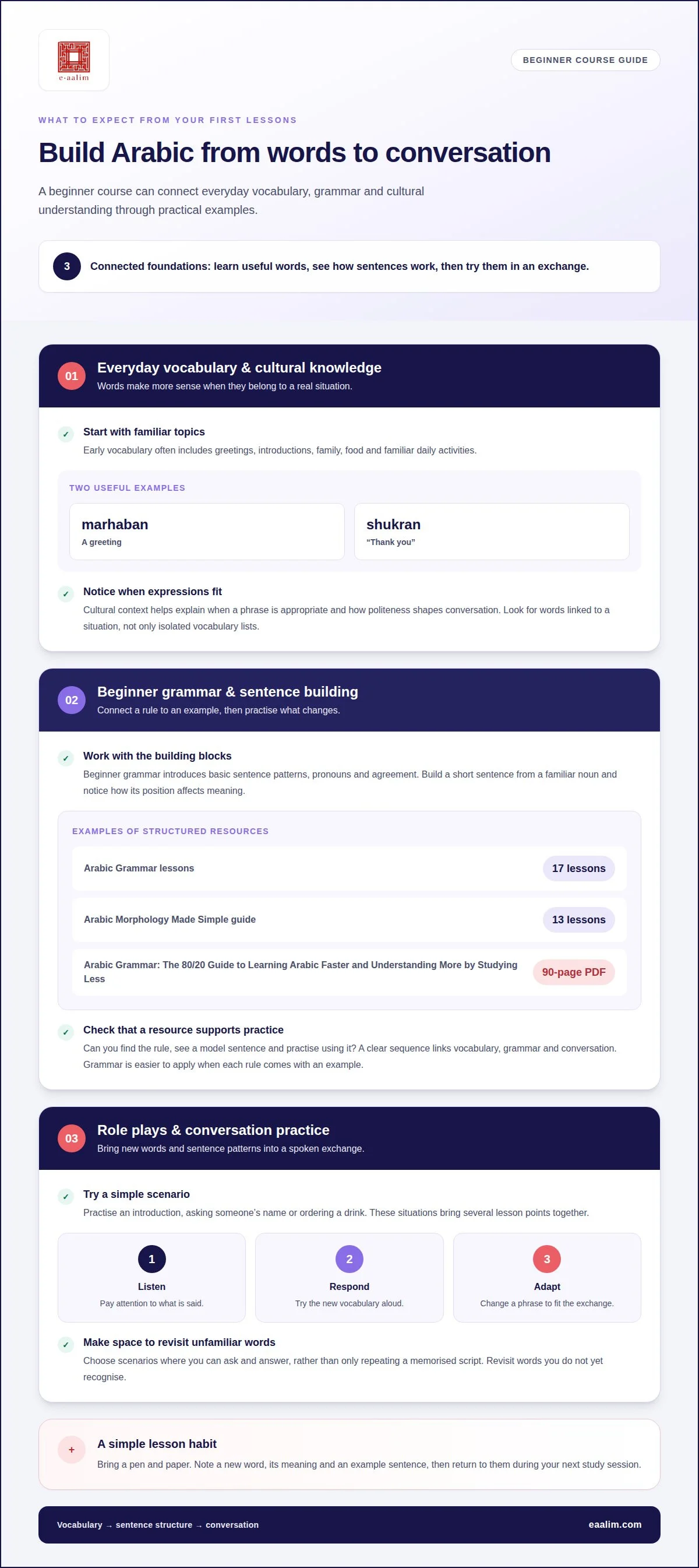
A beginner course can connect vocabulary, grammar and cultural understanding through practical examples. For instance, a greeting becomes more useful when you learn its meaning, pronunciation and place in an everyday exchange.
Everyday Vocabulary and Cultural Knowledge
Early vocabulary often covers greetings, introductions, family, food and familiar daily activities. Practise recognising marhaban as a greeting and shukran as “thank you”, then use each in a short exchange. Cultural context helps you understand when expressions are appropriate and how politeness shapes conversation. Look for lessons that connect each word to a situation rather than presenting isolated vocabulary lists.
Beginner Grammar and Sentence Structures
Beginner grammar explains how Arabic words work together, including basic sentence patterns, pronouns and agreement. A useful step is to build a short sentence from a familiar noun, then notice how its position affects meaning. Arabic Grammar lessons are presented in 17 separate lessons, while the Arabic Morphology Made Simple guide contains 13 Arabic language lessons. These resources illustrate how grammar and word formation can be divided into manageable topics.
Role Plays and Conversation Practice
Role plays give you a structured way to try new vocabulary aloud. A simple introduction, asking someone’s name or ordering a drink can bring several lesson points together. Rather than repeating a memorised script, practise listening, responding and adapting a phrase to fit the exchange. Choose scenarios that let you ask and answer, with time to revisit unfamiliar words.
Grammar is easier to apply when each rule comes with an example. A lesson might show how a pronoun changes a sentence, then ask you to replace a person or object. This step-by-step approach links sentence structure to meaning, instead of requiring you to memorise terminology before using it. Arabic script and grammar both need steady attention, because reading, speaking and understanding develop together.
Course materials may offer different levels of detail. The 90-page PDF Arabic Grammar: The 80/20 Guide to Learning Arabic Faster and Understanding More by Studying Less is one example of a longer reference. For a beginner, the practical question is how a resource supports lesson work: can you find the rule, see a model sentence, and practise using it? A clear sequence helps connect vocabulary, grammar and conversation across the learning journey.
Online Arabic courses for beginners and advanced learners
Your course choice depends on your current level, learning purpose and preferred way to communicate. Start by deciding whether you want everyday spoken Arabic, formal language skills or Arabic for religious study.
Beginner and Advanced Course Options
Complete beginners benefit from a course that starts with familiar foundations and gradually introduces longer reading and conversation tasks. More experienced students can focus on grammar, comprehension or speaking fluency. Look for a clear progression, so activities match your level rather than assuming knowledge you have not studied.
Teacher feedback can also shape the learning journey. One testimonial describes a student who began reading slowly after five hours of lessons, while another reports satisfaction after 10 Arabic lessons. These experiences show different milestones, not a fixed timetable: the learner’s starting point and goals influence what each lesson can cover.
Course Duration and Weekly Study
Course duration varies with your learning aim, lesson frequency and time for practice. A steady weekly routine can help you revisit vocabulary and grammar between lessons. Even a short review of your notes can make the next session easier to follow. Choose a schedule that fits around work, school or family commitments.
Testimonials illustrate how study habits differ. One parent described a child completing a one-hour lesson despite usually sitting to study for no more than 30 minutes. Another student reported learning with the same teacher for over six years. These accounts reflect individual experiences, rather than a standard course length or weekly requirement.
Modern Standard Arabic and Spoken Dialects
Modern Standard Arabic is used across the Arabic-speaking world for formal communication, education and media. Classical or Quranic Arabic has a different focus, so choose according to your intended use. For everyday conversation, a course focused on a spoken dialect may be a closer fit.
Which online Arabic lessons teach a spoken dialect such as Egyptian or Levantine? Choose lessons that explicitly focus on the dialect you want to speak, because Egyptian and Levantine Arabic differ from Modern Standard Arabic. Check that the course description clearly identifies the variety, so the lessons support your communication goals.
Free Lessons and UK Course Choices
Are there free online Arabic lessons for beginners? Free materials can introduce letters, vocabulary or grammar, while a structured course can bring those elements together through teacher guidance and planned practice. The most useful online Arabic lessons for beginners in the UK suit your level, purpose and preferred learning format.
What equipment or materials do beginners need for online Arabic lessons? According to the UK Government, beginners should bring a pen and paper for taking notes. A notebook can help you record a new word, its meaning and an example sentence, ready to revisit during your next study session.
Arabic alphabet, culture and everyday vocabulary
Alphabet study, pronunciation and useful phrases give beginners practical ways to start learning Arabic. A well-structured course links each new sound to a written letter and a real communication example.
Arabic Alphabet and Pronunciation
Arabic is written from right to left, and letters can change shape depending on their position in a word. Start by recognising a letter on its own, then compare how it appears at the beginning, middle and end. An alphabet course includes 22 detailed lessons covering basic pronunciation and tajweed. Look for clear sound examples alongside written practice, so letter recognition and speaking develop together.
Culture and Everyday Communication
Language learning becomes more meaningful when a phrase comes with cultural context. Modern Standard Arabic is used across the Arabic-speaking world for formal spoken and written communication, official occasions, education and media. Lessons can contrast formal expressions with familiar conversational language and explain when a greeting or polite response fits. This context helps you interpret communication rather than simply translate each word.
Survival Vocabulary and Useful Phrases
Useful vocabulary is easier to retain when it serves a clear purpose. For travel, practise asking ayna al-maṭār?, meaning “Where is the airport?”, then learn a simple response or request for help. In everyday exchanges, min faḍlik means “please”, and maʿa as-salāma means “goodbye”. Pair each phrase with its pronunciation and written form.
Build a small vocabulary set around one situation at a time. A travel set might include transport, directions and food; a home routine could cover family, meals and common activities. Practise each word in a short phrase, then say it aloud. Connecting spelling, meaning and pronunciation makes your progress easier to notice.
For each new phrase, follow three steps: listen to its sound, read the Arabic script, then use it in a short exchange. For example, practise asking for a menu before learning a response. Lessons that connect listening, reading and speaking give each item a clear purpose. Over time, these small exchanges help turn vocabulary into everyday communication, whether you are preparing for travel or building a broader foundation.
Audio lessons and pronunciation practice
Audio practice connects what you hear with the letters, words and sentences you encounter in Arabic. A useful routine combines listening, speaking, reading and writing, so pronunciation develops alongside your wider language skills.
Start with a short recording, then listen again while following its written text. Notice where one word ends and the next begins, and repeat the phrase at a measured pace. For example, a beginner can listen to a greeting, read it in Arabic script, say it aloud, then write it from memory. This sequence links the alphabet to sound and meaning, instead of treating each as separate work.
Arabic Conversation Practice contains 17 modules, offering a structured way to work with listening and spoken language. A learner can pause after a line, repeat it, then listen again for differences in rhythm or emphasis. For an unfamiliar sound such as ع or ح, focus on hearing it within a word before practising the full phrase. This careful repetition supports clearer pronunciation without rushing through the material.
Live online lessons add a responsive speaking element to audio practice. In a teacher-led exchange, listen to a question, answer aloud, then try the same response with a different word. Reading the prompt before speaking can connect written forms to conversation; writing a new phrase afterwards gives you a record to revisit. These steps bring speaking, reading and writing into one lesson.
Audio practice can also centre on travel situations. A short exchange about finding a station, asking for directions or ordering food gives each phrase a clear purpose. Listen for the question, repeat the key expression, then practise answering with a place or item. When a learner studies Modern Standard Arabic, it is useful to remember that everyday spoken dialects differ; the course’s language variety should match the intended conversation.
For a manageable practice cycle, choose one short dialogue and work through it in four stages: listen without reading, follow the text, repeat each line, then perform both parts aloud. Finish by writing one phrase from memory and comparing it with the prompt. This combines listening with Arabic grammar and vocabulary in context, while showing which sound or word needs more review. Return to the same dialogue later and notice whether its rhythm and meaning feel more familiar.
A testimonial reports that a student began reading slowly after 5 hours of lessons. The website links to a 21-day workshop on reading Arabic with understanding.
Arabic lessons for complete beginners
You can start as a complete beginner without knowing Arabic letters or grammar. A useful first lesson identifies your starting point, then introduces one new skill at a time. You might recognise a letter, hear its sound and practise reading it in a short word. Each activity then has a clear purpose, making progress easier to follow.
Look for a sequence that connects listening, reading, writing and speaking rather than treating them as separate subjects. A lesson could begin with a teacher modelling a sound, continue with you identifying its letter, then move to copying it and using it in a word. This pattern shows how the written form and spoken sound relate, while giving you several ways to practise.
In online Arabic lessons for beginners, useful early activities include matching letters with sounds, reading short words and repeating a simple exchange. A teacher can introduce a new point, invite you to try it, then explain any correction. This feedback helps distinguish a pronunciation difficulty from a reading or vocabulary question, so your next practice task addresses the right skill.
A manageable lesson can move through these stages:
- Listen to a new sound or phrase, such as a greeting, before trying to repeat it.
- Read the matching Arabic text, noticing the letter forms and direction of the script.
- Write the letter or phrase, then say it aloud in a short example.
- Use the phrase in a brief exchange, such as greeting someone and responding.
This sequence gives beginners a practical path towards fluency: first recognise and understand a phrase, then practise using it in context. Fluency develops through connected skills, not from learning a long vocabulary list alone. A travel example might pair a spoken request for directions with its written form and a suitable response. Each activity gives you a chance to combine listening, speaking and comprehension.
Keep a record of new material. According to the UK Government, beginners should bring a pen and paper to lessons for taking notes. A notebook can hold a new letter, its sound and one example word on the same page. During review, cover the example and try to recall it before checking your notes. This simple step makes lesson material easier to revisit between sessions.
If you’re ready to learn with guided, step-by-step practice, explore online Arabic classes as a next step.
Eaalim: Online Arabic classes
Eaalim offers online Arabic classes for learners seeking guided teaching alongside self-study. Live, private one-to-one lessons are tailored to children and adults, with certified instructors supporting each learner at their level. This can suit a complete beginner who wants individual attention while working through Arabic step by step.
If your goals also include Quran study or broader Islamic learning, Eaalim offers online Quran courses and online Islamic studies courses. These are separate options alongside Arabic classes, so you can choose according to what you want to study.
To take the next step, explore Eaalim’s online Arabic classes and choose a learning goal to discuss in your first lesson.
Choose a steady next step in Arabic
Let your reason for learning guide what you practise next. If you want to speak with Arabic speakers, focus on listening and short exchanges; if reading is your priority, spend more time recognising letters and joining them into words. For online Arabic lessons for beginners, try a simple routine: choose one phrase, practise it aloud, then return to it in your next study session.
Keep your goal in mind, but allow it to develop as your understanding grows. You might start with greetings and later become interested in reading, conversation or a particular variety of Arabic. Choose an approach that gives you room to ask questions and build steadily, rather than trying to cover everything at once.
If guided Arabic study feels right for you, contact Eaalim to discuss Arabic lessons. A thoughtful beginning can make the next step feel clearer, and every new word offers a place to continue.
Start your journey with Eaalim today!
Start 2 Free Trials


 Share
Frequently Asked Questions
If you specifically want Modern Standard Arabic, choose a beginner course that names it as the teaching focus. Course descriptions should distinguish it from Classical or Quranic Arabic and identify practical aims, such as reading formal texts or communicating in educational settings. Look for beginner-level examples and a clear progression through foundational skills. This makes it easier to find lessons suited to your purpose, since Arabic courses do not all teach the same variety.
Eaalim offers live online Arabic classes with individual teaching for learners at different stages. Its Arabic tuition focuses on reading, writing and language comprehension, making it suitable if you want structured learning rather than studying from recordings alone. Live lessons give beginners the chance to practise new skills with an instructor and receive guidance during the session. Choose a course that matches your level and learning aims.
Check which Arabic variety the course teaches and whether it starts with the alphabet or assumes prior knowledge. Look for a sequence that connects reading, writing, listening and speaking, with examples of how lessons apply new material. If you are learning for travel, you may prioritise spoken communication; if you are studying religious texts, you may need a different focus. Clear aims help you judge whether a course fits your reason for learning.
The time needed depends on what you mean by “basic Arabic”, how familiar you are with the script and how regularly you study. Recognising letters is a different goal from holding a conversation or reading a short passage. Set a specific milestone, such as reading a simple sentence or introducing yourself, then review your progress against that skill. Lesson frequency and practice between sessions both shape how quickly you build confidence.
Yes. Eaalim’s online Arabic classes are tailored to children and adults, so learners can start with different ages and study goals. A child might connect a letter with a sound through a short activity, while an adult may prefer more time for reading or writing practice. In either case, a clear learning aim helps shape lessons around the student’s needs.
Look for clear information about a tutor’s teaching credentials, Arabic specialism and experience with beginners. The course should explain what students practise and how feedback supports progress, rather than relying on broad claims. One useful indicator is whether the tutor can explain a point in more than one way, such as modelling a sound and showing its written form. Eaalim connects students with certified instructors.
