


Prophet Ibrahim Story: The Complete Guide to Khalil Allah
By admin on 12/22/2025 · 8 min read
Khalil Allah — the Friend of God
The Prophet Ibrahim story is one of the most important in the Quran. Ibrahim (Abraham, peace be upon him) is the prophet whom Allah Himself called Khalil Allah — the Friend of God (Quran 4:125). He is the patriarch of the three great monotheistic traditions. Through Ismaʿil came the Arab line and ultimately Prophet Muhammad ﷺ. Through Ishaq came the Israelite prophets, including Musa and ʿIsa. For British Muslim families, he is the model of pure Tawhid. Alone in his society, he recognised the Creator and refused every form of idolatry.
The Prophet Ibrahim story: birth and early life
Ibrahim ﷺ was born in ancient Mesopotamia (modern Iraq), in the region historically called Ur of the Chaldeans. According to the Quran, his father was named Azar (Quran 6:74), and he made idols for the local temple. At that time, his people worshipped the moon, the stars and the sun, alongside carved idols.
However, from a young age, Ibrahim questioned this religion. The Quran preserves his reasoning in Surah Al-Anʿam (6:75–79). First, he watched a star rise and said, "This is my Lord." But when it set, he said, "I do not love things that disappear." Next, he watched the moon rise and said the same, yet the moon set too. Then he watched the sun rise — the greatest visible body — and declared, "This is my Lord; this is greater." Finally, when the sun set, he turned away from celestial worship altogether and declared:
﴾إِنِّي وَجَّهْتُ وَجْهِيَ لِلَّذِي فَطَرَ السَّمَاوَاتِ وَالْأَرْضَ حَنِيفًا وَمَا أَنَا مِنَ الْمُشْرِكِينَ﴿
"Indeed, I have turned my face toward He Who created the heavens and the earth, inclining toward truth, and I am not of those who associate others with Allah."(Quran 6:79). E-Aalim is an online platform and institute. The E-Aalim online institute teaches the holy Quran, Arabic language and Islamic studies online.
The confrontation with his father and his people
First, Ibrahim ﷺ confronted his father respectfully. He asked why he worshipped what could neither hear, see nor benefit him. The Quran preserves this dialogue in Surah Maryam (19:42–48). In response, his father grew angry and threatened to stone him if he did not stop. Even so, Ibrahim replied with prophetic dignity: "Peace be upon you. I will ask forgiveness for you from my Lord."
After that, Ibrahim took action against the temple idols themselves. Surah Al-Anbiya (21:57–67) describes what happened. While the people were away at a festival, Ibrahim broke all the idols except the largest. Then he placed the axe in the hand of the largest one. When the people returned, they demanded to know who had done this. Calmly, he replied: "Ask the largest one — perhaps it did this." As a result, the people had to admit that the idols could neither act nor speak. Ibrahim then pressed the point: "Do you then worship besides Allah that which does not benefit you at all and does not harm you?"
The fire
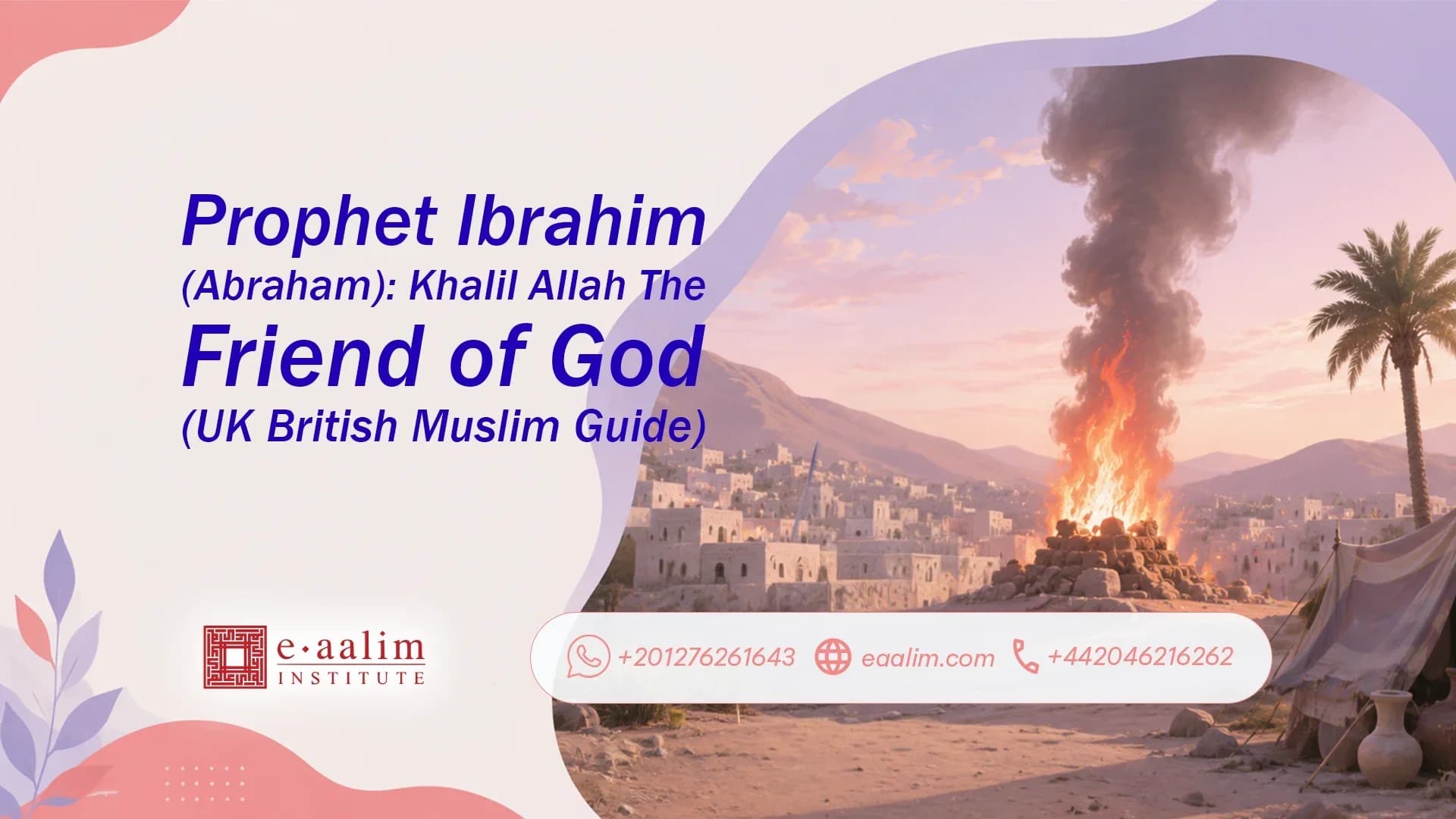
Unable to refute his argument, the people turned to violence instead. They therefore built a great fire and threw Ibrahim into it. Then, as the Quran tells us, Allah commanded the fire:
﴾قُلْنَا يَا نَارُ كُونِي بَرْدًا وَسَلَامًا عَلَىٰ إِبْرَاهِيمَ﴿
"We said, 'O fire, be coolness and safety for Ibrahim.'"(Quran 21:69)
Consequently, the fire became cold and safe, and Ibrahim walked out unharmed. Indeed, this is one of the great miracles of the prophetic line. Thus, it remains one of the moments most beloved in Muslim memory.
Migration, Sarah and Hajar
After the failure of his daʿwah in his homeland, Ibrahim ﷺ migrated with his wife Sarah and his nephew Lut ﷺ — first to Syria-Palestine, then to Egypt, then back to Syria.
The Quran preserves the dignity of Sarah, his first wife — see our Sarah profile.
Sarah remained childless for many years. She gave Ibrahim her Egyptian maidservant Hajar so that he might have a son. Hajar bore him Ismaʿil. Years later, by Allah's miracle, Sarah herself bore Ibrahim a second son, Ishaq, in her old age. From these two sons came the two great prophetic lineages of human history. E-Aalim tutors and teachers are dedicated, efficient, experienced and highly qualified arabic native speaker Al-Azhar graduates.
Hajar and Ismaʿil in the valley of Makkah
Allah commanded Ibrahim to leave Hajar and the infant Ismaʿil in the barren valley of Makkah — a place with no water, no people, no shelter. The classical narration preserved by Bukhari describes Hajar's question to her husband: "Did Allah command you to do this?" When he confirmed, she replied: "Then He will not abandon us."
When their water ran out, Hajar ran between the hills of Safa and Marwah seven times searching for water — the act commemorated by every Muslim performing Hajj or ʿumrah today as the saʿy.
Allah caused the spring of Zamzam to gush forth at the infant Ismaʿil's feet. The water still flows in Makkah today, fourteen centuries later, drunk by hundreds of millions of pilgrims annually.
From Hajar and Ismaʿil came the Arab tribes who eventually populated the Hijaz, and from those tribes came, fourteen generations later, the Prophet Muhammad ﷺ.
The great test — the sacrifice of Ismaʿil
When Ismaʿil reached an age to walk and work alongside his father, Ibrahim ﷺ saw in a dream that he was sacrificing his son. He told Ismaʿil. The Quran preserves the son's response (Surah As-Saffat 37:102): "O my father, do as you are commanded. You will find me, if Allah wills, of the steadfast."
Both submitted. As Ibrahim laid his son down to fulfil the divine command, Allah called out: "O Ibrahim, you have fulfilled the vision." A ram was sent in Ismaʿil's place. The act is commemorated by every Muslim every year at ʿEid al-Adha — the second of the two Eids, marked by the slaughter of an animal in remembrance of Ibrahim's submission.
The building of the Kaʿbah
Ibrahim ﷺ and his son Ismaʿil built (or rebuilt) the Kaʿbah in Makkah — the cubical building at the centre of the Sacred Mosque towards which every Muslim turns five times a day in prayer. The Quran preserves their duʿaʾ as they built (Surah Al-Baqarah 2:127–128): "Our Lord, accept this from us. Indeed, You are the Hearing, the Knowing."
This single act of obedience — two men in a desolate valley building a small structure — is the physical centre of the global daily prayer of 1.9 billion Muslims today.
His role in Muslim daily worship
Every Muslim in every prayer recites — in the second sitting of every salah — the Ibrahimic du'a: "O Allah, send blessings on Muhammad and the family of Muhammad, as You sent blessings on Ibrahim and the family of Ibrahim." No other prophet has this place in our daily worship. Prophet Muhammad's ﷺ companions asked him about the proper form of sending blessings on him, and the Sunnah he taught them places his own name and Ibrahim's together as a single act of devotion. The online learners and students at E-Aalim are kid, adult, male and female Muslims living mainly in the European countries and the USA.
Lessons from the Prophet Ibrahim story for British Muslim families
Tawhid through reason. Ibrahim ﷺ observed the stars, moon and sun and recognised that only their Creator deserves worship. His story teaches Muslim families to connect faith with reflection and reason.
Truth before pressure. Ibrahim respected his father but refused idolatry. Muslims can remain respectful without compromising their beliefs.
Trust in Allah. Hajar’s confidence that Allah would not abandon her is a powerful example of tawakkul during hardship.
Sacrifice requires faith. Ibrahim’s willingness to sacrifice his beloved son shows that obedience to Allah may require giving up what we value most.
Build for future generations. Ibrahim and Ismaʿil built the Kaʿbah, creating a legacy that continues today. Muslim families should likewise invest in faith, education and institutions that benefit generations to come.
Frequently asked questions
Where to go next
For more on Ibrahim's family, see our guides on his wife Sarah, the Egyptian connection through Maria the Copt, and the Quranic narrative of Ibrahim and the Four Birds. For the broader prophetic line, see our guides on Prophet Nuh, Prophet Musa, and Prophet ʿIsa. To study the Prophet Ibrahim story and other prophetic stories one-on-one with an Al-Azhar-graduate teacher, book a free trial lesson.
Start your journey with Eaalim today!
Start 2 Free Trials


 Share
ShareFrequently Asked Questions
Allah Himself called Ibrahim "Khalil" — Friend (Quran 4:125): "And Allah took Ibrahim as a friend." This is the only prophet honoured with this specific title in the Quran. The depth of his relationship with Allah, established through total submission and unwavering tawhid, earned him this divine designation.
After he broke the temple idols and could not be answered with reason, his people built a great fire and threw him in. Allah commanded the fire (Quran 21:69): "O fire, be coolness and safety for Ibrahim." The fire became cold and safe; he walked out unharmed. One of the great miracles of the prophetic line.
Allah commanded Ibrahim to leave Hajar and the infant Ismaʿil in the barren valley of Makkah. When their water ran out, Hājar ran between Safa and Marwah seven times searching for water. Allah caused the spring of Zamzam to gush forth at the infant's feet. Every Muslim performing Hajj or ʿumrah today commemorates Hajar's search by the saʿy ritual; the water of Zamzam still flows.
When Ismaʿil reached an age to walk and work alongside his father, Ibrahim dreamt that he was sacrificing his son. Both submitted to Allah's command. As Ibrahim laid Ismaʿil down, Allah called: "You have fulfilled the vision." A ram was sent in the boy's place. Every Muslim every year at ʿEid al-Adha commemorates this submission by slaughtering an animal.
