

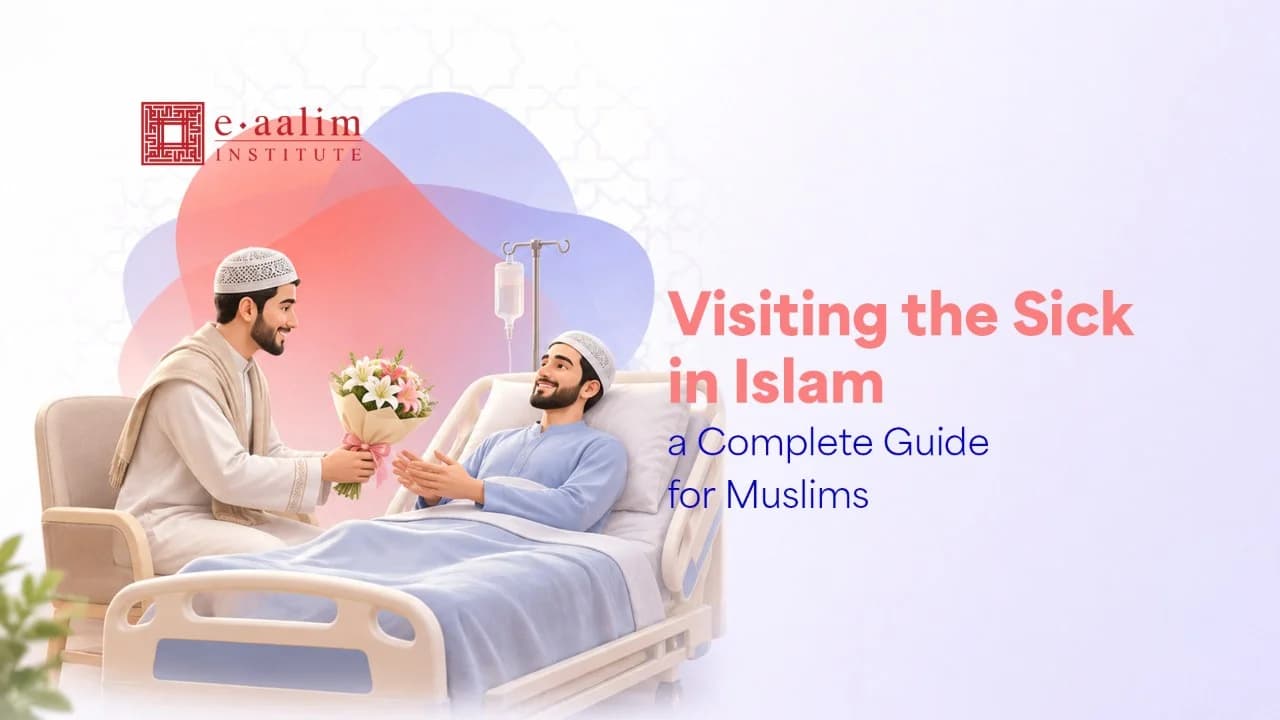
Visiting the Sick in Islam a Complete Guide for Muslims
By Mr. Ali Salama on 5/13/2026 · 15 min read
A simple visit can bring comfort to a struggling heart, strengthen the bonds of brotherhood, and earn immense rewards from Allah. This is the forgotten Sunnah of visiting the sick. The Prophet Muhammad ﷺ regularly visited the ill, teaching his Companions that caring for the sick is an act of worship, compassion, and communal responsibility. Classical scholars even considered it a communal obligation (fard kifāyah). Yet, in many British Muslim communities, this beautiful Sunnah has faded. This guide explores its spiritual rewards, prophetic etiquette, and practical revival in UK hospitals, care homes, and family visits in 2026.
The reward Allah promised the sick-visitor.
The Prophet ﷺ named visiting the sick in Islam as one of the rights a Muslim has on another Muslim. Additionally, in a hadith narrated by Bukhārī and Muslim, he listed five rights of one Muslim upon another. With visiting the sick named specifically as one of them. In another hadith, narrated by Imam Muslim (no. 2569), the Prophet ﷺ reported Allah saying on the Day of Judgment:
"O son of Adam, I was sick and you did not visit Me."
Besides, the astonished believer asks: "O Lord, how could I have visited You. And You are the Lord of the worlds?" Allah replies. "Did you not know that My servant so-and-so was sick? Had you visited him, you would have found Me with him."
Certainly, this is one of the most extraordinary hadiths in the entire prophetic literature. Allah ties His own presence — by His specific knowledge and mercy. Consequently, to the bedside of the sick believer. The British Muslim who visits the sick has, by the prophetic guarantee. Undoubtedly, found Allah waiting in that hospital room. The British Muslim who does not visit has missed an audience Allah Himself had arranged.
The walking angels.
Notably, the Prophet ﷺ added another remarkable detail in a hadith narrated by al-Tirmidhī (no. 969) and graded ḥasan:
"There is no Muslim who visits another Muslim in the morning except that seventy thousand angels make duʿāʾ for him until the evening. And there is no Muslim who visits another Muslim in the evening except that seventy thousand angels make duʿāʾ for him until the morning. And he will have a harvest in Paradise."
The mathematics is staggering. In addition, a British Muslim who visits a sick relative in a UK hospital on a Saturday morning has, by the prophetic standard. Seventy thousand angels making duʿāʾ for him from the moment of the visit until sunset. As a result, the same person who delays the visit and sends only a WhatsApp message has not earned this reward.
The Prophet ﷺ at Saʿd ibn ʿUbādah's bedside.
The biographical literature preserves several detailed descriptions of the Prophet's own sick visits. For this reason, one of the most famous is recorded in Bukhārī (no. 1304) and Muslim (no. 924). When the Prophet ﷺ learned that the senior Companion Saʿd ibn ʿUbādah (RA) was seriously ill. In short, he set out to visit him with four other Companions. ʿAbd al-Raḥmān ibn ʿAwf, Saʿd ibn Abī Waqqāṣ, ʿAbdullāh ibn Masʿūd, and others.
They walked into Saʿd's home and found him unconscious. Also, the Prophet ﷺ leaned over him with concern and began to weep. The Companions, seeing the Prophet ﷺ weep, wept with him. Moreover, when their tears became audible, the Prophet ﷺ raised his head and said, with characteristic precision:
"Allah does not punish for the tears of the eye, nor for the grief of the heart. He punishes for what comes from this". And he pointed to his tongue — "or, by it, gives mercy."
The classical scholars derived multiple lessons from this single visit. First, the Prophet ﷺ wept openly for his Companion — emotional presence is part of visiting . Second, he distinguished clearly between the spontaneous grief of the heart (which is not sinful) and what the tongue might produce in such moments (which can be either mercy or punishment). Third, he was physically there. Furthermore, he did not send a message. He walked across Madinah and sat by the bedside.
The Prophet ﷺ with Jābir ibn ʿAbdullāh.
Indeed, another visit, recorded in Bukhārī (no. 6723) and Muslim (no. 1616), shows a different dimension. When the young Jābir ibn ʿAbdullāh (RA) was severely ill. Importantly, the Prophet ﷺ visited him with Abū Bakr (RA). They walked the distance on foot. Clearly, when they arrived, the Prophet ﷺ found Jābir unconscious. Without speaking, he performed his wuḍūʾ and gently sprinkled the water on Jābir. Additionally, by Allah's permission, Jābir revived and recovered. The hadith goes on to record Jābir asking the Prophet ﷺ about the question of inheritance. Besides, the verse of al-Kalālah in Surah al-Nisāʾ came down in response.
The lesson the classical scholars drew is precise. Certainly, the Prophet ﷺ did not visit and leave. He combined the visit with action — water, du'a, presence, conversation. Consequently, the visit was not a performance; it was a genuine engagement with the sick person's reality.
The Prophet ﷺ and the Jewish boy.
One of the most remarkable sick visits in the prophetic biography is recorded in Imam al-Bukhārī. Undoubtedly, a young Jewish boy had served the Prophet ﷺ in some capacity. When the Prophet ﷺ learned he was ill, he went to visit him. Notably, the Prophet ﷺ sat by his bedside and invited him gently to Islam. The boy looked at his father, who said. "Obey Abū al-Qāsim." The boy accepted Islam and died shortly afterwards. The Prophet ﷺ left the home saying. "Praise be to Allah, who saved him from the Fire through me."
In addition, for British Muslim families in 2026 navigating mixed-faith communities, the lesson is direct. The Sunnah of visiting the sick in Islam is not restricted to Muslims. As a result, the Prophet ﷺ visited a Jewish boy. He visited his polytheist uncle Abū Ṭālib in his final illness. For this reason, the Sunnah extends to neighbours, colleagues, and acquaintances of any background. The dignity, kindness and du'a appropriate to each visit will differ. But the practice of going is the same.
The classical adab of visiting the sick.
In short, the classical scholars, particularly Imam al-Nawawī in al-Adhkār and Imam Ibn al-Qayyim in his various works. Derived a structured list of adab from the prophetic example. Also, the most important elements, adapted for UK British Muslim families:
1. Be timely.
The classical scholars said the sick should not be visited at the very beginning of an illness (which may be merely a passing cold) nor neglected as the illness becomes serious. The right timing is when the illness has lasted long enough to warrant a visit but not so long that the visit comes only when the person is dying. For UK British Muslim families. Moreover, this means visiting within a few days of learning about a serious illness, not waiting weeks or months.
2. Keep the visit short.
The Prophet's own visits were notable for their brevity. Furthermore, he did not stay long. The classical scholars recommended visits of around fifteen to thirty minutes. Indeed, long enough to express care, exchange words, and make duʿāʾ; short enough not to exhaust the patient. The British Muslim who arrives at a UK hospital room and stays for two hours has misunderstood the Sunnah.
3. Make duʿāʾ for the sick person.
Importantly, the Prophet ﷺ used to make a specific duʿāʾ when visiting the sick, preserved in Bukhārī (no. 5742):
"Adhhibi al-baʾs, Rabb al-nās — ishfi anta al-Shāfī, lā shifāʾa illā shifāʾuk, shifāʾan lā yughādiru saqamā."
"Remove the harm, O Lord of mankind. Clearly, cure, You are the Healer — there is no cure except Your cure. A cure that leaves no illness behind."
Additionally, the classical scholars recommended reciting this duʿāʾ over the sick person. Ideally placing the hand on their forehead or where the pain is. Besides, with the sincerity that the Prophet ﷺ himself brought to it.
4. Encourage hope and patience.
The Prophet ﷺ told the sick that their illness was a purification: "No Muslim is afflicted with harm. Certainly, illness, fatigue, anxiety, grief or distress, even the prick of a thorn. Except that Allah expiates by it some of his sins" (Bukhārī and Muslim). Consequently, the British Muslim visiting the sick in Islam should remind them gently of this prophetic promise. Not in a way that minimises their pain. But in a way that places it within the framework of Allah's mercy.
5. Avoid emphasising the seriousness.
Undoubtedly, the Prophet ﷺ said, in a hadith narrated by al-Tirmidhī. "When you visit a sick person, give him good news about his life. Even though that does not change what has been decreed." The classical commentators explained that this means encouraging the sick person about recovery. Longer life, and Allah's mercy. Notably, even when the medical prognosis is poor. The visit is not the place to discuss death, will-writing. In addition, or family logistics unless the patient themselves raises them.
6. Bring something useful, when appropriate.
The Companions often brought practical help to the sick. As a result, food, water, financial support if the sick person could not work. For British Muslim families today. For this reason, this might mean cooking a meal for the family of a hospitalised relative, dropping off groceries. Or organising shifts so the sick person's spouse can rest. The visit need not be empty-handed.
7. Practical help over symbolic presence.
In short, visiting the sick in Islam is not just about the visit itself. The Sunnah extends to practical follow-up. Covering the sick person's responsibilities while they recover. Also, checking on their family, ensuring they have access to good medical care. A British Muslim community that visits beautifully but disappears the moment the visit ends has not fully lived the Sunnah.
The UK realities of sick visiting in 2026.
For British Muslim families today. Moreover, the practical realities of visiting the sick in the UK require some specific considerations:
NHS hospital visiting.
UK hospitals have specific visiting policies. Furthermore, visiting hours, restrictions on the number of visitors. Sometimes restrictions during infection outbreaks (the post-COVID protocols are still operating in many UK hospitals). Indeed, british Muslim visitors should check with the ward before arriving. The Sunnah is performed within the rules of the institution; UK hospitals are not negotiable spaces.
Care homes.
Importantly, for British Muslim families with elderly relatives in UK care homes. Which is increasingly common as the first generation of British Muslim immigrants reaches old age. Regular visiting is one of the most important applications of this Sunnah. Clearly, uK care home residents often face significant loneliness; British Muslim residents face additional cultural and religious isolation. The visit of family and community can transform their daily lives.
Home visits.
Additionally, for the sick recovering at home, British Muslim visitors should call ahead. Time the visit to suit the patient's energy, bring food if appropriate to the family. Besides, and observe basic adab around removing shoes, sitting where indicated, and not overstaying. UK British Muslim culture has often been particularly good at this. Certainly, the recovery is in maintaining it as community sizes grow and individual connections weaken.
Mental illness.
The Sunnah of visiting the sick applies to mental illness as much as to physical illness. Consequently, a British Muslim with depression, severe anxiety, OCD or other mental health conditions deserves the same prophetic visit-and-care. The visit may look different — gentler, perhaps less verbal, more about presence than activity. But the principle is the same. Undoubtedly, mental illness should never be a reason a British Muslim is left alone.
Children and the sick.
British Muslim parents should involve children in Sick visits from a young age. Notably, a child who learns at six that we visit sick relatives. Who at eight is taught the prophetic du'a for the sick. In addition, who at twelve helps the family deliver food to a hospitalised neighbour. Has absorbed the Sunnah by the time they are an adult. The child who has never been to a UK hospital with a parent on a sick visit has not been fully formed in this dimension of Islam.
The mistake of digital substitution.
As a result, one of the most common failures of contemporary UK British Muslim community life is the substitution of digital messaging for actual sick visiting. A WhatsApp message saying "May Allah grant you shifa" is good. It is not, however, a substitute for the Sunnah the Prophet ﷺ described. For this reason, the hadith of seventy thousand angels making duʿāʾ for the visitor specified the visit, not the message. The Allah-presence-at-the-bedside hadith specified the visit, not the message.
In short, for British Muslim families in 2026, the corrective is straightforward. When someone is seriously ill, send the message and arrange the visit. Also, the two are not in competition. The message keeps the connection alive in the meantime. Moreover, the visit fulfils the Sunnah Allah has promised the reward for.
Visiting the dying and the bereaved.
The Sunnah extends to visiting in two specific extended categories. The first is visiting someone who is dying. Furthermore, the prophetic guidance is to gently encourage them to say the Shahadah, to remind them of Allah's mercy. And to make duʿāʾ for them. The second is visiting the recently bereaved family in the days following a death. Indeed, the Prophet ﷺ used to visit the families of his deceased Companions, comfort them. And remind them of the rewards of patience.
Importantly, for British Muslim families in the UK, both of these visits matter. Death in a UK hospital, particularly when the bereaved family is spread across the country or abroad. Clearly, can be an isolating experience. The community presence of fellow British Muslims. Additionally, bringing food, attending the janāzah, visiting the family during the ʿiddah (the formal mourning period for a widow). Helping with practical funeral logistics. Besides, is the Sunnah extending into the most painful moments of a believing family's life.
What this builds in a British Muslim community.
A community that visits its sick well is a community that is structurally healthier than one that does not. Certainly, the classical scholars noted that the practice of Sick visits:
Builds horizontal connections. Families come to know each other through the practical care of visiting.
Consequently,
Reminds the visitors of their own mortality. Walking out of a UK hospital after visiting an ill relative recalibrates the visitor's priorities.
Strengthens the sick person's faith. Knowing the community has come to visit reminds the sick that they have not been abandoned.
Undoubtedly,
Produces angelic du'a for the visitor. By the prophetic guarantee. Seventy thousand angels make du'a from morning to evening.
Notably,
Earns the audience with Allah that the famous hadith describes. Allah is. By His specific knowledge, present at the bedside of His ill servant.
In addition, none of these benefits are achievable by the visitor who never goes.
A British Muslim weekly practice.
For British Muslim families wanting to make Sick visits in Islam a structured part of community life. As a result, here is a practical pattern:
Frequency — Practice.
For this reason,
Whenever you learn of a serious illness: Within 3-5 days, make the visit. Combine with a WhatsApp message if appropriate, but do not let the message replace the visit.
Weekly, where applicable: If a relative or close friend is in extended hospital or care home stay. In short, visit weekly if at all possible.
Monthly: Identify one British Muslim neighbour or community member who has been chronically ill. Also, and add them to your monthly visit rota.
During Ramadan: Make sick visiting part of the month. Moreover, particularly to elderly British Muslims who may be alone during a holy time meant for community.
At Eid: Visit those who could not attend Eid prayer due to illness. This is one of the most rewarded Eid visits possible.
Furthermore,
Always: Teach children to come. Let them learn the Sunnah by walking into UK hospital rooms with their parents.
A new module: the Adab of Sick visits in Islam with Eaalim.
Discover the Islamic teachings and prophetic etiquette of Sick visits, one of the most rewarding yet neglected Sunnahs.
Eaalim introduces a new module within its Islamic Studies series, designed for British Muslim families and adult learners. Taught in English by Al-Azhar-certified teachers, this structured course explores:
Prophetic guidance: Authentic hadiths, the rewards of visiting the sick, and examples from the Prophet's ﷺ life.
Islamic etiquette: The seven elements of classical adab, including timing, brevity, comforting words, du'a, and practical support.
Essential supplications: Du'as for the sick, dying, and bereaved.
UK practical guidance: Visiting patients in NHS hospitals, care homes, and homes, including supporting Muslims with mental illness.
Register your interest or book a free trial lesson to learn how to revive this beautiful Sunnah in everyday life.
Start your journey with Eaalim today!
Start 2 Free Trials


 Share
Frequently Asked Questions
The Prophet named visiting the sick as one of the rights a Muslim has on another. In a hadith narrated by Imam Muslim, Allah says on the Day of Judgment that He was sick and the believer did not visit Him, explaining that had the believer visited His sick servant, he would have found Allah with him. In another hadith narrated by al-Tirmidhi and graded hasan, a Muslim who visits another in the morning has seventy thousand angels making du'a for him until evening, and likewise from evening until morning.
No. The article cites the Prophet's example of visiting a young Jewish boy who had served him, sitting by his bedside and gently inviting him to Islam, after which the boy accepted and the Prophet praised Allah for saving him from the Fire. The Prophet also visited his polytheist uncle Abu Talib in his final illness. The Sunnah extends to neighbours, colleagues and acquaintances of any background, with the dignity, kindness and du'a appropriate to each visit differing while the practice of going remains the same.
The classical scholars derived a structured adab from the prophetic example. One should be timely, visiting within a few days of a serious illness, and keep the visit short, around fifteen to thirty minutes, long enough to express care but not exhaust the patient. One should make du'a for the sick person, encourage hope and patience, avoid emphasising the seriousness of the illness, and where appropriate bring practical help such as a cooked meal. Follow-up support after the visit is also part of the Sunnah.
The article states that a message wishing someone shifa is good but is not a substitute for the Sunnah the Prophet described. The hadith of seventy thousand angels and the hadith of Allah's presence at the bedside both specified the visit, not the message. The corrective for British Muslim families is straightforward: when someone is seriously ill, send the message and arrange the visit, since the two are not in competition, with the message keeping the connection alive in the meantime.
