


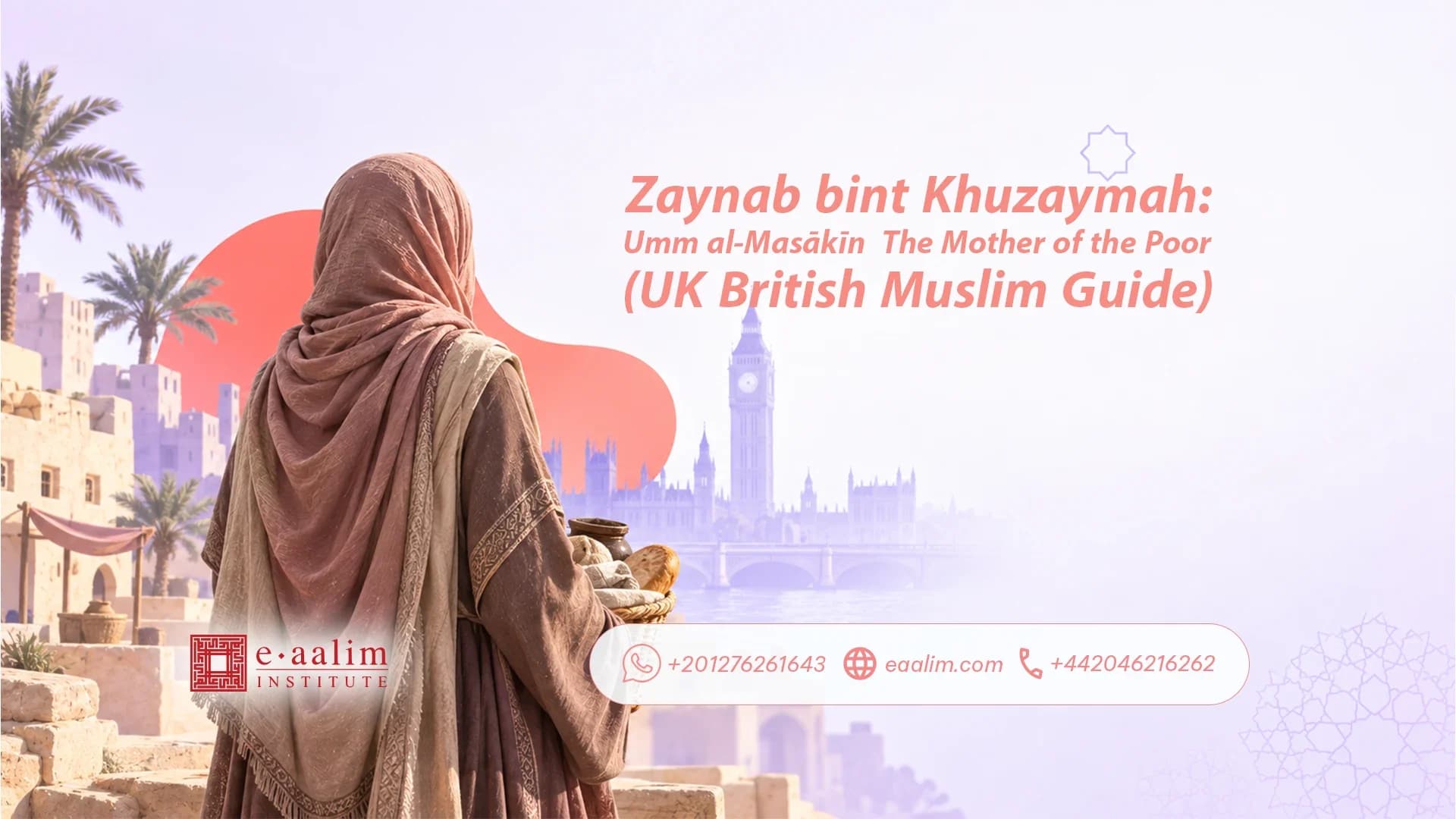
Zaynab bint Khuzaymah: Umm al-Masakin — The Mother of the Poor (UK British Muslim Guide)
By Eaalim Institute on 4/29/2026 · 8 min read
Zaynab bint Khuzaymah (RA) is one of the eleven Mothers of the Believers. She was the only one historically known by a title rather than primarily by name: Umm al-Masākīn — "Mother of the Poor". In fact, she earned this title through her constant, public, well-known charity to the poor. Her marriage to the Prophet ﷺ was the briefest of all his marriages — only for a few months. Yet Islamic history preserves her name because of the spiritual weight she carried in those few months. This piece tells her story.
Zaynab bint Khuzaymah: Brief Facts
Zaynab bint Khuzaymah was not from Quraysh, which makes her a unique woman among the wives of the Prophet ﷺ: she was the first to come from outside his tribe. Her full name was Zaynab bint Khuzaymah ibn al-Ḥārith al-Hilāliyyah, of the Banū Hilāl, a branch of the great Banū ʿĀmir ibn Ṣaʿṣaʿah. Born around 595 CE, she was already known as Umm al-Masākīn, the Mother of the Poor. She married the Prophet ﷺ in about 3 AH (625 CE), with a mahr of 400 dirhams in some reports. Just a few months later, she passed away at around 30 and was buried in al-Baqīʿ.
Background
Zaynab bint Khuzaymah was born around 595 CE into the Banū Hilāl tribe, a branch of the larger Banū ʿĀmir ibn Ṣaʿṣaʿah. Her father was Khuzaymah ibn al-Ḥārith. She was approximately 30 years old when she married the Prophet ﷺ. Moreover, classical works such as Ibn Saʿd’s al-Ṭabaqāt al-Kabīr, Ibn Hishām’s al-Sīrah, and al-Ṭabarī’s Tārīkh record her life.
Her first marriages
The classical sources name several husbands before the Prophet ﷺ, and the reports differ:
Jahm ibn ʿAmr ibn al-Ḥārith — her cousin, in some accounts
ʿAbdullāh ibn Jaḥsh — in some accounts, a marriage that ended before his martyrdom at Uḥud
Al-Ṭufayl ibn al-Ḥārith — divorced
ʿUbayda ibn al-Ḥārith — al-Ṭufayl’s brother and one of the early Muslims, more than thirty years her senior. They emigrated together to Madinah in 622 CE. He was martyred at the Battle of Badr, leaving her a widow.
By the time of her marriage to the Prophet ﷺ, she had endured several marital separations. By the prevailing standards of her time, many would have overlooked her for marriage. Her acceptance of marriage to the Prophet ﷺ, and his accepting her despite her previous marriages, became a model. It guides British Muslim families considering the remarriage of widows and divorced women.
The title "Umm al-Masakin"
Even before she embraced Islam, people widely knew Zaynab as Umm al-Masākīn — Mother of the Poor. In other words, the title pre-existed the marriage. It was not a courtesy honorific; she earned it through observable, sustained, public charity:
She regularly fed the destitute from her own household provisions
She would seek out the orphaned and widowed who lacked support
She gave priority to the poor over her own consumption
The destitute of Madinah identified her as their consistent supporter
For a woman of moderate means (not enormous wealth) to earn this title is significant. Someone asked the Prophet ﷺ which charity is best, and he replied: "The effort of one who has little" (Abū Dāwūd). Zaynab embodied this. Later biographies relate that a poor man once came to her door asking for flour; she gave him the last she had and went to sleep without food herself.
The marriage to the Prophet ﷺ
The Prophet ﷺ married her in approximately 3 AH (625 CE), about a month after his marriage to Ḥafṣah and nearly a year after her widowhood from ʿUbayda. Her cousin Qabīṣa ibn ʿAmr, the brother of her first husband Jahm, arranged the marriage. The Prophet ﷺ gave her a mahr of 400 dirhams; other reports say twelve and a half ūqiyya. The marriage was, in part, an act of welfare — providing for a widowed Muslim woman whose husband had died in service of the Muslim community.
Indeed, this pattern — the Prophet ﷺ marrying widows of Companions killed in battle to provide for them — appears multiple times across his marriages. Many of his marriages were not of romantic preference but of communal welfare and political alliance.
Her brief marriage
Zaynab lived only a few months after the marriage. However, the exact duration varies in classical accounts: 2-3 months according to some, up to 8 months according to others. She died during the Prophet's ﷺ lifetime — making her, along with Khadījah (RA), one of only two of his eleven wives to predecease him.
Afterwards, the Prophet ﷺ led her funeral prayer. Then the Muslims buried her in the Baqīʿ cemetery of Madinah, where she rests today. Three of her brothers went down into the grave to lay next to her to rest. Her room beside the mosque stayed empty for about six months, until Umm Salama (RA) moved into it.
Why her brief marriage matters
Despite the short duration, her status as a Mother of the Believers is identical to that of the longer-married wives:
The title applies regardless of marriage duration — once married to the Prophet ﷺ, she became Mother of the Believers permanently
Her status applies forever — Allah forbade marriage to any Mother of the Believers after the Prophet's ﷺ death (al-Aḥzāb 33:53)
She receives the same honorific in Islamic history — alongside ʿĀʾishah, Umm Salama, Khadījah, and the others
In short, the lesson: Allah does not measure spiritual status by the length of any role, but by the sincerity and consequence of the role.
What we know about her character
The classical sources preserve relatively few specific narrations from Zaynab. This is because of her brief time in the Prophet's ﷺ household and because she died so early in the Madinan period. What we know:
Compassionate — the Umm al-Masākīn title was not casually given
Patient through difficult life circumstances — several divorces and a widowhood before her marriage to the Prophet ﷺ
Quietly devout — no narrations preserve her seeking attention or status
Generous beyond her means — gave from limited resources to those with even less
What the Sunnah emphasises through her case
Sincere charity is often recognised by people before any formal honour — her title pre-existed her status as a Mother of the Believers
Welfare-driven marriages have prophetic precedent — the Prophet ﷺ married widows specifically to support them
A previously married woman’s worth is not diminished — Zaynab had been married before, yet the Prophet ﷺ honoured her despite the cultural expectation that such women would not remarry
Brief lives can carry enormous weight — her few months as a Mother of the Believers do not diminish her permanent status
Lessons for British Muslim families
For widows
Widowhood is not the end of religious life. The Prophet ﷺ married widows and honoured their second chapters. Therefore, British Muslim widows considering remarriage should know there is no Islamic shame; the Prophet’s ﷺ household was full of widows.
For divorced and remarried British Muslim women
Zaynab had been divorced and widowed before she married the Prophet ﷺ. The Sunnah did not treat her past marriages as a disqualification. British Muslim communities should examine their own implicit stigma around remarriage.
For those with limited income but generous hearts
Zaynab was not wealthy. Even so, she gave from limited means. The Prophet ﷺ honoured this above great wealth given grudgingly. British Muslims with modest UK incomes who consistently support the destitute — through Penny Appeal, Islamic Relief, food bank donations, supporting refugees — stand in her tradition.
For those whose lives feel "too short" to matter
Zaynab’s marriage to the Prophet ﷺ lasted only a few months. Nevertheless, her status as Mother of the Believers is permanent. Some British Muslims face terminal diagnoses, late-life Islamic awakening, or limited time. They should know that their brevity does not diminish the spiritual status earned in those moments.
For the wider community
Finally, notice and honour the consistent quiet givers in your local UK mosque community. Her community identified Zaynab before the Prophet ﷺ formally honoured her. The community recognition of charitable workers is itself an Islamic act.
Closing
Zaynab bint Khuzaymah is the Mother of the Believers whose entire historical identity rests on charity to the poor — sustained, public, recognised, and honoured. Her marriage to the Prophet ﷺ was brief; her name in Islamic history is permanent. Teach her story to your British Muslim daughters as a model of generosity from limited means. Book a free Eaalim Qur'ān class to deepen your study of the prophetic household.
Start your journey with Eaalim today!
Start 2 Free Trials


 Share
ShareFrequently Asked Questions
One of the eleven Mothers of the Believers. Born around 595 CE in Makkah, of the Banū Hilāl tribe. Famous as Umm al-Masākīn — Mother of the Poor — for her constant charity to the destitute of Madinah, even before her marriage to the Prophet ﷺ.
She earned the title before her marriage to the Prophet ﷺ through observable, sustained charity. She regularly fed the destitute from her own household provisions, sought out orphaned and widowed who lacked support, and gave priority to the poor over her own consumption. The destitute of Madinah identified her as their consistent supporter.
Two. al-Ṭufayl ibn al-Ḥārith (divorced) and ʿUbayda ibn al-Ḥārith (one of the early Muslims, killed in battle). She was widowed when the Prophet ﷺ married her in approximately 4 AH.
Brief — between 2-3 months and up to 8 months according to varying classical accounts. She died during the Prophet's ﷺ lifetime, making her, along with Khadījah (RA), one of only two of his eleven wives to predecease him.
No. Once married to the Prophet ﷺ, she became Mother of the Believers permanently. Allah forbade marriage to any Mother of the Believers after the Prophet's ﷺ death (al-Aḥzāb 33:53). Her status applies forever, regardless of marriage duration.
Yes — in part. The Prophet ﷺ married her after her widowhood from ʿUbayda specifically to provide for a widowed Muslim woman whose husband had died in service of the Muslim community. Many of his marriages followed this pattern.
Zaynab was approximately 50 at her marriage to the Prophet ﷺ. The Sunnah did not treat her age as a disqualification. British Muslim widows considering remarriage should know there is no Islamic shame; the Prophet's ﷺ household was full of widows.
Zaynab was not wealthy. She gave from limited means. The Prophet ﷺ honoured this above great wealth given grudgingly. British Muslims with modest UK incomes who consistently support the destitute — through Penny Appeal, Islamic Relief, food bank donations, supporting refugees — stand in her tradition. Book a free Eaalim Qur'ān class at eaalim.com/free-trial to deepen your study of the prophetic household.
