

Ikhfaa Shafawi Explained in 5 Simple Points — A UK Guide (2026)
By Eaalim Institute on 6/25/2026 · 5 min read
For British Muslim families learning Tajweed — clear, simple, and example-led.
Ikhfaa Shafawi is one of the easiest Tajweed rules to learn, yet many beginners find it confusing. If you are a British Muslim parent helping a child read, a working adult improving your recitation, or a revert starting the Qur'an, this guide explains Ikhfaa Shafawi in a clear, simple, and example-led way
* What "Ikhfaa Shafawi" means
The term has two parts, and each part tells you something.
Ikhfaa means to hide. The sound is not pronounced fully and clearly, and it is not merged completely either. It sits gently in between — hidden.
Shafawi means of the lips (from the Arabic word shafah, meaning lip). It is so called because the letter involved — the mim (م) — is made with your two lips.
So the rule= "the hiding made with the lips". It is one of the three rules of the mim sakinah (a mīm carrying a sukoon sign, مْ).
Ikhfaa Shafawi: The One Letter That Triggers It
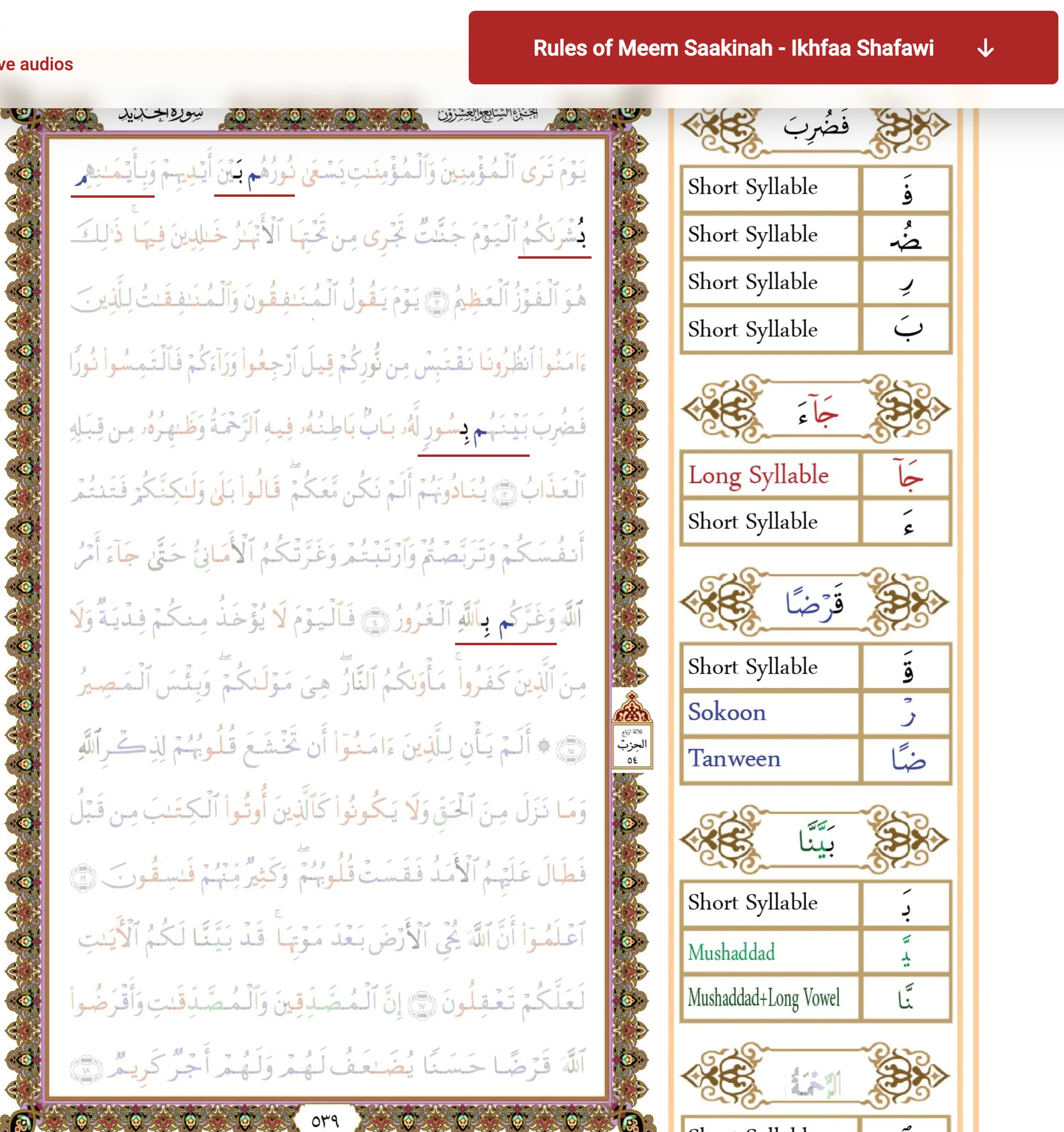
It happens before only one letter. This is the easiest part of the rule.This rule happens before only one letter.
The letter ba' (ب)
That's it. Just one. Whenever a mim sakinah (مْ) is followed by a ba' (ب), you apply this rule. You do not need to memorise a long list — only "meem sakinah, then ba'".
How to Apply such a rule Correctly
Here is the rule in one simple sentence:
When a meem sakinah (مْ) is followed by a ba' (ب), hide the meem with a ghunnah for two counts.
What does "hide" mean here in practice?
First, Your two lips come close together, but you do not press them shut hard like a normal mīm.
Second, You release a soft ghunnah — a gentle nasal hum through your nose.
Then, You hold that hum for about two counts (roughly one and a half to two seconds).
Finally, Then you move into the ba'.
The reader does not lose the meem completely, and they do not press it firmly. The reader softens and hides, with the nasal Ghunnah carrying the sound across to the ba'.
Examples from the Qur'an on this rule:
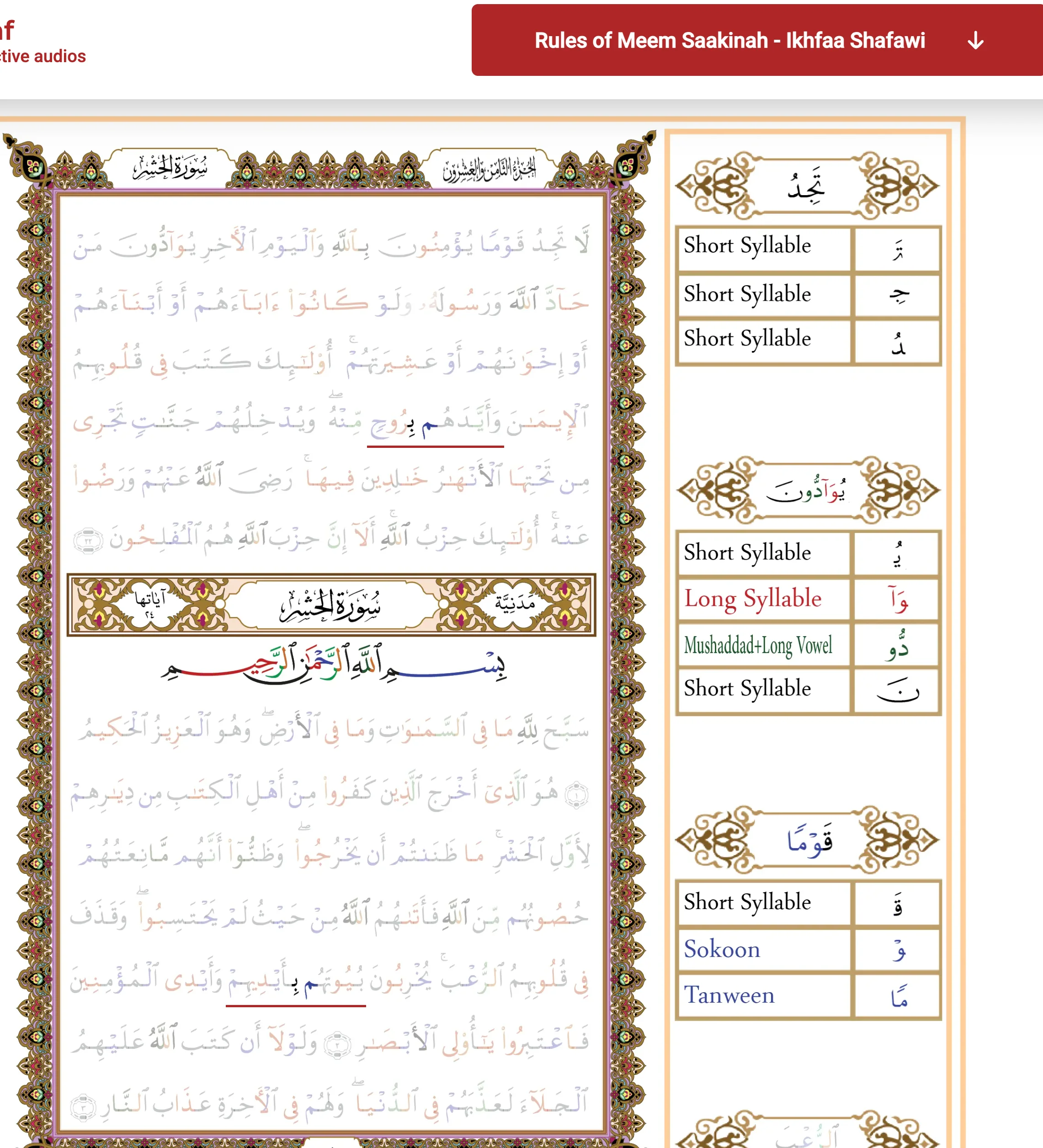
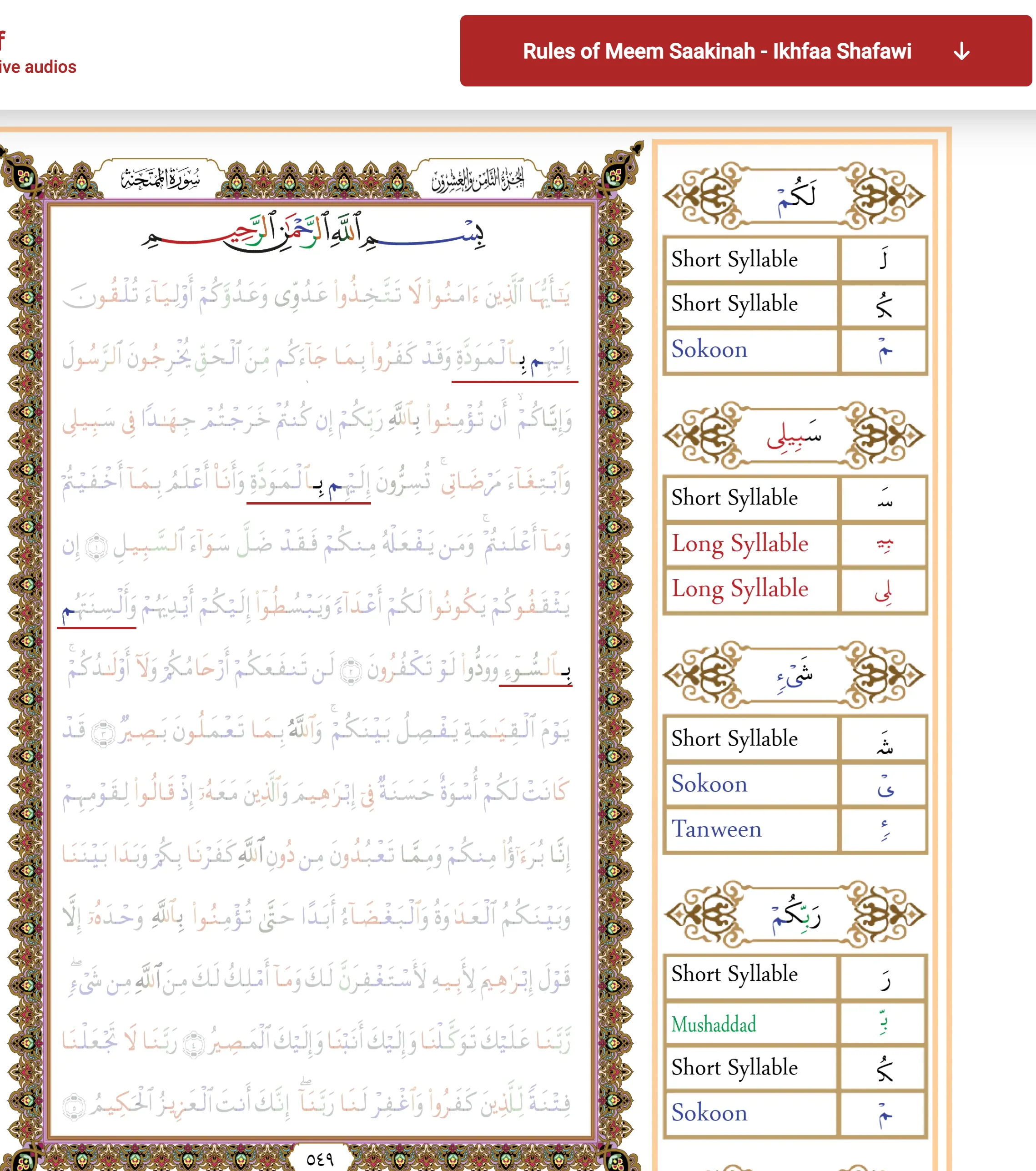
For example, the following verses show you how to apply Ikhfaa Shafawi. Read each one slowly, holding the gentle Ghunnah on the hidden mim:
﴿تَرْمِيهِم بِحِجَارَةٍ﴾ — "tarmihim bi-ḥijarah". You hide the mim at the end of "tarmihim", with a two-count Ghunnah, before the ba' of "bi-ḥijarah".
﴿وَمَا لَهُم بِذَٰلِكَ﴾ — "wa-ma lahum bi-dhalik". You hide the meem of "lahum" before the ba'.
﴿يَعْتَصِم بِاللَّهِ﴾ — "yaʿtasim billah". The meem is hidden, with ghunnah, before the ba'.
﴿أَلَمْ يَجْعَلْ كَيْدَهُمْ﴾ — here the meem is NOT before a ba', so this is not Ikhfaa Shafawi (it is the clear rule). Watch the next letter every time.
Notice the pattern: a soft, Ghunnah meem that gently leads into the ba' — never a hard, fully-closed meem.
Common Mistakes applying this rule:
However, two slight mistakes are very common among British learners.
Pressing the lips too hard. If you shut your lips firmly, you turn the hidden meem into a clear mim. The lips should come close but stay soft and slightly open.
Forgetting the ghunnah. Some learners rush and drop the nasal Ghunnah. The two-count ghunnah is the heart of this rule — do not skip it.
And here is the honest truth: a book or video cannot tell you whether your lips are too tight or your Ghunnah is too short. Only a teacher who can hear you can correct these tiny details in real time — and one good correction can fix the habit for life.
A simple two-week plan:
Then, follow this simple two-week practice plan:
Days 1–3: Remember the one trigger — You follow meem sakinah by ba'.
Days 4–7: Open the short surahs and mark every meem sakinah that comes before a ba'.
Days 8–10: Read those words aloud — soft lips, gentle two-count Ghunnah.
Days 11–14: Take a short live lesson and let a teacher confirm your lips and Ghunnah are correct.
At Eaalim, our Al-Azhar certified teachers teach British Muslim families one-on-one, online, on UK time slots (GMT and BST), with pricing in pounds and a genuine free trial — no card needed, just a real lesson with a real teacher.
Start your free trial: Learn Quran Online (UK)
Build it into a full pathway: 50-Hour Tajweed UK course
For children aged 5–14: Kids UK programme
Finally, Ikhfaa Shafawi means "hiding with the lips"...: It means "hiding with the lips". It has only one trigger — a meem sakinah comes before a ba'. Bring your lips close (not shut), hum a soft ghunnah for two counts, then move into the ba'. Master this one gentle rule, and your recitation becomes noticeably smoother and more beautiful.
May Allah make the Qur'an easy to your tongue and beloved to your heart. Āmīn.
Start your journey with Eaalim today!
Start 2 Free Trials


 Share
Frequently Asked Questions
It is a rule of the mīm sākinah (مْ). When a mīm sākinah is followed by the letter bā' (ب), the mīm is hidden — the lips come close but do not press shut — with a soft nasal sound (ghunnah) held for two counts.
How long is the Ghunnah?
'Shafawi' means 'of the lips', from the Arabic word shafah (lip). It is called this because the mīm is pronounced with the two lips.
