


Learn the Quran as a revert in the UK: a calm, practical guide
By Eaalim Institute on 10/17/2026 · 13 min read
What if your first step in Quran learning isn’t memorising a set of letters, but understanding where you’re starting from? If you’re searching for ways to learn Quran for reverts UK, it’s natural to wonder whether to begin with Arabic letters, reading or recitation, and to feel nervous about making mistakes along the way.
You don’t need prior knowledge or a perfect routine before you begin. A supportive lesson can meet you at your current level, giving you room to practise, ask questions and build confidence at a manageable pace. Eaalim’s individual online Quran lessons are tailored to each learner, with qualified tutors guiding recitation and Tajweed without assuming you already know the basics.
This guide explains how to choose a first learning step, how reading and recitation skills can develop, and how to build a routine around work, family and everyday commitments. The aim isn’t to rush, but to make steady learning feel possible in your life.
Key Takeaways
- Start from your current reading experience, whether you’re recognising Arabic letters or practising recitation.
- Learning can move from letter recognition towards supported Quran reading, without a fixed timetable.
- Quran tuition, mentoring and broader Islamic studies serve different purposes as you learn Quran for reverts UK.
- Build a manageable study rhythm around work, family and other commitments, with brief practice between lessons.
- Eaalim’s live, one-to-one online lessons provide individual guidance in recitation and Tajweed at your pace.
Starting to learn the Quran as a revert in the UK: what comes first?
There isn’t one starting point that suits every new Muslim. You might already recognise Arabic letters, read a little, or be meeting the script for the first time. Choose your first step based on what feels familiar now, rather than assuming every learner follows the same route.
Here, Quran learning means developing the skills to read and recite the Quran, rather than trying to master every aspect of Islam at once. Questions about belief and daily practice matter too, but they don’t all need to be answered in your first reading lesson. People use both “convert” and “revert”; the linked overview of Conversion to Islam offers background on the terminology and process.
Quran learning can begin at any reading level and progress gradually. If you’re looking for ways to learn Quran for reverts UK, consider what you can currently do with Arabic letters, reading and recitation. A tutor can help identify a useful next step, instead of measuring you against an imagined standard.
- If Arabic script is unfamiliar, begin by recognising letters and their sounds.
- If you know the letters, practise how they connect and change shape in words.
- If you can already read, work on recitation, pronunciation and Tajweed with guidance.
Do I need to know Arabic before learning the Quran?
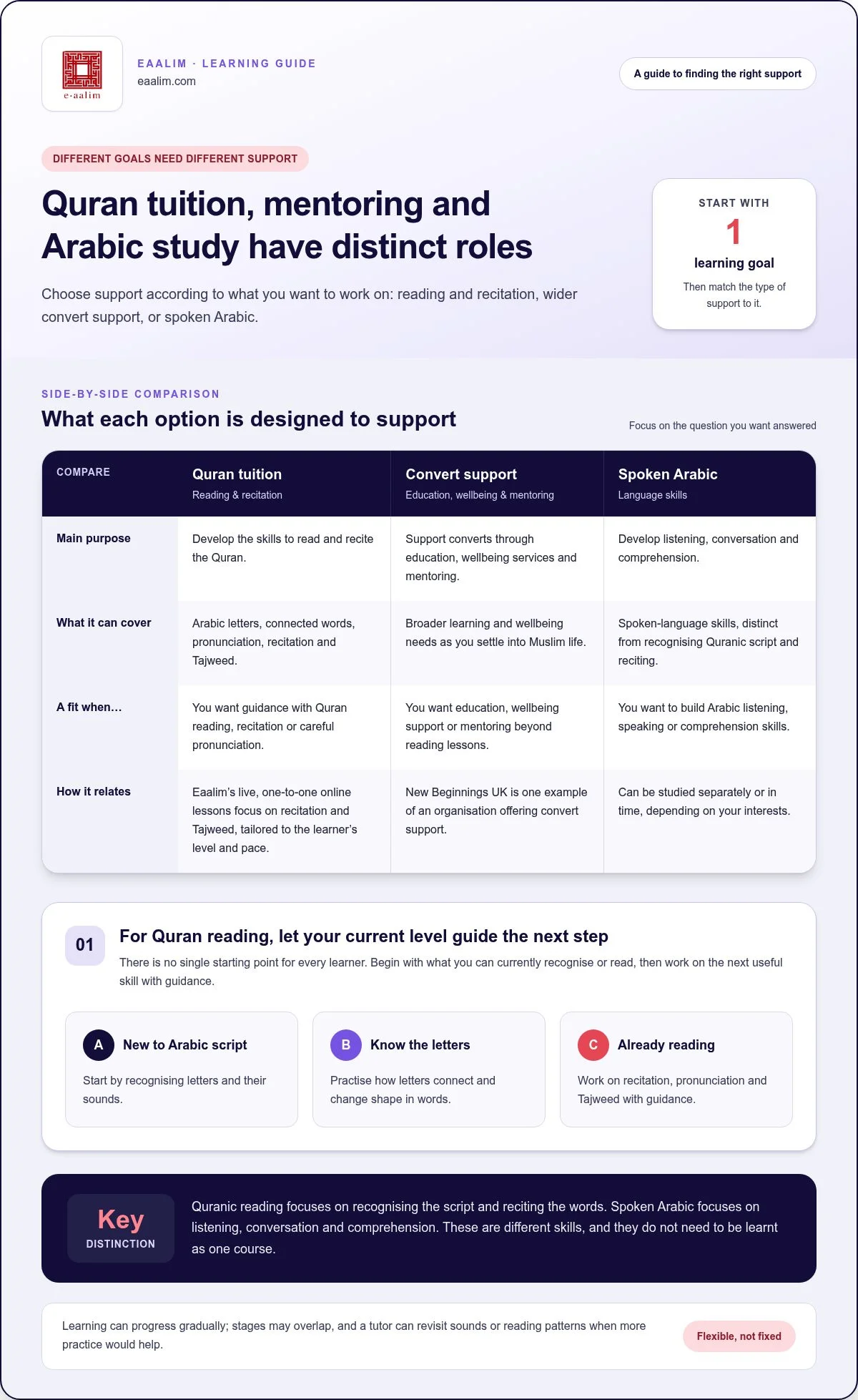
No prior Arabic reading knowledge is needed to begin. Early lessons can introduce the Arabic letters, their sounds and how they join together in written words. Learning to read Quranic Arabic is different from learning to understand spoken Arabic: reading focuses on recognising the script and reciting the words, while spoken-language study develops listening, conversation and comprehension. You can study those skills separately or in time, depending on your interests.
What can a beginner expect from a first lesson?
A first lesson gives a tutor a chance to understand your reading and recitation experience, whether you’re starting with the alphabet or already trying short passages. You can explain what you hope to learn and mention anything that feels uncertain, such as pronunciation or reading aloud. With live, individual online tuition, the lesson can be tailored to your level and pace. It’s a way to find a suitable starting point, not a test.
Mistakes are a normal part of practice. An unfamiliar word or a sound that needs another attempt gives you and your tutor something specific to work on. If you’re unsure how to describe your level, say what you can recognise or read so far. That’s enough to begin a useful conversation about your next step.
How Quran reading and recitation skills can develop step by step
Learning to read and recite the Quran is gradual, but it doesn’t have to follow the same route for everyone. If you already recognise Arabic script, you may be ready to practise connected words. If you’re new to the letters, you may need more time with their shapes and sounds. Treat the stages below as a flexible guide, not a fixed syllabus or a promise about how quickly you’ll progress.
A Quran-learning sequence should reflect your current reading ability. Build on what you can already do, then focus on the next useful skill. Stages can overlap, and your tutor may return to a sound or reading pattern when more practice would help.
From Arabic letters to reading connected words
Recognising individual letters is a foundation for reading connected Arabic script. Letters join together and can take different forms depending on their position in a word. A tutor might help you identify a few letters, show how they connect, then guide you through a short word or passage. Practise slowly, noticing each sound and shape instead of rushing to read independently.
Building careful recitation with Tajweed
Tajweed is guidance on how to recite the Quran carefully, including how sounds are pronounced and articulated. A tutor can listen as you read, model a sound and invite you to try it again, with corrections introduced in manageable steps. Repetition gives you time to focus on accuracy. Particular sounds can be revisited as often as needed.
A learning sequence might include:
- Recognising letters and connecting each shape with its sound.
- Reading connected letters and short words with guidance.
- Practising Quranic passages aloud, with attention to pronunciation and Tajweed.
These are useful markers, not levels to complete by a certain date. You might be comfortable joining letters but need help distinguishing sounds during recitation. Or you may read familiar words confidently and want guidance on Tajweed. For people searching for ways to learn Quran for reverts UK, flexible progression makes it easier to identify what feels straightforward and where support would help.
Quran reading is one part of a new Muslim’s wider learning and wellbeing. Organisations such as New Beginnings UK provide support for converts, including education, wellbeing services and mentoring, while Quran tuition can focus specifically on reading and recitation. Keeping those purposes clear can help you find the right kind of support for each question.
Eaalim’s qualified instructors teach recitation and Tajweed in live, one-to-one online Quran lessons tailored to the learner’s level and pace. This individual guidance lets you practise each stage with a tutor’s support. Learn more about online Quran lessons.
Comparing Quran learning options for new Muslims across the UK
Different kinds of support serve different purposes, so start by identifying the question you want to address. If you want to practise reading Arabic script, improve recitation or learn Tajweed, Quran tuition is a direct fit. If you want to talk through settling into Muslim life, mentoring may help. For questions about beliefs or religious practice, broader Islamic studies can provide a more suitable focus.
These approaches can complement one another, but they aren’t interchangeable. A Quran lesson centres on reading and recitation; it isn’t designed to cover every question about daily practice, relationships or faith. Likewise, a general mentoring conversation may not provide structured reading practice. Being clear about your priority helps you choose support with a manageable purpose.
- Individual Quran tuition: reading, recitation, pronunciation and Tajweed, guided around your learning needs.
- Mentoring: personal support and space to talk through the experience of becoming Muslim.
- Islamic studies: broader learning about beliefs, worship and other aspects of Muslim life.
One-to-one online Quran lessons or group learning?
In an individual lesson, the tutor’s attention stays with one learner. This makes it easier to focus on a particular reading question or practise recitation at a comfortable pace. Group learning offers a shared setting where learners may hear others’ questions and experiences. The formats suit different preferences. Eaalim teaches Quran lessons live online on an individual basis, rather than through group halaqas or in-person classes.
Quran lessons or wider Islamic studies: which need are you addressing?
Consider what you want to work on. If it’s joining Arabic letters, reading a passage or pronouncing a sound more carefully, Quran tuition fits that goal. If you’re asking about the meaning of a religious practice or a broader topic in Islam, Islamic studies may be a better focus. These are distinct areas, and one doesn’t replace the other.
For example, you might work on recitation in Quran lessons and explore questions about belief or worship through Islamic studies. You don’t need to address every learning need at once; separating them can make each step clearer. This distinction is useful when looking for ways to learn Quran for reverts UK: you can seek focused reading support without expecting one lesson format to cover every part of your new life.
Lesson format matters too. Live, individual online tuition makes focused Quran practice accessible across the UK. The right choice still depends on how you learn and what you want to study. For a wider comparison of formats and considerations, read the UK online Quran classes guide.
Creating a steady Quran-learning routine around life in the UK
A routine is easier to keep when it fits around the life you already have, rather than competing with work, family or other commitments. There’s no universal amount of practice that every learner needs between lessons. Start with a manageable rhythm and notice what feels sustainable during an ordinary week, including busy stretches when plans change.
Finding a realistic time and pace for Quran study
Choose a moment you can return to fairly consistently, perhaps after breakfast, during a quiet part of the evening or alongside another regular activity. If shifts, childcare or household routines vary, keep the plan flexible. Brief practice when you can is more helpful than feeling you’ve failed because you missed a set target. Give steady attention priority over pressure for rapid progress.
- Link practice to a routine you already have, such as sitting down with a cup of tea.
- Keep practice brief enough to feel manageable, and adjust it when your week changes.
- Use the time to revisit a letter, sound or passage from your lesson rather than trying to cover everything.
Short, attentive practice can help you arrive at your next lesson with a clearer sense of what feels familiar and what needs more explanation. If you miss a day, return to your routine when you’re able. Quran learning should support your life, not become another source of guilt.
Making online lessons easier to follow
For a remote lesson, choose a quiet place where you can hear the tutor and read without frequent interruption. A stable internet connection can also help. Keep a notebook nearby to record new letters, sounds or questions as they come up. You don’t need elaborate preparation; a calm space and a few useful notes can make it easier to focus.
Between lessons, jot down anything you’d like to revisit. Perhaps two sounds seem similar, a connected word is difficult to recognise, or you’re unsure how to apply a correction while reciting. Bringing one or two specific questions to your tutor gives the lesson a practical starting point. If a topic still feels unclear, say so. Asking to go over it again is a normal part of learning.
- Note what you practised and which part felt difficult.
- Write down questions while they’re fresh, even if you’re not sure how to phrase them.
- Tell your tutor when you’d like to revisit a sound or reading point.
When you learn Quran for reverts UK, a realistic routine can help make online study feel more settled. Live, individual lessons provide guided recitation, while short practice at home helps you return to familiar sounds between sessions. Eaalim’s qualified tutors tailor Quran lessons to your level and pace. Read about Eaalim’s online Quran lessons.
How Eaalim supports Quran learning for reverts in the UK
Choosing a first lesson can feel like a significant step, especially if you’re unsure what you can already read or how recitation is taught. Eaalim provides live, one-to-one online Quran lessons for learners at different levels. Qualified instructors teach Quran recitation and Tajweed, tailoring lessons to your current ability and pace. You can focus on the reading skills you want to develop rather than follow a one-size-fits-all plan.
If you want to learn Quran for reverts UK, you don’t need to arrive with a particular level of Arabic reading. Your tutor can work with your starting point, whether you’re getting to know the letters or want guidance as you recite. Lessons focus on Quran reading and recitation, so you can direct your learning towards the skills you want to practise.
A personal starting point for Quran recitation
Individual instruction gives the tutor space to respond to your reading as it is now. If a letter or sound feels unfamiliar, you can spend time practising it. If you already read connected words, your lesson can focus on recitation and Tajweed. Qualified tutors can listen, model pronunciation and guide practice at a pace suited to you, without assuming prior knowledge or that every learner needs the same starting point.
This can make learning feel more approachable. Instead of trying to keep pace with a general class, you can focus on the parts that matter for your own learning. You might want to become more familiar with Arabic script, practise reading aloud or receive guidance on a particular sound during recitation. These aims can shape your lessons and develop as you gain experience.
Taking the next step with online Quran lessons
Before beginning, consider what you can read now and what you’d most like help with. You might be starting with letters, building confidence in connected reading or hoping to refine your recitation. You don’t need a complete study plan; a clear starting point and a few questions can make the first lesson more focused.
Eaalim delivers lessons live online to learners across the UK. You can learn from home, with individual teaching tailored to your level and pace. A tutor can support your recitation and Tajweed as you practise in a way that suits your circumstances.
Explore Eaalim’s online Quran courses to take a focused next step in your learning.
Let your next step be a gentle one
You don’t need to have your whole learning journey mapped out before you begin. Choose one aim that feels meaningful now, whether that’s becoming more comfortable reading aloud or receiving guidance with recitation. A clear, modest intention can help you begin without turning learning into another pressure in an already full week.
For anyone exploring how to learn Quran for reverts UK, Eaalim’s live, individual online lessons offer qualified instruction in Quran recitation and Tajweed, tailored to each learner’s level and pace. Bring your questions and starting point to your lessons, then build your practice steadily from there.
When you’re ready to begin, explore Eaalim’s one-to-one online Quran lessons and take your next step at a pace that suits you.
Start your journey with Eaalim today!
Start 2 Free Trials


 Share
Frequently Asked Questions
No prior Arabic reading knowledge is needed to begin. Early lessons can introduce the Arabic letters, their sounds and how they join together in written words. Learning to read Quranic Arabic is different from learning to understand spoken Arabic: reading focuses on recognising the script and reciting the words, while spoken-language study develops listening, conversation and comprehension. You can study those skills separately or in time, depending on your interests.
A first lesson gives a tutor a chance to understand your reading and recitation experience, whether you’re starting with the alphabet or already trying short passages. You can explain what you hope to learn and mention anything that feels uncertain, such as pronunciation or reading aloud. With live, individual online tuition, the lesson can be tailored to your level and pace. It’s a way to find a suitable starting point, not a test. Mistakes are a normal part of practice. An unfamiliar word or a sound that needs another attempt gives you and your tutor something specific to work on. If you’re unsure how to describe your level, say what you can recognise or read so far. That’s enough to begin a useful conversation about your next step. Learning to read and recite the Quran is gradual, but it doesn’t have to follow the same route for everyone. If you already recognise Arabic script, you may be ready to practise connected words. If you’re new to the letters, you may need more time with their shapes and sounds. Treat the stages below as a flexible guide, not a fixed syllabus or a promise about how quickly you’ll progress. A Quran-learning sequence should reflect your current reading ability. Build on what you can already do, then focus on the next useful skill. Stages can overlap, and your tutor may return to a sound or reading pattern when more practice would help.
In an individual lesson, the tutor’s attention stays with one learner. This makes it easier to focus on a particular reading question or practise recitation at a comfortable pace. Group learning offers a shared setting where learners may hear others’ questions and experiences. The formats suit different preferences. Eaalim teaches Quran lessons live online on an individual basis, rather than through group halaqas or in-person classes.
Consider what you want to work on. If it’s joining Arabic letters, reading a passage or pronouncing a sound more carefully, Quran tuition fits that goal. If you’re asking about the meaning of a religious practice or a broader topic in Islam, Islamic studies may be a better focus. These are distinct areas, and one doesn’t replace the other. For example, you might work on recitation in Quran lessons and explore questions about belief or worship through Islamic studies. You don’t need to address every learning need at once; separating them can make each step clearer. This distinction is useful when looking for ways to learn Quran for reverts UK: you can seek focused reading support without expecting one lesson format to cover every part of your new life. Lesson format matters too. Live, individual online tuition makes focused Quran practice accessible across the UK. The right choice still depends on how you learn and what you want to study. For a wider comparison of formats and considerations, read the UK online Quran classes guide. A routine is easier to keep when it fits around the life you already have, rather than competing with work, family or other commitments. There’s no universal amount of practice that every learner needs between lessons. Start with a manageable rhythm and notice what feels sustainable during an ordinary week, including busy stretches when plans change.
Yes, you can begin learning even if Arabic script is completely unfamiliar. Reading Arabic is a skill you can develop as part of learning the Quran, rather than something you must already know. You might start by recognising letters and their sounds, then practise reading them together. Tell your tutor what feels new so practice can begin at a useful, comfortable point.
No, you don’t need to learn spoken Arabic first. Quran lessons can focus on reading Arabic script and practising recitation, while spoken Arabic study focuses on understanding and using the language in conversation. For example, you can work towards reading a short passage without first being able to hold a conversation in Arabic. If both aims interest you, treat them as separate areas of learning.
Yes, online lessons can suit new Muslims who want guided learning from home, including those balancing study with work or family responsibilities. Before a lesson, find a quiet place, make sure your internet connection is steady and have any reading material to hand. People searching for learn Quran for reverts UK may find individual online tuition a practical way to receive focused guidance from home.
Quran lessons generally focus on reading and recitation, with instruction shaped around what the learner needs to practise. Depending on your starting point, that may mean working on Arabic letters, reading connected words or refining pronunciation during recitation. At Eaalim, qualified instructors teach recitation and Tajweed to learners at different levels. Share what you hope to work on so lesson time can focus on your Quran-learning aims.
Return to a short passage or reading point covered in your lesson, rather than trying to study too much at once. Read aloud at a comfortable pace, pause at difficult words and note any letters or sounds you’d like to ask about. If you have lesson notes, use them to recall your tutor’s guidance. Manageable practice can help you arrive at the next lesson with clear questions.
Yes, Tajweed can be introduced in a way that suits your current reading ability. You don’t need to know every rule before you begin recitation practice. A tutor can help you focus on a particular sound, demonstrate its pronunciation and give you space to try it again. If a correction takes time to settle, revisit it calmly rather than expecting to remember every detail straight away.
No, they have different learning focuses. Quran lessons concentrate on reading and reciting the Quran, while Islamic studies address wider topics such as religious principles, history and practice. For instance, support with pronunciation belongs in Quran tuition, while a question about a broader aspect of worship may be better suited to Islamic studies. Eaalim offers these as distinct kinds of online learning, so each can address its own purpose.
