

The Natural Madd (Al-Madd Al-Ṭabiee) Explained in 12 Simple Points — A UK Guidie
By Eaalim Institute on 7/1/2026 · 8 min read
For British Muslim families learning Tajweed — clear, simple, and example-led.
Natural Madd (Al-Madd Al-Tabiee) is one of the most important Tajweed rules for British Muslim families learning the Qur'an. If you are a British Muslim parent helping a child read, a busy adult in London, Birmingham or Manchester polishing your recitation, or a revert opening the Qur'an for the first time, this rule appears on almost every page of the Mushaf.
1. What "Madd" means
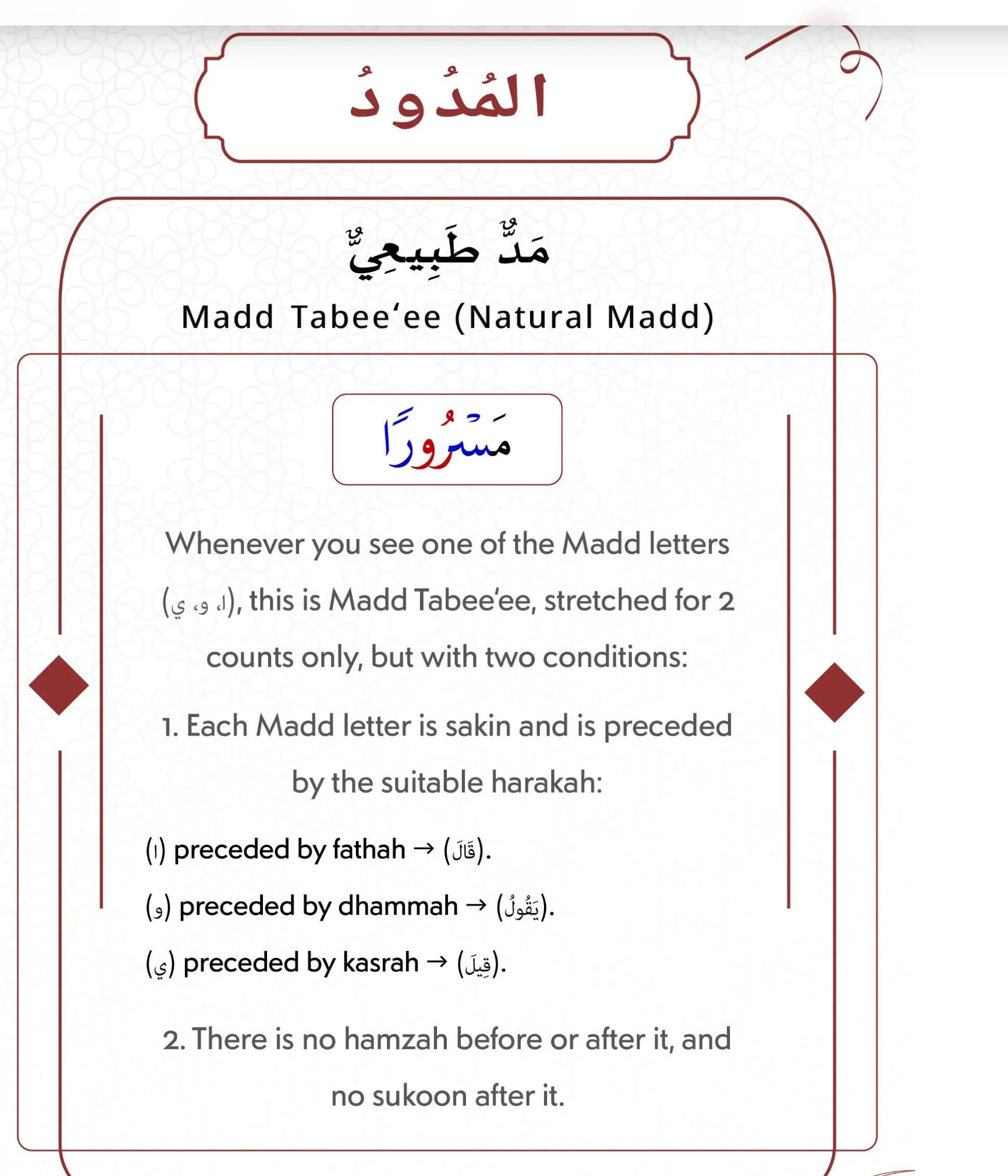
Madd is an Arabic word that means to prolong or to lengthen. In Tajweed it means prolonging the vowel sound of a little longer instead of clipping it short. Think of the difference between a quick "ma" and a gentle "maa" — that extra length is the madd. It is one of the first things that separates careful, beautiful recitation from rushed reading, and it is far easier to feel than it looks written down. Once your ear notices it, you cannot un-hear it.
2. Why it is called "Natural" (Ṭabiʿi)
It is called ṭabiʿi, meaning natural, because it is the plain, built-in length that a long vowel has all by itself — with no special reason after it. Scholars also call it the original madd (al-madd al-aṣli), because every other, longer madd is really this natural madd with an added cause layered on top. In other words, this is the parent rule. Learn this one well and all the bigger madds suddenly make sense.
3. The three letters of Madd
The natural madd lives in three letters only: the alif (ا), the waw (و) and the yaʾ (ي). Teachers gather them in one easy word — نُوحِيهَا ("nuḥeeha") — which happens to contain all three. Each has a simple condition: the alif follows a fatḥah, the waw carries a sukoon after a ḍammah, and the yaʾ carries a sukoon after a kasrah. When the vowel and its matching madd letter line up like this, you have a natural madd — nothing more to check.
4. The two conditions that make it "natural"
A madd stays natural only when two things are absent after the madd letter: there is no hamzah (ء) and no sukoon following it. If either a hamzah or a sukoon appears after the madd letter, the rule changes into a longer madd of four, five or six counts. So picture the natural madd as a long vowel left in peace — with nothing after it pulling the sound out longer. The moment a hamzah or sukoon turns up, you are dealing with a different, bigger rule.
5. How long do you prolong it?
You prolong a natural madd for two counts — in Arabic, ḥarakatan — which is about one second, roughly the time to say "one, two" gently, or to fold one finger down and then a second. The single most important thing is consistency: the same calm two-count length every single time, never dragged longer and never clipped short. This steady, even beat is the heartbeat of good recitation and the foundation of a pleasant reading voice.
6. Reading the colour-coded Mushaf
The pages in the images come from a colour-coded interactive Mushaf. At the bottom you can see the key: a black dot for a Short Syllable and a red dot for a Long Syllable. Every long syllable marked in red is a place where you gently stretch the sound — and the great majority of those are natural madds. Colour turns an simple rule into something your eye can catch instantly, so you spot the madd on the page before your tongue ever reaches it. For children especially, this makes learning fast and almost playful.
7. Understanding the syllable panel
Down the side of each page, every word is broken into its parts: Short Syllable, Long Syllable, Sukoon, Tanween, Mushaddad, Silent Letter, and even Mushaddad + Long Vowel. Look at النَّاس ("an-naas") from Surat an-Naas: the panel shows a shaddah on the noon and a long vowel (نَّا) — a natural madd sitting right after a doubled letter. Analysing a word like this shows you exactly where the two-count stretch belongs, and just as importantly where it does not.
8. Examples from the short surahs
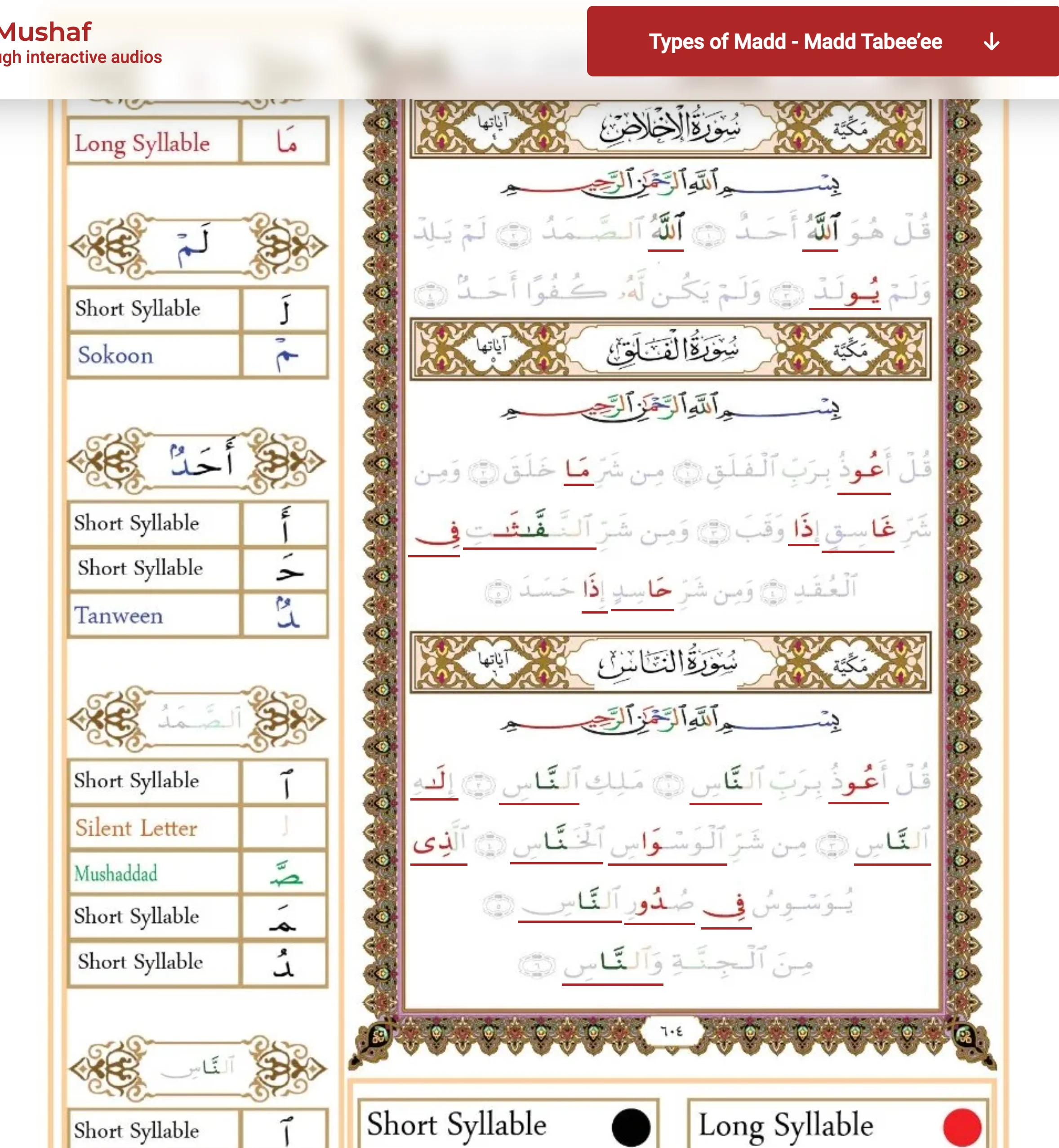
The pages above are the last surahs of the Qur'an — the ones British children usually memorise first — so the examples are already familiar. Natural madds (underlined in red) include: قَالَ and مَا (alif), الْكَافِرُونَ (kaa) in al-Kaafiroon, يُولَدْ (yoo) in al-Ikhlaaṣ, غَاسِقٍ (ghaa) in al-Falaq, and الْمِسْكِينِ (kee) and الْمَاعُونَ (maa and ʿoo) in al-Maaʿoon. Read them slowly and feel the gentle two counts on each red mark. Because these surahs are short and well known, they are the perfect place to practice the rule.
9. It is the most common rule in the Qur'an
The natural madd appears more often than any other Tajweed rule — you will meet it several times on nearly every line, in every surah, on every page. That is exactly why it should be the first rule you master. Get it steady and correct, and a huge deal of your recitation is already sound. Rush it or leave it shaky, and the same small mistake quietly repeats itself everywhere you read. Time invested here pays you back on every single page for ever.
10. How it differs from the longer madds
Learners often confuse the natural madd with the bigger madds that run to four, five or six counts. The difference is refreshingly simple: the longer madds only occurs when a hamzah or a sukoon follows the madd letter — for example جَاءَ (madd before a hamzah) or الضَّالِّينَ (madd before a sukoon/shaddah). With no hamzah and no sukoon after it, the madd simply stays natural at two counts. So think of the natural madd as the calm baseline, and the other madds as special cases that build on it when a cause appears.
11. Common mistakes British learners make
Three slips are very common. First, clipping it too short — making قَالَ ("he said") sound like قَلَ, which can blur or even change the meaning of a word. Second, over-stretching a natural madd to four or six counts, as though a cause were present when it is not. Third, inconsistency — stretching one madd fully and then rushing the very next one. A trained ear and tongue catch all three in a moment; working alone, they are surprisingly easy to miss, which is why feedback matters so much.
12. How to master it — the Eaalim way
Practise in two steps. First, read from a colour-coded Mushaf like the one shown and focus on every red long syllable, holding a clean, even two counts. Then have a teacher listen and correct your prolongation in real time — the one thing no app, video or book can do for you. At Eaalim we teach this live and one-on-one with Al-Azhar certified teachers, on UK time slots (GMT and BST), with pricing in pounds and an honest free trial that needs no card details. One good correction, at the right moment, sets the habit for ever.
Quick recap — the natural madd at a glance
Keep these essentials in mind and the rule becomes second nature:
Meaning: "madd" means to stretch a long vowel; "ṭabiʿi" means natural — the default, original length.
Letters: only three — alif, waw and yaaʾ — gathered in the word نُوحِيهَا.
Length: exactly two counts (about one second), the same every time.
Condition: it stays natural only when no hamzah and no sukoon follow the madd letter.
Frequency: the most common Tajweed rule of all — learn it first.
On the page: in a colour-coded Mushaf it shows as a red long syllable; focus and hold it gently.
A simple home routine works well for British families: read one short surah a day from a colour-coded Mushaf, hold every red mark for a clean two counts, and once a week let a teacher check your length. Little and often beats long, rushed sessions — and it keeps young readers engaged.
Ready to hear your recitation corrected by a qualified teacher? Book a free trial lesson, explore our 50-Hour Tajweed course for the UK, or start your child with our Kids UK programme. May Allah make the Qur'an easy for your tongue and beloved to your heart. Āmeen. — The Eaalim Team, London
Start your journey with Eaalim today!
Start 2 Free Trials


 Share
Frequently Asked Questions
It is the basic two-count stretch of a long vowel — alif, wāw or yāʾ — when no hamzah and no sukoon follow it. It is the original, default length in Qur'anic recitation, and every longer madd is built on top of it.
Two counts (ḥarakatān), roughly one second — the time to say 'one, two' gently. The length should be the same every time, never clipped short and never stretched to four or six counts.
The alif (preceded by a fatḥah), the wāw with sukoon (preceded by a ḍammah), and the yāʾ with sukoon (preceded by a kasrah). They are gathered in the word نُوحِيهَا (nūḥīhā).
The longer madds (four to six counts) only occur when a hamzah or a sukoon follows the madd letter. With no such cause after it, the madd stays natural at two counts.
