



One-to-One Quran Lessons Online: What to Expect
By Eaalim Institute on 10/16/2026 · 13 min read
What if an online Quran lesson felt less like joining a class and more like sitting down with a tutor who can focus on you? It’s natural to wonder how one to one Quran lessons online work, whether learning remotely feels personal, and how you or your child can prepare for a first session.
With individual tuition, the lesson centres on one learner rather than a group. This makes space for different starting points, questions and learning paces. At Eaalim, certified instructors teach live online lessons tailored to children and adults, including Quran recitation and Tajweed. Learning from home can also make it easier to build lessons into a regular routine.
This guide explains what an individual online lesson can involve, how focused tuition differs from other ways of learning, and how to prepare for a first session. A few practical steps can help you arrive ready to learn without needing to plan everything in advance.
Key Takeaways
See how one to one Quran lessons online differ from recorded study and group learning, and what to expect from the live format.
Understand how a lesson can move from practising a passage to receiving guidance and reviewing, with the focus adapted to the learner.
Compare individual tuition, self-study and group learning to decide which approach best supports questions, interaction and independent practice.
Use a practical preparation checklist to make the first online lesson more comfortable and focused.
Discover how Eaalim’s individual online tuition supports children and adults learning recitation and Tajweed.
Table of Contents
How does an online Quran lesson support recitation and Tajweed?
One-to-one Quran lessons online versus self-study or group learning
How to prepare for your first one-to-one Quran lesson online
What are one-to-one Quran lessons online really like?
Rather than watching a recording or joining a group halaqa, the learner meets an instructor live online and takes part in the lesson. They can recite aloud, listen to guidance and ask questions as they go. If a word or letter is difficult, for example, they can ask about it straight away instead of waiting for a general explanation to address their concern.
One-to-one online Quran tuition is live, remote learning shaped around one learner and an instructor. Lessons can focus on becoming more familiar with recitation or practising Tajweed, the rules that guide Quranic pronunciation and recitation. For background, see this overview of Tajweed rules and their importance in Quranic recitation.
How a live individual lesson differs from self-study
Self-study gives learners the freedom to revisit material independently and practise at a time that suits them. It can be a useful part of learning, but it does not provide a live exchange. Someone studying alone may be unsure whether they have pronounced a sound as intended or how to resolve a question that comes up.
In a live lesson, the learner practises while the instructor listens and responds. They can pause to ask what a correction means, try again or clarify a point before moving on. This makes questions part of the learning process. Regular practice between lessons still matters: an instructor can provide guidance during a session, while the learner’s own effort helps build a steady routine.
What personal attention can mean for a learner
Individual tuition allows the instructor to focus on one learner’s recitation and current needs, rather than dividing attention across a group. A new learner can begin from their own starting point, while someone with previous experience may have different areas to work on. The pace and focus can vary, rather than assuming every learner should cover the same material in the same way.
This format is available to children and adults, including beginners and learners with previous experience. At Eaalim, certified instructors teach live, individual online Quran lessons tailored to the learner, with instruction in recitation and Tajweed. Personal attention supports focused learning, but it does not mean everyone progresses at the same rate. Starting points, confidence and practice differ, so a responsive lesson makes room for those differences.
How does an online Quran lesson support recitation and Tajweed?
A live lesson can give recitation a clear focus: the learner works with a passage or a particular learning point, while the instructor listens and offers guidance suited to their level. The session can take different shapes. Someone new to reading may need time with foundational sounds, whilst a continuing learner may be ready to pay closer attention to pronunciation or recitation.
A lesson might follow a sequence like this:
Settle in: The learner and instructor get ready to focus and decide what to work on.
Read or recite: The learner practises a manageable passage or learning point aloud.
Receive guidance: The instructor responds to what they hear and highlights a point that could benefit from more practice.
Review: The learner tries again or revisits the point, with the session focused on their needs.
This is an example, not a fixed lesson plan. The instructor can spend longer on one part or adjust the focus as the learner’s needs become clearer. The aim is to make practice understandable and purposeful, rather than rushing through material simply to cover a set amount.
Reading, listening and practising during a lesson
In a live session, the learner can recite while the instructor listens, then pause to ask about a word, sound or instruction that is unclear. Working on a short passage or one learning point can make practice manageable and leave space to try again. The instructor’s guidance supports the work, while personal practice between lessons remains an important part of learning.
Where Tajweed and pronunciation guidance fit
Tajweed refers to guidance on reciting the Quran with care and attention to its rules. Instead of taking on every rule at once, a learner can focus on a particular point connected to their current recitation. For a broader explanation, see this guide to Tajweed and Quranic recitation.
One pronunciation concept is Makharij, the points in the mouth or throat from which particular Arabic letters are articulated. If a letter is difficult to pronounce, the instructor can help the learner focus on its sound and practise it in context. This close attention is one way one to one Quran lessons online can support recitation while keeping the material relevant to the individual.
At Eaalim, certified instructors provide live, individual Quran tuition for children and adults, with lessons tailored to the learner and instruction that includes recitation and Tajweed. Explore Eaalim’s online Quran courses to learn more about this focused approach.
One-to-one Quran lessons online versus self-study or group learning
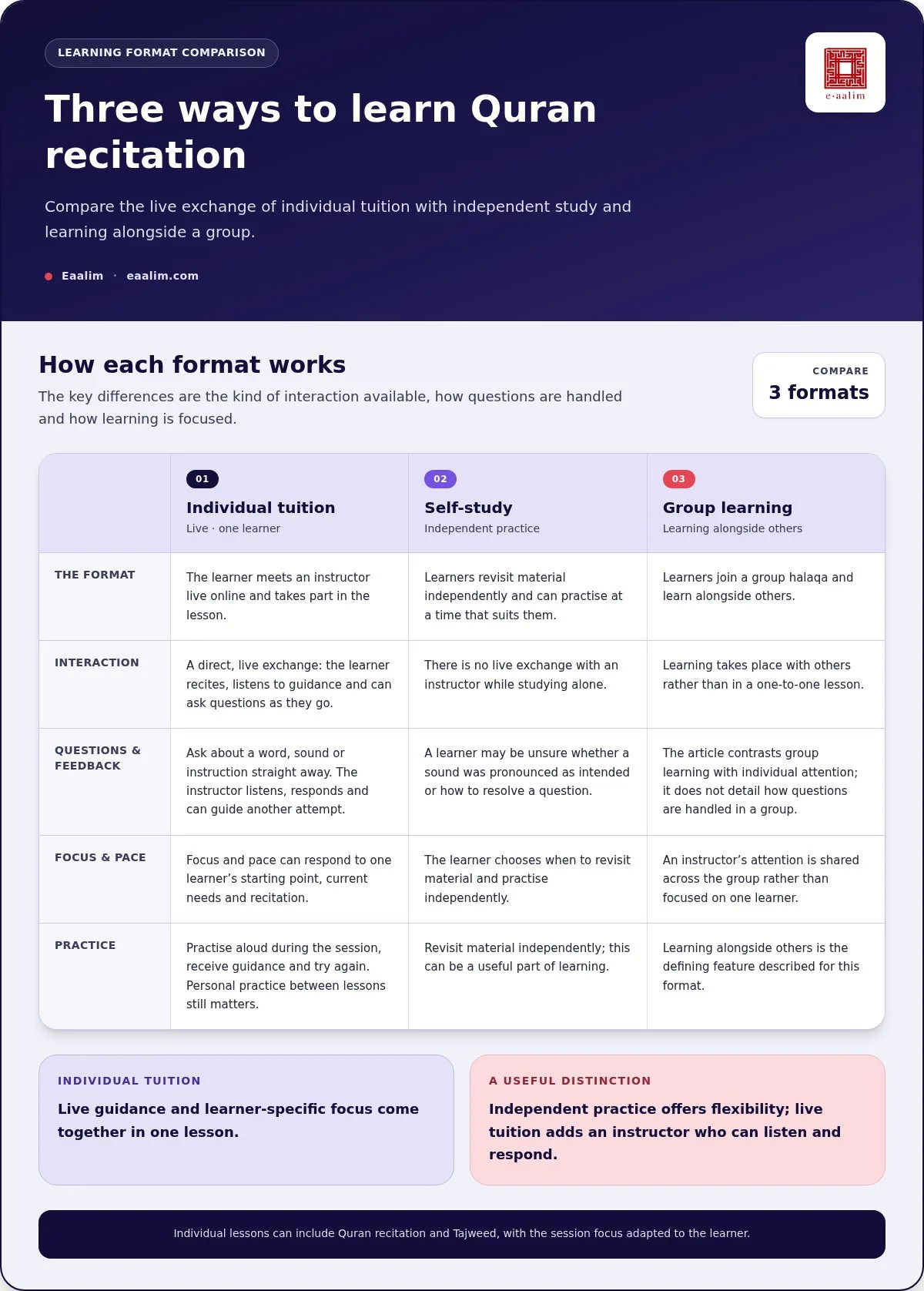
Choosing how to learn depends on more than whether a lesson takes place online. Some learners value a tutor’s focused guidance; others prefer reviewing material independently or learning alongside others. One to one Quran lessons online offer a live exchange between learner and instructor, while self-study and group learning have different strengths. The table below sets out practical differences to help you compare the options.
Learning format | Interaction and questions | Flexibility and practice |
|---|---|---|
Individual tuition | Direct interaction with an instructor, with space to ask questions and receive guidance focused on the learner. | The lesson can reflect the learner’s needs. Independent practice still plays a part. |
Self-study | The learner reviews material alone, without live individual interaction or immediate clarification. | Offers freedom to revisit material at the learner’s own pace, while requiring them to organise and sustain their practice. |
Group learning | Questions and contributions take place within a shared session, so the instructor’s attention is distributed amongst learners. | Learning takes place alongside others, with practice and participation shaped by the group setting. |
These are broad distinctions, not rules. Each learning experience depends on how it is organised and what the learner needs. Online tuition need not feel impersonal: consider whether the learner can take part, receive clear responses and ask for help. Learning from home can still feel attentive when the lesson is individual and the instructor can focus on the learner.
When individual online tuition may suit a learner
A learner who values focused guidance or feels more comfortable asking questions one-to-one may find individual tuition a reassuring fit. If a point in recitation is unclear, for instance, they can raise it directly rather than wait for a group discussion to turn to it. The instructor can then keep the lesson relevant to the learner’s needs and starting point. This can be helpful, though individual tuition is not automatically the best fit for every student.
What self-study and group learning can offer instead
Self-study gives learners room to revisit a passage quietly and independently. That freedom can be useful for someone who prefers to work at their own pace, though it does not provide live individual feedback. Group learning offers shared participation and the experience of learning with others, while the instructor’s attention is spread across the learners present.
Preference, circumstances and goals all matter. Some learners value concentrated feedback, while others thrive on independent review or shared discussion. Consider which format helps the learner participate consistently and practise with purpose.
How to prepare for your first one-to-one Quran lesson online
A little preparation can make the first session feel less unfamiliar without adding another demanding task to a busy day. You do not need to know everything or have a perfect study space. A quiet place to sit, the materials you already use and a clear idea of what feels easy or difficult are enough to help the instructor understand where to begin.
Before the lesson: make the online setting comfortable
Choose a comfortable spot where the learner can hear, speak and concentrate with fewer interruptions. Set up the device and check the internet connection before the lesson, so the time can be spent learning rather than sorting out practicalities. For a child, a parent or carer can help them settle in and arrange their materials, then give them space to answer, recite and participate for themselves.
Use this checklist to get ready:
Find a calm place: Choose somewhere reasonably quiet, with a comfortable seat and enough room for the learner’s materials.
Get the device ready: Make sure it is charged or connected to power, positioned comfortably and able to connect to the internet.
Keep learning materials nearby: Have the Quran or any materials the learner already uses within easy reach.
Think about the starting point: Be ready to share what the learner has studied, what they would like help with and any questions they are bringing to the session.
During and after the lesson: take part at your own pace
There is no need to hide uncertainty. If an instruction or pronunciation point is hard to follow, the learner can ask for it to be repeated or explained another way. This helps the instructor understand what needs attention and tailor the lesson to the learner’s experience. With children, gentle encouragement can help them speak up, while giving them time to respond in their own words.
It can help to remember one point for later, rather than trying to write down everything the instructor says. After the lesson, take a moment to reflect: What felt clear? Was there one sound, passage or instruction the learner would like to revisit? A brief note or quiet recap can make the session easier to remember, without committing to a long study routine before you know what suits you.
The first meeting is also a chance to share preferences and questions, helping the instructor understand the learner’s needs as lessons continue. If you’re considering one to one Quran lessons online, explore Eaalim’s online Quran lessons for children and adults, taught live by certified instructors with tuition tailored to the learner.
Explore Eaalim’s one-to-one Quran lessons online
For learners across the UK looking for Quran tuition from home, Eaalim provides live, individual online lessons for children and adults. Certified instructors tailor lessons to the learner’s experience and needs. The format centres on a live exchange with an instructor, rather than a recorded lesson or group teaching.
Quran recitation and Tajweed are among the areas of instruction. What a learner works on depends on their starting point and aims: someone beginning their studies may need a different focus from someone who wants to refine aspects of their recitation. Individual tuition gives the lesson space to respond to the learner, without suggesting that everyone follows the same route or makes progress at the same pace.
What Eaalim’s individual online format offers
In one to one Quran lessons online, the instructor’s attention is centred on one learner during the live lesson. This allows the lesson to focus on the learner’s questions, needs and areas of interest as they arise, rather than following a shared group discussion. Tuition takes place online, so learners can take part from home. The format is individual, with the subject matter rooted in Quran learning.
For a parent considering lessons for a child, or an adult returning to study, it helps to think about what the learner already knows and what they hope to work towards. Perhaps the priority is becoming more comfortable with recitation or paying closer attention to Tajweed. These are practical starting points for understanding what tailored tuition can mean, without needing to arrive with a detailed plan.
Taking a comfortable next step
Exploring Quran course information is a straightforward first step. Parents and adult learners can consider the learner’s experience, the questions they have and the support they are seeking. A clear sense of those priorities can help make the next decision more grounded, whether the learner is new to Quran study or continuing with areas they already know.
Eaalim’s certified instructors teach children and adults through live, individual online tuition tailored to the learner, including Quran recitation and Tajweed. Explore the course information and enrolment details to find out more.
Begin with the learner’s next small step
Choosing one to one Quran lessons online does not require a complete learning plan from the outset. Begin with one simple question: what would the learner like to understand, practise or feel more comfortable with? A clear starting point makes it easier to explore suitable tuition and explain what matters, without turning learning into a test or setting expectations too far ahead.
For a parent, this might mean talking with your child about what they enjoy and what they find challenging. Adult learners might reflect on previous study or questions they have been meaning to ask. These thoughts do not need to become formal targets. They simply keep the learner’s hopes and circumstances in view as you consider the next step.
When you’re ready, explore Eaalim’s Quran course information and enrolment details. Explore one-to-one Quran lessons online with Eaalim and consider what could support the learner’s next stage of study. A thoughtful beginning is enough; progress can take shape one step at a time.
Start your journey with Eaalim today!
Start 2 Free Trials


 Share
Frequently Asked Questions
Yes. Beginners can take one-to-one Quran tuition. Explain that reading is new and mention anything that feels unfamiliar, such as recognising Arabic letters or following a line of text. This gives the instructor a clearer picture of where to start. Eaalim’s online Quran courses are tailored to individual learners at different levels.
Yes, children can take live online Quran lessons from home. A parent or carer can help the child get settled, prepare the device and stay nearby if practical help is needed. Choose a time when the child is not tired or rushing between activities. A familiar, comfortable place can help them feel at ease as they take part.
No, you do not need to be fluent in Arabic before beginning Quran lessons online. A learner can explain their experience and aims, even if Arabic feels unfamiliar. Speaking or reading Arabic and learning Quran recitation are related but distinct skills, so the learner’s starting point can guide what to focus on. If you are unsure how to describe your level, say what you can currently read or recognise.
You’ll need an internet-connected device, such as a computer, tablet or smartphone, with working audio so you can hear and speak with the instructor. Headphones can help reduce background noise. Keep the Quran or learning materials you plan to use close by. Before the session, check that the device is charged, the sound is clear and the connection is working.
There is no single ideal frequency for every learner. Consider your aims, weekly commitments and how much time you can comfortably give to practice between lessons. A routine that fits around school, work or family life may be easier to maintain than an ambitious plan that is difficult to keep up. Discussing a realistic pace with your instructor can help shape one-to-one Quran lessons online around your circumstances.
Say so during the lesson. Ask the instructor to repeat an explanation, go more slowly or clarify a particular word or instruction. For example, rather than saying only “I don’t understand”, explain where you lost track in a passage. That detail helps pinpoint what is confusing, so the instructor can respond to the difficulty instead of leaving you guessing.
