



Online Quran Classes UK: A Guide to Finding the Right Fit in 2026
By Eaalim Institute on 10/15/2026 · 13 min read
What makes an online Quran class a good fit: a timetable that works, a tutor who understands the learner’s level, or lessons focused on a clear goal? If you’re comparing online Quran classes UK families can access, it’s worth considering how one-to-one learning works and what a child or adult needs to feel comfortable learning from home.
A suitable class should take account of the learner’s age, current ability and aims, while leaving room for regular practice around school, work and family life. This guide explains what to look for in reading, recitation and Tajweed teaching, how individual guidance can support learning, and which details matter when comparing course descriptions. At Eaalim, certified instructors teach live, one-to-one Quran lessons tailored to children and adults, with a focus on recitation and Tajweed. Use the practical checks below to identify a suitable focus and build a manageable study routine.
Key Takeaways
Choose a study routine that fits alongside school, work and family commitments.
Separate the goals of learning to read the Quran, developing recitation and applying Tajweed rules.
Compare classes by tutor expertise, individual attention, course focus and how teaching can suit the learner’s pace.
Use this guide to assess online Quran classes UK and identify a class that matches the learner’s age, level and aims.
Prepare for lessons with a specific goal, a quiet space and a regular study time that feels manageable.
Table of Contents
Why consider online Quran classes in the UK for your learning routine?
What can you learn in online Quran classes, from reading to Tajweed?
How to compare online Quran classes in the UK for learner fit
How to prepare for online Quran lessons and keep study manageable
Start online Quran classes in the UK with individual support from Eaalim
Why consider online Quran classes in the UK for your learning routine?
Can Quran learning fit around work, school and family life? For households balancing school runs, work and busy evenings, travelling to lessons can be difficult to fit in. Online Quran classes UK learners join remotely provide an alternative: live, individual tuition from home. Learning online removes the journey, but a useful routine still needs regular attention and practice. Choose a time when the learner can focus, then leave space to revisit lesson work between sessions.
Start by identifying the learner’s current ability rather than choosing a class based on age alone. A child beginning to recognise Arabic letters has different needs from an adult who can read but wants to refine pronunciation. Be specific about the goal too: is the learner developing reading skills, practising recitation or focusing on Tajweed? These details help make the lesson focus relevant from the outset.
One-to-one online Quran tuition is live teaching between one tutor and one learner, with guidance shaped around that learner’s current level and goals. The tutor can focus on an individual’s reading, recitation and questions rather than setting a shared group pace. This can suit learners who value personal guidance, although comfort with remote learning varies from person to person.
What does an online Quran class involve?
The learner joins a live remote lesson and works individually with a tutor. Depending on their starting point and aims, teaching can focus on reading Arabic script, practising recitation or learning how Tajweed rules guide pronunciation. These are related but distinct areas: reading involves recognising and following the text, while recitation and Tajweed focus on how it is pronounced. For background on The Quran and its significance in Islam, readers can explore this introductory reference.
Who might benefit from learning from home?
Children and adults may value individual attention when beginning or continuing Quran study remotely. Learning at home allows families to organise lessons around existing commitments, and some learners find it easier to focus in a familiar setting. Think about the learner’s comfort, attention and readiness, especially for children. A quiet, familiar space can help, but the format should suit the individual rather than being assumed to work for everyone.
Keep the routine realistic. Choose a regular time when the learner is alert and the household can limit interruptions, and leave room for practice between lessons. A demanding schedule can compete with homework, work and family responsibilities, so consider what the learner can sustain before setting expectations. As skills or circumstances change, revisit the timing and learning focus to keep Quran study purposeful and manageable.
What can you learn in online Quran classes, from reading to Tajweed?
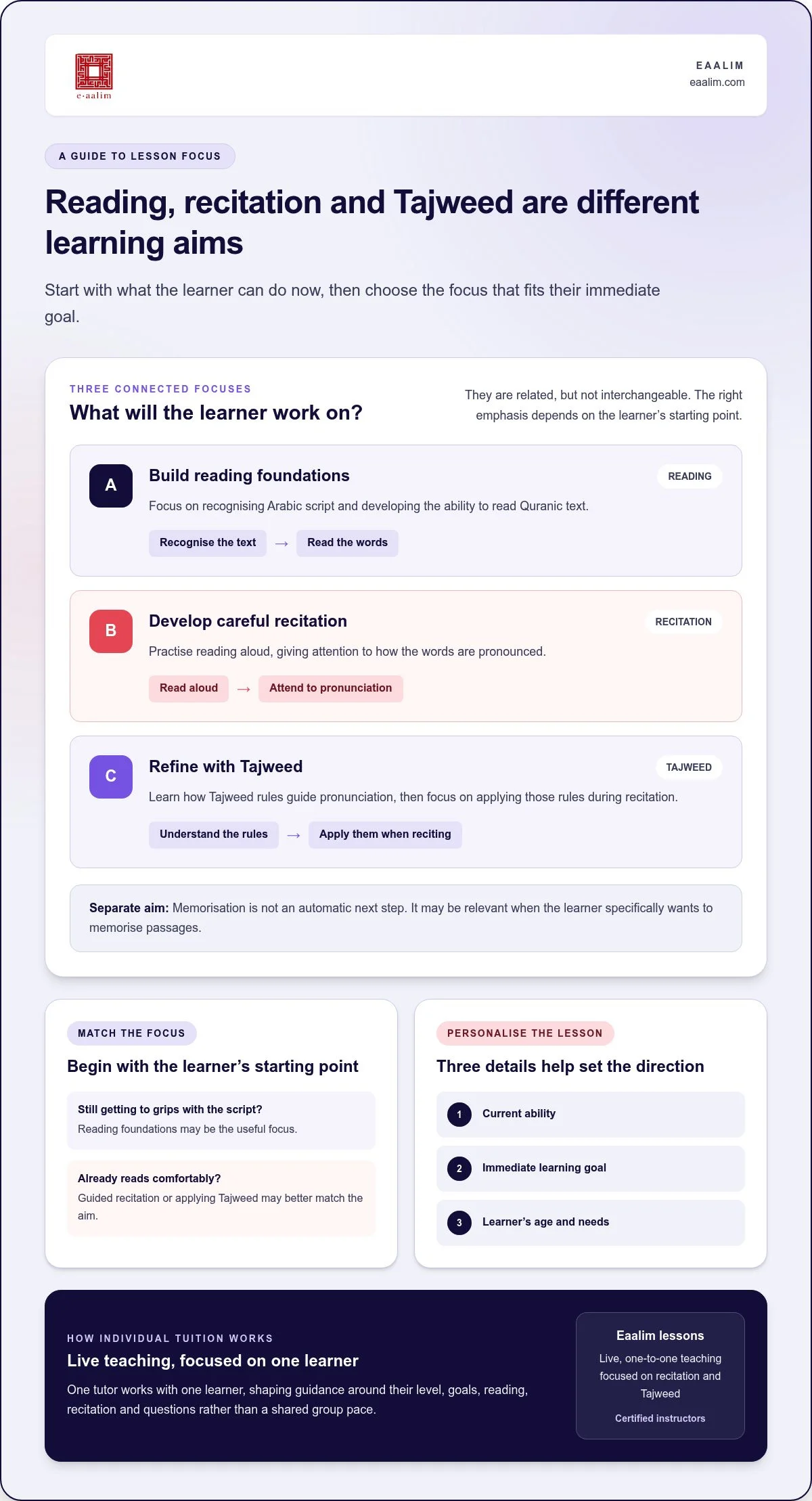
Begin with a practical question: what does the learner want to work on first? One person may need to recognise Arabic letters and read words; another may want to recite more carefully or understand how Tajweed rules apply. These aims connect, but they are not interchangeable. Describe the learner’s starting point and immediate goal so lessons can focus on a useful next step instead of assuming everyone should follow the same sequence.
In online Quran classes UK learners can access, the focus may be reading, recitation or Tajweed. A beginner might build familiarity with the text before practising reading aloud. Someone who already reads may benefit from guided recitation and feedback on applying rules. The right emphasis depends on what the learner can do now and what they want to develop.
How do Quran reading and recitation differ as learning aims?
Learning to read means developing the ability to recognise and read Quranic text. Recitation involves reading aloud with care given to pronunciation. A learner still getting to grips with the script may need support with reading foundations, while someone who reads comfortably may be ready to concentrate on how the words sound. Both benefit from guidance matched to their actual starting point, rather than assumptions based on age or experience.
What does Tajweed add to Quran learning?
Tajweed refers to the rules and practices that guide Quran recitation. It helps learners pay close attention to pronunciation and apply recitation rules as they read aloud. Tajweed gives careful Quran recitation a framework, guiding how the text is pronounced and read aloud. The practical distinction is that learning Tajweed goes beyond recognising words on the page: it focuses on how the learner recites them.
It can help to match a learning aim to the learner’s current ability:
Building reading foundations: focus on recognising and reading the text.
Developing recitation: practise reading aloud with attention to pronunciation.
Refining Tajweed: work on understanding and applying recitation rules.
Memorisation is a separate aim, not an automatic next step for every learner. It may be relevant if the learner specifically wants to memorise passages, but it need not replace reading or recitation goals. A child may first want to build confidence with the text, while an adult who already reads may want to focus on pronunciation. Naming one immediate goal gives the tutor a clear starting point and helps the learner understand what they are practising.
Eaalim’s live, one-to-one online Quran lessons focus on recitation and Tajweed, with certified instructors tailoring teaching to individual learners. Eaalim’s online Quran lessons provide individual support for learners whose aims match that focus.
How to compare online Quran classes in the UK for learner fit
When comparing online Quran classes UK learners can attend, look beyond a long course description. Focus on what the learner needs from each lesson and whether the teaching addresses it. In a live, one-to-one class, the tutor can give attention to one learner’s reading, recitation and questions instead of expecting them to keep pace with a group. This individual format can be helpful for a child who needs focused guidance or an adult beginner who wants time to ask questions.
Use the comparison below to assess the practical points. The aim is not to find one format that suits everyone, but to see whether the tutor’s expertise, individual attention, course focus and approach to pace match this learner.
Learner need | Useful question | What a good fit looks like |
|---|---|---|
Learning foundations | Does the teaching begin from the learner’s current reading ability? | The starting point reflects what the learner can already recognise and read. |
Recitation or Tajweed | Is the lesson focus clear and relevant to the learner’s aim? | Teaching addresses recitation or Tajweed without losing sight of the learner’s level. |
Individual attention | Will the learner have space to practise and receive guidance? | Live one-to-one teaching gives attention to the individual learner. |
Age and pace | Can teaching be tailored to the learner’s needs? | The approach takes account of age, confidence and how quickly the learner is ready to move forward. |
Tutor expertise | Does the tutor have relevant expertise for Quran learning? | Instruction is led by a certified instructor with a focus suited to the learner’s aims. |
Which questions help identify the right course focus?
Write down what the learner can currently read and how familiar they are with Quran recitation. Then choose one immediate priority: developing reading, practising recitation or focusing on Tajweed. A specific goal makes it easier to judge whether a course is relevant and to notice what the learner is practising. Review the focus as their confidence and needs develop, rather than treating the first goal as permanent.
How can a learner’s age and pace shape the choice?
A child may need encouragement and a pace suited to their age, while an adult beginner may value time to revisit foundations and ask questions. Neither learner needs to be measured against the other. One-to-one tuition centres attention on the individual’s current understanding and response to teaching. At Eaalim, certified instructors provide live lessons tailored to children and adults, with Quran teaching focused on recitation and Tajweed.
Picture the learner taking part in a lesson. What would help them feel comfortable enough to practise and ask for guidance? Look for a clear focus and teaching that starts at the learner’s current level. Avoid assuming they must begin from the beginning or move ahead before they are ready.
How to prepare for online Quran lessons and keep study manageable
A little preparation can make a remote lesson calmer, especially when it falls between school, work and family commitments. You do not need a dedicated study room or a demanding timetable. Set up a comfortable place to focus, have the learner’s materials ready and choose a routine that can be repeated without adding pressure. These simple steps can help online Quran classes UK learners attend become a settled part of the week.
What should learners arrange before a remote lesson?
Choose a comfortable spot where the learner can listen and speak with minimal interruption. Set out the Quran and any other materials they normally use, and leave a little time to get settled before the lesson. A calm start helps the learner give their attention to study instead of rushing in from another activity.
Use this short preparation plan:
Choose a focus. Keep the immediate aim in mind, such as reading practice, recitation or Tajweed, so the learner knows what they are working towards.
Make a quiet space. Find a place where the learner can concentrate and speak comfortably. A familiar corner may be enough; it does not need to be a dedicated study room.
Prepare materials and connection. Have the Quran and usual learning materials ready, and check that the internet connection is working before the lesson begins.
Allow time to settle. Leave a little time beforehand to put away distractions and start the lesson without rushing.
How can families support consistent Quran study?
Choose a recurring study time that fits the household instead of squeezing lessons into the busiest part of the day. For example, consider a quieter period after school or a time that works with an existing weekly routine. The most useful option is one the learner can return to regularly while still leaving room for rest and other commitments.
For children, gentle encouragement can make study feel supported rather than pressured. Help them get ready and recognise their effort, while leaving the tutor to guide the lesson. Try not to turn each session into a test of how much they remember. If the routine becomes hard to maintain, adjust it. A realistic rhythm with manageable practice between lessons is generally easier to sustain than an ambitious plan that leaves everyone feeling rushed. The same approach can help families build a consistent Quran learning routine over time.
Eaalim’s live online Quran lessons are taught one-to-one and tailored to individual learners.
Start online Quran classes in the UK with individual support from Eaalim
Once you have considered the learner’s goals, starting point and routine, look for teaching that brings those needs together. Eaalim provides live, one-to-one online Quran lessons across the UK for children and adults. Certified instructors tailor lessons to individual learners, focusing on Quran recitation and Tajweed. For anyone considering online Quran classes UK-wide, this means individual teaching shaped around the learner rather than a shared group pace.
What makes Eaalim’s one-to-one format personal?
In a live one-to-one lesson, the tutor teaches one learner at a time. This creates room to focus on the learner’s current understanding, offer individual guidance and shape teaching around their pace. A child and an adult may approach Quran study differently, and a learner’s needs can change as they become more familiar with recitation or Tajweed. Eaalim’s instructors tailor lessons for children and adults, keeping the individual learner at the centre of teaching.
Individual attention can help keep the lesson focused on the learner’s immediate aim, whether that is recitation or applying Tajweed. It does not mean every lesson will feel effortless or that progress follows a fixed timetable. A suitable routine, attentive guidance and practice all have a part to play, and learning outcomes cannot be guaranteed. Steady expectations leave room for learners to build confidence at a manageable pace.
What is a sensible next step for a UK learner?
Describe the learner’s needs in simple terms before beginning. This helps keep the decision grounded in the person rather than course labels alone. Consider:
Age: Is the learner a child or an adult, and what kind of encouragement helps them feel comfortable?
Starting point: What can they currently read or recite, and where would individual guidance be useful?
Immediate aim: Is the priority Quran recitation, Tajweed or another part of the learner’s Quran study?
Routine: What regular study time can fit around the household’s existing commitments?
These notes do not need to form a detailed plan. They simply clarify what a suitable learning fit might look like, while allowing the learner’s focus to develop over time. Parents can help children by providing a calm setting and gentle encouragement. Adult learners can choose a routine that feels realistic alongside work and home life.
Eaalim’s online Quran classes offer live, one-to-one teaching tailored to individual learners.
Take a thoughtful first step towards Quran learning
You do not need a complete study plan to begin. Identify one clear aim for the learner, then consider what regular time could fit around work, school or family commitments. This creates a practical starting point without making learning feel like another demanding task in an already full week.
As you explore online Quran classes UK learners can access, keep that first aim in view. The routine can settle gradually, and the learner’s focus may change as their confidence and needs develop. Regular attention and practice matter, but there should also be room to adjust the plan. Progress takes patience and can look different for each person.
When you’re ready to take the next step, explore Eaalim’s online Quran classes for individual support with Quran learning.
Start your journey with Eaalim today!
Start 2 Free Trials


 Share
Frequently Asked Questions
The learner joins a live remote lesson and works individually with a tutor. Depending on their starting point and aims, teaching can focus on reading Arabic script, practising recitation or learning how Tajweed rules guide pronunciation. These are related but distinct areas: reading involves recognising and following the text, while recitation and Tajweed focus on how it is pronounced. For background on The Quran and its significance in Islam, readers can explore this introductory reference.
Children and adults may value individual attention when beginning or continuing Quran study remotely. Learning at home allows families to organise lessons around existing commitments, and some learners find it easier to focus in a familiar setting. Think about the learner’s comfort, attention and readiness, especially for children. A quiet, familiar space can help, but the format should suit the individual rather than being assumed to work for everyone. Keep the routine realistic. Choose a regular time when the learner is alert and the household can limit interruptions, and leave room for practice between lessons. A demanding schedule can compete with homework, work and family responsibilities, so consider what the learner can sustain before setting expectations. As skills or circumstances change, revisit the timing and learning focus to keep Quran study purposeful and manageable. Begin with a practical question: what does the learner want to work on first? One person may need to recognise Arabic letters and read words; another may want to recite more carefully or understand how Tajweed rules apply. These aims connect, but they are not interchangeable. Describe the learner’s starting point and immediate goal so lessons can focus on a useful next step instead of assuming everyone should follow the same sequence. In online Quran classes UK learners can access, the focus may be reading, recitation or Tajweed. A beginner might build familiarity with the text before practising reading aloud. Someone who already reads may benefit from guided recitation and feedback on applying rules. The right emphasis depends on what the learner can do now and what they want to develop.
Learning to read means developing the ability to recognise and read Quranic text. Recitation involves reading aloud with care given to pronunciation. A learner still getting to grips with the script may need support with reading foundations, while someone who reads comfortably may be ready to concentrate on how the words sound. Both benefit from guidance matched to their actual starting point, rather than assumptions based on age or experience.
Tajweed refers to the rules and practices that guide Quran recitation. It helps learners pay close attention to pronunciation and apply recitation rules as they read aloud. Tajweed gives careful Quran recitation a framework, guiding how the text is pronounced and read aloud. The practical distinction is that learning Tajweed goes beyond recognising words on the page: it focuses on how the learner recites them. It can help to match a learning aim to the learner’s current ability: Memorisation is a separate aim, not an automatic next step for every learner. It may be relevant if the learner specifically wants to memorise passages, but it need not replace reading or recitation goals. A child may first want to build confidence with the text, while an adult who already reads may want to focus on pronunciation. Naming one immediate goal gives the tutor a clear starting point and helps the learner understand what they are practising. Eaalim’s live, one-to-one online Quran lessons focus on recitation and Tajweed, with certified instructors tailoring teaching to individual learners. Eaalim’s online Quran lessons provide individual support for learners whose aims match that focus. When comparing online Quran classes UK learners can attend, look beyond a long course description. Focus on what the learner needs from each lesson and whether the teaching addresses it. In a live, one-to-one class, the tutor can give attention to one learner’s reading, recitation and questions instead of expecting them to keep pace with a group. This individual format can be helpful for a child who needs focused guidance or an adult beginner who wants time to ask questions. Use the comparison below to assess the practical points. The aim is not to find one format that suits everyone, but to see whether the tutor’s expertise, individual attention, course focus and approach to pace match this learner.
Write down what the learner can currently read and how familiar they are with Quran recitation. Then choose one immediate priority: developing reading, practising recitation or focusing on Tajweed. A specific goal makes it easier to judge whether a course is relevant and to notice what the learner is practising. Review the focus as their confidence and needs develop, rather than treating the first goal as permanent.
A child may need encouragement and a pace suited to their age, while an adult beginner may value time to revisit foundations and ask questions. Neither learner needs to be measured against the other. One-to-one tuition centres attention on the individual’s current understanding and response to teaching. At Eaalim, certified instructors provide live lessons tailored to children and adults, with Quran teaching focused on recitation and Tajweed. Picture the learner taking part in a lesson. What would help them feel comfortable enough to practise and ask for guidance? Look for a clear focus and teaching that starts at the learner’s current level. Avoid assuming they must begin from the beginning or move ahead before they are ready. A little preparation can make a remote lesson calmer, especially when it falls between school, work and family commitments. You do not need a dedicated study room or a demanding timetable. Set up a comfortable place to focus, have the learner’s materials ready and choose a routine that can be repeated without adding pressure. These simple steps can help online Quran classes UK learners attend become a settled part of the week.
Choose a comfortable spot where the learner can listen and speak with minimal interruption. Set out the Quran and any other materials they normally use, and leave a little time to get settled before the lesson. A calm start helps the learner give their attention to study instead of rushing in from another activity. Use this short preparation plan:
Choose a recurring study time that fits the household instead of squeezing lessons into the busiest part of the day. For example, consider a quieter period after school or a time that works with an existing weekly routine. The most useful option is one the learner can return to regularly while still leaving room for rest and other commitments. For children, gentle encouragement can make study feel supported rather than pressured. Help them get ready and recognise their effort, while leaving the tutor to guide the lesson. Try not to turn each session into a test of how much they remember. If the routine becomes hard to maintain, adjust it. A realistic rhythm with manageable practice between lessons is generally easier to sustain than an ambitious plan that leaves everyone feeling rushed. The same approach can help families build a consistent Quran learning routine over time. Eaalim’s live online Quran lessons are taught one-to-one and tailored to individual learners. Once you have considered the learner’s goals, starting point and routine, look for teaching that brings those needs together. Eaalim provides live, one-to-one online Quran lessons across the UK for children and adults. Certified instructors tailor lessons to individual learners, focusing on Quran recitation and Tajweed. For anyone considering online Quran classes UK-wide, this means individual teaching shaped around the learner rather than a shared group pace.
In a live one-to-one lesson, the tutor teaches one learner at a time. This creates room to focus on the learner’s current understanding, offer individual guidance and shape teaching around their pace. A child and an adult may approach Quran study differently, and a learner’s needs can change as they become more familiar with recitation or Tajweed. Eaalim’s instructors tailor lessons for children and adults, keeping the individual learner at the centre of teaching. Individual attention can help keep the lesson focused on the learner’s immediate aim, whether that is recitation or applying Tajweed. It does not mean every lesson will feel effortless or that progress follows a fixed timetable. A suitable routine, attentive guidance and practice all have a part to play, and learning outcomes cannot be guaranteed. Steady expectations leave room for learners to build confidence at a manageable pace.
Describe the learner’s needs in simple terms before beginning. This helps keep the decision grounded in the person rather than course labels alone. Consider: These notes do not need to form a detailed plan. They simply clarify what a suitable learning fit might look like, while allowing the learner’s focus to develop over time. Parents can help children by providing a calm setting and gentle encouragement. Adult learners can choose a routine that feels realistic alongside work and home life. Eaalim’s online Quran classes offer live, one-to-one teaching tailored to individual learners. You do not need a complete study plan to begin. Identify one clear aim for the learner, then consider what regular time could fit around work, school or family commitments. This creates a practical starting point without making learning feel like another demanding task in an already full week. As you explore online Quran classes UK learners can access, keep that first aim in view. The routine can settle gradually, and the learner’s focus may change as their confidence and needs develop. Regular attention and practice matter, but there should also be room to adjust the plan. Progress takes patience and can look different for each person. When you’re ready to take the next step, explore Eaalim’s online Quran classes for individual support with Quran learning.
Yes. Beginners can join online Quran classes, including learners who are just starting to recognise Arabic letters. Share what the learner already knows, even if it is only a little, so teaching can start at a suitable point rather than assuming prior experience. A clear first aim, such as becoming more familiar with reading, can also make early lessons easier to approach.
Yes. Children in the UK can take online Quran classes with Eaalim through individual online lessons tailored to the learner. Families can help a child feel ready by choosing a calm time and making sure they are settled before the lesson begins. A child’s attention and confidence may vary from day to day, so a patient, supportive approach can help them take part without feeling under pressure.
Online Quran classes take place remotely, with the learner receiving live teaching from a tutor. Eaalim’s one-to-one format means the tutor and learner meet for an individual lesson rather than learning as a group. The learner can take part from home, which allows the household to organise study around existing commitments. Lessons focus on Quran learning, including recitation and Tajweed.
Yes. Quran lessons can include Tajweed, which may suit a learner who can already read and wants to focus more closely on recitation and applying its rules. For example, a learner might set a goal of working on pronunciation while reading aloud. Eaalim’s Quran instruction includes Tajweed, with certified instructors tailoring teaching to individual learners rather than assuming everyone needs the same focus.
Eaalim provides live, one-to-one online Quran lessons, so each learner receives individual teaching rather than sharing a lesson with a class. This format can suit someone who prefers to ask questions privately or practise recitation with the tutor’s attention focused on them. The tutor tailors instruction to the learner’s needs, though each person’s experience and progress will vary.
Yes. Adults can begin Quran study without having taken lessons before. Be clear about your starting point, even if you are unsure how to describe it. You might simply say that you have not learnt to read Quranic text yet. Eaalim provides lessons for adults, with instructors tailoring teaching to individual learners. Starting with a manageable aim can make it easier to build study into an adult routine.
No. A class can provide teaching and guidance, but it cannot guarantee fluency or a particular outcome. Learners have different starting points, aims and opportunities to practise, so progress will not look identical for everyone. It is more useful to identify what the learner wants to work on and follow their development over time. Regular study and patient guidance can support learning without promising a specific result.
