

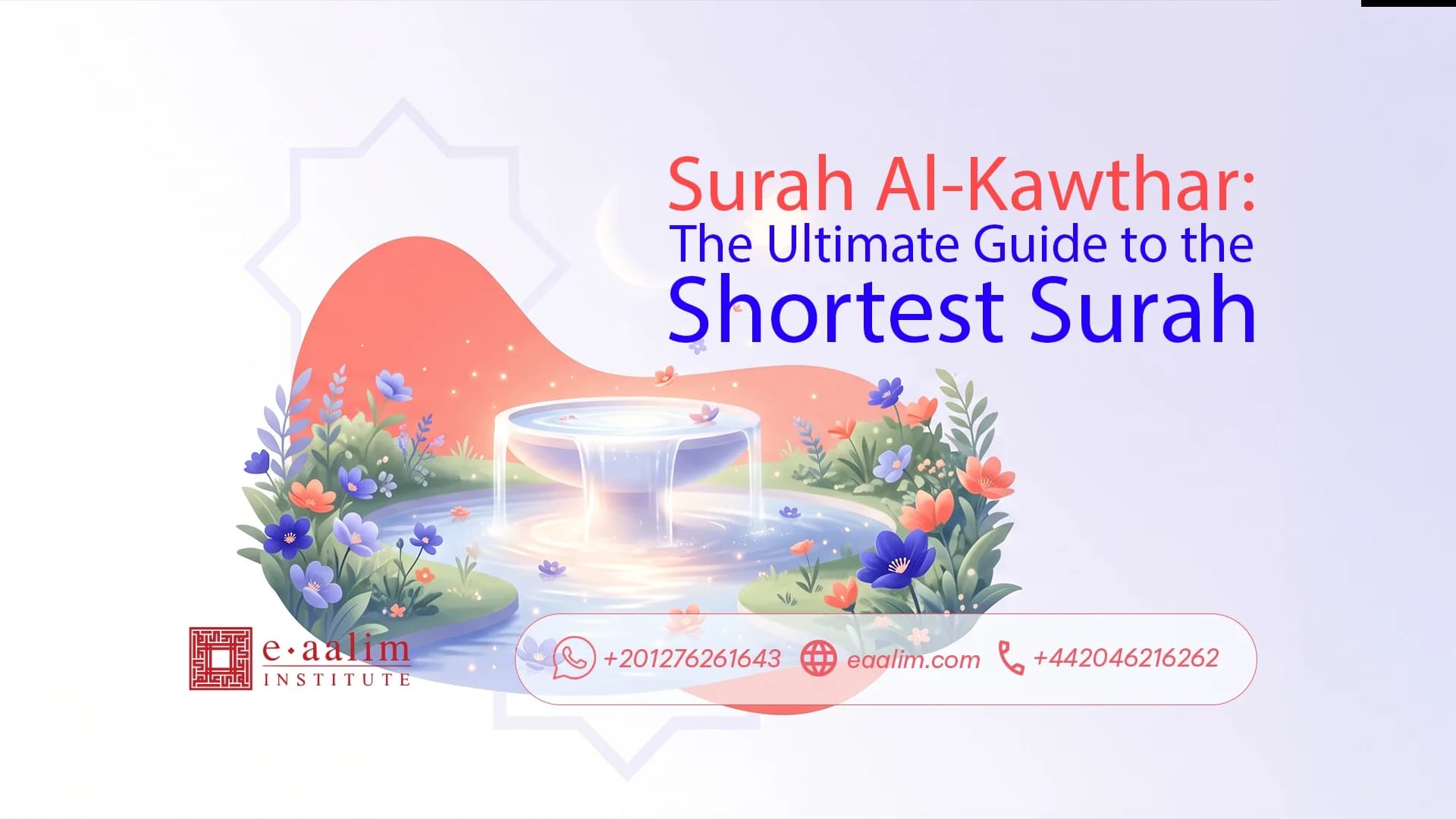
Surah Al-Kawthar The Shortest Surah and Its Loaded Reply (UK British Muslim Guide)
By Eaalim Institute on 4/27/2026 · 7 min read
Surah Al-Kawthar (108) is the Quran’s shortest surah, revealed in Makkah after the Prophet ﷺ lost his infant son ʿAbdullah and his enemies mocked him as al-abtar
“the cut off”. Its three verses answer that cruelty with a divine promise: short enough to learn in a day, rich enough to study for a lifetime.
Surah Al-Kawthar, full text in Arabic and English (Saheeh International)
بِسْمِ اللَّهِ الرَّحْمَٰنِ الرَّحِيمِ
إِنَّا أَعْطَيْنَاكَ الْكَوْثَرَ ﴿١﴾ فَصَلِّ لِرَبِّكَ وَانْحَرْ ﴿٢﴾ إِنَّ شَانِئَكَ هُوَ الْأَبْتَرُ ﴿٣﴾"Indeed, We have granted you al-Kawthar. So pray to your Lord and sacrifice. Indeed, your enemy is the one cut off." (Quran 108:1–3)
The historical occasion
The Prophet ﷺ had sons by Khadijah (RA) who died in infancy — al-Qasim and ʿAbdullah (also called al-Tayyib and al-Tahir in some narrations). Afterwards, Quraysh enemies — most reports name al-ʿĀṣ ibn Wāʾil al-Sahmī, father of the Companion ʿAmr ibn al-ʿĀṣ — mocked him as al-abtar, “the cut off”. In fact, in pre-Islamic Arab culture, people considered a man without a surviving son cut off after his death, so the mockery was deliberately wounding.
As a result, Allah revealed Surah Al-Kawthar in answer, and the reply is breathtaking in its compression. Allah does not merely defend the Prophet ﷺ; He turns the insult around: your enemy is the one truly cut off. Today, 1,400 years later, al-ʿĀṣ ibn Wāʾil and his branch of Banū Sahm are forgotten footnotes, while the name Muhammad ﷺ is the most uttered name in human history.
What does "al-Kawthar" mean?
The word al-Kawthar comes from the root k-th-r, meaning abundance. Its intensified form (fawʿal) means not just “much” but abundance upon abundance. Classical commentators explain it in several complementary ways:
The Pond of Kawthar in Paradise — the most authentic interpretation, given by the Prophet ﷺ himself: “Al-Kawthar is a river my Lord has promised me. Its water is whiter than milk, sweeter than honey, and its drinking vessels are as numerous as the stars. Whoever drinks from it will never thirst again” (Bukhari 6579, Muslim 2290). His ummah will gather there on the Day of Judgment.
Abundant prophethood — the message, the wisdom and the legacy.
Abundant followers — the ummah that became the largest, most enduring religious community in history.
The Quran itself — the eternal word that never loses its readers.
Goodness in both worlds — the blessing of being the final messenger.
Verse-by-verse meaning
Ayah 1 — "Indeed, We have granted you al-Kawthar"
Notice first the grammatical weight. Innā (“Indeed We”) — the divine plural of majesty. Aʿṭaynāka (“We have granted you”) — past tense, even though the Pond of Kawthar lies in the future. In Quranic Arabic, the past tense for future events conveys absolute certainty: it is so settled that Arabic can speak of it as having happened. Therefore, the first verse defeats the mockery — Allah Himself, in the divine plural, declares that He has granted the Prophet ﷺ abundance.
Ayah 2 — "So pray to your Lord and sacrifice"
The fāʾ at the start of fa-ṣalli (“so pray”) connects to the gift of verse 1. Hence, the proper response to receiving such an abundance is worship. Specifically, the verse names two acts: ṣalāh (prayer) and naḥr (sacrifice). Classical scholars including Ibn Kathir derive from this verse the basis of the ʿEid al-Adha prayer (the morning prayer) and then the slaughter of the sacrificial animal. In other words, this single Quranic verse encodes the whole logic of ʿEid al-Adha as a ritual.
Ayah 3 — "Indeed, your enemy is the one cut off"
The closing verse delivers the divine reversal. Shāniʾaka means “the one who hates you” — an intense verb suggesting deep, personal enmity, not mere disagreement. Huwa al-abtar — “he is the cut off”. Thus, Allah throws the enemies’ word back at them, adding huwa (“he himself”) for emphasis: not “you”, but “he”. The Quran is precise.
The historical proof is clear. The Prophet’s ﷺ daughter Fatimah (RA) and ʿAli (RA) produced descendants who number in the millions today. Hashemite kings sit on thrones in Jordan and Morocco, and tens of millions on every continent claim lineage to the Prophet ﷺ. Meanwhile, the line of al-ʿĀṣ ibn Wāʾil (the most commonly named mocker) has vanished. Even history largely forgets his Muslim son ʿAmr ibn al-ʿĀṣ’s line. Indeed, the historical record itself verifies the Quran’s prophecy.
Why Al-Kawthar matters for British Muslim families today
1. Comfort in childhood loss
Allah revealed the surah after the Prophet ﷺ lost an infant son. Therefore, for British Muslim parents who have suffered miscarriage, stillbirth, or the loss of a child, this surah carries direct comfort. The Prophet ﷺ knew what it was to bury a small child and to face mockery for it. Allah did not minimise his grief; instead, He gave him a divine answer that turned the tragedy into the foundation of his eternal honour. Today, bereaved British Muslim parents have direct access to the same Lord, the same Quran, the same comfort.
2. Refusal to internalise the world's labels
The Prophet ﷺ was called al-abtar, "the cut off". Allah did not say: "Don't worry, ignore them, words don't matter". He took the word, weighed it, and threw it back. For young British Muslims facing labels — from Islamophobic slurs to softer dismissals of their identity — Al-Kawthar is a model of refusing the world's assignment. You are who Allah says you are, not who your enemies call you.
3. Worship as the response to blessing
The structure of the surah — gift, then worship — is the structure of every blessed life. When good things happen — a successful job interview, a new baby, a recovery from illness — the Quranic response is not Instagram, not boasting, not self-congratulation. It is ṣalāh. The British Muslim family that receives news of an unexpected blessing should reach for the prayer mat first, the phone last — and the same discipline of turning to the Qur'an is exactly what regular online Quran classes help a family build.
The Sunnah uses of Surah Al-Kawthar
The Prophet ﷺ frequently recited it in Witr prayer, often in the second rakʿah after Surah Al-Aʿlā in the first.
It is recited in ʿEid prayers by some scholars, drawing on its connection to sacrifice.
It is one of the surahs the Prophet ﷺ encouraged daily recitation of, alongside the other short surahs of Juz' 'Amma.
One-week memorisation plan
Day | Target | Tip |
|---|---|---|
Monday | Listen 10 times to al-Ḥuṣarī's recitation | The surah is short — 10 listens take less than 5 minutes total. |
Tuesday | Memorise verse 1; explain what al-Kawthar means | Use the simplest definition: "the great abundance" — including a river in Paradise. |
Wednesday | Memorise verse 2; review | Discuss why prayer and sacrifice are paired. |
Thursday | Memorise verse 3; review | Tell the story of the Quraysh mockery and Allah's reply. |
Friday | Recite the full surah three times after Jumuʿah | Use it in Witr that night. |
Saturday | Use in five daily prayers | One ṣalāh, one rakʿah of Al-Kawthar. |
Sunday | Have the child explain the surah back to you | If they can teach it, they own it. |
Tajweed points British students miss
The shaddah on إِنَّا. Hold the nūn — clearly two units of time.
Ikhfāʾ in الْكَوْثَرَ. The lām of al- assimilates with the kāf cleanly; the wāw in kawthar is a sākin requiring a clean stop.
The shaddah on فَصَلِّ. Hold the lām before moving to the kasra.
The hāʾ in انْحَرْ when stopping. Soft, voiced.
Shaddah on إِنَّ شَانِئَكَ. Hold the nūn carefully; the hamzat al-qaṭʿ in shāniʾaka requires a clean stop.
Frequently asked questions
Where to go next
Surah Al-Kawthar sits between Surah Al-Maʿun (107) and Surah Al-Kafirun (109) in the Mushaf. Together with Surah Quraysh, Surah Al-Ikhlas and the Mu'awwidhatayn, these are the surahs every British Muslim child should hold by age 8.
For one-to-one help with memorisation, tajweed and tafsir under an Al-Azhar-graduate teacher, book a free 30-minute trial lesson.
Start your journey with Eaalim today!
Start 2 Free Trials


 Share
ShareFrequently Asked Questions
It was revealed at one of the lowest moments of the Prophet ﷺ's life — the death of his infant son ʿAbdullah — after which certain Quraysh enemies (most reports name al-ʿĀṣ ibn Wāʾil al-Sahmī) mocked him as al-abtar, "the cut off". In pre-Islamic Arab culture, a man without a surviving male heir was considered to have his name and lineage cut off after his death. Surah Al-Kawthar answered the personal cruelty with a divine promise.
It comes from the root k-th-r meaning abundance, in the intensified form — "abundance upon abundance". The Prophet ﷺ himself defined it as a river he was promised in Paradise: "Its water is whiter than milk, sweeter than honey, and its drinking vessels are as numerous as the stars" (Bukhari 6579). Classical commentators also identify it with abundant prophethood, abundant followers, the Quran itself, and comprehensive blessing in this world and the next.
The surah promised that the Prophet ﷺ's enemy was the one cut off, not him. The historical proof is in the family lines. The Prophet's ﷺ daughter Fatimah (RA) and ʿAli (RA) produced descendants today numbering in the millions across the world. Hashemite kings sit on thrones in Jordan and Morocco. Tens of millions claim some lineage to him. Meanwhile, the line of al-ʿĀṣ ibn Wāʾil is gone. The Quran's prophecy is verified by the historical record itself.
Three verses — making it the shortest surah in the Quran. It sits at number 108 in the Mushaf, between Surah Al-Maʿun (107) and Surah Al-Kafirun (109). Despite its brevity it carries one of the most concentrated theological and emotional payloads of any passage in scripture.
The Prophet ﷺ's pond in Paradise, promised in this surah. He described it in multiple authentic hadith: a vast body of water, with cups numerous as the stars, where his ummah will gather to drink on the Day of Judgment. Whoever drinks from it never thirsts again. The Pond is one of the established realities of Islamic eschatology, mentioned across the major hadith collections.
It means "So pray to your Lord and sacrifice". The fāʾ at the start connects directly to the gift of verse 1: the proper response to receiving such an abundance is worship. Classical scholars including Ibn Kathir derive from this verse the basis of the ʿEid al-Adha prayer (the morning prayer) followed by the slaughter of the sacrificial animal — the entire logic of ʿEid al-Adha as a ritual is encoded in this single verse.
The surah was revealed after the Prophet ﷺ buried an infant son and was mocked for it. For British Muslim parents who have suffered miscarriage, stillbirth or the loss of a child, the comfort is direct: the Messenger of Allah ﷺ knew what it was to bury a small child and to be mocked for it. Allah did not minimise his grief; He gave him a divine answer that turned the tragedy into the foundation of his eternal honour. The same Lord, the same Quran, the same comfort are available to bereaved British Muslim parents today.
He frequently recited it in Witr prayer, often in the second rakʿah after Surah Al-Aʿlā in the first. Some scholars hold it is recited in ʿEid prayers, drawing on its connection to sacrifice. It is one of the surahs the Prophet ﷺ encouraged daily recitation of, alongside the other short surahs of Juz 'Amma.
It is short enough to memorise in a single week. Use the simplest meanings: al-Kawthar means "much-much good things from Allah, including a river in Paradise"; the third verse means "the people who hate the Prophet ﷺ are the ones really losing". Tell the historical story of the Quraysh mockery and Allah's reply — children love the drama of the divine reversal.
Eaalim teachers are all Al-Azhar graduates trained in classical tajweed, available 1-to-1 across UK time zones with male and female teachers on request. Book a free 30-minute trial at eaalim.com/free-trial — your teacher will assess current level and structure a memorisation plan including tajweed and tafsir.
