

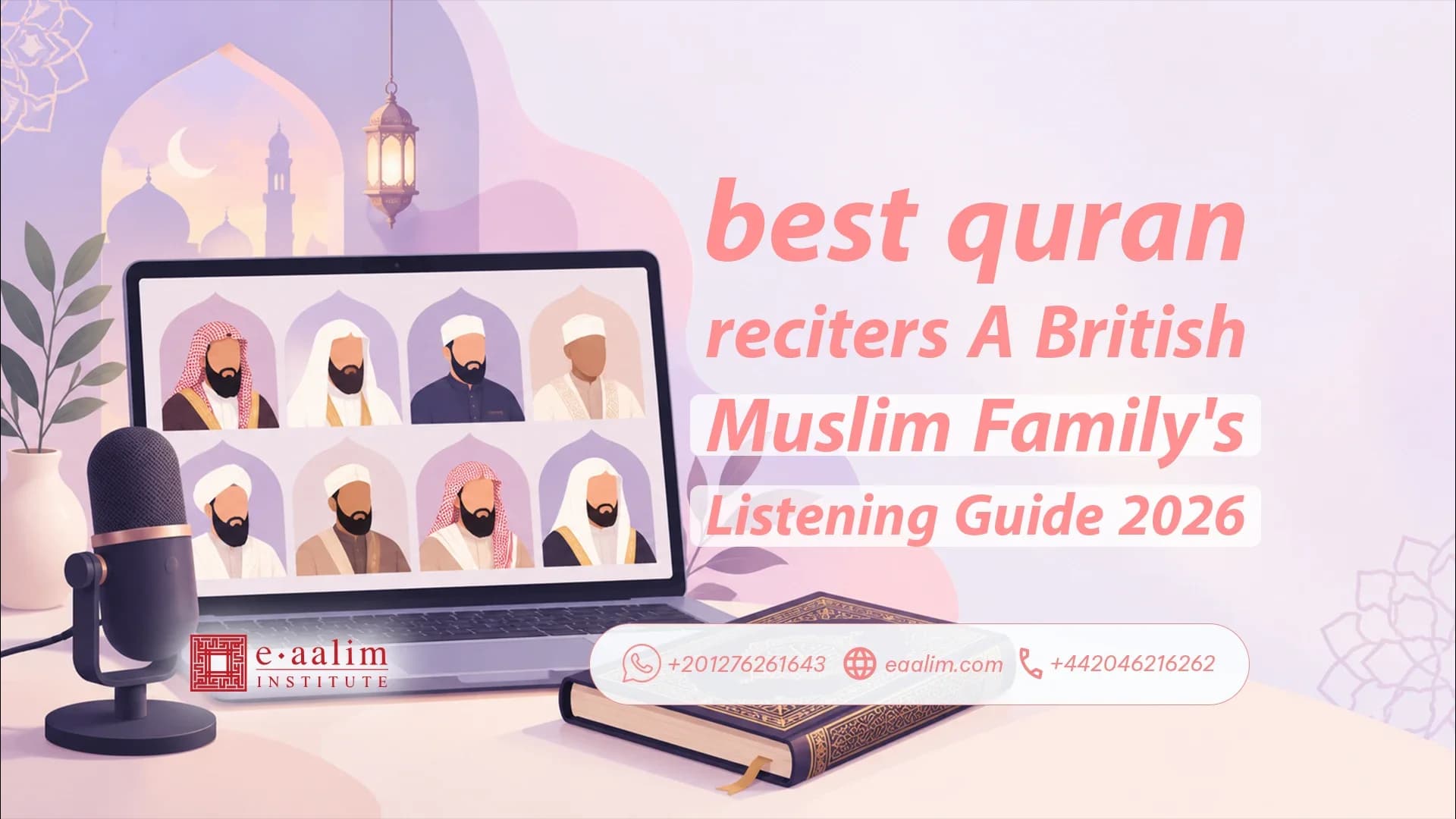
best quran reciters A British Muslim Family's Listening Guide 2026
By Eaalim Institute on 4/27/2026 · 6 min read
The best Quran reciters can turn a simple listening moment into one of the most moving experiences in Muslim life. In fact, the voices of great Qaris shape how millions of British Muslims hear the Quran every day. Many listen on the morning commute, while preparing iftar, or during family bedtime routines. This UK guide profiles ten of the greatest Qaris in modern Muslim history. For each, it gives a brief biography, what makes the reciter distinctive, and a starting point for families.
Why the Best Quran Reciters Matter
The Prophet Muhammad ﷺ said: "Beautify the Quran with your voices" (Sunan Abu Dawud 1468, sahih). Indeed, the great Qaris show what correct, beautiful recitation with Tajweed sounds like. As a result, they set a clear model for every learner. For British Muslim children learning to recite, daily exposure to these voices speeds up their own progress dramatically.
1.Sheikh Mahmoud Khalil al-Husary (1917–1980)
Many call him the "father of modern Quranic recitation". In fact, he was an Egyptian Qari trained at Al-Azhar. Moreover, he was the first Qari to record the complete Quran. Today, his Mushaf al-Mu'allim recordings, designed for learners, remain the gold standard for teaching the Quran in the classical style.
Recommended starting point: his Mujawwad recitation of Surah Yasin or Surah Ar-Rahman.
2. Sheikh Abdul-Basit Abdus-Samad (1927–1988)
The world celebrates him for his powerful, emotive Mujawwad style. Like al-Husary, he was an Egyptian Qari trained at Al-Azhar. In addition, his recitation of Surah Maryam at the United Nations General Assembly in 1955 is one of the most iconic moments of 20th-century Quranic recitation.
Recommended starting point: his Mujawwad recitation of Surah Yusuf or Surah Maryam.
3. Sheikh Mahmoud Ali al-Banna (1926–1985)
Similarly, this Egyptian Qari is known for his soft, melodic style and his exceptional command of the seven canonical Qira'at. Furthermore, his recitations have a contemplative quality that resonates with listeners seeking spiritual depth.
Recommended starting point: his Mujawwad recitation of Surah Al-Anfal.
4. Sheikh Mohammed Siddiq al-Minshawi (1920–1969)
This Egyptian Qari is celebrated for his emotional, heart-rending recitation. Moreover, his mastery of the Mujawwad style made him one of the most beloved Qaris of the 20th century. Likewise, the depth of feeling in his voice still touches listeners today. Although he died young, his recordings continue to move millions worldwide.
Recommended starting point: his recitation of Surah Al-Hashr.
5. Sheikh Muhammad Jibreel
Sheikh Muhammad Jibreel is a modern Egyptian Qari who leads prayers at the Amr ibn al-As Mosque in Cairo. In addition, he is known for his powerful Mujawwad style and his iconic recitation during Ramadan Taraweeh and the Night of Decree. As a result, listeners across the Muslim world recognise his voice.
Recommended starting point: his Taraweeh recordings from Cairo, widely available on YouTube.
6. Sheikh Mishary Rashid Alafasy
This Kuwaiti Qari is the most globally recognised contemporary reciter on digital platforms. In fact, people have listened to his Quran.com and YouTube recordings billions of times.Above all, he is especially known for his Tarteel (slow, measured) style, which is excellent for learners.
Recommended starting point: any short surah from his slow Mushaf recordings — ideal for British Muslim children learning Tajweed.
7. Sheikh Abdul Rahman Al-Sudais
Sheikh Abdul Rahman Al-Sudais is an imam of the Masjid al-Haram in Makkah. Moreover, through Saudi state media, he is the most-broadcast Qari in the world. For example, Muslims everywhere hear his Taraweeh recitations from Makkah during Ramadan. Overall, his recitation is powerful and traditionally Saudi in style.
Recommended starting point: his Taraweeh recordings from Makkah.
8. Sheikh Maher al-Muaiqly
Sheikh Maher al-Muaiqly has served as an imam at both the Masjid al-Haram and the Masjid an-Nabawi. Furthermore, his contemporary style combines a measured pace with exceptional Tajweed clarity. Therefore, many British Muslim families favour him for daily listening, thanks to his calm, accessible delivery.
Recommended starting point: his Mushaf recordings of Juz 'Amma.
9. Sheikh Saud Ash-Shuraim
Sheikh Saud Ash-Shuraim served as an imam of the Masjid al-Haram alongside Sheikh Sudais. Moreover, his powerful, deep voice and emotional Taraweeh made him one of the most beloved contemporary Qaris.
Recommended starting point: his Taraweeh recordings.
10. Sheikh Hamdi al-Zamil
Likewise, this Egyptian Qari is known for his technical precision in Tajweed and his clear, confident style. Admittedly, he is less famous worldwide than the household names. However, Tajweed teachers highly respect him for the accuracy of his recitation.
Recommended starting point: his recitations of the longer Madinan surahs.
Honourable Mentions
Sheikh Mohamed Refaat (1882–1950) — the legendary Egyptian Qari who pioneered radio recitation. In fact, his voice opened the era of broadcast Quran.
Sheikh Abu al-Enein Sha'isha — an Egyptian Qari known for his depth of expression.
Sheikh Abdul-Aziz Ali Farag — an Egyptian Qari and senior teacher of Tajweed.
Sheikh Mohamed Saei Nasr al-Jerzawi — an Egyptian Qari who taught several generations of Egyptian reciters.
How to Use This Guide to the Best Quran Reciters
Choose 2–3 Qaris for daily listening. For example, Mishary Alafasy, Sudais and Maher al-Muaiqly are excellent first choices for UK families.
Then, play them in the background of daily life, such as the school run, meal preparation in the kitchen, or before-bed routines.
Pair the listening with the Mushaf. In fact, children who follow along while listening absorb Tajweed faster.
Make Taraweeh recordings part of Ramadan. Sudais, Maher and Sheikh Jibreel from Cairo are all wonderful Ramadan companions.
Discover the classical Egyptians. Finally, Husary, Abdul-Basit, Minshawi and Mahmoud al-Banna are essential listening for spiritual depth.
Where to Listen for Free
Quran.com — free streaming and downloads for all major Qaris.
YouTube — near-complete recordings of every Qari listed above.
Tarteel app — supports all major Qaris.
Islamicaudio.com — a comprehensive Qari archive.
How Eaalim Teachers Help British Muslim Children Develop Their Own Beautiful Recitation
Indeed, listening to the best Quran reciters speeds up learning. However, it cannot replace one-to-one Tajweed correction. For this reason, Eaalim's Al-Azhar certified teachers work with each child individually to refine their recitation in our online Quran classes. Lessons last 30 minutes, or 15–20 minutes for under-7s and beginners. In addition, we schedule lessons in GMT/BST and charge in pounds. Best of all, you can start with a free trial.
Start your journey with Eaalim today!
Start 2 Free Trials


 Share
Frequently Asked Questions
Ten globally celebrated Qaris: Sheikh Mahmoud Khalil al-Husary (the 'father' of modern Mujawwad recitation), Sheikh Abdul-Basit Abdus-Samad (legendary emotive Egyptian), Sheikh Mahmoud Ali al-Banna, Sheikh Mohammed Siddiq al-Minshawi, Sheikh Muhammad Jibreel, Sheikh Mishary Rashid Alafasy (most globally listened-to contemporary), Sheikh Abdul Rahman Al-Sudais (Masjid al-Haram imam), Sheikh Maher al-Muaiqly, Sheikh Saud Ash-Shuraim, and Sheikh Hamdi al-Zamil. Honourable mentions include Mohamed Refaat (radio pioneer), Abu al-Enein Sha'isha, Abdul-Aziz Ali Farag, and Mohamed Saei Nasr al-Jerzawi.
Sheikh Mishary Rashid Alafasy is the standard starting choice for British Muslim children. His Tarteel (slow, measured) recordings are ideal for learners — clear, paced, with proper Tajweed audible. Pair with Sheikh Maher al-Muaiqly for slightly more contemporary style. Add Sheikh Sudais and Sheikh Husary as the child's listening matures. Background listening on the school run or before bed accelerates Tajweed learning dramatically.
Four reading speeds. Tahqeeq (slowest, most deliberate) — for teaching beginners. Tarteel (slow, measured) — the standard for daily reading and prayer; the Quran instructs 'recite the Quran with measured recitation' (Surah Al-Muzzammil 73:4). Tadweer (medium pace) — used in Tarawih during Ramadan when imams need to complete a juz per night. Hadr (fast pace) — for advanced reciters and revision. Beginners should focus on Tahqeeq and Tarteel.
Because he was the first Qari to record the entire Quran with full Tajweed in the standard Mujawwad style. Born in Egypt 1917 and Al-Azhar trained, his Mushaf al-Mu'allim recordings (designed specifically for learners) became the gold standard for teaching Quran in classical style globally. Generations of Qaris and teachers learned from his recordings. He is the technical foundation that every modern Egyptian-school Qari builds on.
Quran.com offers free streaming and download for all major Qaris with translations and tafsir. YouTube has near-complete recordings of every Qari listed in this guide. The Tarteel app supports all major Qaris with AI-assisted memorisation. Shamela.ws and Islamicaudio.com have comprehensive Qari archives. Most UK Muslim families combine Quran.com (mobile/desktop) with YouTube (TV/audio) for daily listening.
Sheikh Abdul-Basit Abdus-Samad recited Surah Maryam (chapter 19) at the United Nations General Assembly in 1955 during a session on the Middle East. The recitation, broadcast globally, is one of the most iconic moments of 20th-century Quranic recitation and introduced the powerful Mujawwad style to Western audiences. It is freely available on YouTube and remains essential listening for anyone studying the great Egyptian Qari tradition.
Yes — pick one Qari and stick with them for memorisation. Switching between reciters during memorisation creates inconsistency in Tajweed and rhythm. Sheikh Mishary Alafasy's slow Mushaf recordings are the standard choice for British Muslim children memorising. Sheikh Maher al-Muaiqly is also excellent. Once the surah is memorised, listening to other Qaris reciting the same surah deepens the child's understanding and appreciation.
Female Qaris exist and have a long history in Islamic tradition. Throughout the 20th century, Egypt produced several female Qariat (the female form): Sheikha Munira Abdullah, Sheikha Nura Abdullah, and others. In contemporary times, Mariam al-Mahbasi, Sumayya Eddib, and others lead recitations in women's settings. Public broadcasting of female recitation is more limited in some Muslim-majority countries, but in the UK, Muslim women's gatherings often feature female Qariat.
Mujawwad is the slow, melodic, ornamented style used for special occasions (Ramadan Tarawih, mahafil al-Quran). Sheikh Husary, Sheikh Abdul-Basit, and Sheikh Minshawi recorded primarily in Mujawwad style. Murattal is the simpler, more measured Tarteel-pace style used for daily recitation. Sheikh Mishary Alafasy and Sheikh Maher al-Muaiqly's standard Mushaf recordings are Murattal. Both are valid; Mujawwad is more dramatic; Murattal is more practical for daily recitation.
Three ways. (1) Auditory memory — children's ears learn proper Tajweed from extended listening before they consciously study the rules. (2) Pacing model — children naturally adopt the rhythm of the Qaris they listen to most. (3) Spiritual connection — beautiful recitation makes the Quran genuinely beloved, not just a duty. Pair daily listening with Eaalim's one-to-one Tajweed correction for the complete approach. Free 30-minute trial: https://eaalim.com/free-trial
