

Ancient Quran Manuscripts: The Complete Birmingham Quran Guide (UK 2026)
By Eaalim Institute on 5/13/2026 · 14 min read
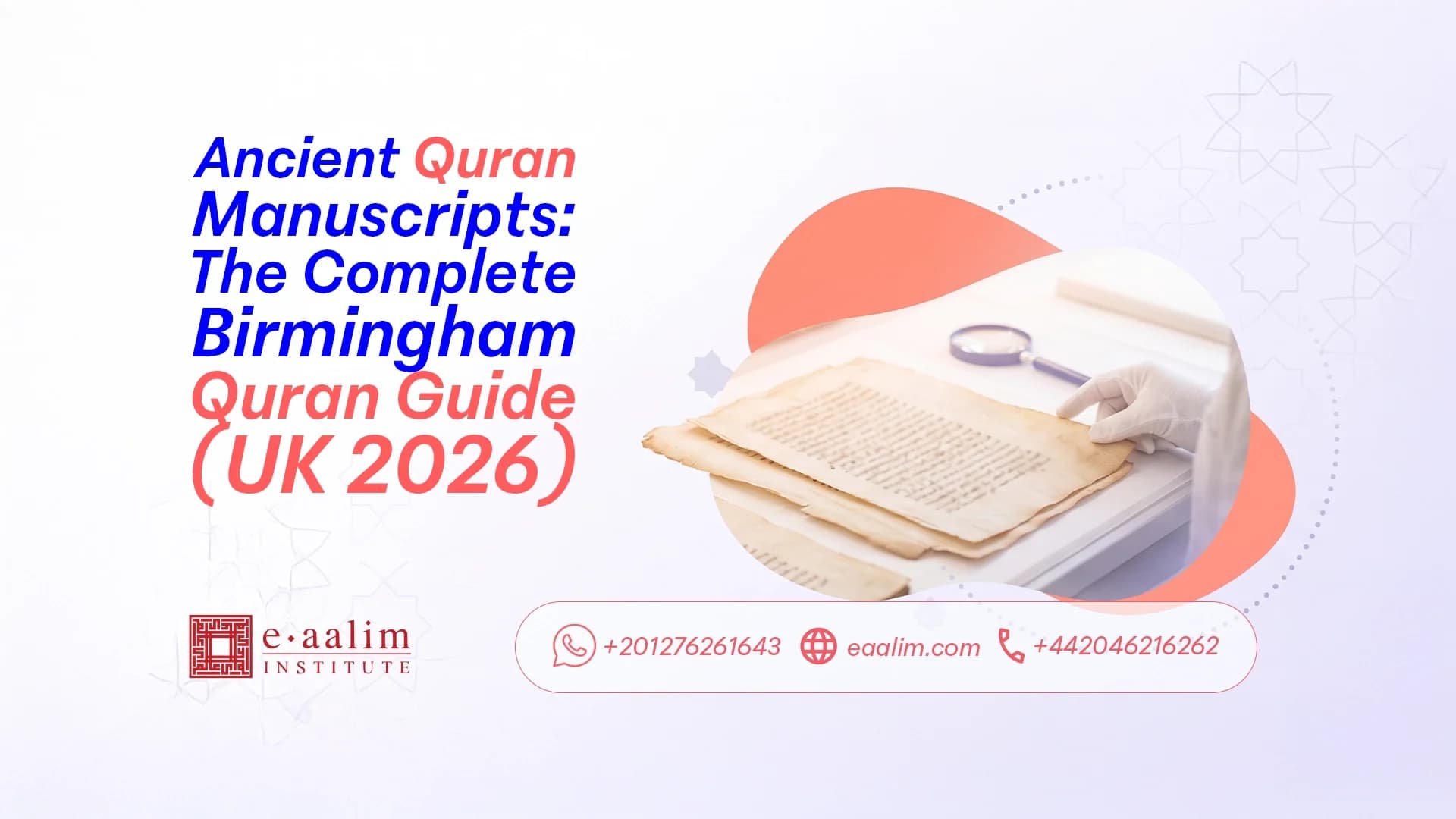
The Birmingham Quran manuscript is one of the oldest Quran manuscripts in the world. And its story matters for every Muslim family. Also, in a temperature-controlled vault in the University of Birmingham's Cadbury Research Library sits one of the oldest fragments of the Qur'an in the world. Two parchment pages, written in elegant Hijazi script in dark brown ink. It includes verses from Surahs 18, 19 and 20. Moreover, when radiocarbon dating was completed in 2015, the result startled the scholarly world. The parchment had been written between 568 and 645 CE. Meaning it is possible that the manuscript was inscribed during the lifetime of the Prophet Muhammad ﷺ himself.
Furthermore, this is the Birmingham Qur'an. It is not in Cairo or Madinah or Istanbul. It is in the West Midlands. Indeed, and for British Muslim families in 2026, it is the most powerful reminder available. Within a short train ride of London, Manchester or Leeds. That the Qur'an they recite in their living rooms every evening is the same text, word for word. Importantly, that the Companions of the Prophet ﷺ heard and wrote down fourteen centuries ago.
This guide gives British Muslim families a tour of the most important ancient Qur'an manuscripts in the world. It explains what they tell us about how the Qur'an was preserved. And it answers the equally practical question that many UK households face today. What should a British Muslim do with an old, worn out or damaged copy of the Mushaf at home?
The Birmingham Qur'an — Britain's oldest Islamic treasure.
Clearly, the Birmingham Qur'an manuscript is part of the Mingana Collection. A body of around 3,000 Middle Eastern manuscripts assembled in the 1920s by the Iraqi-born scholar Alphonse Mingana with the financial backing of Edward Cadbury of the famous Cadbury chocolate family. The Qur'anic fragments sat unidentified in the collection for nearly a century until a PhD researcher noticed they had been catalogued separately from a related Hijazi manuscript.
When the parchment was sent to the Oxford Radiocarbon Accelerator Unit in 2015. The dating gave a 95.4 percent confidence interval between 568 and 645 CE. Additionally, the Prophet ﷺ was born around 570 CE and died in 632 CE. This means the Birmingham parchment could have been written during the prophetic lifetime itself. And even on the most conservative reading. Besides, the dating places it during the caliphate of Abu Bakr or ʿUmar (RA). Within thirteen years of the Prophet's death.
For British Muslim parents looking for a powerful single trip to anchor their children's relationship to the Qur'an. Certainly, the Cadbury Research Library at the University of Birmingham allows public viewings of the manuscript by appointment. Standing in front of those two parchment pages. A British Muslim child sees what no amount of Islamic studies homework can communicate as clearly. The Qur'an that came down to the Prophet ﷺ is in physical. Consequently, datable form, in the country we live in. And it matches the Qur'an we recite at home.
The Sana'a Palimpsest — the manuscript beneath a manuscript.
In 1972, builders working on the Great Mosque of Sana'a in Yemen discovered a hidden cache of old Qur'anic parchments concealed in the loft space between the mosque's roof and ceiling. Among them was what later became known as the Sana'a Palimpsest. Undoubtedly, a manuscript with two layers of writing. The lower layer scraped off and overwritten by the upper layer in the way medieval parchments were often reused.
Radiocarbon dating placed the lower layer between 578 and 669 CE. Notably, the upper layer matches the standardised ʿUthmanic codex. The lower layer contains a slightly variant text. Almost certainly one of the personal Qur'anic codices belonging to a Companion of the Prophet ﷺ before the caliph ʿUthman (RA) ordered a unified text. Far from undermining the Qur'an's preservation, the Sana'a manuscript confirms it. In addition, it shows the Muslim community in the early period rigorously eliminating personal variations to preserve the single text the Prophet ﷺ recited.
The Topkapi and Tashkent Qur'ans — the codices attributed to ʿUthman (RA).
When ʿUthman ibn ʿAffan (RA) standardised the Qur'an around 650 CE. He ordered the production of a small number of master copies and dispatched them to the major Islamic centres of the time. As a result, Makkah, Madinah, Kufa, Basra, Damascus and (probably) Egypt. Several manuscripts surviving today are traditionally identified as the surviving ʿUthmanic copies. Though scholarly debate continues over which are originals and which are very early copies of originals.
The Topkapi Mushaf, held in the Topkapi Palace Museum in Istanbul, is one of the most famous. For this reason, it is a complete codex with extensive evidence of early Hijazi script. The Tashkent (Samarkand) Mushaf, held in Uzbekistan, is another candidate. Partially damaged but containing roughly a third of the Qur'an. Both are venerated as physical witnesses to ʿUthman's standardisation effort. A third, the Husayn Mosque Mushaf in Cairo, completes the most famous trio of "ʿUthmanic" candidates.
In short, what every honest study of these manuscripts shows is the same thing. The text they preserve, allowing for differences of orthography and dialectal qiraa'aat that the Prophet ﷺ himself authorised. Is the same Qur'an British Muslim children memorise today.
The Tubingen Qur'an and other European holdings.
Also, Britain is not alone in Europe in holding ancient Qur'anic material. The Tubingen Qur'an at the University of Tubingen in Germany was dated in 2014 to between 649 and 675 CE. Within twenty to forty years of the Prophet's death. Moreover, various fragments are held in the Bibliotheque nationale de France in Paris, the Vatican Library. And the Khalili Collection in London. For British Muslim families with the appetite for Islamic-history travel. Furthermore, a self-guided tour of Europe's Qur'anic manuscript holdings is a richer education than most paid Islamic studies courses.
How the Qur'an was preserved — the history that explains the manuscripts.
To understand why the ancient manuscripts agree so closely with the Qur'an in the hands of every British Muslim today. The history of preservation needs to be sketched briefly.
The Qur'an came down in portions to the Prophet ﷺ over twenty-three years between roughly 610 and 632 CE. Each portion was memorised by the Companions and simultaneously written down on whatever materials were available. Palm leaves, flat stones, leather, animal shoulder blades — by appointed scribes. Indeed, the Prophet ﷺ himself reviewed the memorised and written portions with the Angel Jibreel every Ramadan. And twice in the Ramadan of his final year.
After the Prophet's death, the Companion Zayd ibn Thabit (RA) was tasked by Abu Bakr (RA). Importantly, at the urging of ʿUmar (RA), with gathering all the written fragments into a single complete codex. This first official compilation — the Ṣaheefah was kept first with Abu Bakr, then ʿUmar. Then ʿUmar's daughter Hafsa (RA), one of the Mothers of the Believers.
Twenty years later, when the Muslim community had expanded across three continents and dialectal differences in recitation began to cause confusion. The caliph ʿUthman (RA) ordered a definitive standardisation. He borrowed Hafsa's Ṣaheefah, commissioned a team led again by Zayd ibn Thabit (RA) to produce master copies in the Quraysh dialect of the Prophet ﷺ. Clearly, and sent these copies to the major centres of the Muslim world. He also ordered all other personal copies destroyed to prevent further variation.
The Sana'a Palimpsest, with its lower layer of a pre-ʿUthmanic personal copy and its upper layer of the standardised text is the physical confirmation of exactly this history.
What should a British Muslim do with a damaged Mushaf at home?
Additionally, this is a real practical question for British Muslim families. Almost every UK Muslim household has at least one of the following. An old children's Mushaf with torn pages. Besides, a Qur'an memorial copy left from a deceased relative whose pages have started to fall out. A small pocket Qur'an whose binding has disintegrated. Or duplicate copies in the wrong language inherited from family travels.
Certainly, throwing the Qur'an in the household recycling bin. Where the pages will be pulped alongside Tesco flyers and council tax letters, is not appropriate. The classical scholars. Consequently, including Ibn Taymiyyah, al-Bahuti in the Hanbali school, and the contemporary Saudi scholar Ibn ʿUthaymīn. Discussed exactly this situation. They identified three permissible methods of respectfully retiring a damaged Mushaf:
Method 1: Burying.
Undoubtedly, the Mushaf is wrapped in a clean cloth and buried in a clean place where it will not be disturbed. Typically a quiet area of a garden, the cemetery (with permission), or under a tree on Islamic-trust land. The depth should be sufficient to prevent it being uncovered by animals or weather. Notably, the principle is the same as the respectful burial of a deceased believer. The parchment that carried the Word of Allah is returned to the earth with dignity.
For UK families, burying is often the most accessible option. In addition, a garden in suburban Bradford, Birmingham or Edinburgh works perfectly well. The classical scholars did not require any ceremony — the act itself is the dignified retirement.
Method 2: Burning.
The Mushaf is burned completely until only ash remains, in a clean and safe location. As a result, this may sound shocking to a British sensibility. But it is the historical method used by the caliph ʿUthman (RA) himself when he disposed of the personal Companion copies after standardisation. The principle is that fire transforms the physical pages into clean ash. Leaving no possibility of disrespect or future misuse.
For this reason, for UK families, this method requires care. Many British gardens do not permit open fires. And Muslim charities in some UK cities offer a coordinated burning service through their local masajid for exactly this need. In short, a British Muslim family considering this method should check with their local imam or community before proceeding privately.
Method 3: Shredding into illegible pieces.
The third option, recognised by contemporary scholars as a permissible modern alternative. It is to shred the Mushaf in a mechanical paper shredder until the words are no longer legible. And then you can bury or recycle the unreadable confetti. This is the easiest method for UK households with a normal home shredder. Also, and it carries no risk of fire damage. The condition is that the result must be genuinely illegible. Fragments are small enough that no single Qur'anic verse can be read on any one piece.
Moreover, some UK masajid now run periodic Mushaf-retirement services exactly along these lines. Accepting damaged copies from the community and processing them collectively. If your local mosque does not yet offer this, consider asking. It is a simple service that fills a real need in every British Muslim community.
What about partially damaged Mushafs that are still readable?
The classical scholars distinguished between Mushafs that were damaged beyond repair (where retirement was appropriate) and Mushafs that could be salvaged (where repair was preferable). If a binding has come loose but the pages are intact. Furthermore, taking the Mushaf to a bookbinder for repair is a meritorious act. Many UK university libraries, including in Edinburgh, Manchester, Cambridge and London. Employ professional book conservators who will rebind a Mushaf for a small fee. Eaalim's view, in line with the classical position, is that repair should always be the first choice. And retirement only the second.
What this teaches British Muslim families.
Indeed, the ancient manuscripts in Birmingham, Sana'a, Istanbul, Tashkent and Tubingen tell one consistent story. They show the same text our British Muslim children memorise today. Written down within years of the Prophet's death and preserved across fourteen centuries through the conscious effort of generations of Muslims to copy. Importantly, verify, retire and replace damaged copies with reverence.
The personal habits that produced this miracle of preservation. Handling the Mushaf carefully, retiring it respectfully, copying it accurately, teaching it to children. Clearly, are exactly the habits British Muslim families need to maintain today. There is no separation between the Companion who buried a worn parchment under a Madinan tree in 650 CE and a British Muslim mother who teaches her child to keep the Mushaf above all other books on the shelf. Never to put it on the floor. And never to throw it carelessly into a recycling bin. Additionally, the same chain of care has held the text intact for fourteen centuries. It is the British Muslim's job to pass that chain to the next generation.
A new course: the classical Tafsir tradition for British Muslim families.
Knowing the history of the Qur'an's preservation is one thing. Understanding what the Qur'an actually says. Besides, verse by verse, surah by surah, in the way the classical mufassiroon explained it. Is the next, deeper step. The classical Islamic tradition produced an extraordinary body of tafsir literature. Al-Ṭabari's Jamiʿ al-Bayān (the foundational ninth-century tafsir running to dozens of volumes), Ibn Kathīr's accessible Tafsīr al-Qurʾan al-ʿAzeem. Certainly, al-Qurtubi's legal-focused al-Jamiʿ li-Ahkam al-Qurʾan, al-Razi's philosophical Mafateeḥ al-Ghayb. And al-Saʿdi's modern and accessible Tayseer al-Kareem al-Raḥman.
For British Muslim families who want to study the Qur'an at this depth. Consequently, E-aalim is starting a brand-new course in our Islamic Studies department. The Online Classical Tafsir Course UK. The course is a structured live one-on-one programme taught in English by Al-Azhar certified teachers on UK GMT/BST time slots. Undoubtedly, designed for British Muslim families and adult learners who already have a basic grasp of Arabic. The curriculum includes:
The science of tafsir. Notably, the principles ('uṣool al-tafsir'), the categories of tafsir bi-l-maʾthoor and tafsir bi-l-raʾy. And the conditions a mufassir must meet.
Selected sessions on al-Ṭabari. In addition, the methodology of the founding work of Sunni tafsir and how its chains of transmission are read.
Ibn Kathir in depth. The most widely studied tafsir in the Muslim world today. As a result, walked through surah by surah at a pace British students can sustain.
Comparative sessions across mufassiroon. Taking a single verse and examining what al-Ṭabari, al-Qurṭubī, Ibn Katheer, al-Saʿdī, and al-Shaʿrawi each said about it.
For this reason,
The history of the Qur'an's preservation. Including the ancient manuscripts covered in this article. And the relationship between manuscript evidence and the science of tafseer.
In short, the course pairs particularly well with our introductory online Tafsir Course UK. Many families take the beginner course first and graduate to the classical course afterwards. Building a full nine-to-twelve-month tafseer curriculum at home.
To register your interest. Also, or to book a free trial lesson with one of our Al-Azhar certified teachers. Fill in the booking form on our site and mention "Classical Tafsir course" in the message. We will confirm a UK time slot. Send the lesson plan for the first four weeks, and pair your child. Moreover, or you, if you are an adult learner — with the right teacher for your level.
Until the course starts for public enrolment. We encourage British Muslim families to take one Saturday and visit the Birmingham Qur'an in person if you can. Stand in front of those two seventh-century parchment pages, read aloud the verses of Surahs 18. 19 and 20 from your own pocket Mushaf at home that evening. Furthermore, and notice the silence in which the two texts match. That is the Qur'an. It has not changed. Indeed, our job — as British Muslim parents, professionals, students and reverts. It is to make sure that what is written in those parchments lives in the hearts and habits of our children for another fourteen centuries.
Start your journey with Eaalim today!
Start 2 Free Trials


 Share
ShareRelated Blogs
The Onset of Prophethood: The First Revelation in Cave Hira (UK British Muslim Guide)
The first revelation of the Quran to the Prophet Muhammad ﷺ in Cave Hira around 610 CE. The 40 years of preparation, the moment of revelation, the support of Khadijah, the pause, and what the moment teaches British Muslim families.
Ibrahim and the Four Birds: How the Quran Demonstrates Resurrection (UK Tafsir Guide 2026)
Learn the story of Prophet Ibrahim and the Four Birds in Surah Al-Baqarah and discover how the Quran explains resurrection and strengthens faith.
Frequently Asked Questions
Radiocarbon dating completed in 2015 at the Oxford Radiocarbon Accelerator Unit placed the parchment between 568 and 645 CE with 95.4 percent confidence. Since the Prophet ﷺ was born around 570 CE and died in 632 CE, the manuscript could have been written within his lifetime, and even on the most conservative reading dates to within thirteen years of his death. The two parchment pages, written in Hijazi script, contain verses from Surahs 18, 19 and 20, and are held in the Cadbury Research Library at the University of Birmingham.
Discovered in 1972 in the loft of the Great Mosque of Sana'a in Yemen, it is a manuscript with two layers: an upper layer matching the standardised Uthmanic codex and a lower, scraped-off layer dated between 578 and 669 CE containing a slightly variant text. The blog explains this lower layer was almost certainly a personal Companion's codex from before Caliph Uthman (RA) ordered a unified text. Rather than undermining preservation, it physically confirms the early community rigorously eliminating personal variations to preserve the single text the Prophet ﷺ recited.
The blog cites classical scholars including Ibn Taymiyyah and Ibn Uthaymin, who identified three respectful methods: burying it wrapped in clean cloth in a clean undisturbed place; burning it completely to ash (the method Caliph Uthman used for the personal copies after standardisation); or shredding it into genuinely illegible pieces before burying or recycling. Throwing a Qur'an in the household recycling bin is not appropriate. If the Mushaf is only partially damaged but still readable, repair through a bookbinder is preferable to retirement.
Beyond the Birmingham Qur'an, the blog notes the Tubingen Qur'an in Germany, dated in 2014 to between 649 and 675 CE, within twenty to forty years of the Prophet's death. Further fragments are held in the Bibliotheque nationale de France in Paris, the Vatican Library, and the Khalili Collection in London. The Topkapi Mushaf in Istanbul and the Tashkent (Samarkand) Mushaf in Uzbekistan are among the famous codices traditionally identified with Caliph Uthman's standardisation effort.
