


Arabic Tutors for Children in the UK: Lessons and Progress
By Eaalim Institute
What makes an Arabic tutor a suitable, trusted match for your child? Choosing an Arabic tutor for children in the UK means looking beyond fluent speech: your child’s age, confidence, previous learning and goals all shape what a helpful lesson looks like. It’s reasonable to want clear information about a tutor’s qualifications and how lessons are tailored before your child starts.
A calm, supportive approach can help children try new words, ask questions and build confidence at their own pace. Lessons can focus on conversation, listening, vocabulary or reading, depending on what your child already knows and wants to learn.
This guide explains what to consider when assessing a tutor’s credentials and suitability, what a trial lesson can involve, and how progress may become visible over time. It also covers the online classroom and practical details that can help you find a comfortable fit for your child and family routine.
Key Takeaways
- See how live online lessons can make Arabic learning more personal and easier to fit around family routines.
- Understand how a child’s age, experience, confidence and learning goals can shape lesson activities.
- Know what a trial lesson can reveal about your child’s current skills and the next useful learning step.
- Spot progress through everyday signs, from more independent speaking to greater ease with familiar reading patterns.
- Use practical matching considerations to find an approach that feels comfortable and supportive for your child.
What is the online interactive classroom like for Arabic lessons?
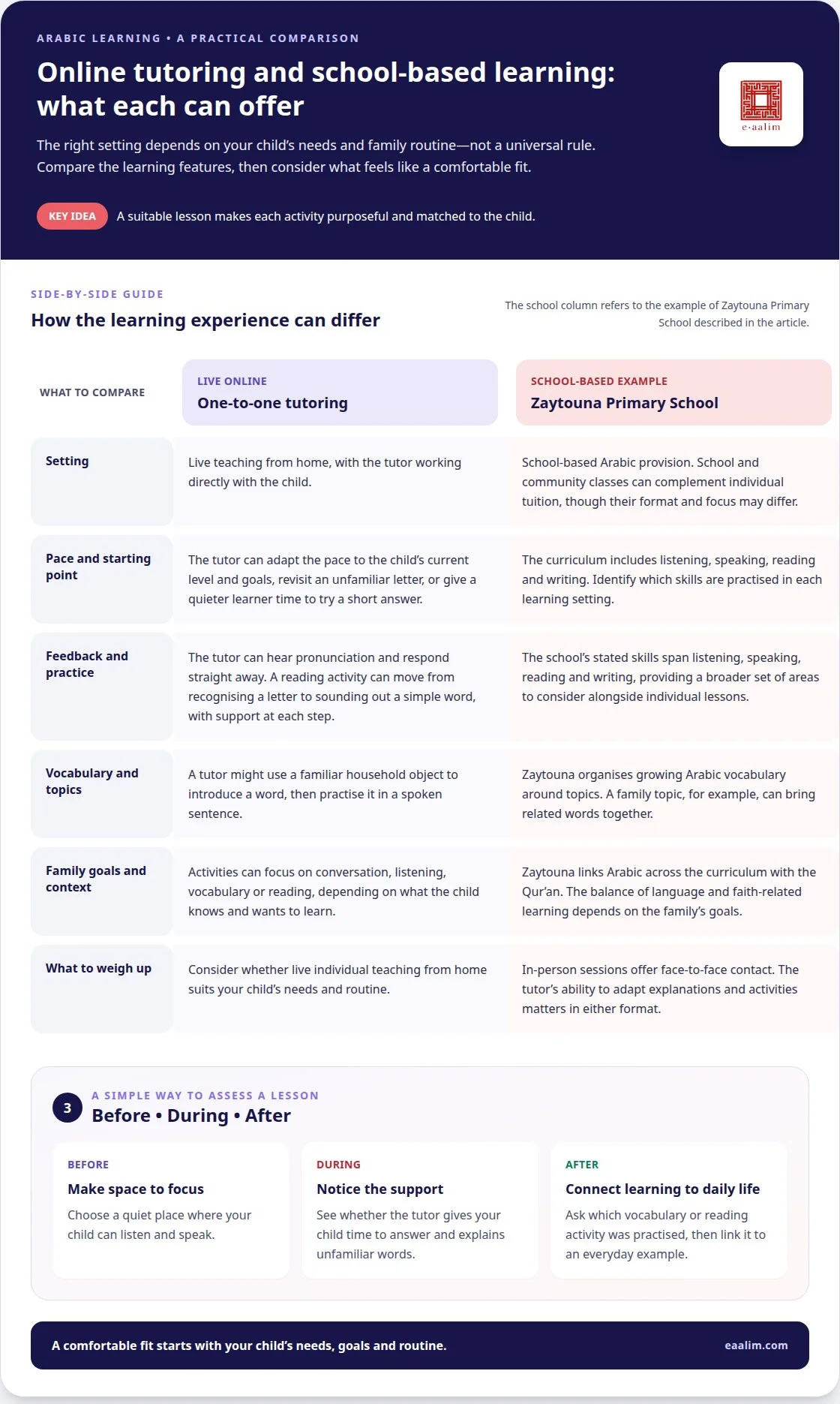
Online Arabic lessons let children learn from home through live teaching adapted to their current level and goals. School-based Arabic provision also exists: Zaytouna Primary School aims to develop listening, speaking, reading and writing skills.
One-to-one online tutoring
In one-to-one online tutoring, a child works directly with a tutor instead of sharing lesson time with classmates. The tutor can adjust the pace, revisit an unfamiliar letter or invite a quieter learner to practise a short answer. For example, a child who recognises Arabic letters but hesitates when reading words can focus on joining letters and sounding them out.
Look for lessons that reflect your child’s actual starting point. Their exposure to Arabic at home, listening comprehension, vocabulary, reading ability and confidence can all shape what comes next. A tutor might use a familiar household object to introduce a word, then practise it in a spoken sentence, connecting new learning to something the child already understands.
Live online classes
Live one-to-one Arabic lessons let the tutor hear a child pronounce a word and respond straight away. A reading activity might move from recognising a letter to sounding out a simple word, with support at each step. The child can also ask for a word to be repeated or explained during the lesson.
Consider whether the tutor makes room for both guided practice and conversation. A child might listen to a short prompt, answer aloud, then read or write a related word. For a shy learner, starting with familiar vocabulary can make the first exchanges feel easier. The goal is a lesson that encourages participation instead of rushing through material.
Online Arabic tutoring can go beyond conversation. Zaytouna Primary School organises growing Arabic vocabulary around topics, helping children learn related words together. A topic such as family, for example, offers a natural way to name people, answer simple questions and practise pronunciation. A tutor can choose activities to match the child’s learning needs.
Some Arabic learning also connects language with faith. Zaytouna Primary School links Arabic across the curriculum with the Qur’an, helping children begin to learn the language of their faith. This can sit alongside practical skills such as listening to a word, repeating it clearly and recognising it while reading. The balance depends on the family’s goals.
Whether online or in person is better depends on the child’s needs and routine, not a universal rule. Online lessons suit families looking for live, individual teaching from home; in-person sessions offer face-to-face contact. In either format, the tutor’s ability to adapt explanations and activities matters.
School or community classes can complement individual tuition, although their format and learning focus may differ. Zaytouna Primary School’s curriculum, for example, includes listening, speaking, reading and writing. If you’re considering a combination, identify which skills each setting practises, such as conversation in one lesson and Arabic reading elsewhere.
- Before a lesson: choose a quiet place where your child can focus on listening and speaking.
- During a lesson: notice whether the tutor gives your child time to answer and explains unfamiliar words.
- After a lesson: ask which vocabulary or reading activity your child practised, then connect it to an everyday example.
These points can help you understand how an online classroom supports learning. A suitable Arabic tutor for children in the UK makes each activity purposeful, whether the focus is a spoken answer, a new word or reading practice.
Age-appropriate lessons for children
A useful Arabic learning plan starts with the child, not a fixed workbook sequence. Age matters, but exposure to Arabic at home, reading level, listening comprehension, vocabulary, pronunciation, confidence and family goals also shape teaching.
Child-centred teaching
A child-centred approach gives the tutor a clear picture of what the learner already understands and can do. For example, a child may follow spoken Arabic at home but feel unsure about forming answers independently. Lessons can build on familiar words with guided questions and simple sentence-building, rather than starting with material the child already knows.
Family goals help set the direction, too. One household may prioritise spoken Arabic for conversations with relatives; another may want to build a foundation in reading. A tutor can account for both aims while keeping activities manageable for the child’s age and attention. The key is a plan that responds to the child’s starting point.
Previous learning matters as well. A child who has studied Arabic may recognise vocabulary but need help with pronunciation or confidence. Someone new to the language may benefit from familiar topics and repeated practice. These differences affect the pace and choice of activities, so the tutor should adjust lessons as the child’s responses become clearer.
Culture can give new language meaningful context. A tutor might connect a family goal with words used in everyday greetings, or build a topic around familiar people and routines. This gives children a reason to use vocabulary instead of treating each word as an isolated item. The approach should respect the family’s aims and the child’s stage.
Tutor teaching approaches
Teaching should match the skill being developed. A child who understands Arabic but rarely speaks can practise recalling vocabulary, answering guided questions and building sentences. For a learner focused on reading, the tutor may work through letters in different positions, short and long vowels, joining letters, simple words and repeated reading for fluency.
Pronunciation practice can support either pathway. The tutor listens to the child, models a sound, then gives them a chance to try it again in a word or short phrase. This connects feedback to actual use. For a shy learner, low-pressure interaction can build confidence without making every answer feel like a test.
To understand whether the approach suits your child, notice how the tutor responds when an activity feels difficult. For instance, they might offer a prompt, use a simpler example, or revisit a sound before moving on. A good fit balances encouragement with useful teaching, and leaves room for spoken practice, reading or vocabulary according to the agreed goals. Explore online Arabic classes as one way to support your child’s learning.
What Should Happen in an Arabic Tutor Trial Lesson?
A useful trial gives the tutor an initial picture of your child’s Arabic and a chance to teach. It should include activities suited to the child’s experience, rather than just a general introduction.
Trial activities and assessment
The tutor can start by discussing previous learning and your family’s goals. Simple listening or speaking questions can reveal what your child understands and can express. If reading is relevant, the tutor might ask them to recognise a letter or read a familiar word. These activities provide a practical starting point.
Observation matters as much as correct answers. The tutor can notice vocabulary, pronunciation and confidence, then teach a short example and suggest a next step. A child who understands Arabic but rarely speaks might practise recalling a familiar word, answering a guided question and building a sentence aloud.
For children, a trial should feel like a real lesson, with room to participate and ask for help. The tutor might introduce a few words around a familiar topic, listen as the child uses them, then adapt the activity. This gives you a clearer sense of whether the teaching pace and interaction suit your child.
Lesson flexibility and frequency
Lesson frequency should reflect your child’s routine, attention and learning goals. A family balancing school, clubs and Arabic practice may prefer a consistent, manageable time. The tutor can shape lesson content around the time available, revisiting vocabulary or reading patterns instead of trying to cover too much at once.
Flexibility also means responding to what happens during a lesson. If a child finds a spoken exercise difficult, the tutor might offer a prompt or use a familiar example. If reading feels comfortable, more of the session can focus on listening or conversation. A trial can show whether the tutor adjusts activities thoughtfully.
Free trial lesson
A free trial lesson is an introductory session with no lesson fee. “Free” describes the cost, not the depth of assessment, so the session should still give the child a chance to learn and the tutor a chance to observe. Use the same practical criteria you would for any trial.
Notice whether the tutor asks about your child’s previous Arabic learning, explores a relevant skill and suggests a clear next step. A beginner might try listening to and repeating familiar words, while a child with reading experience might read a short passage. Activities should suit the learner rather than follow a fixed demonstration.
If your child’s goal includes Quran reading, distinguish it from learning conversational Arabic. Quran lessons may focus on recitation, while Tajweed covers rules for reciting the Quran accurately. A trial should make clear which skill it teaches and let your child try an appropriate example, such as listening to a recitation and practising a short phrase.
After the session, consider three things: whether your child took part, what useful next step the tutor identified, and whether the lesson matched your family’s goals. A clear recommendation might prioritise spoken answers, vocabulary practice or reading. These observations can help you decide whether the tutor’s approach suits your child.
What kind of progress can I expect for my child's Arabic?
Progress is easier to recognise when you look at specific skills rather than relying on one overall impression. Parents can notice changes in reading, vocabulary, speaking, listening, pronunciation and confidence during familiar activities.
Progress expectations and revision
Arabic develops across different skills, and progress may show up differently in each. A child might read familiar letter patterns with less hesitation before speaking more freely. Another may start reusing words from earlier lessons in a new sentence. Revisiting vocabulary and reading patterns helps children practise previous learning alongside new material.
Revision works best when it focuses on something the child has already encountered. For example, a tutor can return to a sound that caused repeated pronunciation errors, then practise it in familiar words. This links review to the next learning step instead of repeating material without purpose.
Measuring a child’s progress
To observe reading, notice whether familiar patterns take less effort to sound out. For vocabulary, listen for words from earlier lessons appearing in a new answer or conversation. In speaking, compare whether answers become longer and more independent, rather than focusing on a single correct response.
Listening offers another practical measure. Notice whether your child needs less translation or repetition to understand a familiar instruction. For pronunciation, listen for repeated sound errors becoming less frequent. Confidence matters too: a child who attempts an Arabic answer without waiting for perfect wording is showing meaningful change.
A simple progress record can help you see these changes clearly. After a lesson, note one example, such as a word remembered, a sentence spoken independently or a reading pattern completed with less hesitation. Compare similar activities over time instead of judging progress by one difficult day or one especially easy exercise.
A tutor’s progress update is most useful when it names the skill practised and gives a concrete example. It might say that your child answered a familiar question without a prompt or needed fewer repetitions during a listening activity. That detail helps you understand what has changed and what the next learning focus could be.
Online lessons can make these observations easier to discuss because parents can hear examples from the live session. A brief note about vocabulary, listening or spoken answers gives the tutor and family a shared point of reference. It also helps you offer specific encouragement at home: praise the effort to try a new word, not just a perfect answer.
Progress does not always happen at the same pace across every skill. A child may confidently reuse vocabulary but still need help with reading, or understand spoken Arabic before answering independently. Looking at several signs together gives you a fuller picture and keeps learning goals grounded in what the child can currently do.
Finding and matching with an Arabic tutor for a child
A suitable match depends on your child’s goals, starting point and comfort with the tutor. Listings include 4,329 Arabic teachers as available, so narrowing the choice by teaching fit matters more than browsing names alone. For parents who prefer comprehensive support when sourcing high-calibre private educators, educational consultancies such as Royal Family Concierge can assist in arranging tailored academic programmes.
Start with the purpose of learning. A beginner aiming to talk with family needs practice hearing and using everyday vocabulary; a child aiming to read Arabic needs a different lesson focus. Write down the main goal, such as answering familiar questions or recognising written words, so the tutor can shape lessons around it.
Consider your child’s experience with spoken Arabic, too. They may understand relatives but feel hesitant about replying, or have little exposure and need a gentle introduction. A native speaker may bring familiarity with spoken language, but that alone does not show whether their teaching approach suits a child. Clear explanations and patient interaction matter, too.
Confidence is another useful factor when choosing a tutor. A shy child may take part more readily when the tutor allows thinking time and starts with familiar words. A first conversation about food or family, for example, may feel more accessible than an unfamiliar topic. Notice whether the tutor gives your child room to respond without making each pause feel pressuring.
Use these points to describe the kind of match your family is looking for:
- Learning goal: conversation, vocabulary, reading, or a combination.
- Starting point: beginner, some home exposure, or previous lessons.
- Lesson style: guided speaking, reading practice, or a balance.
- Child’s comfort: more structure, gentle prompts, or extra thinking time.
Credentials and teaching experience matter, but consider them alongside your child’s response to a lesson. A tutor may know Arabic well yet explain it in a way that feels too advanced for a young learner. A better fit makes new language understandable, then gives the child a supported chance to use it in conversation.
It can take more than one lesson to see whether the match works. A child may be quiet at first, then speak more freely as the routine becomes familiar. Look for engagement, such as attempting a new word or responding to a prompt. If your child’s goal shifts from conversation to reading, the lesson focus should shift too.
For one-to-one online Arabic learning shaped around a child’s needs, explore online Arabic classes as a next step.
Eaalim: Online Arabic classes
Eaalim offers online Arabic classes for children, with live one-to-one lessons tailored to their current level and goals. This is a natural next step if your child would benefit from guided practice in vocabulary, conversation or reading.
Families with related learning goals can also explore Eaalim’s online Quran courses and online Islamic studies courses. Each supports a different area of learning, so the right choice depends on what your child hopes to study.
When considering lessons, share your child’s previous experience and the skills you want them to develop. This gives the instructor useful context to shape teaching around your child. To discuss online learning for your child, contact Eaalim.
Take a thoughtful next step
Choosing an Arabic tutor for children in the UK can start with one practical question: what would help your child feel ready to take part? A clear learning goal gives your next conversation a useful focus, whether that means speaking with more confidence, building vocabulary or developing reading skills.
Eaalim offers online Arabic classes, alongside online Quran courses and online Islamic studies courses. If one-to-one online Arabic learning suits your family, discuss your child’s aims and previous experience directly with Eaalim.
Contact Eaalim about Arabic lessons to take that next step at a pace that feels comfortable for your household. A calm beginning, guided by your child’s needs, can help make learning feel like a positive part of family life.
Start your journey with Eaalim today!
Start 2 Free Trials


 Share
Frequently Asked Questions
Eaalim connects learners with certified instructors, and its teachers are background-checked and DBS-aware. “Fully qualified” can mean different things, so assess suitability by considering the stated certification alongside experience teaching children and the tutor’s ability to explain concepts clearly. Your child should be able to follow the lesson, ask for clarification and practise without feeling rushed.
Tutors can develop spoken Arabic through regular, guided conversation that builds on words a child already knows. For example, a tutor might invite a learner to describe a familiar meal, then help extend a one-word answer into a short sentence. Listening to the child’s response helps the tutor choose useful vocabulary and offer focused pronunciation feedback, while questions encourage more independent speaking.
Children can learn through private online Arabic tuition, with lessons shaped around their current skills and goals. A beginner might focus on recognising letters and building basic vocabulary, while a child with previous experience may want more conversation or reading practice. Eaalim teaches Arabic online in individual lessons, not in person or in groups, so instruction focuses on one learner.
A thoughtful match takes account of the child’s starting level, learning aims and preferred lesson style. For example, a child who understands Arabic but hesitates to speak may benefit from patient conversation practice, while a new learner may need structured foundations. Eaalim connects students with certified instructors for live remote lessons tailored to children and adults, supporting individual learning rather than a one-size-fits-all class.
A provider should clearly describe the tutor’s relevant certification and experience teaching children. This information should help families understand how that experience relates to their child’s needs, such as beginner support or Arabic reading. Eaalim connects learners with certified instructors; families can use their child’s goals and lesson experience to judge whether the teaching approach feels suitable.
Eaalim’s courses are available for children aged five and up. Lesson frequency depends on the child’s goals, attention and family routine, rather than one schedule being right for every learner. A family, for instance, may prioritise a manageable, regular lesson alongside school and other commitments. Consistency gives the tutor opportunities to build on previous learning and adapt activities as the child develops.
Safeguarding matters whenever children receive private tuition. Eaalim’s teachers are background-checked and DBS-aware. Families can also consider whether online lessons take place in a setting where a parent or carer can support the child’s participation and feel comfortable with the arrangements. A calm, clear approach to child safety should go hand in hand with teaching ability.
An Arabic tutor can help your family decide what to prioritise by first clarifying where and how your child hopes to use Arabic. Modern Standard Arabic may suit goals involving formal reading, while a spoken dialect may be relevant to conversations with relatives or a particular community. Your child may have both aims, so discuss which should come first and how learning activities can support that goal.
