

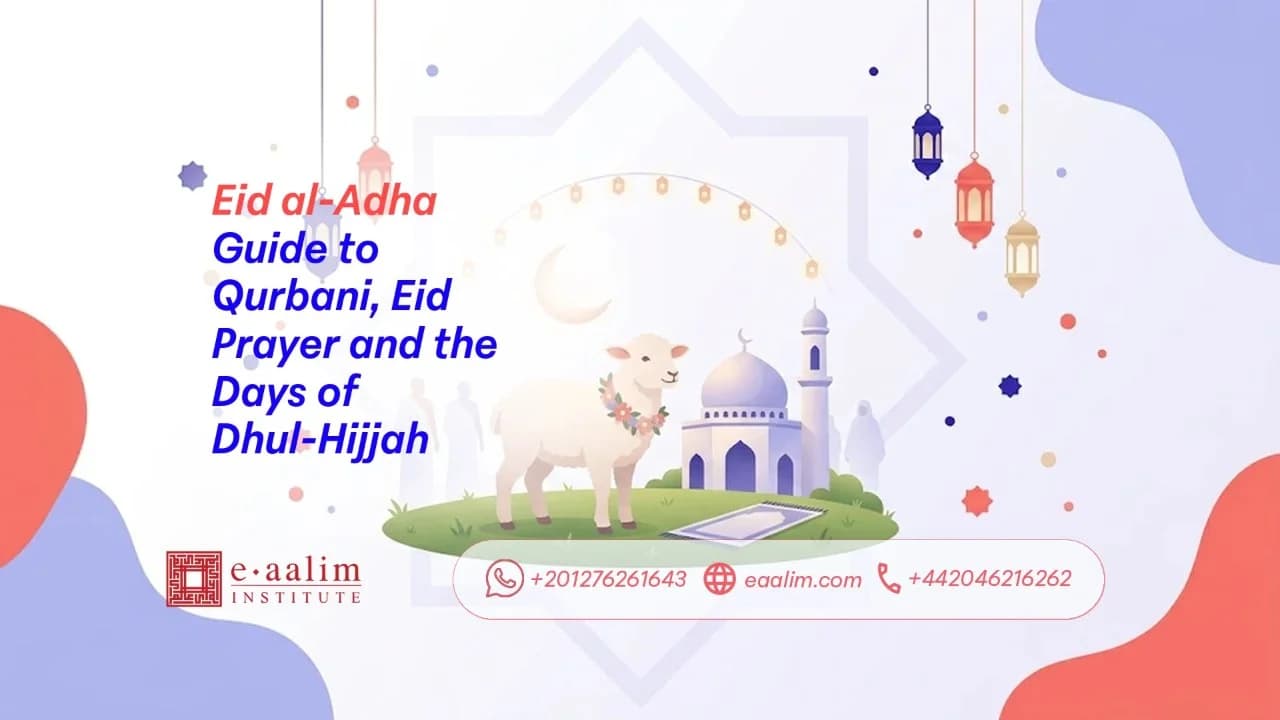
Eid al-Adha Guide to Qurbani, Eid Prayer and the Days of Dhul-Hijjah
By Mr. Ali Salama
A blessed celebration of faith, sacrifice, and devotion brings Muslims together each year to mark Eid al-Adha. This special occasion carries deep spiritual meaning, reminding believers of Prophet Ibrahim’s (AS) obedience to Allah and the importance of generosity and worship. This guide explores the Sunnah of Eid, how to perform the Eid prayer, the rules of Qurbani, and the significance of the first ten days of Dhul-Hijjah, helping Muslims observe this blessed occasion with understanding and confidence.
What is Eid al-Adha?
Eid al-Adha, the Festival of Sacrifice, falls on the 10th of Dhul-Hijjah, the final month of the Islamic lunar calendar. It marks the climax of Hajj and commemorates the moment when Prophet Ibrahim (AS) prepared to sacrifice his son Ismail (AS) in obedience to Allah. However, Allah redeemed the boy with a magnificent ram. Indeed, Surah As-Saffat (37:99–111) tells this story in full.
Moreover, Eid al-Adha is one of the two annual Eids in Islam. When the Prophet ﷺ arrived in Madinah, he found people celebrating two days from before Islam. Therefore, he said: “Indeed, Allah has replaced them for you with two better days: the day of al-Adha and the day of al-Fitr” (Sunan Abi Dawud 1134, an-Nasa’i 1556). In other words, Eid al-Fitr follows Ramadan, while Eid al-Adha follows the days of Hajj. E-Aalim is an online educational platform and institute. The E-Aalim online institute teaches the Holy Quran, Arabic language and Islamic studies online.
When is Eid al-Adha 2026?
Eid ul-Adha 1447 AH is expected to fall on Wednesday 26 May 2026 in the UK, with the Day of Arafah on Tuesday 25th. May 2026. The exact date depends on the moon sighting for the start of Dhul-Hijjah, which UK mosques typically follow either by the Saudi declaration or by independent UK moon-sighting committees ( In this case, all Muslims follow the Saudi declaration as Hajj takes place in Makkah) (Wifaqul Ulama, HMNAO, and others). British Muslim families are advised to check with their local masjid the night before to confirm.
Because Eid ul-Adha tracks the lunar calendar, it moves roughly 11 days earlier each Gregorian year. As a result, between 2026 and 2030, the day falls in the British spring and summer — meaning Eid prayers will be in mild morning weather and outdoor parks remain a realistic venue.
The first ten days of Dhul-Hijjah, a season many people miss
Eid al-Adha crowns a season many Muslims overlook. In fact, the Prophet ﷺ said that no days are more beloved to Allah for righteous deeds than these ten, not even Jihad, except for a man who goes out with himself and his wealth and returns with neither (Sahih al-Bukhari 969).
Therefore, for those not on Hajj, these days are an opportunity to:
Fast all nine days, or at least the Day of Arafah, which “expiates the sins of the previous year and the coming year” (Sahih Muslim 1162). However, pilgrims at Arafah do not fast.
Also, recite the Takbir after every obligatory prayer from Fajr on Arafah until Asr on the 13th.
Increase Qur’an, dhikr and du’a. Moreover, some scholars consider these days better than the days of Ramadan’s last ten.
Finally, avoid cutting hair and nails if you intend to offer Qurbani, as the Prophet ﷺ instructed (Sahih Muslim 1977).
Eid al-Adha morning and its Sunnah
The Sunnah for Eid ul-Adha morning differs slightly from Eid ul-Fitr morning, and these differences matter:
Do not eat before the Eid prayer. Unlike Eid ul-Fitr, when the Sunnah is to eat dates first, on Eid ul-Adha the Sunnah is to delay the first meal until after the Eid prayer — and ideally to break the fast on the meat of the Qurbani.
Perform Ghusl. Indeed, a full bath before the Eid prayer is the established Sunnah of the Prophet ﷺ.
Wear your best clothes. In fact, the Prophet ﷺ kept a special cloak for the two Eids and Jumu'ah. British Muslims should dress in their finest — new if possible — and apply a permitted scent.
Recite the Takbir aloud on the way to the Eid prayer. Also, the Sunnah for Eid ul-Adha is to recite the Takbir audibly as you walk to the masjid or park where the prayer is held.
Walk to the prayer if practical and return by a different route — both established Sunnahs (Sahih al-Bukhari 986).
The Eid prayer in the UK
The Eid prayer consists of two rakahs with extra Takbirs. According to the majority of scholars, there are seven in the first rakah after the opening Takbir, and five in the second rakah before the recitation. Then, the imam delivers a khutbah.
In the UK, worshippers have several options:
Local masjid prayers — most mosques run several Eid jama’ahs from around 7:30 am to suit work schedules.
Open-air park gatherings — the Sunnah is to pray Eid in an open prayer ground. For example, Birmingham’s Small Heath Park hosts one of the largest Eid prayers in Europe, as do Bradford, Leicester and Manchester.
Eid in the Square —however, the Mayor of London’s official Eid event in Trafalgar Square takes place on the Saturday closest to Eid, and it is a community festival, not the prayer itself.
Eid al-Adha is not a public holiday in the UK. Therefore, parents usually take annual leave, and most schools grant authorised absence if parents ask in advance, although policies vary. E-Aalim tutors and teachers are dedicated, efficient, experienced and highly qualified Arabic native speaker Al-Azhar graduates.
Ibrahim and Ismail, the story behind the day
Allah granted Prophet Ibrahim (AS) a son, Ismail (AS), in his old age. Later, Allah tested Ibrahim (AS) with a vision to sacrifice his son, as Surah As-Saffat (37:102) records:
"O my son, indeed I have seen in a dream that I [must] sacrifice you, so see what you think." He said, "O my father, do as you are commanded. You will find me, if Allah wills, of the steadfast."
Then, Ibrahim (AS) laid his son on his forehead, but the knife did not cut, for Allah wanted obedience, not blood. Allah called out: “O Ibrahim, you have fulfilled the vision” (37:104–105). According to some narrations, Jibril (AS) brought a ram, and Ibrahim (AS) sacrificed it in his son’s place.
Therefore, tell children this story before mentioning the Eid lamb, so they know what Eid al-Adha is truly for.
Qurbani and how Muslims fulfil the sacrifice
The sacrifice (Qurbani or Udhiyah) is a strongly emphasised Sunnah for every Muslim adult who has the financial means. Some scholars (notably the Hanafi madhhab, which is the dominant school among UK Muslims of South Asian heritage) consider it obligatory (wajib); the majority of other schools consider it Sunnah Mu'akkadah (a strongly emphasised Sunnah). Either way, no British Muslim with the means should let Eid ul-Adha pass without offering a Qurbani.
The eligible animals and their ages
Sheep or goat — minimum 1 year old (Hanafi); 6 months for fat sheep is permitted in some schools. Counts for one person.
Cow or buffalo — minimum 2 years old. Counts for seven people who share the offering.
Camel — minimum 5 years old. Counts for seven people. Rare in UK Qurbani schemes.
The animal must be free from defects: not blind in one or both eyes, not visibly lame, not visibly ill, not extremely emaciated. The intention must be solely to please Allah.
Three ways British Muslims perform Qurbani
Through a UK charity for distribution overseas. By far the most common option. Islamic Relief, Muslim Hands, Penny Appeal, Human Appeal, Ummah Welfare Trust, and many smaller UK charities run Qurbani programmes. You pay a fixed price (typically £50–£75 for a sheep share, £350–£525 for a cow share split into seven), the charity arranges slaughter in a country of need (Yemen, Syria, Somalia, Pakistan, Afghanistan, Palestine, Bangladesh) and distributes the meat to families who cannot afford it themselves.
Through a UK halal abattoir. A growing number of British Muslim families arrange Qurbani at a UK abattoir, collect the meat themselves, and distribute it locally to family, neighbours, and the poor. This more closely matches the Sunnah of seeing the meat with one's own eyes and is increasingly popular among UK families with freezer space.
A combination. One Qurbani share locally, one share overseas — a balance many British Muslim families settle on.
The etiquette of dividing the meat
Furthermore, the classical Sunnah is to divide the meat into three portions:
One third for your own household.
One third for relatives, friends, and neighbours — including non-Muslim neighbours, which is one of the great da'wah opportunities of Eid ul-Adha for British Muslims.
One third for the poor and needy.
The Qur'an commands: "So eat from them and feed the desperate and poor." (Al-Hajj 22:28). However, when a UK family commissions Qurbani overseas, all three portions effectively go to the poor — which is why the local-meat option is gaining ground among families who want the children to see, touch, and personally distribute the meat.
Eid al-Adha in Makkah and its rhythm for pilgrims
For a British Muslim performing Hajj, the morning of Eid ul-Adha looks completely different from a morning in Bradford or Birmingham:
No Eid prayer. Pilgrims do not perform the Eid ul-Adha prayer. Their major worship is the rituals of Hajj itself.
No fasting on Arafah. Pilgrims at Arafah do not fast — fasting is only for non-pilgrims back home.
The four major rituals. On the 10th of Dhul-Hijjah the pilgrim stones Jamrat al-Aqabah, slaughters the Hady, cuts or shaves the hair, and proceeds to Makkah for Tawaf al-Ifada and Sa'ee.
For the full sequence of these rituals — and what comes after through the Tashreeq days — see our guide to the conclusion of Hajj and the night of Muzdalifah between Arafat and Mina.
British Muslim Eid traditions
British Muslim communities have, over four generations, built a distinctive set of Eid customs that blend South Asian, Arab, Turkish, North and West African, and converted-British family traditions:
Eidi. Cash gifts to children from elders — typically £5 to £20 per child depending on age and family generosity. Often given in fresh notes from the bank.
The family round. A full day of visiting grandparents, aunts, uncles, and close friends, often spanning multiple cities — Manchester to Birmingham, London to Leicester.
Eid breakfast on Qurbani meat. The Sunnah is to break the day's first meal on the meat of one's own Qurbani — increasingly possible for UK families using local abattoirs.
Henna for girls and women on the night before.
New clothes for the children — often shalwar kameez, thobes, or abayas chosen weeks in advance.
Phone and WhatsApp salams to family in Pakistan, Bangladesh, India, Somalia, Yemen, Egypt, Morocco — the WhatsApp voice notes wishing "Eid Mubarak" reach every continent before noon UK time.
Open-house catering. Many UK Muslim families set out continuous food — biryanis, kababs, samosas, sweet rice, baklava, dates, mithai — for any visitor who drops in.
Teaching Eid ul-Adha to British Muslim children
Discover practical guidance in our UK-focused Islamic course
Eid ul-Adha is the day when British Muslim children are most aware of being a religious minority. Their classmates do not know the day exists; their teachers may have heard of "Eid" but not the difference between the two; their British calendar shows nothing. This is exactly the day to invest in the child's Islamic identity. Practical steps for UK parents:
Tell the Ibrahim and Ismail story
in Ramadan or in early Dhul-Hijjah, repeatedly, until the child can re-tell it. Read Surah As-Saffat 99–111 together with translation.
Watch the Hajj live-stream
from Mina and Makkah on Saudi state TV (KSA1), Makkah TV, or the official Saudi Hajj YouTube channels. Sit with your child for fifteen minutes on each of the days from the 8th to the 13th of Dhul-Hijjah.
Show the Qurbani receipt
from the UK charity. Read together where the meat will be distributed and look up the country on a map.
Take the child to the Eid prayer in person
— outdoor if possible. Eid ul-Adha morning at Small Heath Park or Newham is a memory that stays with a Muslim child for life.
Recite the Takbir aloud in the car
on the way to the prayer. The cadence sticks in the child's memory more deeply than any lecture about Eid.
Encourage the child to give Eidi back.
Beyond receiving, give the child £5 to give to a younger cousin or to the masjid donation box. This shifts Eid from a receiving day to a giving day in the child's mind.
Write a short letter to the school
explaining the day in advance and request authorised absence. This teaches the child that the day matters enough to be claimed — not hidden.
Eid al-Adha vs Eid al-Fitr and the key differences
Element | Eid ul-Fitr | Eid ul-Adha |
|---|---|---|
Date | 1st of Shawwal | 10th of Dhul-Hijjah |
Follows | Ramadan fasting | The days of Hajj |
Length | 1 day | 4 days (10th–13th Dhul-Hijjah) |
Pre-prayer Sunnah | Eat odd number of dates | Do not eat until after prayer |
Compulsory charity | Zakat al-Fitr (before prayer) | Qurbani for those with means |
Takbir | From Maghrib of last day of Ramadan to start of Eid prayer | From Fajr of Day of Arafah to Asr of 13th Dhul-Hijjah |
UK common name | Sweet Eid / Small Eid | Big Eid / Bakra Eid (S. Asian) / Eid el-Kebir |
How E-Aalim helps British Muslim children prepare for Eid ul-Adha
At E-Aalim Institute, every Quran teacher is Al-Azhar qualified. Moreover, the rites of Hajj and the meaning of Eid al-Adha are part of our regular curriculum for younger students, alongside Quran reading and Tajweed. Our online lessons run in GMT and BST to fit school terms and weekends, and private 30-minute sessions typically cost £15–£25, with free trial lessons for new families. Therefore, in the four weeks before Eid, a teacher can take your child through the story of Ibrahim and Ismail, the rites of Hajj, the Takbir and the verses of the Eid prayer, so your child knows exactly what happens and why.
For the full sequence of Hajj rites, see our guides on the night at Muzdalifah and the conclusion of Hajj. In addition, families teaching Quran reading at home can read our parent’s guide to teaching Quran reading at home in the UK. The E-Aalim learners and students at E-Aalim are kid, adult, male and female Muslims living mainly in Europe and the U.S.A.
A closing reflection
Eid ul-Adha is not just a date on the calendar. It is the day every Muslim, in every UK city and every village in the world, turns at once toward the same story: a father, a son, a knife that did not cut, and a ram brought from the heavens. May Allah accept the Hajj of every British pilgrim of 1447 / 2026, the Qurbani of every UK Muslim family, the prayers of every child standing in their first row at Small Heath Park or Newham or their local masjid, and the love that travels by WhatsApp voice note from Bradford to Bangladesh and from Cardiff to Cairo on Eid morning. Taqabbal Allahu minna wa minkum. Ameen.
Start your journey with Eaalim today!
Start 2 Free Trials


 Share
Frequently Asked Questions
Eid ul-Adha 1447 AH is expected to fall on Wednesday 26 May 2026 in the UK, with the Day of Arafah on Tuesday 25th. May 2026.
It marks the climax of Hajj and commemorates the moment when Prophet Ibrahim (AS) prepared to sacrifice his son Ismail (AS) in obedience to Allah.
The exact date depends on the moon sighting for the start of Dhul-Hijjah, which UK mosques typically follow either by the Saudi declaration or by independent UK moon-sighting committees ( In this case, all Muslims follow the Saudi declaration as Hajj takes place in Makkah) (Wifaqul Ulama, HMNAO, and others).
Eid al-Adha, the Festival of Sacrifice, falls on the 10th of Dhul-Hijjah, the final month of the Islamic lunar calendar.
