


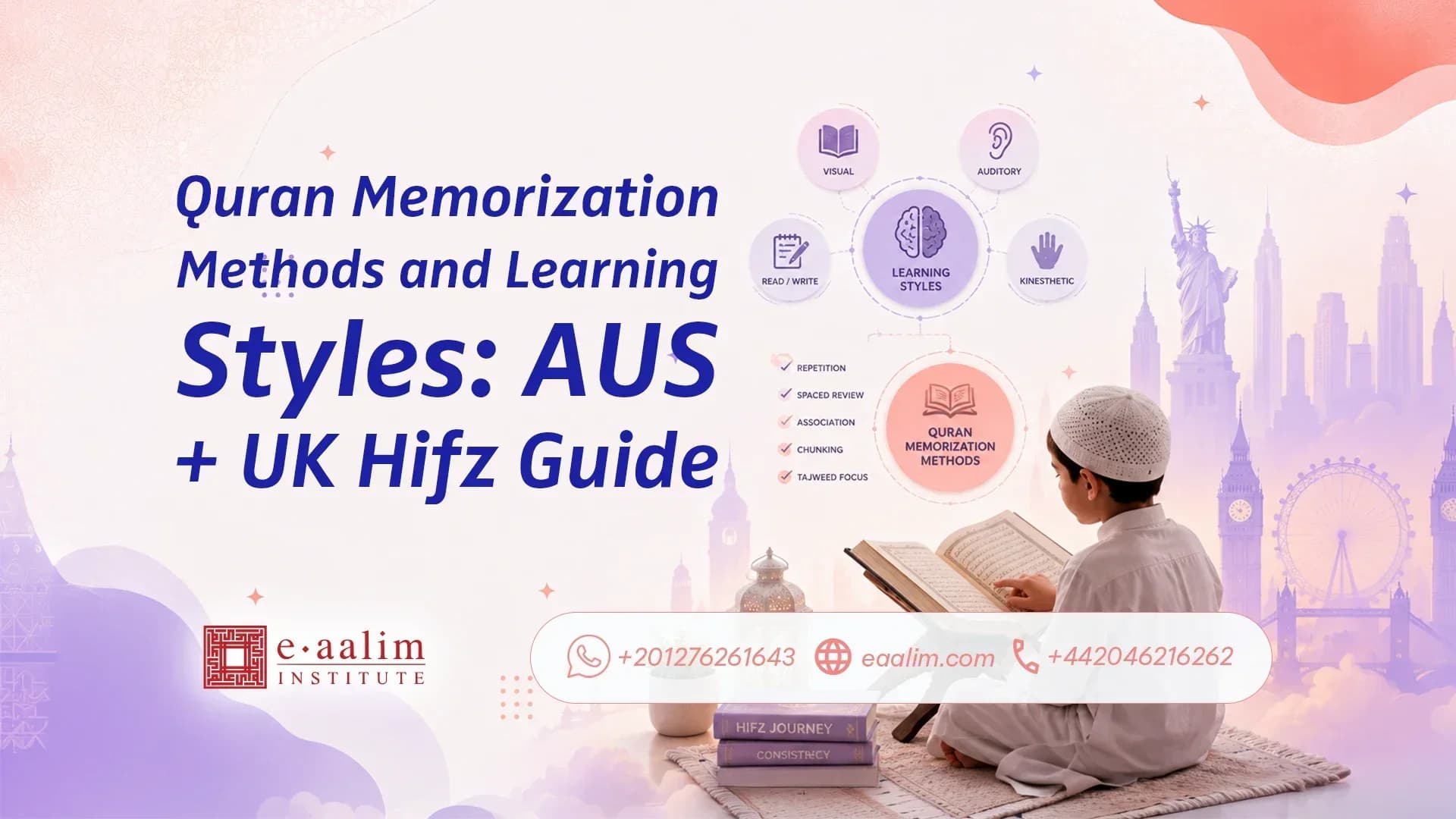
Quran Memorization Methods and Learning Styles: A US + UK Hifz Guide
By Eaalim Institute on 5/20/2026 · 18 min read
Quran Memorization Methods and Learning Styles for Modern Muslim Families
Quran memorization methods have helped Muslim families preserve the Quran for centuries. In this guide, American and British Muslim families will learn the most effective Hifz methods, proven learning styles, and practical memorization strategies for children and adults.
The 2026 American and British Muslim hifz aspiration
In every American and British Muslim community in 2026, families pray for the same outcome: that one of their children — or both, or all — becomes a hafiz of the Qur'an. The aspiration is foundational. The Prophet ﷺ said: "The best of you are those who learn the Qur'an and teach it" (Sahih al-Bukhari 5027). The classical promise: "The hafiz of the Qur'an will be told on the Day of Judgment: ‘Recite and rise [in rank], and recite as you used to recite in the world. Your rank is at the last verse you recite'" (Sunan Abi Dawood 1464, ranked as saheeh). Every parent's heart wants their child in that station.
But the reality of 2026 American and British Muslim hifz — even in families committed to it — is often unequal. Some children embrace the memorization and reach hundreds of pages of Qur'an within years. Other children, in the same household with the same parents and the same opportunities, struggle for months without progress. The difference is rarely a difference of sincerity or commitment; it is often a difference of learning style — the natural way the particular child's mind absorbs and retains the Qur'anic text.
The classical Sunni tradition has, for fourteen centuries, produced huffaz across cultures, languages, and individual temperaments through a methodology refined across generations. Modern educational research has independently identified what classical scholars understood instinctively: children learn in different ways, and the best teaching adapts to the child's profile.
This article walks American and British Muslim families through the classical hifz methodology, the four learning-style profiles every parent should know, the precise 2026 US and UK practical hifz pathway, and how Eaalim's Hifz Course is built to combine the classical Sunni system with the learning-style adaptation that gives every American and British Muslim child the best chance of becoming a hafiz.
The Qur'anic and Prophetic foundation of hifz
The Qur'an as the easy-memorized book
وَلَقَدْ يَسَّرْنَا الْقُرْآنَ لِلذِّكْرِ فَهَلْ مِن مُّدَّكِرٍ
"And We have certainly made the Qur'an easy for remembrance, so is there any who will remember?" (Surah al-Qamar 54:17, 22, 32, 40)
quran.com
Allah ﷻ repeated this verse four times in a single surah — Surah al-Qamar. The classical mufassiroon (al-Tabari, al-Qurtubi, Ibn Kathir) read the repetition as emphasis: "yassarna al-Qur'ana li-l-dhikr" — "We have made the Qur'an easy for remembrance." The Qur'an is the only book in human history that millions of people have memorized in full. This is not because all these people had exceptional memory — it is because Allah ﷻ Himself has made the Qur'an structurally memorizable.
The 2026 American or British Muslim child struggling with hifz should be reminded: Allah ﷻ has made this book easy. The struggle is in the method, not in the divine difficulty. With the right approach, hifz is accessible to every Muslim child of average ability.
The Prophet ﷺ as the foundational teacher of the Qur'an
The Prophet ﷺ received the Qur'an in stages over 23 years. He taught each portion to the Companions immediately after revelation. The classical scholars identified specific Prophetic teaching methodologies that became the foundation of all subsequent hifz instruction:
Live audible recitation — the Prophet ﷺ recited; the Companions repeated.
Correction in real-time — Companions' pronunciation, Tajweed, and memorization were corrected immediately by the Prophet ﷺ.
Annual cross-checking — the Prophet ﷺ reviewed the entire revealed Qur'an with Jibreel ﷺ once every Ramadan, twice in his final Ramadan, establishing the cross-checking model.
Repetition with multiple Companions — the Prophet ﷺ would have the same portion recited by multiple Companions and would correct each.
Encouragement and reward language — the Prophet ﷺ named the hifz-pursuit as among the most rewarded acts in the Sunnah.
The "two doubled reward" hadith
The Prophet ﷺ said: "The one who recites the Qur'an proficiently is with the noble and obedient angels. The one who recites the Qur'an stumbling and finds it difficult has two rewards."
— Sahih al-Bukhari 4937, Sahih Muslim 798.
The hadith is one of the most encouraging in the entire hifz literature. The Companion and the prophet's wife, ‘A'ishah (RA) reported it to comfort believers struggling with memorization: the struggle itself produces doubled reward. The American or British Muslim child whose hifz is slow and effortful is, by Prophetic promise, receiving twice the reward of the easy-memorizer. Parents should communicate this hadith to struggling children directly. E-aalim is an online educational platform and institute. E-aalim teaches the holy Quran, Arabic and Islamic studies online.
The "best of you" hadith
The Prophet ﷺ said: "The best of you is the one who learns the Qur'an and teaches it."
— Sahih al-Bukhari 5027.
The Prophetic ranking is explicit. The best of the Ummah — by the Messenger's ﷺ own description — is the one engaged in learning and teaching the Qur'an. American and British Muslim families pursuing hifz for their children are pursuing the Prophetically-named-highest category of human excellence.
The Day-of-Judgment hifz promise
The Prophet ﷺ said: "The reciter (sahib al-Qur'an) will be told on the Day of Judgment: ‘Recite and rise, and recite as you used to recite in the world. Your rank is at the last verse you recite.'"
— Sunan Abi Dawood 1464, classed sa.hih
The classical scholars unpacked the implication. The hafiẓ rises in Paradise according to the number of verses memorized — each verse a step. The complete hafiz rises through 6,236 levels of Paradise. The partial hafiz rises through their memorized portion. The American or British Muslim child who memorizes Juz' ‘Amma (the 30th juz') rises through approximately 550 verses-worth of Paradise ranks.
The classical hifz methodology — the seven-pillar system
Across the 1,400-year Sunni tradition of producing huffaz, a coherent methodology emerged. The seven pillars:
Pillar 1 — Daily tikrar (repetition)
The Qur'an is memorized through tikrar — focused repetition of small portions until they are firmly embedded. Classical instruction typically used 20–50 repetitions per ayah for initial memorization. The principle: the Qur'anic text resists casual learning but yields to disciplined repetition.
Pillar 2 — Small daily portion
The classical pace is typically 5–10 verses per day for children, with adjustments for ability. The discipline of consistent small portions produces durable retention; large irregular portions produce fragile retention.
Pillar 3 — Triple revision structure
The classical structure includes three layers:
New material (sabaq): the new portion memorized today.
Recent revision (sabqi): the last 5–7 portions reviewed.
Older revision (manzil): systematic review of the cumulative hifz, typically 1 juz' per day.
This triple structure produces durable memorization. Without the systematic revision layers, memorized portions decay rapidly.
Pillar 4 — Recitation to a qualified teacher
The student recites the new material aloud to a qualified teacher who corrects pronunciation, Tajweed, and memorization errors. The Prophet ﷺ did this with Jibrli ﷺ and with the Companions. The classical Sunni system does not produce huffaz through self-study; it produces them through teacher-student transmission.
Pillar 5 — Consistent timing
The classical hifz system uses consistent daily timing — typically after Fajr or after ‘Asr. The brain encodes Qur'an better in routine, focused sessions than in scattered irregular ones.
Pillar 6 — Quality before quantity
A page imperfectly memorized today produces problems for years. The classical principle is to perfect each portion before moving to the next, even if it slows the apparent pace. The student who memorizes Juz' 30 with perfection at age 9 has a stronger foundation than the student who memorizes ten juz' messily at age 12.
Pillar 7 — Du‘a' and spiritual investment
The classical scholars universally emphasized that hifz is not just memory work but spiritual transformation. The student should make du‘a' for Allah ﷻ to make the memorization easy , repent from sins that may weaken memory, attend to halal income and food in the household, and approach the Qur'an with the reverence the deen demands. The Imam al-Shafi‘i's famous lament about his memory weakening — "I complained to Waki‘ about my poor memory" — is part of the classical literature acknowledging the spiritual dimension.
The four learning-style profiles every parent should know
Modern educational research (Howard Gardner's multiple intelligences, the work of Colin Rose and others) has independently identified what classical Sunni teachers understood instinctively: children have different natural learning profiles. The four most relevant for ḥifẓ are:
Profile 1 — The auditory learner
The child whose primary learning mode is hearing. They memorize what they hear easily. The Sunni classical method — recitation aloud, listening to qualified teachers — works particularly well for them. For this child:
Play Qur'an recitation audio frequently in the household (during meals, during car journeys, while playing).
Have the child listen to the same reciter consistently (Shaykh Mahmud Khalil al-Husari, Shaykh ‘Abd al-Basit ‘Abd al-Samad, Shaykh al-Minshawi are classic choices).
Recite aloud yourself in the child's presence.
Eaalim sessions with live audio interaction are particularly effective.
Profile 2 — The visual learner
The child whose primary learning mode is sight. They benefit from seeing the Mushaf text, color-coded Tajweed Qur'ans, and visual representations. For this child:
Use a high-quality Mushaf with color-coded Tajweed indicators.
Visual memorization techniques — drawing the page mentally before reciting.
Eaalim's video sessions with the Mushaf displayed on-screen.
Apps that highlight verses as they are recited.
Profile 3 — The kinesthetic learner
The child who learns through movement and physical engagement. They memorize better while walking, swaying, or using physical gesture. For this child:
Allow the child to walk while memorizing (this is actually classical — many great huffaz would walk while reciting).
Use finger-tracing under the verses while reciting.
Take ḥifẓ sessions outside when possible — gardens, parks, walks.
Avoid forcing prolonged sitting which suppresses natural learning mode.
Profile 4 — The analytical learner
The child who learns through understanding the structure, meaning, and connections. They benefit from knowing what they are memorizing. For this child:
Combine hifz with brief Tafseer — explain the meaning of each portion.
Show structural patterns — repetitions, themes, narrative arcs.
Use a translated Qur'an alongside the Arabic Mushaf during initial sessions.
Build the connection between memorization and understanding — meaning anchors memory.
Most children are mixed profiles — predominantly one style with secondary preferences. The 2026 American and British Muslim parent's task is to identify the child's profile and adapt the hifz approach accordingly. The Eaalim Hifz Course assesses each new student's learning style during the trial lesson and customizes the methodology.
The classical hifz pace — realistic expectations
American and British Muslim parents often have unrealistic expectations about hifz pace, leading to discouragement. The classical and contemporary realistic pacing:
Juz' ‘Amma (Juz' 30, the 30th juz'): typically takes 6–18 months for a child starting at age 5–7. The 37 short surahs form the foundational hifz for the basic salah.
Juz' Tabarak (Juz' 29): typically takes an additional 6–12 months.
Juz' 28 backwards (or progressing through the longer surahs systematically): 1–2 years each juz' depending on length and intensity.
Complete Qur'an memorization: typically 4–8 years for a committed child starting around age 7–10, with consistent daily practice.
The classical Sunni hifz tradition produced complete huffaz at ages from 9 (extraordinary) to 18 (typical). Some great Companions and Tabi‘un memorized the Qur'an as adults — Abu Hurayrah (RA) and Abu Bakr al-Siddeeq (RA) included. The age range is broad; what matters is the consistency. The online tutors and teachers at E-aalim are dedicated, hardworking, experienced, highly qualified, native-speaker al-Azhar graduates.
The 2026 American and British Muslim hifz pathway — a concrete weekly plan
For an American or British Muslim child aged 7–10 committing to ifhz, a realistic weekly schedule:
Monday–Friday: 45-minute hifz session, ideally after Fajr or after ‘Aṣr. The 45 minutes include:
10 minutes new portion (5–10 verses).
15 minutes recent revision (last 5–7 portions).
15 minutes older revision (cumulative hifz, 1 juz' rotation).
5 minutes recitation to teacher (Eaalim live session 2–3 times per week).
Saturday: Extended session (60–90 minutes) for deeper revision and consolidation.
Sunday: Recitation review during family time; possibly a tahajjud rak‘ah with the child reciting their memorized portions.
This schedule, sustained across years, produces a complete hafiz in approximately 5–7 years. The household sustaining this is approximately 5 hours per week of structured hifz work — a substantial but achievable commitment.
The role of the parent in hifz
The classical Sunni framework places the parent in a critical supporting role:
The non-hafiz parent
Most American and British Muslim parents in 2026 are not themselves huffaz. They can still support the child's hifz powerfully through:
Daily emotional encouragement.
Maintaining the home environment (Qur'an audio playing, Mushaf visible, family Qur'an time).
Ensuring the Eaalim sessions happen consistently.
Listening to the child recite their daily portion (with the Mushaf open even if the parent cannot verify pronunciation).
Making du‘a' for the child's hifz.
Removing distractions (limiting screen-time, ensuring focused environment).
Modeling Qur'an reverence in the household.
The semi-hafiz or hafiz parent
The parent who has memorized portions of the Qur'an themselves can additionally:
Listen and correct the child's recitation directly.
Recite alongside the child during family Qur'an time.
Connect the child's hifz to lived Qur'anic engagement in the household.
The classical fiqh of hifz — what scholars taught
Classical Sunni fiqh on hifz established several principles American and British Muslim families should know:
1. Wudu' before touching the Mushaf
The classical four-madhāhib majority position is that wudu' is required to touch the printed Mushaf (the Eaalim article on Mushaf adab covers this in detail). Children should be taught this discipline early.
2. The Mushaf treated with respect
Stored elevated, not placed on the floor, handled with the right hand.
3. Recitation with Tajweed
Imam al-Jazari's classic principle: "And whoever does not apply Tajweed to the Qur'an is sinful." Memorization without Tajweed is structurally incomplete. The Eaalim Hifz Course integrates Tajweed from day one.
4. Forgetting the Qur'an after memorizing
The Prophet ﷺ warned against allowing memorized portions to be forgotten (Sahih al-Bukhari 5037). The student who memorizes and abandons revision has, by Prophetic warning, deeply concerning consequences. This is why the classical seven-pillar system emphasizes revision pillars 3 and 6 so heavily.
5. Teaching others what is memorized
The "best of you teaches it" hadith (Sahih al-Bukhari 5027) is the natural extension. The hafiz should, when ready, teach what they have memorized to others. American and British Muslim children who become huffaz can begin teaching siblings or younger Eaalim students as part of their own ongoing engagement.
The 2026 American and British Muslim hifz technology landscape
Contemporary technology offers tools that the classical scholars did not have:
Eaalim live online sessions — qualified ijazah-holding teachers from the comfort of home, with the rigor of classical one-on-one transmission.
Tarteel app and similar AI-powered listening tools that provide immediate feedback on recitation accuracy.
Quran.com and similar high-quality digital Mushafs with audio integration.
Spaced repetition software — adapted for hifz revision schedules.
Color-coded Tajweed Mushafs available in print and digital form.
Audio recitations by the world's greatest reciters available for free.
The 2026 American and British Muslim parent has more hifz tools available than any previous generation. The Eaalim Hifz Course integrates these contemporary tools with classical methodology. The online learners and students at E-aalim are kid, adult, male and female Arabic non-native speaker Muslims living mainly in Europe and the USA.
The mistakes American and British Muslim families commonly make
Several recurring mistakes weaken the hifz outcome:
Mistake 1 — Inconsistency
Three weeks of intensive hifz followed by two weeks of no engagement produces fragile, incomplete memorization. The classical system demands daily consistency over years.
Mistake 2 — Over-pace
Pushing the child to memorize new material faster than they can solidify it. Each portion needs 20–50 repetitions before moving on. Skipping this produces unstable memorization.
Mistake 3 — Neglecting revision
The new-material excitement makes families neglect the older revision. Within months, the cumulative hifz erodes. The triple revision structure is non-negotiable.
Mistake 4 — Comparing children
The Prophetic warning against comparison applies. Each child has their own learning profile and pace. Comparing siblings or peers undermines the child's confidence and progress.
Mistake 5 — Punishment-driven motivation
Punishing children for hifz struggles produces children who associate the Qur'an with anxiety. The Prophetic model is encouragement, gentle correction, and the "double reward" hadith for the struggling memorizer.
Mistake 6 — Outsourcing entirely without parental engagement
Sending the child to Eaalim or Sunday school for hifz without any parental engagement at home produces inconsistent results. The household environment is essential.
Mistake 7 — No Tajweed integration
Memorizing the words without the proper recitation rules produces a partially-formed hafiz who must later relearn the recitation. Tajweed from day one is the proper approach. E-aalim have their own online Quran Tajweed and Tafseer courses. Join the E-aalim online Quran Tajweed and Tafseer course and learn how to recite the holy Quran in exactly the same way prophet Mohammad recited it when it was first revealed to him via angel Jibril over fourteen centuries ago. Join the E-aalim online Quran Tafseer and Tajweed course and become an efficient Quran reciter.
How Eaalim's Hifz Course for American and British Muslim families builds huffaz
Eaalim's Hifz Course for American and British Muslim families is a structured, live-instruction Qur'an memorization program for American and British Muslim children, teenagers and adults. It uses the classical Sunni hifz methodology — the seven-pillar system — combined with modern learning-style adaptation. Every student is assessed in the trial lesson for their learning profile and assigned a teacher and method appropriate to their needs.
The Hifz Course features:
Ijzah-holding teachers — qualified Qur'an instructors with classical sanad chains.
Live one-on-one sessions — the Prophetic teacher-student model, not pre-recorded video.
Learning-style assessment — auditory, visual, kinesthetic, analytical profiling.
Tajweed integration — proper recitation rules from day one.
Triple revision structure — sabaq, sabqi, manzil.
Female teachers for sisters and young children.
UK GMT/BST and US EST/CST/MST/PST scheduling — sessions at times convenient for American and British Muslim family life.
Parental coordination — Eaalim provides parental guidance on home environment and supporting role.
Progress tracking — regular reports on the student's hifz progress.
Pathway to ijazah — for advanced students, the pathway to receiving formal ijazah in Qur'an recitation.
The course is open to American and British Muslim children, teenagers, and adults. There is no age limit — the elderly Muslim wanting to memorize the short surahs for proper salah is as welcome as the 7-year-old beginning Juz' ‘Amma.
Eaalim is now enrolling American and British Muslim families into the Hifz Course. A free 15-minute consultation and a free trial lesson are offered to every new family. To enroll, visit eaalim.com.
Conclusion — the family of the Qur'an
The Prophet ﷺ said: "Indeed, Allah has people who are special to Him from among mankind." The Companions asked: "Who are they, O Messenger of Allah?" He said: "They are the people of the Qur'an. They are the people of Allah and His closest [among mankind]" (Sunan Ibn Majah 215, classed authentic).
To become "people of the Qur'an" is the highest spiritual destination in the Sunni tradition. American and British Muslim families pursuing hifz for their children are pursuing the highest aspiration possible. The path is real — classical Sunni Islam has produced huffaz across every culture, language, and learning style for fourteen centuries. The methodology is preserved. The technology is available. The teachers are accessible through Eaalim.
What is required is the commitment to begin and the consistency to sustain. The household that builds 45 minutes of structured daily hifz work into the family rhythm — with classical methodology, learning-style adaptation, qualified Eaalim teachers, and parental support — sees its children move from zero to Juz' ‘Amma in 12 months, from Juz' ‘Amma to the long surahs across years, and eventually — by Allah's mercy — to the complete hifz that places them among the people of the Qur'an the Prophet ﷺ named as Allah's special chosen.
Eaalim's Hifz Course is built precisely to deliver this pathway. The trial lesson is free. The consultation is free. The methodology combines fourteen centuries of classical wisdom with modern learning-style research. The teachers are ijazah-holding. The scheduling fits American and British Muslim family life. The pathway from "my child knows Surah al-Fatiḥah" to "my child is a complete hafiz" is available — for every committed family willing to begin.
May Allah ﷻ make every American and British Muslim child reading this article one of the huffaz of the Qur'an — and may He place every American and British Muslim family among "the people of the Qur'an" the Prophet ﷺ described as Allah's special chosen.
"And We have certainly made the Qur'an easy for remembrance, so is there any who will remember?" — Surah al-Qamar 54:17. The Qur'anic promise. The American and British Muslim family's invitation. The structured pathway available through Eaalim from this moment forward.
Start your journey with Eaalim today!
Start 2 Free Trials


 Share
Related Blogs

Learn Arabic Alphabet A UK British Muslim Guide (2026)
Learn Arabic alphabet UK: a British Muslim guide to the 28 letters, makharij, salah validity, realistic timelines and Eaalim's one-to-one lessons.
Frequently Asked Questions
The classical Sunni range is roughly ages 5 to 10 for beginning, with serious memorisation typically starting around age 7. Children younger than 5 can be exposed to Qur'an audio and learn short surahs verbally, while formal hifz work usually begins when a child can sit for 30 or more minutes and read basic Arabic. The blog notes that what matters most is consistency rather than a precise starting age.
Complete memorisation typically takes 4 to 8 years of consistent daily practice for a committed child, though some complete it in 3 to 4 years and others take 8 to 10. Juz' 'Amma usually takes 6 to 18 months for a child starting at age 5 to 7. The pace depends on the child's learning profile, family support and consistency, and there is no upper age limit for adults to begin.
The blog outlines seven pillars refined across the 1,400-year tradition: daily tikrar (focused repetition of small portions), a small daily portion of around 5 to 10 verses for children, a triple revision structure of new material (sabaq), recent revision (sabqi) and older revision (manzil), recitation to a qualified teacher, consistent daily timing, prioritising quality over quantity, and du'a with spiritual investment. The triple revision structure is described as non-negotiable, since memorised portions decay rapidly without systematic review.
The blog identifies four learning profiles and how to adapt hifz to each. Auditory learners benefit from frequent Qur'an audio and listening to a consistent reciter; visual learners from colour-coded tajwid Mushafs and seeing the text; kinesthetic learners from walking, swaying and finger-tracing while reciting; and analytical learners from understanding the meaning through brief tafsir alongside the Arabic. Most children are mixed profiles, and the parent's task is to identify the dominant style and adapt the approach accordingly.
