

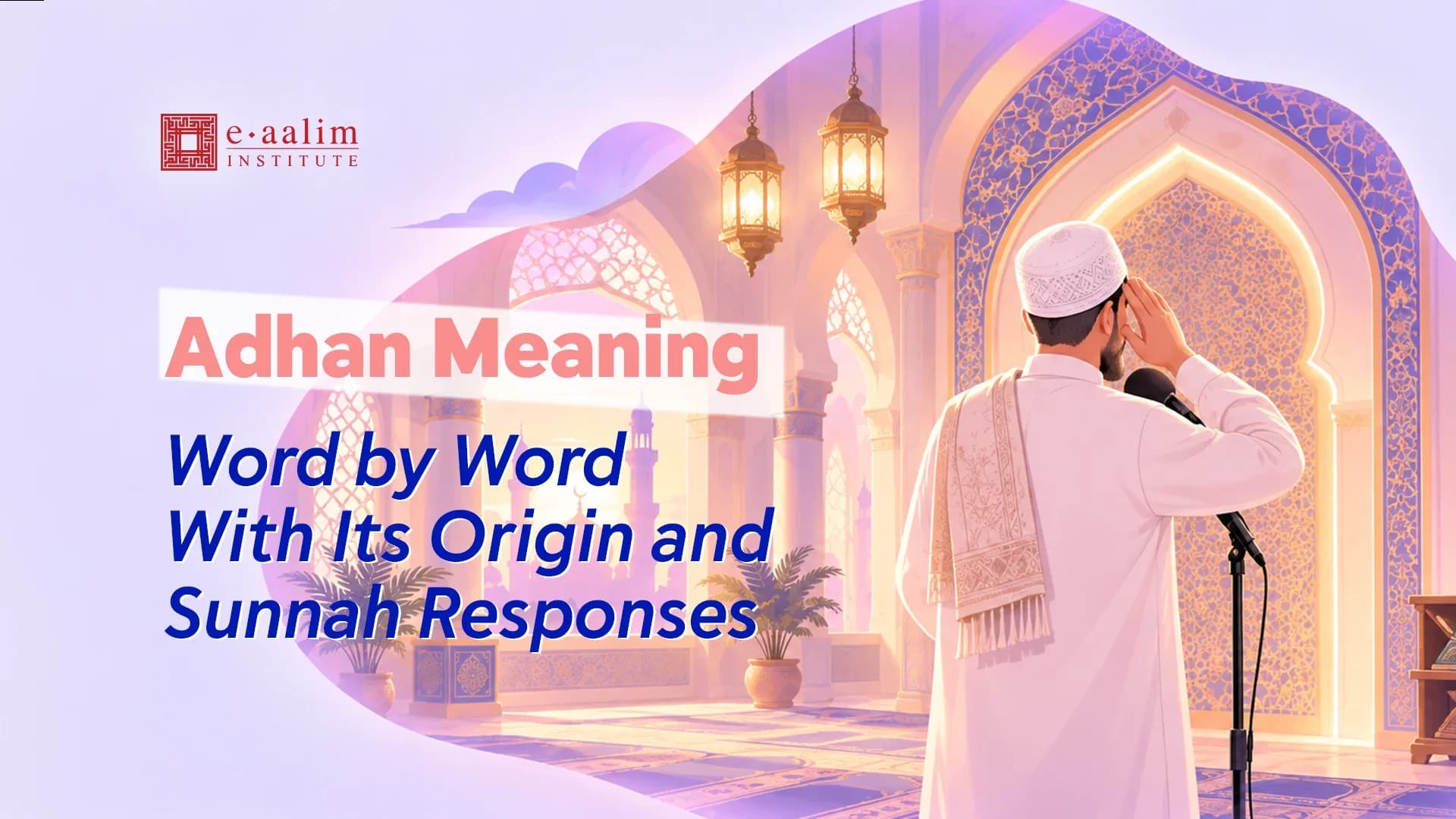
Adhan Meaning Word by Word With Its Origin and Sunnah Responses
By admin on 12/22/2025 · 5 min read
To understand the adhan meaning, remember that five times a day, in every Muslim community on earth, the muezzin calls out the same words that Muslims have heard for over fourteen centuries: Allāhu akbar... ashhadu an lā ilāha illā Allāh... ashhadu anna Muḥammadan rasūl Allāh. The adhan, the call to prayer, is one of the most distinctive features of Muslim life and one of the most beautifully simple acts of public worship. Therefore, this guide explains the adhan meaning in full, including its origin, its words, the Sunnah responses, the role of the muezzin and the call to prayer today.
The origin of the adhān
The adhān was not part of Muslim practice when the Prophet ﷺ first arrived in Madinah in 1 AH. However, the community soon discussed how to call people to prayer: some suggested a horn, others a bell, and others a fire signal. Then the Companion ʿAbd Allah ibn Zayd (RA) had a remarkable dream in which a man taught him the words of the adhān. Therefore, he told the Prophet ﷺ, who confirmed: “This is a true dream, by the will of Allah.”
As a result, the Prophet ﷺ instructed Bilāl ibn Rabāḥ (RA), the freed African Companion with the most resonant voice, to recite these words at each prayer time. Bilāl thus became the first muezzin of Islam, and the adhān has summoned Muslims to ṣalāh ever since. Indeed, the Quran itself refers to this call in al-Jumuʿah 62:9.
Adhan meaning word by word
Phrase | Repetition | Meaning |
|---|---|---|
Allāhu akbar | 4 times | Allah is the greatest |
Ashhadu an lā ilāha illā Allāh | 2 times | I bear witness that there is no deity except Allah |
Ashhadu anna Muḥammadan rasūl Allāh | 2 times | I bear witness that Muhammad is the Messenger of Allah |
Ḥayya ʿalā al-ṣalāh | 2 times | Come to the prayer |
Ḥayya ʿalā al-falāḥ | 2 times | Come to success |
Allāhu akbar | 2 times | Allah is the greatest |
Lā ilāha illā Allāh | 1 time | There is no deity except Allah |
For the Fajr (dawn) prayer specifically, the muezzin adds an extra phrase after "Ḥayya ʿalā al-falāḥ":
aṣ-ṣalātu khayrun mina al-nawm — "Prayer is better than sleep" (recited twice)
The Sunnah responses
When you hear the adhān, the Sunnah is to repeat each phrase silently after the muezzin — except for the two ḥayyaʿalā phrases, where you instead say:
lā ḥawla wa lā quwwata illā billāh — "There is no power and no strength except in Allah."
After the adhān is complete, recite the Sunnah du'ā:
"O Allah, Lord of this complete call and of the prayer about to be established, grant Muhammad al-wasīlah and al-faḍīlah, and raise him to a praiseworthy station that You have promised him" (Bukhari 614).
The Prophet ﷺ said that whoever recites this du'ā after the adhān will receive his intercession on the Day of Judgement.
The iqāmah — the second call
The muezzin or another worshipper recites the iqāmah just before the obligatory prayer begins. It uses similar words to the adhān but the caller says each phrase only once instead of twice, and repeats an additional phrase — qad qāmat al-ṣalāh (“the prayer has been established”) — twice. The iqāmah signals that the prayer is about to begin and worshippers should align in rows.
The muezzin — who recites the adhān
Classical Islamic teaching honours the muezzin highly. The Prophet ﷺ said: "The muezzins will have the longest necks of all people on the Day of Judgement" (Muslim 387) — a metaphor in classical Arabic for the highest dignity. Bilāl ibn Rabāḥ (RA), the first muezzin, was so beloved by the Prophet ﷺ that the Prophet ﷺ instructed him to call the adhān at the conquest of Makkah from the roof of the Kaʿbah itself — an act of profound symbolic significance, with the African freed slave proclaiming the divine unity from the most sacred building in Islam.
For most British masājid today, the muezzin is the imam himself or a designated regular Companion of the masjid. In addition, the role does not require any specific qualification beyond a clear voice, accurate Arabic pronunciation, and devotion.
The adhān in modern Britain
Muezzins recite the adhān inside masājid five times a day. Moreover, some councils permit an external (loudspeaker) adhān, and it is increasingly common — particularly in areas of high Muslim concentration like Tower Hamlets, Birmingham, Bradford and Blackburn. In fact, some London boroughs have permitted an external adhān since the 1980s.
For British Muslims who do not live within hearing distance of a masjid (the majority of UK Muslims), prayer-time apps like Muslim Pro, IslamicFinder and the Athan app provide audio adhān at the correct UK times — adjusted for season and location. Similarly, smart speakers (Alexa, Google) can play the adhān at prayer times.
The adhan meaning in daily family life
The adhān reorients the day. Hearing the call to prayer five times a day — even from a phone app — is a powerful interruption of secular time. It anchors the day in worship.
It is a tool of remembrance for children. British Muslim children growing up with the adhān playing in the home five times a day internalise the rhythm of Muslim life from infancy.
It carries community memory. Every Muslim in every era hears the same words. Your grandfather in Pakistan, your great-grandmother in Yemen, your great-great-grandfather in Bosnia — all heard "Ashhadu an lā ilāha illā Allāh" in exactly the same form. The adhān binds you to the global ummah across time.
Frequently asked questions
Where to go next
For more on prayer and worship, see our guides on Salah and Its Significance, The Favour of Congregational Prayer, and The Sunan of Prayer. To learn the adhān with proper tajweed under an Al-Azhar-graduate teacher, book a free trial lesson.
Start your journey with Eaalim today!
Start 2 Free Trials


 Share
Frequently Asked Questions
Through the dream of the Companion ʿAbd Allah ibn Zayd (RA) shortly after the Hijrah to Madinah. The Muslim community was discussing how to call people to prayer; ʿAbd Allah dreamt of a man teaching him the words. He told the Prophet ﷺ, who confirmed: "This is a true dream, by the will of Allah."
Bilāl ibn Rabāḥ (RA) — the African freed slave with the most resonant voice in the Companion community. The Prophet ﷺ instructed him to learn the words and recite them from a high place at each prayer time.
Allāhu akbar (4 times). Ashhadu an lā ilāha illā Allāh (2 times). Ashhadu anna Muḥammadan rasūl Allāh (2 times). Ḥayya ʿalā al-ṣalāh (2 times). Ḥayya ʿalā al-falāḥ (2 times). Allāhu akbar (2 times). Lā ilāha illā Allāh (1 time). For Fajr only, an additional "aṣ-ṣalātu khayrun mina al-nawm" (twice) is added.
Repeat each phrase silently after the muezzin — except for the two ḥayyaʿalā phrases, where you instead say "lā ḥawla wa lā quwwata illā billāh". After the adhān is complete, recite the Sunnah du'ā establishing the Prophet ﷺ's wasīlah.
The second call recited just before the obligatory prayer begins. It uses similar words to the adhān but each phrase is recited only once instead of twice, and an additional phrase — "qad qāmat al-ṣalāh" (the prayer has been established) — is recited twice.
Because Fajr is at dawn when most people are still asleep. The phrase — added on the Prophet ﷺ's instruction — emphasises the importance of rising for the prayer rather than continuing to sleep.
Yes — it is a valuable way to mark prayer times in the home, particularly for British Muslim families who do not live within hearing distance of a masjid (the majority of UK Muslims). Apps like Muslim Pro and IslamicFinder, and smart speakers like Alexa and Google Home, can play the adhān at the correct UK times.
In some UK areas with appropriate council permissions, yes. In some London boroughs, external adhān has been permitted since the 1980s. It is increasingly common in areas of high Muslim concentration like Tower Hamlets, Birmingham, Bradford and Blackburn.
That nobility in Islam is determined by faith and conduct, not birth or social class. The African freed slave became the first muezzin of Islam. At the conquest of Makkah, the Prophet ﷺ instructed Bilāl to call the adhān from the roof of the Kaʿbah — one of the most symbolically powerful moments of early Islamic history.
Eaalim teachers can teach the adhān with proper Arabic pronunciation. Book a free trial at eaalim.com/free-trial.
