


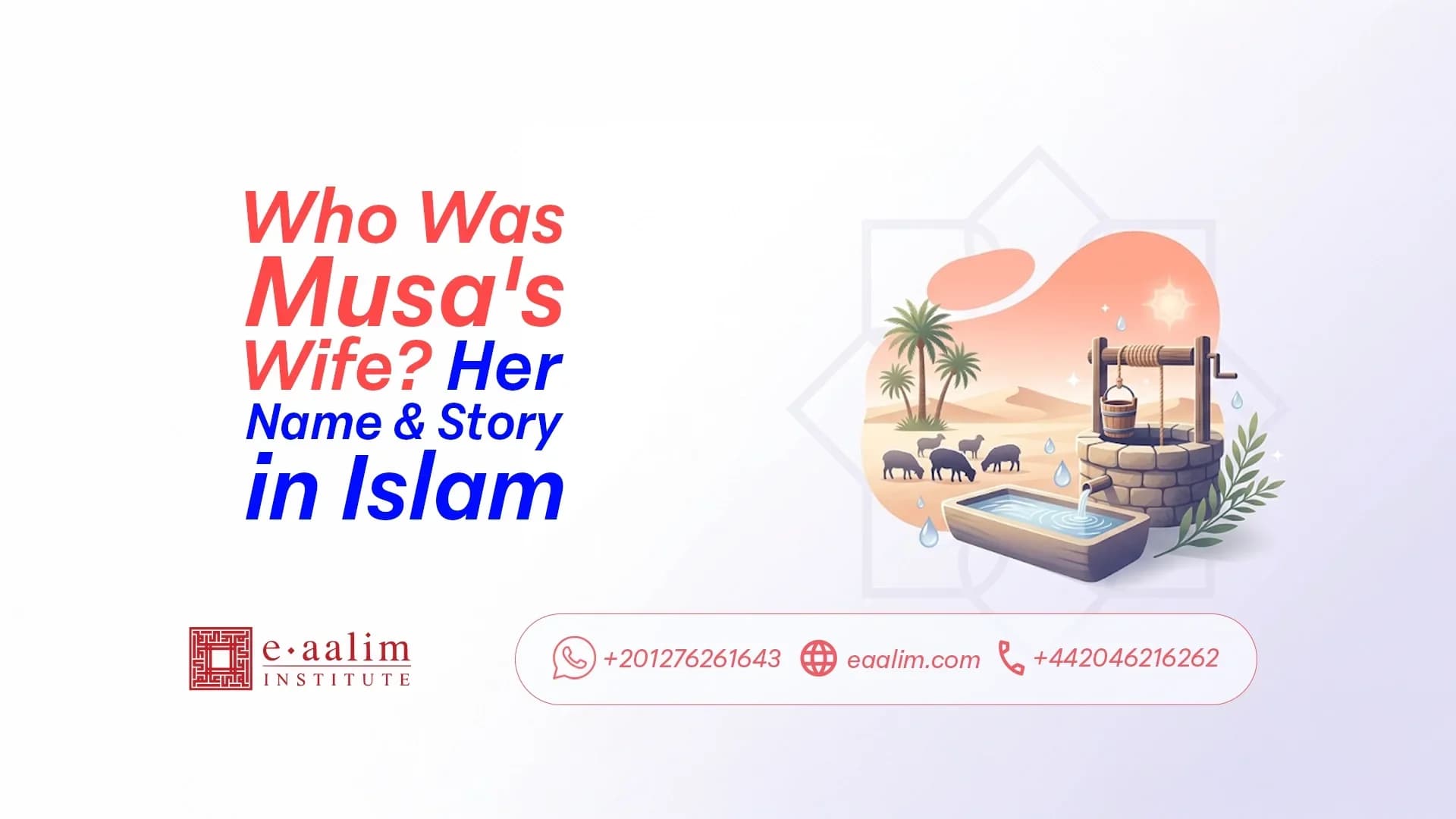
Who Was Musa's Wife? Her Name & Story in Islam
By admin on 12/22/2025 · 6 min read
Who Was the Wife of Prophet Musa? The Ultimate Guide
The wife of Prophet Musa — traditionally identified as Safura bint Shuʿayb — is one of the Qur'an's most quietly transformative female figures. Her story appears in Surat al-Qasas, and although it occupies only a handful of verses, it carries far-reaching implications. Therefore this guide walks through her story and draws out the lessons for British Muslim families.
The setting
Musa had fled from Egypt after the death of an Egyptian who was beating an Israelite. Pursued by Pharaoh's authorities, he crossed the Sinai desert toward Madyan — an Arab settlement east of the Gulf of Aqaba. Exhausted, hungry and alone, he arrived at a well where shepherds were watering their flocks.
The Qur'an describes the scene:
﴿وَلَمَّا وَرَدَ مَاءَ مَدْيَنَ وَجَدَ عَلَيْهِ أُمَّةً مِّنَ النَّاسِ يَسْقُونَ وَوَجَدَ مِن دُونِهِمُ امْرَأَتَيْنِ تَذُودَانِ ۖ قَالَ مَا خَطْبُكُمَا ۖ قَالَتَا لَا نَسْقِي حَتَّىٰ يُصْدِرَ الرِّعَاءُ ۖ وَأَبُونَا شَيْخٌ كَبِيرٌ﴾
— القصص: ٢٣
Musa's first action — service
Without being asked, Musa watered their flock for them. Then he retreated to the shade and made his famous du'a:
﴿رَبِّ إِنِّي لِمَا أَنزَلْتَ إِلَيَّ مِنْ خَيْرٍ فَقِيرٌ﴾
— القصص: ٢٤
Note the structure of his life at that moment. He was a fugitive, hungry, with no possessions and no contacts. Even so, his first action on arriving was to help two strangers, and only then did he turn to Allah in du'a. In short, this is Musa's spiritual signature.
The daughter returns — and the invitation
The Qur'an continues:
﴿فَجَاءَتْهُ إِحْدَاهُمَا تَمْشِي عَلَى اسْتِحْيَاءٍ قَالَتْ إِنَّ أَبِي يَدْعُوكَ لِيَجْزِيَكَ أَجْرَ مَا سَقَيْتَ لَنَا﴾
— القصص: ٢٥
Three things stand out here, and the Qur'an preserves all of them deliberately:
She walked with shyness (ʿala istihyaʾ). The Qur'an specifically describes her bearing. Modesty, therefore, is not weakness; it is dignified composure.
She delivered a clear message. There was no flirtation and no familiarity. The mission was specific: my father wants to repay you.
She acted decisively. She did not delegate. When a need arose, she walked.
The conversation with her father
Musa went to Shuʿayb's home and recounted his story. Shuʿayb reassured him:
﴿لَا تَخَفْ ۖ نَجَوْتَ مِنَ الْقَوْمِ الظَّالِمِينَ﴾
— القصص: ٢٥
Then the daughter spoke to her father. Indeed, this is one of the Qur'an's most striking moments of female agency:
﴿قَالَتْ إِحْدَاهُمَا يَا أَبَتِ اسْتَأْجِرْهُ ۖ إِنَّ خَيْرَ مَنِ اسْتَأْجَرْتَ الْقَوِيُّ الْأَمِينُ﴾
— القصص: ٢٦
She made a recommendation directly to her father — confident, articulate, and backed by reasons. Moreover, the classical commentators (Ibn Kathir, al-Qurtubi) point out that her recommendation came with a specific evaluative framework: al-qawiyyu al-amin — strong, meaning capable of the work, and trustworthy, meaning sound in character.
Shuʿayb then asked how she had assessed his strength and his trustworthiness. She explained. When Musa watered the flock, she observed his physical capability. Afterwards, when she came to fetch him, he asked her to walk behind him so that he would not look at her — and that proved his trustworthiness.
In other words, the Qur'an deliberately preserves a young woman's assessment of a man's character and capability, presented to her father as authoritative input.
The marriage proposal
Shuʿayb then proposed marriage between Musa and one of his daughters, with a dowry of eight years of labour, optionally extended to ten. Musa agreed.
The Qur'an does not specify which daughter. However, Islamic tradition identifies her as Safura. They married, and he served Shuʿayb for the agreed years. Later they left Madyan together, and his prophetic call began on Mount Sinai.
What the Qur'an emphasises about the wife of Prophet Musa
Female agency in marriage. The daughter participated in the recommendation that led to the marriage. She did not wait passively; instead, she gave evaluative input. The Islamic tradition has always permitted and honoured a woman's opinion in her own marriage decision.
Modesty as composure. "Walking with shyness" is not synonymous with timidity. She walked. She spoke. She recommended. In short, her shyness was her bearing, not her absence.
Trustworthiness assessed by behaviour. She did not assess Musa by his words or his appearance. Rather, she assessed him by what he did. He helped without expecting anything. He asked her to walk behind him. These were the data.
Hospitality as recognition. Shuʿayb invited a stranger because his daughter recognised that the stranger had served them. Consequently, the pattern of recognition and hospitality became foundational.
Marriage as partnership. The dowry was years of labour — service to the family. The relationship therefore began with Musa serving his father-in-law.
Lessons for British Muslim families
For young British Muslim women
You are entitled — and encouraged — to participate in assessing any potential spouse. The model is not passive waiting. Instead, it is observing, evaluating, and providing input to your guardians using clear frameworks. Al-qawiyyu al-amin — capable and trustworthy — is the Quranic checklist.
For young British Muslim men
Trustworthiness is not asserted; it is observed. Your behaviour with women in workplaces, on public transport and in mixed social settings is the data your future in-laws will assess. Be the kind of person who lowers his gaze, not because someone forces you to, but because that is simply your character.
For British Muslim parents
Listen to your daughter when she gives input on a potential match. Shuʿayb listened. Notably, the Qur'an records his response — and the marriage that followed shaped prophetic history.
For everyone
Help when you can, without expecting reward. Musa's du'a at the well was not for the women's benefit but for his own — and Allah answered it through them. As a result, the world Allah designs often returns service to the giver through unexpected channels.
Pair with related stories
Closing
The story of Ṣafura bint Shuʿayb is short in verses but vast in implications for how British Muslim families think about modesty, female agency, marriage, and the assessment of character. Teach this story alongside the Qur'an's other women. Book a free Eaalim trial to study Surat al-Qasaṣ with a qualified teacher.
Start your journey with Eaalim today!
Start 2 Free Trials


 Share
ShareFrequently Asked Questions
Islamic tradition identifies her as Ṣafūrā bint Shuʿayb. The Qur'an does not name her directly, but tells her story in Sūrat al-Qaṣaṣ 28:23-28.
At a well in Madyan, where she and her sister were waiting to water their flock until the male shepherds finished. Mūsā watered their flock for them without being asked, then retreated to the shade and made the famous du'ā: "My Lord, indeed I am, for whatever good You would send down to me, in need."
She walked "with shyness" (ʿalā istiḥyāʾ) when she returned to fetch Mūsā. Modesty as composure, not timidity. She delivered her father's message clearly and decisively.
"O my father, hire him. Indeed, the best one you can hire is the strong and the trustworthy." Her evaluation framework was specific: capable of the work, sound in character. Female agency in marriage at the heart of the Qur'an's narrative.
She observed his physical strength when he watered the flock. She observed his trustworthiness when he asked her to walk behind him as she led him to her father — so as not to look at her.
Eight years of labour for Shuʿayb, optionally extended to ten. Mūsā agreed. They lived in Madyan during those years.
You are entitled to participate in the assessment of any potential spouse. Use the Qur'anic checklist: al-qawiyyu al-amīn — capable and trustworthy.
Trustworthiness is observed, not asserted. Your behaviour with women in workplaces, on public transport, in mixed social settings — that is the data your future in-laws will assess.
