



How to Build a Consistent Quran Learning Routine
By Eaalim Institute
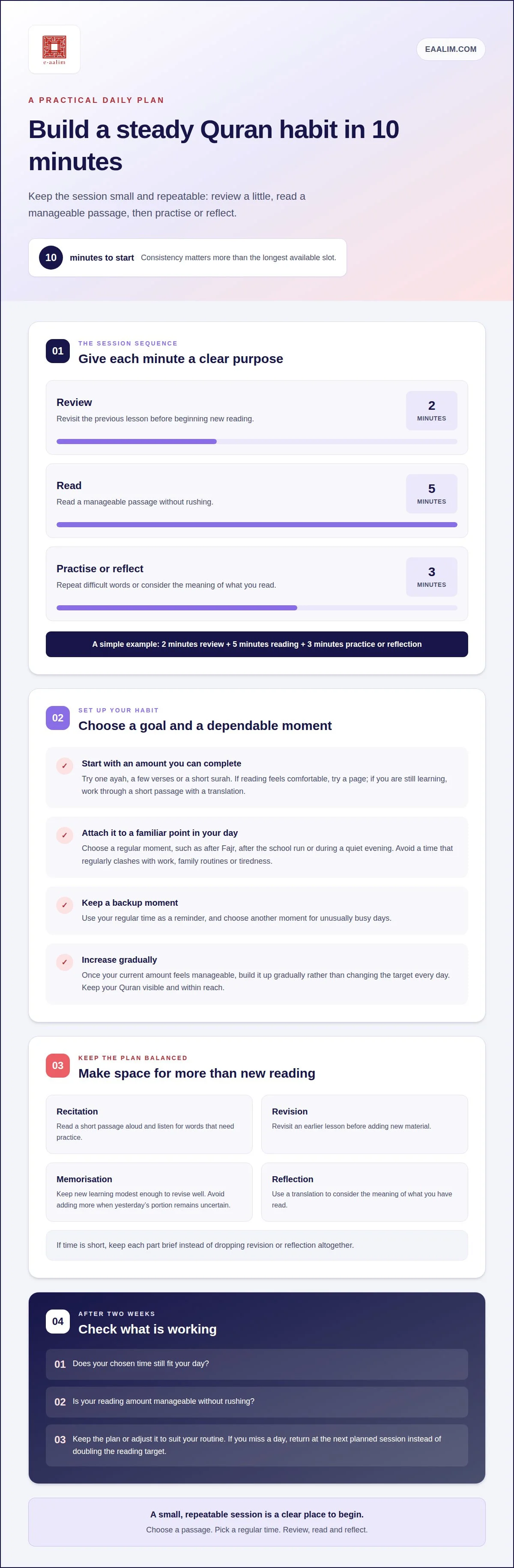
A steady Quran habit does not need to begin with a long study session. To build a consistent Quran learning routine, start with 10 minutes a day: review a little, read a manageable passage, then practise or reflect on what you’ve read. A modest plan that fits your day is easier to return to than an ambitious one that leaves you feeling behind.
If work, school runs or family commitments make your schedule unpredictable, you can still make space for Quran learning. Choose a calm, regular moment, decide what you want to learn and leave room to adjust your routine as your needs change.
This guide shows you how to set a clear intention, balance recitation, revision, memorisation and reflection, and shape your study around your circumstances. You’ll also find a gentle four-week approach to building the habit, starting with a realistic step and adjusting as you discover what works.
Key Takeaways
- Anchor study time to a regular daily activity, and choose a backup moment for unusually busy days.
- Give recitation, revision, memorisation and reflection distinct places in your study plan so one activity doesn’t crowd out the others.
- Adjust the session to the learner: children may benefit from varied activities, while adults can fit study around work and family routines.
- Set an intention and a specific learning goal to help each session feel purposeful and manageable.
- After two weeks, review whether your chosen time and study amount are working, then adapt your plan without guilt.
How can beginners build a Quran reading habit?
Start with a small amount you can return to each day. Choose a familiar time, then adjust your reading and revision as the habit takes hold.
-
Choose a manageable daily reading goal
Choose one ayah, a few verses or a short surah to start. If reading feels comfortable, try a page; if you’re still learning, work through a short passage with a translation. Choose an amount you can complete without rushing, even on a school day. Don’t base your target on what another learner can manage.
- Set a simple daily goal, such as reading one ayah.
- Keep your Quran visible and within reach, so the next reading session is easy to begin.
- Once your current amount feels manageable, increase it gradually rather than changing the target every day.
-
Choose a sustainable daily study time
Choose a regular moment that already fits your day, such as after Fajr, after the school run or during a quiet evening. Ten minutes is a practical starting point: consistency matters more than using the longest available slot. Avoid times that regularly clash with work, family routines or tiredness.
- Connect reading to an activity you already do, so that moment becomes a reminder.
- Keep one regular time and choose a backup for unusually busy days.
- After two weeks, review whether the time and reading amount still fit your routine.
-
Practise daily revision for retention
Spend a little time reviewing the previous lesson before starting new reading. A ten-minute session might include two minutes of review, five minutes reading a manageable passage and three minutes repeating difficult words or considering the meaning. This clear sequence helps students practise without making every session feel long.
- Read the passage aloud, then repeat words that need more practice.
- Use a translation to reflect on meaning, or listen to a recitation and follow the text.
- If a day is missed, resume with the next planned session instead of doubling the reading target.
To build a consistent Quran learning routine, keep your first plan simple: choose a daily passage, a dependable time and a brief review. A small, repeatable session gives you a clear starting point. After two weeks, check whether to keep or adjust the plan.
Balancing recitation, revision, memorisation and reflection
Give each activity a clear place in your learning plan, rather than expecting every session to do everything. Set a specific goal and track it in a simple notebook; in the UK, a qualified Quran teacher can help assess your level, correct pronunciation and choose suitable goals.
-
Divide your session into learning layers
Structure each session around three elements: new learning, revision and reflection. Read a short passage, revisit something you memorised earlier, then consider its meaning. This balances recitation with understanding, rather than focusing only on how much text you cover. If time is short, keep all three elements brief instead of dropping revision or reflection.
-
Use teacher checks for recitation
Recite your current passage to a qualified Quran teacher and ask for specific feedback on pronunciation and Tajweed. A teacher can spot mistakes that are hard to hear in your own recitation and help you set a suitable next goal. Prepare one passage for review, note any corrections and practise them before your next lesson to build a steady learning habit.
Choose a teacher who listens to your recitation, explains corrections clearly and sets goals suited to your level. Parents can support a child by having the lesson passage ready and encouraging practice between teacher check-ins.
-
Track recitation and Tajweed progress
Use a notebook or checklist to record the passage you recited, the revision you completed and one Tajweed point to practise. Note corrections clearly, such as a word to listen to again or a sound to repeat carefully. Revisit the note before starting new memorisation at your next session. This makes progress visible without turning every entry into a score.
- Record the date, passage and one learning goal.
- Mark whether you practised the correction again.
- Review the notes regularly and adjust the next goal.
- Keep memorisation modest enough to revise well. One method repeats a new portion 10 times while looking at the text, then 10 times from memory. Another approach repeats a verse or short passage 10 to 20 times. Use the repetition that helps you recite accurately; avoid adding new material when yesterday’s portion remains uncertain.
- Use Salah as an opportunity to recite memorised portions, where appropriate for your practice. Reciting familiar passages can help you revisit them beyond a separate study session. Keep a clear distinction between revision and new memorisation, then note what needs attention. Huffādh and revisers commonly review 1 to 3 ajzāʾ daily, but choose a portion that fits your own learning stage.
- Review your plan each week and choose one achievable next step. For instance, a student might memorise 10 pages weekly, learning two pages daily and revising on the remaining two days. That example is not a required target; use it to see how new learning and revision can have separate places. The benefit is a plan you can follow with care, rather than a rushed target pursued for reward alone.
Adapting study sessions for adults, children and beginners
Adapt each session to the learner’s age, energy and daily commitments. A flexible plan can support progress without expecting everyone to learn at the same pace.
-
Structure a short reading session
Choose one focus for each session, such as reading, listening or memorising. For a child, try ten minutes before breakfast with a short, familiar passage. Ask them to read or listen, then recall one word or idea. If their attention fades, avoid adding more tasks. A calm, completed session is easier to repeat.
-
Prioritise consistency over session length
Set a regular study time that fits the learner’s day and keep the target manageable. A child could start with five minutes at the same time each day during the first week, then try ten minutes in the second week if that feels easy. Don’t lengthen every session automatically. Let the learner’s focus and progress guide any changes.
- Adapt the approach as children grow. For ages 3-5, build familiarity and affection through listening and gentle reading before introducing rules. Ages 6-8 can begin simple routines, while ages 9-12 can take more responsibility for preparing materials. For learners aged 13 and older, make space for deeper understanding and personal commitment. A child who becomes distracted may benefit from switching between recitation, meaning and listening.
- For adults, place Quran learning around work, caring responsibilities and household routines. A parent might choose a quiet evening, while a student may prefer a study break. Children’s daily routines can gradually work towards 20 to 30 minutes, divided into activities if needed. Beginners can focus on one ayah per day; older children can start with one section per week. Treat these as starting points, not identical targets.
- After a missed session, resume the next day without guilt or an extra catch-up target. Return to the previous passage, or take the next small step if circumstances have changed. For example, a child who missed an evening lesson could listen to the familiar passage the following day. Use a tracker to mark completed sessions and note what needs more practice. Continue from there instead of treating one missed day as lost progress.
Setting a sincere intention and a clear learning goal
Give your Quran study a purpose, then turn that purpose into steps you can review. A clear intention can guide your effort when daily commitments shift.
-
Set a sincere learning intention
Before each session, name your reason for learning: to recite more carefully, understand a passage or strengthen your connection with the Quran. Keep your intention personal rather than comparing your progress with someone else’s. Write one sentence in your study notebook and read it before you begin. If your reason changes, update the wording and continue with renewed purpose.
-
Choose small weekly learning goals
Choose one goal for the coming week and break it into actions that fit your existing study sessions. A beginner might practise one pronunciation point, while another learner could set aside time for reflection. Write down what you’ll practise and when. At the week’s end, note what you completed and what needs more attention instead of adding several new goals at once.
- Separate your long-term aim from this week’s work. You might want to read more fluently, memorise a chosen passage or understand Quran meanings more deeply. Turn that aim into a practical next step, such as revisiting a short passage before moving on. Keep your plan structured, but let your progress set the pace. A goal should help you continue, not make every session feel like a test.
- Include a spiritual goal alongside a reading or memorisation target. After reading a passage, for example, pause to consider one meaning and how it connects with your daily choices. A translation can support your reflection, and a notebook can capture a thought to return to. Keep it focused: one passage and one reflection can give your study direction without crowding the session.
- Prepare your materials before your chosen study time so your intention leads to action. Keep your Mushaf, translation or notebook together, then write your next task where you’ll see it. You might note “review yesterday’s passage” or “practise a pronunciation correction”. This makes it easier to start. After completing the task, record one point of progress and decide what to continue next.
- Review your goals after two weeks and decide whether they’re still realistic. Check whether the study time fits your daily commitments, the task is clear and you can describe your progress. If a goal repeatedly feels too large, divide it into smaller actions. If it feels manageable, continue or choose a slightly more demanding next step. Let sincere intention and steady effort shape the plan together.
A four-week routine-building challenge
Use four weeks to establish a pattern, then adjust it to your real schedule. The aim is a routine you can continue, not a demanding timetable.
- Week 1: Keep the plan simple. Choose a regular time and one manageable Quran task for each study day. Follow a six-study-days-and-one-review-day pattern, leaving the review day for returning to previous passages. Decide what “completed” means before you begin, such as reading a chosen passage or revisiting memorised lines. A clear task makes it easier to notice whether the routine fits work, school or family commitments.
- Week 2: Give different studies their own place. Keep your regular reading, then assign focused activities to selected days. For example, set aside 15 minutes on Tuesday for Tafsir or meaning study, 20 minutes on Wednesday for revision, and 10-15 minutes on Thursday for listening and reflection. On Saturday, use 15 minutes for recitation practice. Keep these activities distinct, so revision doesn’t disappear beneath new memorising.
- Week 3: Track what you actually do. Add a progress tracker to a notebook, calendar or checklist. Record the day’s activity, the passage or skill practised, and one point to revisit. A short note such as “read passage, repeat difficult words” gives more useful guidance than a tick alone. If a planned session doesn’t happen, mark it honestly and resume the next day; don’t double the following session to catch up.
- Week 4: Evaluate and adjust. Review your tracker and identify which study times felt workable, which activities helped you continue, and where the plan became crowded. Keep useful elements, such as Tuesday’s meaning study, and reduce or move tasks that regularly compete with daily responsibilities. If classes or other studies affect your week, make the Quran plan flexible around them rather than abandoning it. Choose the next month’s goal from what your notes show.
After four weeks, keep the parts that supported steady reading and revise the rest. For structured learning beyond your routine, explore online Islamic studies as a way to broaden your study of meaning and faith.
Eaalim: Online Quran courses
Eaalim offers one-to-one online Quran courses for learners who would value structured guidance with recitation, revision or memorisation. Live lessons with certified instructors are tailored to children and adults, giving learners a chance to practise and receive individual attention as they develop their studies.
If your goals also include learning about Islamic subjects or Arabic, Eaalim offers online Islamic studies courses and online Arabic classes. These can complement your Quran study when you want to broaden your learning alongside recitation.
To explore whether Eaalim’s online courses suit your learning needs, contact Eaalim.
Carry your intention into the next step
Your learning routine can change as family life, work and energy shift. Treat it as a practice you return to, not a perfect streak you must protect. If an approach stops fitting, adjust the plan while keeping its purpose in view. That flexibility can help Quran study stay part of everyday life instead of becoming another source of pressure.
As you build a consistent Quran learning routine, choose one meaningful next action for today. You might set a fresh learning goal, seek guidance on a difficult point or decide what you want to understand more deeply. A clear next step gives your intention something practical to lead to, while leaving room for your learning to develop at its own pace.
If personal guidance would help you take that next step, contact Eaalim about Quran learning. Bring the goal you have in mind and the questions you would like to explore. You can begin gently, with purpose, and let each session support the one that follows.
Start your journey with Eaalim today!
Start 2 Free Trials


 Share
Frequently Asked Questions
Choose an amount you can read attentively each day, such as a few verses or a page. If your available time varies, set a modest baseline and treat extra reading as optional, not a debt. Stay with a passage long enough to consider its meaning when needed. Careful reading and understanding matter more than reaching a particular page count.
Return to your usual reading at the next planned opportunity. Don’t double your next session to make up for the missed one, as that can make it harder to restart. If the passage feels unfamiliar, begin by reading a few lines slowly. A missed day is a pause in practice, not a reason to give up your intention.
Beginners can work towards 30 to 60 minutes of daily Quran practice, adjusting the session to their reading ability and attention. If that feels too demanding, ten minutes can be a starting point, with time increased gradually. Longer study can include recitation, revision and meaning work, rather than asking you to concentrate on one activity throughout.
A realistic week alternates new reading with revision instead of setting a fresh target every session. Read a chosen passage, revisit it next time, then use another session for recitation or meaning. Set aside one regular review day for material studied during the week. If commitments interrupt the plan, move a session instead of squeezing everything into one evening.
Start by establishing careful reading, then work on Tajweed alongside it. Add memorisation and reflection at a manageable pace. Meaning can support your reading from the beginning, so consider a translation as you study. Ask a qualified teacher to identify pronunciation points and suitable goals. Your sequence can then reflect your current ability and learning needs.
Make the start of study specific: decide which passage or skill you’ll work on beforehand, and choose a cue that fits your day. For example, begin after a regular household task rather than waiting for an ideal stretch of free time. Keep a short note of what you’ll tackle next, so you don’t have to decide everything again when you return to study.
Look for a dependable opening in your existing schedule instead of building a plan around an unusually quiet day. A working adult might study before leaving home, while a parent could choose a calmer time after the school run. If your weeks change, decide which activity can move and which study time is easiest to protect. This keeps learning connected to real commitments.
If you’ve missed several sessions, don’t treat every unfinished task as a debt to clear at once. Choose the passage or skill that matters most now, then return to older material gradually through revision. If your schedule has changed, reshape the routine around your current commitments. A smaller plan you can resume is more useful than a backlog that keeps you from starting again.
