


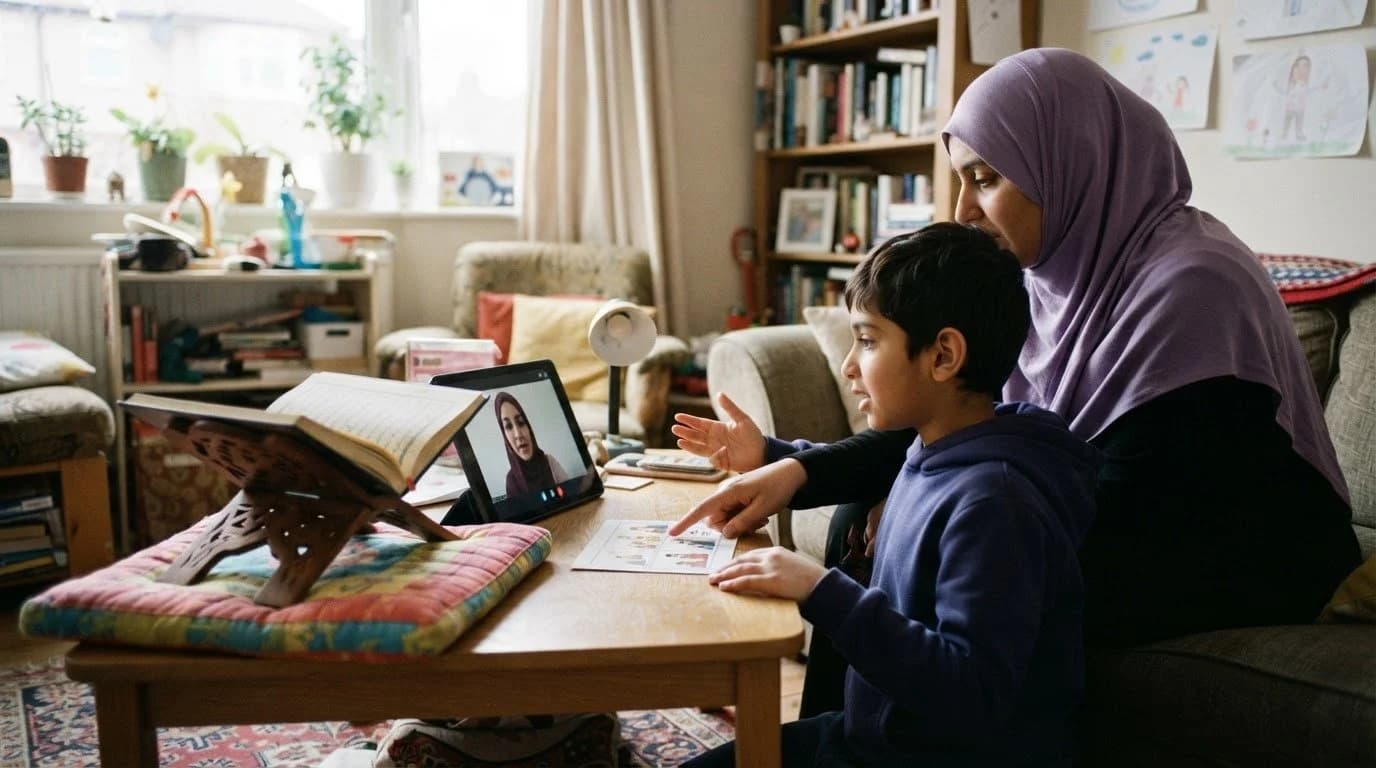
How to Help Children Learn the Quran at Home with Meaning
By Eaalim Institute
A child can grow to love the Quran before understanding Arabic. If you’re wondering how to help children learn Quran at home, a gentle routine can combine listening, reading practice, memorisation and simple explanations in a language your child understands.
It’s natural to want your child to recite accurately and remember what they learn, while keeping lessons warm rather than pressured. These aims can go together: steady practice and patient guidance support progress at your child’s pace.
This guide explains how to balance home practice with lessons, bring reading, memorisation and dua into a routine, and nurture understanding even if Arabic isn’t spoken at home. You’ll also find ways to encourage curiosity and affection for the Quran, making learning a meaningful part of family life.
Key Takeaways
- Pair teacher-led lessons with a calm home routine that supports learning without making it feel rigid.
- Give reading, memorisation and dua a place in lessons, while keeping each activity suited to your child’s pace.
- Connect recitation with simple explanations of meaning so children can begin to understand what they learn.
- Encourage interest through patience, shared goals and positive motivation rather than pressure.
- Parents can support Quran learning at home even without Arabic, with guidance from an online Quran teacher.
Balancing professional Quran classes with learning at home
Set a steady timetable that gives teacher-led lessons and home practice distinct roles. A teacher can guide recitation and Tajweed, while familiar moments at home help learning become part of family life.
-
Choose a child-friendly Quran teacher
Choose a teacher who can explain Quran reading and Tajweed clearly to children, not just recite accurately. In an introductory lesson, notice whether the teacher listens to your child, corrects gently and adapts when a sound or letter proves difficult. A good fit means specific guidance, room for questions and a step-by-step foundation. Avoid treating a child like an adult learner; for families seeking bespoke assistance with private tuition, Royal Family Concierge offers educational consultancy to help structure tailored learning at home.
-
Coordinate home learning with formal Quran classes
Agree with the teacher which small part of the lesson your child can revisit at home, such as listening to a recited passage or practising a familiar letter. Keep that practice consistent but not rigid, so it can fit around school, meals and rest. One family account describes daughters finishing school at 2.30pm and leaving for Madrasa at 3.30pm, a useful reminder to consider the whole day before adding lessons.
-
Learn Tajweed through listening and repetition with a teacher
Ask the teacher to model a sound, give your child time to listen, then invite them to repeat it. Listening and gentle correction help accurate Quranic sounds become familiar through practice. The teacher can focus on one sound or rule at a time instead of interrupting every phrase. At home, revisit the passage taught in the lesson rather than introducing a new one.
- Keep practice patient and choose resources that encourage active learning. Montessori-aligned materials might include tactile Arabic letter cards, movable letters or matching activities, so a child can handle and arrange what they’re learning. Use these to support the teacher’s lesson, not replace listening to Quran recitation or careful correction. For example, a child can arrange familiar letters before practising their sounds with the teacher.
Ask the teacher to set a manageable focus for each lesson and recognise effort as well as accuracy. If your child struggles with a sound, return to it calmly next time instead of turning practice into a test. Consistency allows gradual improvement, while a flexible home routine keeps learning from feeling like another formal class every afternoon.
Including Quran reading, memorisation and dua in a teacher-led lesson
Ask the teacher to link Arabic reading, recitation, memorisation and dua in a clear sequence. Each activity should build on your child’s current reading skills instead of competing for their attention.
-
Assess Qaida skills before beginning Quran reading
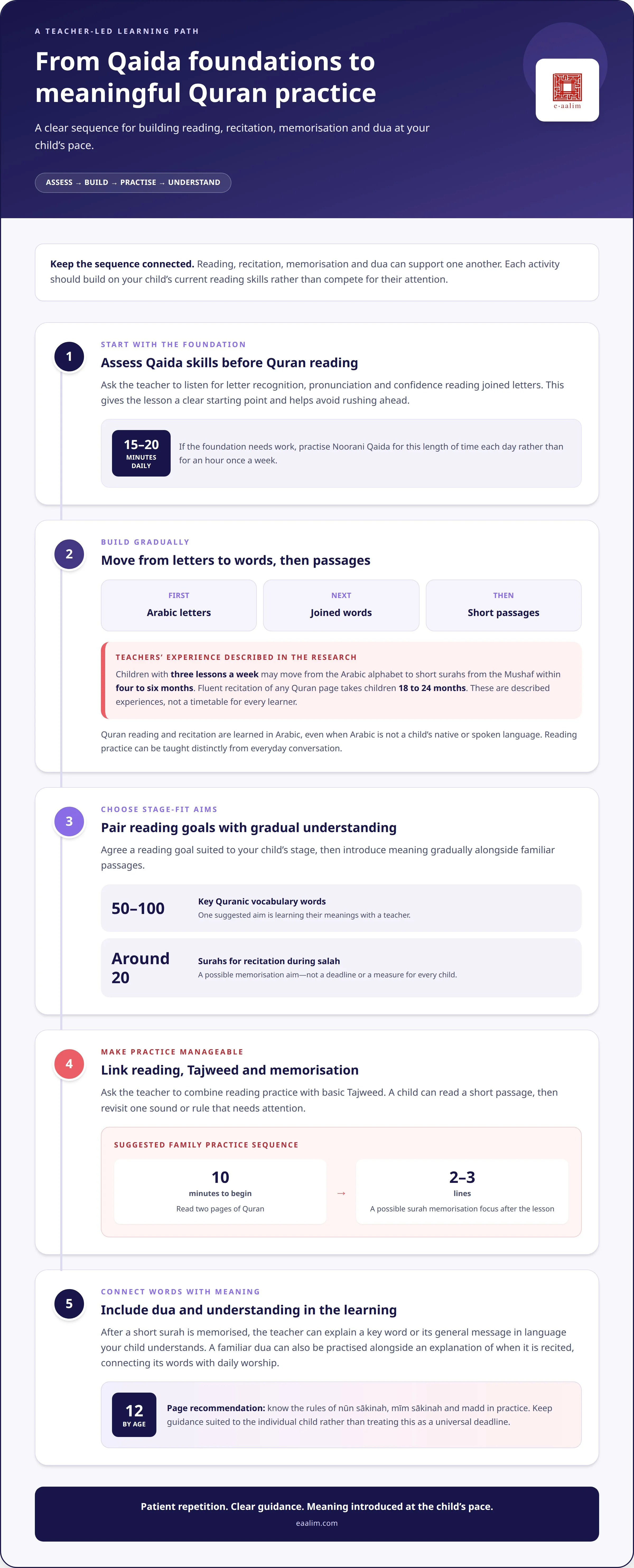
Ask the teacher to assess your child’s Qaida reading before moving on to the Quran. They can listen for letter recognition, pronunciation and confidence reading joined letters. If the foundation needs work, practise Noorani Qaida for fifteen to twenty minutes each day rather than for an hour once a week. This gives the teacher a clear starting point and helps prevent rushing into Quran reading.
-
Progress from letters to words with a Quran teacher
Ask the teacher to build a path from Arabic letters to joined words, then short Quran passages. In the teachers’ experience described in the research, children with three lessons a week may progress from the Arabic alphabet to short surahs from the Mushaf within four to six months. Fluent recitation of any Quran page takes children 18 to 24 months. These are described experiences, not a timetable for every learner.
King Saud University explains that Muslims learn to read and recite the Quran in Arabic, even if Arabic isn’t their native language or a language they speak. A teacher can distinguish Arabic reading practice from everyday conversation and shape lessons accordingly.
-
Set Arabic reading and comprehension goals with a teacher
Agree a reading goal that suits your child’s stage, then add meaning gradually. One suggested goal is learning the meanings of 50-100 key Quranic vocabulary words; a teacher can introduce relevant words alongside familiar passages. For memorisation, a possible aim is around 20 surahs for recitation during salah. Keep the goal meaningful and manageable, rather than treating it as a deadline.
-
Practise reading and basic Tajweed with a Quran teacher
Ask the teacher to make reading practice and basic Tajweed part of the same lesson. For example, the child can read a short passage, then revisit one sound or rule that needs attention. A suggested family routine begins with reading two pages of Quran during the first 10 minutes. The teacher can then guide memorisation, perhaps two to three lines of a surah after the lesson.
Leave space for dua, too. The teacher can help the child practise a familiar dua and explain when it is recited, connecting words with daily worship. By age 12, the page recommends knowing the rules of nūn sākinah, mīm sākinah and madd in practice. A teacher-led online Quran course can support reading and recitation lessons with individual guidance.
How Quran teachers balance memorisation and understanding
Ask the teacher to connect memorised verses with their meaning in a way that suits your child’s age and attention. A thoughtful online Quran lesson can develop accurate recitation alongside reflection, rather than treating either as the only measure of progress.
- Set two connected goals for each passage: learn a manageable portion and explore one idea within it. After memorising a short surah, for example, the teacher can explain a key word or its general message in language your child understands. You can reinforce the meaning in everyday conversation without turning every family moment into a lesson. The Prophet ﷺ said the best people are those who learn the Quran and teach it.
- Choose lesson times around your child’s energy, not only the school timetable. A morning routine may suit a parent and child who feel fresher earlier; another family may find the period after Asr more settled. One family studied Quran between 4 and 5pm each day. Treat that as an example, then choose a regular time that leaves room for school, meals and rest.
- Match the lesson’s length and focus to your child’s stage. For children under seven, sessions should last about fifteen to twenty minutes; slightly older children may manage up to thirty minutes. A younger child might listen, repeat and talk about a familiar verse, while an older learner could spend longer reading, memorising and discussing meaning. Ask the teacher to adjust the balance as your child’s concentration changes.
- Begin with readiness, not a birthday deadline. Children can start Quran learning at around four to six years old, while starting at seven or eight is also considered fine. From ages 3 to 6, focus on fostering affection for the Quran before concentrating on letters. Ages 7 to 12 can centre on developing reading ability, and learners aged 13 and older can explore deeper study and application.
- Keep memorisation connected to understanding as your child progresses. A teacher can revisit a familiar passage, invite your child to recall its meaning, then introduce a new portion at a comfortable pace. If your child is still building confidence, listening and talking about a verse may matter more than memorising another line. This helps show that Quran learning includes both its words and guidance.
How Quran teachers nurture a love of the Quran without forcing children
Invite the teacher to make encouragement part of each lesson, alongside Quran recitation and Islamic learning. A beginner’s confidence can grow through specific praise, achievable goals and explanations that connect Quranic words with a child’s life.
- Ask the teacher to agree on a small learning goal with your child before starting. It could be reading a familiar passage clearly, recalling a short surah or explaining one word. Let your child help choose which goal to work on first. A shared purpose makes progress feel less like a demand imposed by adults.
- Encourage the teacher to recognise effort with specific, sincere words. “You remembered where to pause in that verse” tells a child what they did well, while “You’re brilliant” gives less useful guidance. A sticker or small gift may suit your family when a goal is reached, but it shouldn’t become the only reason your child takes part in Quran learning.
- If your child resists a lesson, ask the teacher to find a gentler way into the same learning. A child who finds repeated reading tiring might listen to a short recitation, identify a familiar word, then return to reading when ready. Avoid turning a difficult moment into a contest over who will give in. Adjust the activity calmly and keep your child’s connection with the Quran intact.
- Ask the teacher to explain a verse or word in language your child understands. After practising a familiar passage, for example, discuss one key word and how its meaning relates to kindness at home. This helps a Muslim child encounter the Quran as guidance, not just sounds to repeat. Keep the explanation suited to your child’s questions and learning stage.
- Share observations with the teacher so encouragement reflects your child’s interests and daily life. If your child enjoys a particular surah at bedtime, for example, the teacher can draw on that familiarity to begin a lesson. Celebrate progress in ways that feel natural to your family, such as telling a relative about a new recitation skill or revisiting a favourite passage together.
- Prioritise your child’s relationship with learning over completing a target on a difficult day. If they become upset during practice, pause and tell the teacher before the next lesson. The teacher can make the next step smaller, perhaps listening first and reading together afterwards. This response models patience and helps your child associate Quran study with care, attention and meaningful learning.
How a Quran teacher can help children learn at home when parents do not know Arabic
You don’t need to speak Arabic to support your child’s Quran routine. If you’re considering how to help children learn Quran at home, a teacher can guide pronunciation and reading, while familiar listening and encouragement connect lessons with everyday life.
- Tell the Quran teacher what your child already recognises, even if you can’t assess Arabic pronunciation yourself. Mention whether they know any alphabet letters, follow a familiar recitation or remember a short surah. This gives the teacher a useful starting point without asking you to correct sounds you haven’t learned. The teacher can then discuss progress in clear, everyday language.
- Ask the teacher to model each sound before your child tries it. You can keep the learning space calm and give your child time to listen, without needing to judge every pronunciation. A simple routine might be to listen to a short passage, repeat the teacher’s example together, then finish with a familiar recitation. The teacher provides detailed correction.
- Make listening part of ordinary family life, without expecting it to replace teaching. One mother’s daughter had memorised three surahs and some of Ayat-ul-Kursi by age 3 through listening alone. Treat this as an example of early familiarity, not a measure every child must match. You can play a known passage during a quiet routine and enjoy listening alongside your child.
- For children under seven, keep Quran sessions to about fifteen to twenty minutes, with activities suited to their stage. A child learning the alphabet might listen, point to a familiar letter and repeat its sound with the teacher. Add a simple matching activity or short recitation to vary the session. The teacher guides Arabic learning while you make room for regular practice.
- Ask the teacher to explain your child’s learning in terms you can follow. After a lesson on a short surah, for instance, they might identify the passage practised, the pronunciation focus and what your child can revisit by listening. Encourage your child to recite what they remember without testing them on unfamiliar Arabic. This helps you support learning without confusing encouragement with formal correction.
- Choose a repeatable daily moment, such as after breakfast or before bedtime, for listening or revisiting a familiar passage. If school or family plans disrupt the routine, return to it at the next suitable opportunity rather than making missed practice a source of blame. A practical approach to how to help children learn Quran at home is to make the routine welcoming and let the teacher guide the Arabic. To give your child individual guidance in reading and recitation, explore online Quran teaching.
Eaalim: Online Quran courses
Eaalim offers one-to-one online Quran lessons for children who would benefit from individual, teacher-led guidance alongside home learning. Live sessions with Al-Azhar graduates can support your child’s reading and recitation at their own pace. This may be a helpful next step if you want a teacher to guide pronunciation and tailor lessons to your child’s needs.
Eaalim also offers online Arabic classes and Islamic studies courses, which can complement your child’s wider learning. Home routines can still provide a relaxed space to listen, practise familiar passages and share what your child is learning.
If you’d like to discuss online Quran learning for your child, contact Eaalim.
Let your child’s learning grow at its own pace
Helping children learn the Quran at home isn’t about making every day perfect. It’s about building a steady, caring connection over time. Let your child’s questions guide the next conversation, and notice what brings confidence or curiosity. These observations can help shape a more personal learning path.
If you’d value individual guidance as your family considers the next step, Eaalim offers online Quran lessons alongside online Islamic studies and Arabic classes. Explore the option that fits your child’s interests and allow their learning to develop naturally.
Contact Eaalim about Quran learning to discuss a suitable next step for your child. A gentle beginning can grow into a meaningful part of family life.
Start your journey with Eaalim today!
Start 2 Free Trials


 Share
Frequently Asked Questions
Choose learning that suits your child’s reading ability, temperament and family routine. Ask how the teacher will set goals, explain progress and respond if a lesson feels difficult. A beginner who recognises some Arabic letters, for example, may need a different starting point from a child already reading short passages. Consider whether lessons leave room for questions and understanding, not just recitation practice.
A useful routine can begin with a brief check-in about what the child remembers, followed by one clear learning focus and a calm finish. For example, a teacher might review a previous pronunciation point, introduce a new passage, then ask the child to describe what felt easy or challenging. A short note for parents about the next practice focus helps connect the lesson with home life.
A teacher can distinguish a letter’s name from the sound it makes in recitation, then listen as your child practises each sound. If a beginner confuses two letters, for instance, the teacher can model them clearly and invite your child to identify each one. Once the sounds are familiar, the teacher can show how letters join in Arabic words.
Choose resources that suit your child’s reading stage and support the teacher’s current goals. A beginner may benefit from clear Arabic letter examples and carefully pronounced audio; a more confident reader may need passages that follow their lessons. Preview material together, check that explanations are understandable and avoid switching between several tools at once. An app can support learning, but it doesn’t replace a teacher’s feedback.
A teacher can give your child one specific recitation point to practise between lessons, such as a sound or pause in a familiar passage. In the next session, the teacher listens again and guides any needed correction. You can invite your child to recite the assigned section, then note which part felt uncertain rather than trying to teach Tajweed yourself.
A teacher can divide a surah into manageable phrases and help your child recall each one before adding more. They might listen to a short section, recite it with support, then try again from memory. Revisiting earlier passages in later lessons helps the teacher notice what your child remembers and what needs more practice, without making memorisation feel like a race.
Suitable study time depends on your child’s age, concentration, reading stage and energy after school. A teacher can adjust the time spent listening, reading, memorising or discussing to keep lessons focused. If concentration fades, shorter activities with a clear change of task may work better than continuing the same exercise. Regular progress can guide future lessons.
A teacher can involve your child in choosing a familiar passage or setting a small personal goal, then recognise the effort behind each step. Your child might choose to revisit a favourite surah before trying something new. If enthusiasm dips, the teacher can vary the activity or ask what your child enjoys. Encouragement works best when it’s genuine and specific.
