



How to Learn Tajweed Online: A Calm, Step-by-Step Guide
By Eaalim Institute on 10/19/2026 · 14 min read
What if learning Tajweed online felt less like memorising unfamiliar terms and more like building a steady recitation habit? If you’re wondering how to learn Tajweed online and check whether you’re applying each rule correctly, follow a clear sequence: listen carefully, practise aloud and get feedback on what to focus on next.
It’s understandable if the terminology feels difficult to organise or independent practice leaves you unsure about a pronunciation. When family routines are already full, finding a regular study time can take patience too. You don’t need to master everything at once. A manageable pace gives you room to revisit sounds and rules as your confidence develops.
This guide sets out a practical order for learning core Tajweed skills, from listening and focused recitation to consistent review. It also explains how individual live online lessons give you space to recite and receive guidance tailored to your level, so you can keep progressing without expecting instant results.
Key Takeaways
- Tajweed is learned progressively, with attention to how Quranic Arabic is pronounced and recited.
- A useful starting sequence is to practise letter sounds and articulation before exploring selected recitation rules.
- Recorded examples can support review, while live individual guidance gives you a chance to recite and receive feedback.
- Build a sustainable routine by reviewing one rule, listening to an example, reciting and noting questions to revisit.
- Learning how to learn Tajweed online can feel more manageable when your study follows a clear sequence and lessons are tailored to your level.
How to learn Tajweed online: understand the foundations before the rules
Tajweed is the practice of reciting the Quran with care for how each letter is pronounced and for the rules that shape recitation. It draws attention to details such as where a sound is formed and how it is voiced, rather than simply reading words from the page. For a broader overview of its meaning and background, see Tajweed on Wikipedia.
Learning to recognise and read Arabic script is a useful foundation, but it isn’t the same as applying Tajweed. Reading helps you identify letters and words; recitation also involves producing each sound carefully and following the relevant rules aloud. You may be comfortable reading Arabic and still need guidance with pronunciation, just as reading a musical score and performing it are different skills.
If you’re considering how to learn Tajweed online, start by identifying your current reading level rather than expecting yourself to know every rule. Tajweed can be studied progressively: first build familiarity with letters and their sounds, then notice how those sounds work in recited words, and gradually explore rules that support accurate recitation. You don’t need to treat the whole subject as a test you must pass before you begin.
What should you know before beginning Tajweed?
Familiarity with the Arabic letters makes later pronunciation practice easier because you can focus on how a sound is made instead of identifying the letter at the same time. Fluent Arabic conversation isn’t a prerequisite for learning Quranic recitation. Speaking a language and carefully articulating its written forms are different skills, so limited conversational Arabic doesn’t by itself determine your ability to study Tajweed.
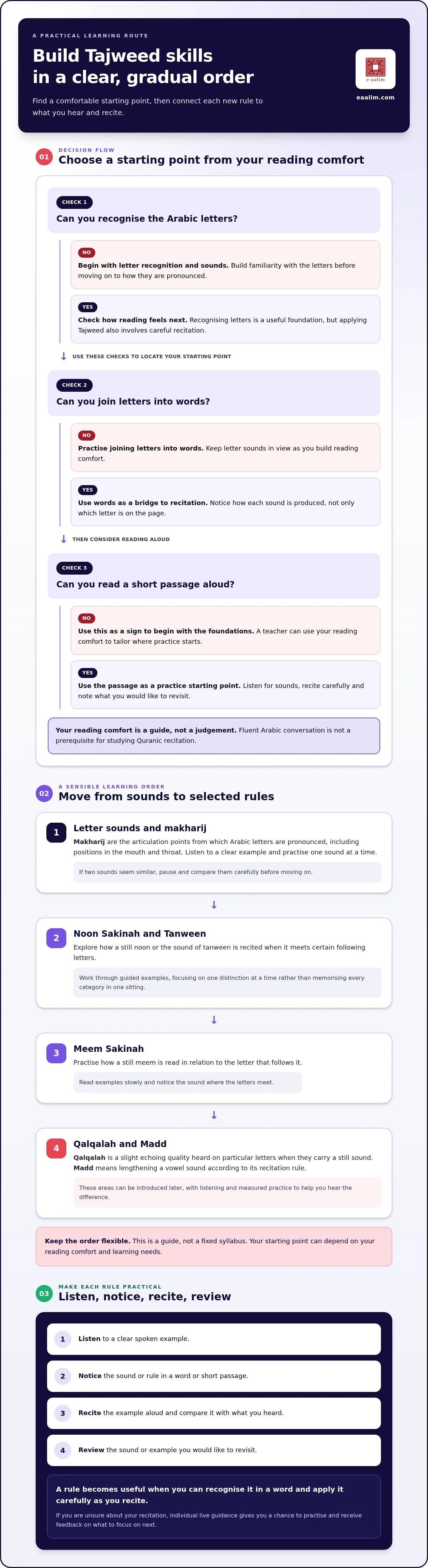
Take a practical look at your current reading comfort. Can you recognise the letters, join them into words or read a short passage aloud? These are useful observations, not judgements. They help show where practice should begin and give a teacher a starting point for tailoring guidance to your level.
Why learn Tajweed with a gradual approach?
Trying to absorb many terms and rules at once can make recitation harder to follow. A small set of connected skills gives each practice session a clear focus. For example, pay attention to a letter’s sound and point of articulation, listen for that sound in a word, then try reciting it yourself. The rule becomes more meaningful when you can hear and apply it, rather than memorising its name in isolation.
Progress won’t follow one fixed timetable. Some sounds may become familiar quickly, while others need repeated listening and practice. The aim at the beginning isn’t instant mastery, but a growing ability to notice what you’re practising and return to it with care. A well-paced foundation makes the next stages easier to organise.
A sensible order for learning Tajweed rules online
There isn’t one sequence every learner must follow, but a gradual order can make the subject easier to understand: begin with letter sounds, explore where they’re formed, then study selected rules and practise them in recitation. This connects each new idea to something you can hear and say, rather than asking you to memorise a long list of terms at once.
Begin with letter sounds and makharij
Makharij means the articulation points from which Arabic letters are pronounced, including different positions in the mouth and throat. Listen to a clear example, then practise one sound at a time. This helps you focus on how a letter is formed before meeting it in a longer passage. If two sounds seem similar, pause and compare them carefully instead of rushing to the next rule.
Move from individual sounds to recurring rules
Once letter sounds feel more familiar, explore rules that affect how letters are read beside one another. Meet each concept through an example, listen for it in a short passage, then try the passage aloud. The order below is a guide, not a fixed syllabus. Your starting point may depend on your reading comfort and learning needs.
- Letter sounds and articulation: Practise recognising and producing individual letters, with attention to their makharij. Listen to a clear spoken example and compare it with your own recitation.
- Noon Sakinah and Tanween: These related rule groups guide how a still noon or the sound of tanween is recited when it meets certain following letters. Work through guided examples, focusing on one distinction at a time rather than memorising every category in one sitting.
- Meem Sakinah: This group concerns how a still meem is read in relation to the letter that follows it. Practise examples slowly and notice the sound where the letters meet.
- Qalqalah and Madd: Qalqalah is a slight echoing quality heard on particular letters when they carry a still sound; Madd means lengthening a vowel sound according to its recitation rule. These areas can be introduced later, using listening and measured practice to help you hear the difference.
A Tajweed rule becomes useful not when you can only name it, but when you can recognise it in a word and apply it carefully as you recite. After learning a concept, choose a short passage where it appears. Practise that passage and note any sound or example you’d like to revisit. Give this rule your attention before adding another.
If it’s difficult to hear and correct your own recitation, individual live Quran lessons with certified instructors give you a chance to practise and receive guidance tailored to your level. Feedback can help you decide which sound or rule to focus on next, keeping your learning steady and manageable.
Can you learn Tajweed online accurately without a classroom?
Yes, online study can support careful Tajweed learning when it includes opportunities to recite aloud and receive individual feedback. The key isn’t simply being in front of a screen. You need a way to hear examples, practise them and get help noticing details you might miss alone. A live lesson gives you that feedback loop from home, without a physical classroom.
What independent study can and cannot do
Recorded explanations are useful for revisiting a term, replaying an example or reviewing a rule at a comfortable pace. Pause, listen again and return to the same material when it suits your routine. Recordings can support practice, but they can’t respond to your recitation or tell you whether a sound needs attention.
It can be difficult to judge your own pronunciation while you’re concentrating on reading. You might recognise a rule in an explanation yet feel unsure when it appears in a passage. Videos and recordings can support learning, but they won’t suit every learner in the same way or guarantee correct recitation.
How live online feedback supports practice
In a one-to-one online lesson, you recite while an instructor listens and guides you through sounds or rules that need attention. Instead of trying to correct everything at once, the instructor can focus on your current needs, offer an example and give you a chance to try again. This makes online learning more personal than studying from recordings alone.
Live guidance can turn a question from independent practice into a specific point to work on. You might ask about a sound that’s difficult to distinguish, then listen, recite and try it again with the instructor’s feedback. Eaalim’s one-to-one online Quran lessons provide individual instruction tailored to learners’ levels.
A few practical preparations can help you focus during a lesson. Choose a reasonably quiet place where you can recite aloud, and use clear audio so you and the instructor can hear the recitation. A steady internet connection can help reduce interruptions. These details don’t need to be perfect, but making them comfortable keeps attention on the learning itself.
When deciding how to learn Tajweed online, treat recorded study and live instruction as complementary. Use recordings to revisit explanations in your own time, then use a live session to practise aloud and receive individual guidance. You can review between lessons and get help identifying what to practise next, without expecting instant mastery.
Build an online Tajweed practice routine you can sustain
A useful routine doesn’t need to take over a busy day or follow a strict timetable. It needs to be simple enough to return to, whether you find a quiet moment after breakfast or settle down once the household is calmer. Choose one skill you’ve already met, such as a letter sound or a rule from a lesson, and focus on it instead of trying to cover several new topics at once.
Keep the practice loop simple: review one rule, listen to an example, recite it carefully, then note any questions to revisit. This gives each session a clear purpose and connects what you’ve studied with what you can hear and practise in your recitation.
Practise one small skill at a time
Begin with a clear example of the sound or rule you’re working on. Listen closely, then recite the same word or short passage slowly, keeping your attention on that one skill. Return to the example later and try again. You may find that a sound feels more familiar, or that you’ve found a question to bring to your next lesson. Either is useful progress.
Keep your practice flexible. On a full day, you might listen and review; when you have more time, recite a passage and write down a question. There’s no single daily duration that suits every learner, and missing a planned session doesn’t mean you’ve lost your progress. Return when you can and pick up with the same skill, rather than trying to catch up by adding more rules.
Use lesson feedback to guide your next practice
After a lesson, jot down corrections in plain language while they’re still clear. For example, note the sound to focus on, the passage where it came up and what the instructor asked you to listen for. A brief record of topics practised and feedback to revisit helps you see what you’ve worked on and keep your next session focused.
Try the corrected passage again before moving on to an unrelated rule. If the same question comes up, write it down and bring it to your next live session instead of guessing. An instructor can listen to your recitation and clarify what to practise, keeping independent study connected to individual guidance. Eaalim’s one-to-one online Quran lessons are tailored to learners’ levels and offer a setting for ongoing feedback. Explore individual online Quran lessons.
Returning to a sound, passage or correction can make study easier to organise around everyday life. The aim isn’t to complete a fixed checklist at speed. Practise attentively, keep track of useful feedback and continue at a pace you can sustain. This is a practical foundation for how to learn Tajweed online without turning recitation into another source of pressure.
Start learning Tajweed online with individual guidance from Eaalim
Once you know which skills you’d like to practise, individual guidance can help you give your recitation focused attention. Eaalim provides live one-to-one online Quran lessons, including recitation and Tajweed instruction for children and adults at different levels. Certified instructors tailor lessons to the learner, so the starting point can reflect their current reading and recitation needs rather than requiring everyone to follow the same pace.
What individual online Quran lessons can offer
In a one-to-one lesson, you have space to recite aloud while the instructor listens. This makes it possible to focus on the sounds, words or rules most relevant to you, instead of trying to keep pace with a group. If a part of a passage feels uncertain, it can become a clear focus for guidance and further practice.
Tailored instruction can also help you decide what to work on next. A newer learner may need support with reading and pronunciation foundations, while someone with more experience may have different recitation questions. Lessons are shaped around each learner’s level and needs, for both children and adults. This doesn’t mean every difficulty disappears at once; it provides individual attention as you continue practising.
Take a calm first step towards guided study
You don’t need to arrive with a perfect reading voice or a long list of Tajweed terms. It’s enough to have an honest sense of what feels comfortable and where you’re unsure. You might be able to read familiar passages but want help hearing the difference between sounds, or want to strengthen your foundations before taking on more rules. Sharing those observations gives the instructor a useful starting point.
Steady effort matters more than rushing through rule names. Between lessons, return to the points you’ve discussed and bring questions back for individual guidance. Progress may mean becoming more at ease reading aloud, noticing a sound that needs attention or understanding how a rule applies in a passage. These are practical steps, not demands to reach a particular milestone by a fixed date.
If you’re considering how to learn Tajweed online with support suited to your current level, you can explore Eaalim’s live lessons at a comfortable pace. You don’t need to have everything organised before you begin; your current reading and questions can help shape your learning.
Explore online Quran lessons with Eaalim.
Let your next recitation begin at your own pace
You don’t need to wait until you feel fully prepared to take a next step. Start with one question about your recitation or a passage you’d like to approach with greater care. That small point of focus can give your learning direction without turning it into a race to master every rule.
If guided support would help, Eaalim’s certified instructors teach live, one-to-one online Quran lessons tailored to learners’ levels, for children and adults. Keep your expectations realistic: learning how to learn Tajweed online is a process of returning to recitation with attention and patience, not a promise of instant change.
Explore Eaalim’s one-to-one online Quran lessons and consider what would make a comfortable starting point for you. A thoughtful first step is enough; steady effort can grow from there.
Start your journey with Eaalim today!
Start 2 Free Trials


 Share
Frequently Asked Questions
Familiarity with the Arabic letters makes later pronunciation practice easier because you can focus on how a sound is made instead of identifying the letter at the same time. Fluent Arabic conversation isn’t a prerequisite for learning Quranic recitation. Speaking a language and carefully articulating its written forms are different skills, so limited conversational Arabic doesn’t by itself determine your ability to study Tajweed. Take a practical look at your current reading comfort. Can you recognise the letters, join them into words or read a short passage aloud? These are useful observations, not judgements. They help show where practice should begin and give a teacher a starting point for tailoring guidance to your level.
Trying to absorb many terms and rules at once can make recitation harder to follow. A small set of connected skills gives each practice session a clear focus. For example, pay attention to a letter’s sound and point of articulation, listen for that sound in a word, then try reciting it yourself. The rule becomes more meaningful when you can hear and apply it, rather than memorising its name in isolation. Progress won’t follow one fixed timetable. Some sounds may become familiar quickly, while others need repeated listening and practice. The aim at the beginning isn’t instant mastery, but a growing ability to notice what you’re practising and return to it with care. A well-paced foundation makes the next stages easier to organise. There isn’t one sequence every learner must follow, but a gradual order can make the subject easier to understand: begin with letter sounds, explore where they’re formed, then study selected rules and practise them in recitation. This connects each new idea to something you can hear and say, rather than asking you to memorise a long list of terms at once.
Yes, speaking Arabic fluently isn’t necessary to begin learning Tajweed online. Conversational Arabic and careful Quranic recitation are different skills. Recognising Arabic letters can help, but you can explain your current reading level to your instructor and begin from there. For example, if you can read words but feel unsure about certain sounds, that gives you a practical starting point for lessons and practice.
There’s no fixed timeframe, because learners begin with different levels of reading confidence and may practise at different rhythms. The time also depends on the skills you’re focusing on and how much individual guidance you receive. Rather than setting a deadline for mastering every rule, choose a small learning goal, such as paying closer attention to one sound, and review it with your instructor as you progress.
Yes, children can learn Tajweed online, and Eaalim provides individual Quran lessons for children as well as adults. Lessons can be tailored to a child’s level, with room to practise recitation and focus on the skills they’re working on. At home, choose a place where your child can hear the instructor clearly and feel at ease reading aloud.
No, you don’t need to memorise a glossary before you start practising. It’s often more useful to understand a term as it comes up in a lesson, then connect it with the sound or recitation example it describes. If you forget a name, note it beside the relevant passage and return to it later. Understanding what to listen for matters more than recalling terminology from memory.
You’ll need a device with a working internet connection and audio that lets you hear and be heard clearly. Keep the Quran text or passage you’ll be studying nearby, along with a notebook for unfamiliar terms or questions. Before the lesson, check that your microphone is working and have the relevant page ready, so you can focus on listening and reciting.
Look for specific signs rather than expecting every part of recitation to change at once. You might notice that you can repeat a sound more confidently, recognise a rule in a passage or remember a correction when you meet a similar example. Keep a short note of the feedback you receive and revisit it with your instructor. Their observations can help you assess what’s becoming clearer and what still needs practice.
Use both, but let recitation show you how a rule works in context. Reading an explanation can help you understand what to listen for, while reciting gives you a chance to apply that idea to actual words. If you’re unsure how a rule affects a particular passage, mark the words and ask your instructor to guide you through them. That way, theory supports practice rather than replacing it.
