



How to Read Quran Without Mistakes: Common Errors to Correct
By Eaalim Institute on 10/26/2026 · 14 min read
Rushing often turns small slips into common Quran recitation mistakes. To read more accurately, slow down, apply Tajweed rules to letter sounds and elongation, follow the signs that guide pauses, and review your recitation regularly. A teacher’s feedback can help you notice errors that are difficult to hear in your own reading.
It’s understandable to want every sound and pause to feel right, especially when you’re practising around the demands of family life. Progress comes from patient, steady attention, not trying to correct everything at once. This guide explains how to spot frequent pronunciation and stopping errors, practise the relevant rules, and build a gentle review routine to make your recitation clearer over time.
Key Takeaways
- Build a steady routine with short daily practice, beginning with familiar passages and adding more as your confidence grows.
- Focus on one Tajweed skill at a time, such as clear letter articulation, heavy and light sounds, or consistent elongation.
- Learn the pausing signs and consider how a stop affects the verse’s meaning before changing your recitation flow.
- Record a passage and listen back to notice slips, then practise the sound carefully before it becomes a habit.
- Use constructive teacher feedback alongside listening practice, and treat corrections as gradual steps rather than a reason to rush.
1. How to Read Quran Without Mistakes?
A major recitation mistake changes a word or its meaning, or omits an essential sound. A minor mistake affects pronunciation or a Tajweed rule without changing the meaning, such as imperfectly applying a nasal sound. A qualified teacher can help assess the difference in context, since similar slips may need different corrections.
Start with a short passage from the mushaf, then recite slowly enough to hear each letter and vowel. Practise the rules of noon sakinah and tanween using Qur’anic examples, noticing how the following letter affects the sound. Study silent letters too, and mark the verses where they occur. This gives each session a clear focus instead of asking you to correct everything at once.
Choose a manageable daily routine and repeat the same passage before moving on. A useful drill is to spend 10–15 minutes daily on letter sounds, then read a short surah aloud. Start with familiar short surahs and progress to longer ones as your accuracy develops. Regular, brief practice makes it easier to notice whether a sound is becoming clearer or slipping back.
Teacher feedback offers a kind of listening you can’t provide for yourself. Ask a qualified teacher to hear a specific passage, identify the exact sound or rule, and model the correction. For example, if you read tanween without the required change before a following letter, repeat the phrase after the teacher’s model. Return to the same example in your next practice session, so the correction becomes deliberate.
Listening to a trusted Quran reciter can help you hear rhythm, pronunciation and pauses. However, listening alone doesn’t replace a teacher correcting your recitation. A recording provides a model; a teacher can respond to the particular sounds you produce. Try listening to a passage while following it in the mushaf, then recite it yourself and note any point that feels uncertain.
For a simple feedback routine, ask someone knowledgeable to listen for five minutes a day. Recite a short section without rushing, then invite one or two specific corrections. Repeat each corrected phrase carefully before continuing. This keeps feedback focused, helps you remember what changed, and makes it easier for the listener to spot recurring errors.
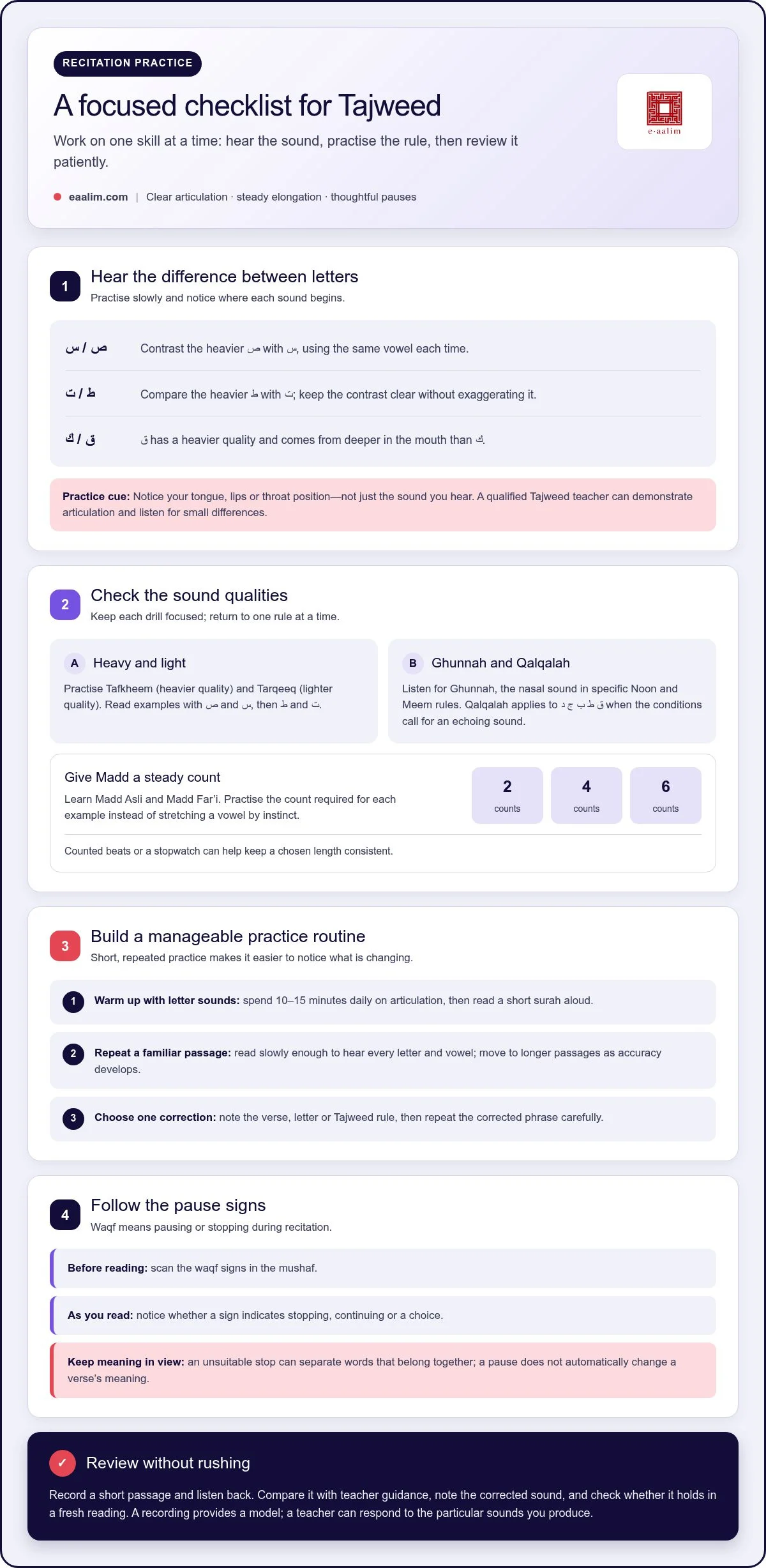
Some common Quran recitation mistakes are easier to correct when you record a short passage and compare it with your teacher’s guidance. Note the verse, letter or Tajweed rule, and corrected sound in a notebook. Bring that passage to your next lesson, then check whether the correction holds during a fresh reading. Patient review and teacher feedback help you build accuracy without treating every slip as a reason to stop learning.
2. Tajweed rules, including letter characteristics and elongation
Arabic letters can sound similar, but their articulation points, or makharij, distinguish them. Common pairs include ص and س, ط and ت, and ق and ك. The first letter in each pair has a heavier quality; ق also comes from deeper in the mouth than ك. These differences matter because replacing a letter may alter the word and its meaning.
Beginners often confuse similar letters, overlook a sound’s heavy or light quality, or apply Tajweed rules inconsistently. Other frequent slips include shortening or lengthening Madd incorrectly, missing Ghunnah, and weakening Qalqalah. Ghunnah is the nasal sound used in specific Noon and Meem rules. Qalqalah applies to ق ط ب ج د when the conditions call for an echoing sound.
To distinguish similar letters, practise each pair slowly and listen for where the sound begins and how your tongue, lips or throat move. For example, contrast ص with س, then ط with ت, using the same vowel each time. A qualified Tajweed teacher can demonstrate the articulation and listen to whether your reading matches the intended letter.
Makharij are the points from which Arabic letters are articulated. Learn them by grouping letters according to their points of origin, then practise each group in short Qur’anic examples. Notice your mouth shape and tongue position, not just the sound you hear. Noorani Qaida can help beginners build a foundation in letter pronunciation, while a qualified teacher can correct small differences in articulation as they arise.
Next, practise Tafkheem, the heavier quality, and Tarqeeq, the lighter quality. Read examples containing ص and س, then ط and ت, and compare how the sound resonates. Keep the contrast clear without exaggerating it. Five minutes of daily heavy- and light-letter drills gives you a focused way to revisit these pairs within a regular routine.
Madd requires steady timing, not stretching a vowel by instinct. Learn Madd Asli and Madd Far’i, then practise the count required for each example. Two, four and six counts are useful lengths to recognise in practice. A stopwatch or counted beats can help you keep a chosen length consistent, while slow, balanced reading gives each letter and vowel room to sound clearly.
For further guidance, practise these distinctions with a structured online Quran course, where a teacher can help you focus on articulation and Tajweed as you read.
3. Pausing and stopping at appropriate places
Waqf means pausing or stopping during recitation, and its signs help guide the flow of verses. Learn the stopping symbols in your mushaf instead of treating every pause as a breath break. A sign may indicate whether to stop, continue, or consider a pause. Following it thoughtfully helps preserve the connection between words and their meaning.
Can Quran recitation mistakes change the meaning of a verse? Yes. Mispronouncing a letter or vowel can change a word, while stopping at an unsuitable point can separate words that belong together. A pause does not automatically change a verse’s meaning, but careless stopping or restarting can obscure its sense.
Before reading a passage aloud, scan the waqf signs in the mushaf. Notice where a stop is encouraged, where continuing is preferable, and where the marking signals a choice. Then read slowly enough to connect each phrase. For example, don’t pause midway through a phrase simply because you’ve reached the end of a line; a line break is not itself a stopping rule.
If you need to pause for breath, choose a suitable point rather than cutting through a connected phrase. If you unexpectedly run short of breath, stop where you can, then review the words around that point before restarting. Begin again from a phrase that makes sense with what follows, rather than repeating only the final word without context.
Meaning offers a useful check. Read the surrounding verses in translation or consult a tafseer to understand how each phrase relates to the next. These aids don’t replace learning recitation rules, but they can show why a pause matters. If a stop makes the sentence seem incomplete, revisit the waqf sign and read the connected words together.
Practise stopping and restarting with a short passage. First, listen to a trusted reciter and follow the same verses in your mushaf. Next, read aloud, pausing at the marked points and keeping your pronunciation clear each time you restart. Repeat the passage, focusing on one or two stops instead of trying to monitor every detail at once.
When reviewing your recitation, note the exact word where a pause felt uncertain. Check its waqf marking, then read the phrase before and after it as a single unit. This helps distinguish a deliberate stop from a break caused by rushing, hesitation or breath. A teacher can also explain how the marking guides the flow of that passage.
Finally, listen back to a recording and mark any pauses that interrupt a phrase or make the restart awkward. Compare those points with the mushaf’s symbols and the verse’s meaning. Repeating the passage with attention to those specific places makes waqf practice more deliberate, helping you read connected verses with clearer pronunciation and a steadier flow.
4. Prioritising and correcting mistakes patiently
A recording can reveal habits that disappear while you concentrate on reading. Choose a short passage, record one careful recitation, then listen once without stopping. Note the exact word where a sound, elongation or stopping point feels uncertain. On the next listen, focus on that point and compare it with your Tajweed learning or a teacher’s correction.
Use a simple method: identify the slip, learn the correct sound, practise the phrase, then return to the full passage. Avoid correcting several unrelated details in the same attempt. If a letter is unclear, work on its pronunciation first; if it sounds right but its duration varies, focus on timing instead. This keeps practice specific and makes it easier to tell whether you’ve applied the correction correctly.
For Ghunnah, listen for the nasal sound in the relevant Noon and Meem rules. In specific situations, hold it for two beats. Practise by repeating the affected phrase slowly, keeping the nasal sound steady instead of dropping it or extending it beyond its required duration. Then read the whole verse at a measured pace, checking that the sound remains clear in context.
Madd needs its proper length, not an arbitrary stretch. Mark the Madd example in your mushaf, identify the required count, then repeat the phrase while counting evenly. Two, four and six counts are examples to practise, depending on the rule. A steady beat can help you notice whether your vowel is shortening or lengthening inconsistently; return to the phrase until its timing is controlled.
Correct your recitation before memorising it, because repeated errors can become harder to change. The guidance for this practice warns that repeating a wrong sound fifty times makes it harder to unlearn. Read a new passage carefully, resolve uncertain letters or Tajweed rules, then memorise the corrected version. If an error appears during revision, pause and repair the phrase before continuing.
Keep a small review record with the date, passage, specific mistake and corrected form. For example, write “Ghunnah: hold for two beats” beside the relevant verse, then revisit the note during regular practice. Once the correction feels stable in the phrase, check it again in the full passage. This gradual method helps you prioritise meaningful corrections without letting one difficult sound overshadow the rest of your reading.
Listen to your recording again after practising the correction, rather than relying on memory alone. Check the same letter or Madd point, then note whether it remains consistent across the passage. If the error persists, return to the model and ask a qualified teacher to clarify the sound. Patient, focused review makes correction a repeatable practice, not a hurried attempt to fix everything at once.
5. Common mistakes such as rushing, skipping foundations and neglecting review
Rushing can blur vowel marks, weaken letter sounds and make a recitation harder to follow. The instruction to recite with measured recitation is cited as Qur’an 73:4. Slow down enough to pronounce each harakah clearly, then listen for whether the word sounds complete. If you hurry through a familiar verse, repeat it at a moderate pace and notice which sounds become clearer.
A student may also move on to longer passages before building a secure foundation. Practise Arabic letter sounds and makharij first, especially when two letters feel similar in the mouth. Then read a short passage slowly, checking each vowel and letter against the mushaf. This helps reveal whether an incorrect sound comes from articulation, rushing or uncertainty about the written form.
Skipping foundational reading habits can make later learning harder to organise. For example, a learner who recognises a word from memory may overlook its vowel marks when reading a different verse. Take one line, read each word carefully, and check the letters before joining the phrase. Muslims learning Quran recitation can treat careful reading as part of practice, not as a test of speed.
Another common error is focusing only on new material whilst leaving memorised passages unrevised. A learner might reach juz 15 while juz 1 has faded from memory. Regularly return to earlier surahs and recite them aloud, checking pronunciation, Tajweed and stopping points. If an old passage feels uncertain, review it before adding more new material.
Use a simple balance: practise new reading, revisit earlier passages, and note one issue to work on next. For instance, if your recitation becomes hurried near the end of a page, repeat that section more slowly. If the letters are clear but the vowels are not, focus on the harakah instead. This keeps each review purposeful and helps prevent small slips from becoming a repeated pattern.
Listening can support review, but it should be active. Follow the same passage in the mushaf, notice where the reciter slows or stops, then read it yourself and compare the flow. A recording of your own reading can also help you hear skipped vowel sounds or rushed endings. Write down the word or verse that needs attention, then return to it during your next practice.
Keep the aim clear: accurate, measured recitation matters more than finishing quickly. When a passage contains difficult makharij or unfamiliar marks, pause and strengthen that foundation first. Once your reading is steadier, resume the wider passage and keep older surahs in regular review. This approach addresses errors at their source instead of correcting the same rushed mistake repeatedly.
Eaalim: Online Quran courses
Eaalim offers online Quran courses for learners seeking guided practice with pronunciation, Tajweed and recitation review. Lessons are live, online and one-to-one, with instruction tailored to children and adults. This can be a helpful next step when you’ve identified a recurring error but need a teacher to hear your reading and guide your correction.
Bring a short passage and the points you’re practising, such as a difficult makhraj, Ghunnah or stopping place. Eaalim’s qualified instructors can listen, offer feedback and help you work through the relevant Quran reading at your pace. Eaalim also offers online Arabic classes and online Islamic studies courses for learners seeking support in those areas.
For guidance with your recitation practice, contact Eaalim or visit eaalim.com.
Take the Next Step in Your Recitation
Let your next reading begin with one clear intention: listen closely to a passage and notice where you’d value guidance. The common Quran recitation mistakes you’ve identified needn’t discourage you; each can point to a specific skill to practise with care. When you’re ready for support, a teacher can help you work through those questions and build a thoughtful routine around your learning.
Eaalim offers online Quran courses, alongside online Islamic studies courses and online Arabic classes. If you’d like guidance with your Quran learning, take the next step at a pace that feels manageable for you.
Contact Eaalim about Quran lessons, and continue your learning with patience and care.
Start your journey with Eaalim today!
Start 2 Free Trials


 Share
Frequently Asked Questions
Read at a measured pace, checking each word against the mushaf rather than relying only on memory. Choose a short passage and listen for one feature at a time, such as vowel sounds, letter articulation or a stopping point. If a word remains difficult, mark it and ask a qualified teacher to model it. Return to the same passage later to see whether the correction holds during fresh reading.
Frequent errors include rushing, confusing similar Arabic letters, misapplying Tajweed rules, stretching Madd inconsistently and pausing where phrases belong together. For example, a learner may pronounce ص like س or stop midway through a connected phrase. These slips need different corrections: letter confusion calls for articulation practice, while a misplaced pause requires attention to waqf signs and the surrounding meaning.
Common Madd errors include shortening a required stretch, extending it too far or changing its length between repetitions. Practise Madd Asli and Madd Far’i separately, following the count required by each example. Two, four and six counts are useful lengths to recognise. Count evenly as you recite, then compare repeated readings of the same phrase; inconsistent timing is easier to hear when the passage stays unchanged.
Errors include missing Ghunnah, holding it for an unsuitable duration, or applying the wrong Noon sakinah or tanween rule before a following letter. Practise with a Qur’anic example and identify the letter that follows Noon sakinah or tanween; that letter determines the rule. The letters ي ن م و trigger idgham with Ghunnah, while the 15 ikhfa letters require a different treatment. In specific situations, Ghunnah lasts two beats.
A common difficulty is stopping at the end of a line without considering the waqf sign or phrase meaning. Restarting from a word that depends on the previous phrase can also make the passage difficult to understand. Check the symbol in your mushaf, then read the words around it together. If you pause unexpectedly for breath, resume at a point that reconnects naturally with the following words.
Record one short passage, then listen for a specific feature rather than judging the whole reading at once. Mark the verse and note whether the concern involves a letter, vowel, Madd, Ghunnah or pause. Compare the sound with a trusted recitation, then ask a qualified teacher to clarify anything uncertain. Practise the corrected phrase in context and record it again, so you can compare the attempts directly.
