


Online Quran Tutor for Children: Find a Class That Fits
By Eaalim Institute
The best first Quran class is one your child can return to with confidence. Choosing an online Quran tutor for children means looking beyond subject knowledge to a tutor’s experience with young learners, patient approach to correction, clear communication and ability to meet your child at their current level. The lesson should support a meaningful goal, whether that’s learning Arabic letters, improving recitation or beginning memorisation.
It’s understandable to want lessons that are worthwhile and comfortable for your child, while feeling confident about their learning and privacy. A thoughtful choice starts with your child’s needs, rather than a one-size-fits-all programme, and supports steady progress at a manageable pace.
This guide explains how to assess a tutor’s qualifications and teaching style, protect your child’s privacy during online lessons, and set goals that suit their age and experience. It also covers beginner lessons and the differences between recitation, Tajweed and memorisation, helping you choose an approach that fits your family’s routine and your child’s readiness.
Key Takeaways
- Look for a tutor who understands how to teach children, explains concepts patiently and meets your child at their current level.
- Use an introductory lesson to notice how the tutor responds to mistakes and whether your child feels comfortable engaging.
- Set a clear starting goal, such as recognising Arabic letters, developing recitation or building towards memorisation.
- Keep online learning privacy in view by using approved communication channels and choosing lessons with clear safety and privacy practices.
- For beginners, look for a structured progression that builds foundational reading skills before moving on to more advanced learning.
1. What Makes an Exceptional Online Quran Tutor for Diaspora Kids?
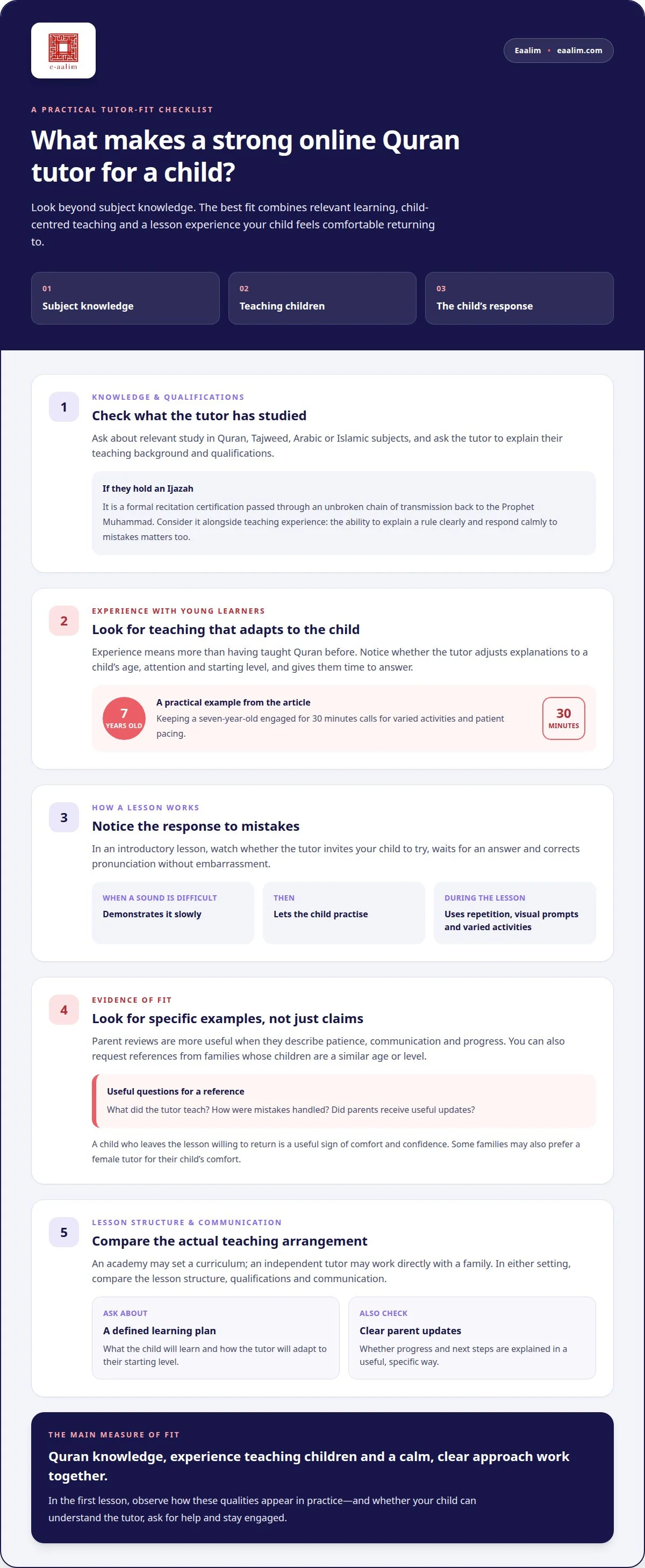
Choosing an online Quran tutor for children means weighing subject knowledge alongside the ability to teach young learners. A tutor may know the rules of recitation, but patience and clear explanations also help a child feel comfortable. Look for relevant study in Quran, Tajweed, Arabic or Islamic subjects, as well as experience teaching your child’s age and level. These details help you assess whether the tutor can build understanding, not simply lead a lesson.
Ask about the tutor’s Quran-teaching background and qualifications, including any postgraduate study, intensive Islamic courses at a recognised Islamic school, or Quran Ijazah. An Ijazah is a formal recitation certification passed through an unbroken chain of transmission back to the Prophet Muhammad. It can indicate a foundation in recitation, but should be considered alongside teaching experience. The ability to explain a rule clearly and respond calmly to mistakes matters too.
For children, experience means more than having taught Quran before. It includes adjusting explanations to a learner’s age, attention and starting level. For example, keeping a seven-year-old engaged for 30 minutes calls for varied activities and patient pacing. During an introductory lesson, notice whether the tutor invites your child to try, gives time to answer, and corrects pronunciation without embarrassment. A child who leaves the lesson willing to return is showing useful signs of comfort and confidence.
Interactive teaching can keep a child involved through recitation, repetition, visual prompts and changes of activity. Ask how the tutor handles a difficult sound or a forgotten letter. A helpful response might be to demonstrate it slowly, then let the child practise. Some families also prefer a female tutor for their child’s comfort. The right fit depends on your child’s needs, communication and response during lessons, not on one qualification alone.
Online academies and independent tutors differ mainly in how teaching and oversight are organised. An academy may set a curriculum, while an independent tutor may work directly with a family. Compare the actual lesson structure, qualifications and communication in either setting. Look for a defined learning plan and a clear explanation of the tutor’s background.
When assessing tutors in the UK, read parent reviews for specific examples of patience, communication and progress, rather than relying on star ratings alone. You can also request references from families whose children are a similar age or level. Ask what the tutor taught, how mistakes were handled and whether parents received useful updates. These practical details give a clearer picture than a general claim of expertise.
Education Scotland notes that children learn at different rates and in different ways, so a strong tutor adapts instead of expecting every child to follow the same pace. Consider whether your child understands the tutor’s language, can ask for help and stays engaged. Relevant Quran knowledge, an Ijazah or other study, and experience teaching children together offer a fuller basis for choosing a tutor. In a first lesson, observe how these qualities appear in practice.
2. Protecting a child's privacy during online lessons
Privacy starts with clear boundaries for lessons, communication and personal information. Before classes begin, find out which platform the tutor uses and how parents can get in touch. Keep messages within agreed platform channels, and don’t share your child’s private contact details elsewhere. Agree who may join a lesson, how a parent can observe and what happens if the connection fails. These arrangements let families stay involved without making a child responsible for adult communication.
Ask directly about safeguarding procedures, the tutor’s identity and background checks. In the UK, ask whether a DBS check has been completed, what level it was and how the organisation verified the result. A DBS check is one part of a wider safeguarding picture, so also ask about supervision, conduct expectations and how to raise a concern. Don’t assume every tutor has the same check or that a check alone explains an organisation’s full safeguarding arrangements.
A trial lesson offers a practical way to see how boundaries work in real time. During the lessons, notice whether the tutor speaks respectfully to your child, gives them time to answer and responds gently when they hesitate or forget a letter. Check that the tutor assesses your child’s starting level before teaching, then adapts explanations rather than pressing ahead. You can also observe how the tutor includes you, answers questions and keeps communication focused on learning.
Before choosing, ask what the lesson will cover, how progress is shared, which communication channel is used and how privacy concerns are handled. Ask whether lessons are recorded, who can access recordings and how long they are kept. Some academies use recordings or supervisor reviews for oversight, so families should understand the policy before lessons start. A clear answer explains the arrangements rather than leaving you guessing.
Progress reports make family communication more useful than a general “good lesson” message. Ask for updates that describe the material covered, what needs repetition and the next learning step. A note such as “practised letter recognition; repeat the same sounds next lesson” gives you something specific to discuss with your child. Share relevant observations with the tutor, such as when your child seems tired or finds an explanation difficult.
One-to-one lessons give a child individual reading time and direct correction, while a well-run group class may offer peer interaction. The choice depends on whether your child benefits more from focused attention or learning alongside others. Ask how questions are handled, how much time each child gets to read and how mistakes are corrected. These details show whether the format supports both learning and comfort.
3. Identifying a child's Quran learning level and goals
Start by describing what your child can already do: recognise Arabic letters, join them into words or recite familiar surahs. A child starting from scratch may need structured letter recognition before reading short words and simple surahs. Children can often start learning letters around five to seven years old, depending on readiness and attention. This is a starting point, not a deadline. Education Scotland notes that children learn at different rates and in different ways, so the Quran teacher should assess your child individually.
A useful assessment looks beyond reading speed. The teacher can listen to recitation, identify letters or sounds that need practice, and ask what the child understands. For an existing learner, the assessment might cover Tajweed, memorised passages and retention of previous material. These observations distinguish a new skill from one that needs revision and give the family a clearer picture of the child’s level before regular lessons begin.
Set a goal that describes an observable next step. A beginner, for example, might work towards recognising letters with their vowel marks, while a more experienced child might focus on smoother recitation or revising memorised surahs. Avoid treating memorisation as the only measure of learning. Reading accuracy, Tajweed development, revision and willingness to continue can all show progress.
A structured curriculum connects each lesson to the next instead of presenting disconnected topics. Ask how the online Quran teacher plans to move from your child’s current ability towards the agreed goal. A progress plan might track reading level, Tajweed practice, memorisation, revision and areas needing more attention. These markers make it easier to adjust the learning path when a child needs extra practice or is ready for a new challenge.
Personalised learning also means adapting explanations and practice to the child. One learner may respond well to repeating a sound aloud; another may benefit from seeing the letters while reading. Supplementary resources work best when they support the lesson’s objective, such as a short practice sheet linked to the letters taught that day. Agree which materials the tutor will use and how they connect to classwork, so extra tasks reinforce rather than distract from the plan.
Technology should make sessions easier to follow, not create another barrier. An unstable internet connection can interrupt concentration, so the tutor should be able to resume the reading or explanation without losing focus. After each session, ask your child what felt easy and difficult, then share their observations with the teacher. If your child is old enough, involve them in choosing a suitable lesson time. Learning is easier when it fits their routine and they understand the goal.
4. Quran memorisation, recitation and Tajweed
Recitation, Tajweed and memorisation are connected, but develop different skills. Recitation builds accurate reading aloud; Tajweed guides the pronunciation of Quranic sounds and letters. Memorisation involves retaining and repeating passages. A tutor should identify which skill needs attention first, then shape each lesson around it. For example, a child who knows short surahs by heart may still need help reading unfamiliar words accurately.
Live pronunciation correction should give children a clear model and time to try again. If a learner struggles with ع، ح، or ق, the tutor can demonstrate the sound slowly, isolate it and invite the child to repeat it. Familiar examples from earlier lessons can connect the sound to what the child already knows. Patience matters: corrections should guide practice without making every slip an interruption.
Age-appropriate Quran teaching introduces Tajweed through examples a child can hear and repeat, then builds towards more detailed rules. Look for a tutor who explains a rule in clear English and connects it to the child’s recitation. A useful method might be to listen to a short passage, practise one sound, then read the passage again. This makes learning active, rather than relying on a long explanation without practice.
Online lessons can support recitation through live listening and repetition. The tutor hears the child read, demonstrates a correction and listens as the child tries again. Listening repeatedly to correct Quran recitation can also support memorisation. Supplementary audio is most useful when it matches the passage being learnt, so the child can follow along instead of practising unrelated material.
Arabic skills support Quran reading, but a child doesn’t need to master Arabic grammar before practising recitation. A tutor can build knowledge of letter sounds and pronunciation alongside reading, introducing each element when it helps with the current task. For instance, the child might practise a difficult sound in a familiar word before encountering it in a new verse. This keeps basic Arabic learning connected to Quran learning.
Memorisation should follow accurate, fluent recitation with Tajweed, rather than take priority over pronunciation. A tutor can first listen to a passage, correct recurring errors and let the child practise until the reading is steady. Then the child can learn a manageable portion through repetition and revisit it in later lessons. Judge progress by recitation, corrected mistakes, understanding and willingness to continue, not memorised quantity alone.
To assess the teaching method, notice how the tutor balances demonstration, repetition and independent attempts. Do they correct a difficult sound calmly, explain the reason in clear English and give the child another chance? An age-appropriate lesson makes room for practice without overwhelming the learner. This combination helps children develop careful recitation and a lasting connection with Quran learning.
5. Choosing beginner classes for children
A beginner lesson should start with what the child can do, not an assumption based on age. For a child who has never read Arabic, a suitable sequence begins with letter recognition and Harakat, then moves towards short words and simple surah recitation with Tajweed. This gives parents a clear way to judge whether classes for children build skills step by step, rather than expecting a new learner to recite before they’re ready.
Look for a programme with clear progression from one learning stage to the next. A first goal might be recognising letters; a later one could be reading short words or practising a simple surah. Each lesson should build on the last, with corrections that help the child try again. If the tutor introduces unfamiliar material before the child can manage the current task, the pace may need adjusting.
Lesson length and timing also shape a beginner’s experience. Online Quran lessons for children are often more effective at 20-30 minutes than longer sessions. Choose a time when your child is rested and ready to concentrate, rather than exhausted after school. If your family routine changes during a school holiday, keeping a regular learning rhythm while adapting the timetable can help lessons remain familiar.
Ask how the teacher will assess progress beyond the number of verses memorised. For a beginner, useful signs include recognising letters with more confidence, reading a short word with support, responding to correction and wanting to continue. A simple progress update can identify what the child practised and what comes next. Parents can then ask what felt enjoyable or difficult and share that with the teacher.
A good beginner programme makes room for different learning needs. One child may benefit from hearing a letter sound and repeating it; another may need to see the letter while practising. The teacher can vary explanations and repetition while keeping the learning goal in view. For example, if a child confuses two sounds, a lesson can revisit those letters before moving to a new reading task.
Choose a class that respects the child’s ability today while offering a clear next step. Arabic letter recognition can be a useful foundation for Quran reading, and separate online Arabic classes can support families seeking focused Arabic learning. The central test is whether the beginner can follow the lesson, receive helpful correction and see how each activity supports their Quran learning.
Eaalim: Online Quran courses
Eaalim offers private, one-to-one online Quran courses for children, with live lessons tailored to each learner. When you’re ready to put your child’s learning goals into regular practice, lessons can support them whether they’re beginning with Arabic letters or developing their recitation.
Families can also choose online Arabic classes or online Islamic studies courses to complement their child’s learning. Individual lessons give the tutor space to focus on the learner’s level and pace, while online study fits around home routines. The right course depends on what your child is ready to learn and which subject you want to prioritise.
If you’d like to talk about suitable lessons for your child, please contact Eaalim.
Let your child’s learning grow at a steady pace
A first lesson begins a relationship with learning; it isn’t a test your child must pass. As you continue choosing an online Quran tutor for children, make space for your child’s reflections: what they look forward to, what feels challenging and what they’d like to practise next. These conversations help keep lessons connected to family life and your child’s growing confidence.
You can revisit the learning goal as your child develops. A focus on reading may gradually make room for smoother recitation, while a new interest in Arabic or Islamic studies may shape the next step. Give learning time to take root, and let your child’s needs guide the pace.
For support with a suitable learning path, contact Eaalim about Quran lessons. May each lesson bring your child closer to the Quran with curiosity, care and confidence.
Start your journey with Eaalim today!
Start 2 Free Trials


 Share
Frequently Asked Questions
A good tutor communicates clearly with a child and makes Quran learning feel approachable. Notice whether your child can ask for clarification, follow the teacher’s instructions and stay engaged. One practical sign of a good match is your child being able to describe something they learnt afterwards. Relevant Quran knowledge matters, alongside teaching that respects the child’s confidence and pace.
Choose a tutor who supports accurate recitation and a steady revision routine. Before memorisation becomes the main focus, ask the teacher to listen to a passage your child already knows and one they are learning. This can show how the tutor approaches retention, correction and repetition. Agree how previously learnt passages will be revisited, so new memorisation doesn’t leave earlier work behind.
No. The best format depends on how your child learns. One-to-one lessons let the tutor focus on an individual learner, while a well-run group setting can offer peer interaction. If your child needs frequent individual feedback or feels shy reading aloud, personal attention may suit them. Eaalim’s Quran teaching is delivered through private, one-to-one online lessons, not group classes.
Yes, learners can study Quran online through live lessons with a teacher. Eaalim offers online Quran courses with individual tuition to support recitation and Tajweed. A learner can read aloud, receive guidance and practise during a session at home. Before lessons start, decide whether the immediate priority is learning to read, improving recitation or strengthening an existing skill.
Choose a teacher your child feels comfortable learning with, taking your family’s preference into account. Some families prefer a female teacher for their daughter; others focus on teaching style and communication. Eaalim has male and female teachers, and parents may request a female teacher for daughters. A comfortable teacher-child relationship can make it easier for a learner to participate and ask for help.
Support your child’s interest, then help them build a manageable routine with their teacher. Memorisation works best when the child can first recite the passage accurately and fluently with Tajweed. The teacher can divide it into smaller portions, practise each one and revisit earlier sections for revision. Encourage your child to talk about what feels achievable, rather than measuring effort only by how much they memorise.
Talk through the difficulty with your child and the teacher, using specific examples such as feeling rushed or not understanding an explanation. A change in pace or teaching approach may help. If your child continues to feel anxious or uncomfortable, consider a tutor whose approach suits them better. A mismatch offers useful information about what your child needs from future lessons, not a reason to abandon learning.
A trial lets you observe how a teacher interacts with your child before lessons become part of the family routine. Notice whether the tutor gives your child time to respond, explains activities clearly and adapts when something is difficult. Eaalim offers two free trial lessons, each with a different teacher, so families can experience both teaching styles. Attendance is required for both lessons.
