

Quran Classes Online for adult UK: Noon & Meem Mushaddadah — the Two-Count Ghunnah Every Child Must Master
By Eaalim Institute on 4/24/2026 · 13 min read
If you are searching for Quran classes online in the UK, there is one test that tells you immediately whether a teacher understands how British children actually learn. Ask them which rule they teach first. A good UK Quran academy will not start with twenty Tajweed terms. They will start with a sound. A Ghunna. Two counts long. And they will teach it using two letters that your child is already reciting every single day in salah without realising it: Noon Mushaddadah (نّ) and Meem Mushaddadah (مّ).
This is the Ghunnah rule of Noon and Meem Mushaddadah — and it is the foundation of every other nasal Tajweed rule your child will ever learn. Ikhfa, Idghaam, Iqlaab, Ikhfa Shafawi, Idghaam Shafawi — all of them borrow their nasal sound from this one rule. Learn this properly and the rest becomes easy. Skip it and every nasal rule afterwards sits on a broken ground.
This guide walks through Noon and Meem Mushaddadah exactly as Eaalim teaches it in a UK online class: the classical definition, the stopping rule, eight drill pages from our own Online Mushaf (four for Noon, four for Meem), the common UK mistakes, and the way we sequence this rule inside a British child’s weekly routine.
What “Al-shaddadah” Actually Means
Before discussing the rule, the mark. Shaddah (شدّة) is the small w-shaped sign written. It refers to the integration of two identical letters, the first is sakin, the latter is Mutaharrik, (with a short vowel). It looks like this: ّ . It When you see it on any letter, that letter is pronounced twice in one breath — once with sukoon (silent), once with its vowel. In classical terminology the letter becomes mushaddad (strengthened). For feminine grammatical agreement when we refer to Noon and Meem specifically we say Noon Mushaddadah and Meem Mushaddadah.
The Eaalim Online Mushaf underlines every mushaddad letter in red. That is deliberate. Before a student learns which mushaddad letters get Ghunnah, they first have to see them. Recognition comes before rule.
The Rule, in One Sentence
“Whenever you see a Noon (ن) or a Meem (م) with a Shaddah, you must recite it with a full Ghunnah for two counts.”
That is it. One rule. Two letters. Two counts. Every other Tajweed rule involving the nose (Ikhfa, Idghaam with Ghunnah, Iqlaab, Ikhfa Shafawi, Idghaam Shafawi) is derived from the sound you produce here.
What is a “count”?
A count (harakah) in Tajweed is roughly the time it takes to open or close one finger at a steady pace. Two counts = two finger-taps at a calm recitation speed. Not fast. Not slow. Children learn this best by tapping their knee while reciting — the same method Al-Azhar teachers use in classical Egyptian kuttab and the same method Eaalim uses in UK online lessons.
What is “Ghunnah”?
Ghunnah (غُنّة) is a nasal hum. It is produced by closing off part of the oral passage and letting sound resonate through the nose. If you pinch your nostrils while saying “innnna” or “thummma”, the sound changes or disappears entirely — proof that the resonance is nasal. That nasal resonance, held for two counts, is the Ghunnah.
The Eaalim Definition Pages
Eaalim’s Online Mushaf presents this rule across two parallel definition cards — one for Noon, one for Meem — so the student sees the identical rule applied to both letters side by side. The classical tradition treats these as one rule. The Mushaf reinforces that by using exactly the same wording for each.
Noon Mushaddadah definition card from the Eaalim Online Mushaf, with “إنّهم” as the anchor example.
Meem Mushaddadah definition card from the Eaalim Online Mushaf, with “ثمّ” as the anchor example.
The Rule of Stopping (Waqf)
Notice the second line on each Eaalim card: “In case you stop on Noon/Meem Mushaddad at the end of a word, you must recite it with a full Ghunnah for two counts.”
Why does this need its own line? Because many students shortcut the final letter when they stop on it. When the recitation ends mid-ayah on a word like لَتَرَوُنَّ or ثُمَّ, the temptation is to release the sound quickly. The rule says: no. Full Ghunnah, two counts, even at the stop. This is the single most common UK correction Eaalim teachers make during evening lessons.
Part A — Noon Mushaddadah Drill (4 Pages from Juz ‘Amma)
The next four drill pages are taken directly from the Eaalim Online Mushaf. Every red-underlined letter on these pages is mushaddad. Your child’s job is to spot the Noon mushaddadahs specifically and apply the Ghunnah for two counts on each.
Drill Page 1 — Al-Ikhlas, Al-Falaq, An-Nas
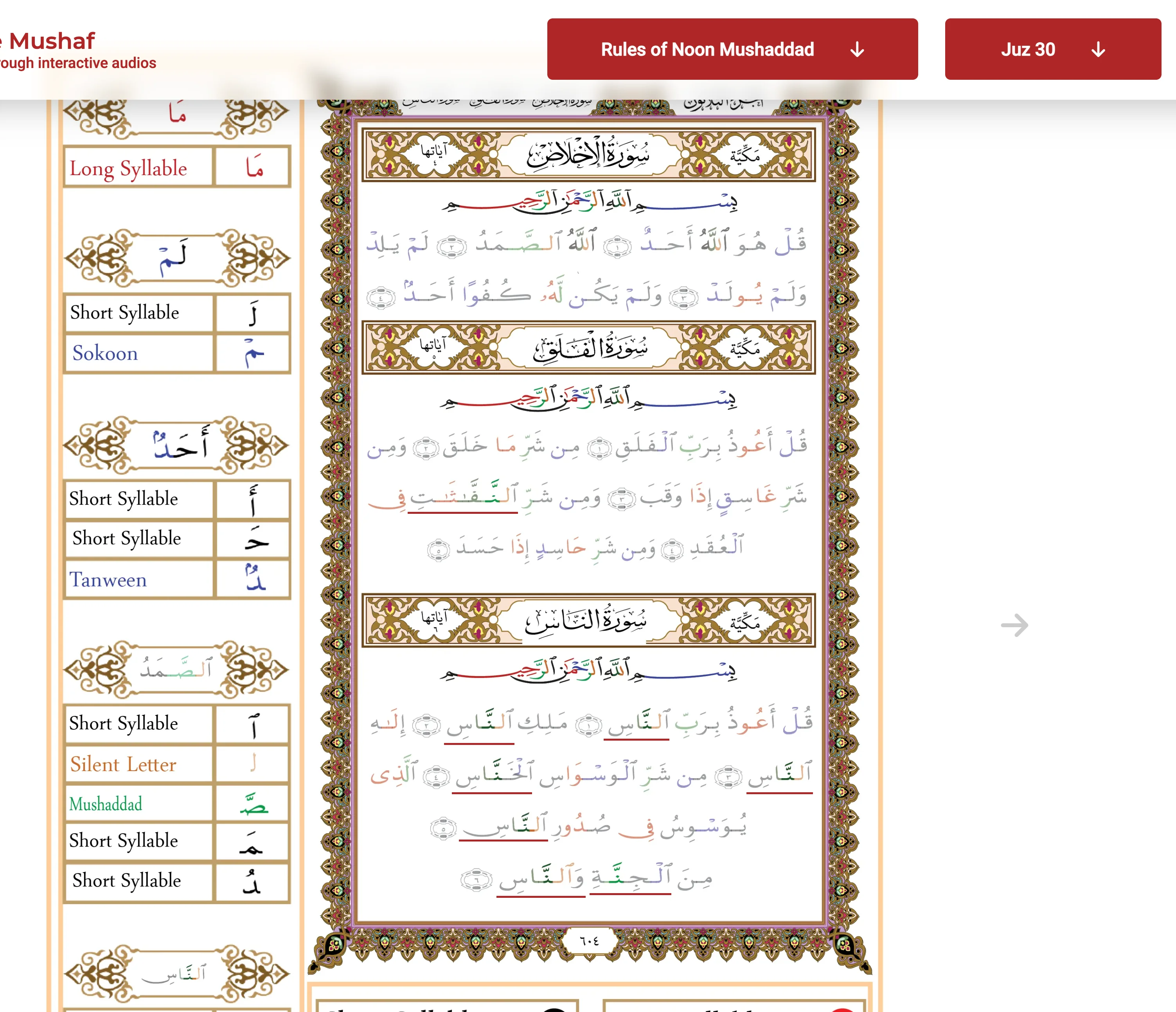
Drill page 1: three surahs every UK child recites daily in salah.
Noon Mushaddadah examples on this page:
ٱلنَّفَّـٰثَـٰتِ (Al-Falaq 113:4) — Noon mushaddad inside the word
ٱلنَّاسِ (An-Nas 114:1–6, repeats across the opening) — Noon mushaddad as part of the defined noun “al-Naas”
Notice the Mushaf also underlines ٱلصَّمَدُ (Ikhlas 112:2). That is Saad mushaddad, not Noon. It is mushaddad — but there is no Ghunnah. This is the first contrast every student has to feel: all mushaddad letters are doubled, but only Noon and Meem get the two-count nasal hum.
Drill Page 2 — Quraysh, Al-Ma’un, Al-Kawthar
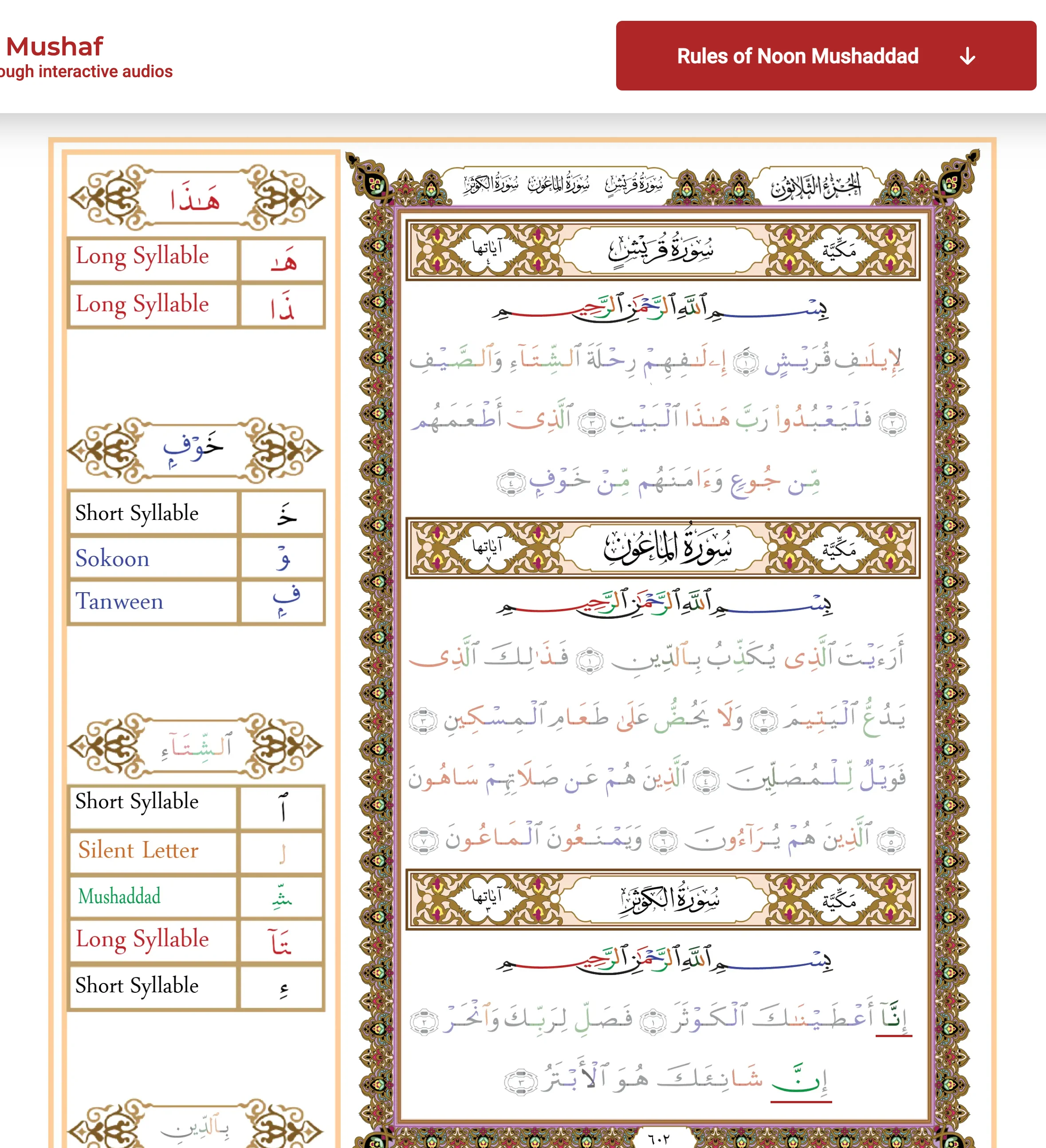
Drill page 2: short daily-salah surahs featuring Al-Kawthar’s opening Noon.
Noon Mushaddadah examples:
إِنَّا (Al-Kawthar 108:1) — the opening of the shortest surah in the Qur’an starts with a Noon mushaddadah. Every UK child learning this surah must apply the rule from the very first breath.
إِنَّ (Al-Kawthar 108:3) — “إِنَّ شَانِئَكَ”, Noon mushaddad, two counts
This page also shows ٱلشِّتَآءِ (Quraysh 106:2) — Sheen mushaddad, no Ghunnah. Another contrast to feel.
Drill Page 3 — Al-Qari’ah, At-Takathur
Drill page 3: the most important page for the stopping rule.
Noon Mushaddadah examples:
ٱلنَّاسُ (Al-Qari’ah 101:4)
لَتَرَوُنَّ (At-Takathur 102:6) — Noon mushaddad at the end of the word — this is where the stopping rule applies
لَتُسْـَٔلُنَّ (At-Takathur 102:8) — same pattern: terminal Noon mushaddad, full Ghunnah even at the stop
ٱلنَّعِيمِ (At-Takathur 102:8)
The Mushaf also marks كَلَّا (At-Takathur 102:3–5) with the label Mushaddad+Long Vowel. That is Laam mushaddad followed by a long alif — strengthened, but no nasal Ghunna. Another important contrast.
Drill Page 4 — Az-Zalzalah, Al-‘Adiyat
Drill page 4: three Noons in a single ayah cluster — stamina practice.
Noon Mushaddadah examples:
بِأَنَّ (Az-Zalzalah 99:5)
إِنَّ (Al-‘Adiyat 100:6)
وَإِنَّهُۥ (Al-‘Adiyat 100:7)
وَإِنَّهُۥ (Al-‘Adiyat 100:8) — three Noon mushaddadahs in three consecutive ayat, all requiring the full two-count Ghunnah
Al-‘Adiyat 100:6–8 is the stamina test. Three Ghunnahs in quick succession. If your child rushes any of them to two short beats, it will be audible. Eaalim teachers ask students to tap through all three on one knee during the first month of lessons.
Part B — Meem Mushaddadah Drill (4 Pages from Juz ‘Amma)
Same drill format, same Mushaf, different letter. The red-underlined mushaddad letter on these pages is specifically Meem.
Drill Page 5 — An-Nasr, Al-Masad
Drill page 5: two kinds of Meem mushaddadah in Al-Masad.
Meem Mushaddadah examples:
حَمَّالَةَ (Al-Masad 111:4) — Meem mushaddad inside a single word. The purest form of the rule.
مِّن مَّسَدٍ (Al-Masad 111:5) — Meem mushaddad at the start of the second word. This is the result of Idghaam Mithlayn (see below): the tanween-Noon at the end of “حَبْلٌ” and the Meem at the start of “مِّن” would be a separate Iqlaab rule, but the Meem at the start of “مَّسَدٍ” is already written mushaddad because of the shaddah mark.
Drill Page 6 — Quraysh, Al-Ma’un
Drill page 6: Quraysh’s two gems — and the pedagogical gold.
Meem Mushaddadah examples:
أَطْعَمَهُم مِّن (Quraysh 106:4)
وَءَامَنَهُم مِّن (Quraysh 106:4) — same pattern
Pedagogical gold: both of these Meem mushaddadahs are created, not written. The original text is Meem saakin (the final Meem of “أطعمَهُمْ”) followed by Meem with kasrah (“مِن”). When two identical letters meet and the first is saakin, classical Tajweed merges them into one mushaddad letter — this rule is called Idghaam Mithlayn (or in the Meem case, Idghaam Shafawi). The result is a Meem mushaddadah — and that means the two-count Ghunnah rule now applies.
This is the bridge between foundational Ghunnah and the advanced Meem Saakin cluster. Once a student understands this, they realise that Ikhfa Shafawi, Izhar Shafawi, and Idghaam Shafawi all exist because of what happens around the Meem. Ghunnah of Noon and Meem Mushaddadah is the root sound they all point back to.
Drill Page 7 — Al-Qari’ah, At-Takathur
Drill page 7: three thummas in At-Takathur.
Meem Mushaddadah examples:
فَأَمَّا (Al-Qari’ah 101:6)
وَأَمَّا (Al-Qari’ah 101:8)
فَأُمُّهُۥ (Al-Qari’ah 101:9) — “his mother”, Meem mushaddad inside the word
ثُمَّ (At-Takathur 102:4) — the Eaalim definition example, in its native surah
ثُمَّ (At-Takathur 102:6)
ثُمَّ (At-Takathur 102:8)
Three thummas in a six-ayah surah. That is intentional Qur’anic repetition. For the UK student it is the best drill available: one short surah that forces the Ghunnah three times on the same word.
Drill Page 8 — Al-Layl
Drill page 8: Al-Layl’s conditional pairs.
Meem Mushaddadah examples:
فَأَمَّا (Al-Layl 92:5) — “As for the one who gives…”
وَأَمَّا (Al-Layl 92:8) — “As for the one who withholds…”
The classical amma / wa-amma conditional structure is the Qur’an’s way of presenting a pair: one path and its opposite. Notice the rhythm: the Ghunnah on each “أَمَّا” signals the start of a clause. British children who internalise this pattern begin to hear the meaning move through the sound.
Why Only Noon and Meem Trigger Ghunnah
This is the question every UK student asks once they spot the red underlines on other letters. The Eaalim Mushaf underlines every mushaddad letter, so why does only Noon and Meem get the nasal Ghunnah?
The classical answer: Noon and Meem are the two letters in Arabic whose sound naturally passes through the nose. Every other consonant produces its sound primarily in the mouth. You double a mouth sound. When you double a Noon or a Meem, you double a nasal sound — and doubling a nasal sound produces a prolonged nasal resonance that the ear cannot miss.
The Tajweed rule is not adding an artificial nasal hum. It is giving the natural nasality of these two letters its full time. Two counts. Enough for the listener to hear that the letter is doubled, and enough for the reciter to feel it.
Common UK Mistakes on Noon and Meem Mushaddadah
One-count Ghunnah. The most common mistake. The child touches the nasal sound but releases it after one beat. The correction: clap or finger-tap twice while holding the letter. Most Eaalim UK lessons spend the first three weeks on this one fix.
Cutting the Ghunnah at the stop. When a recitation ends on a word like لَتَرَوُنَّ or ثُمَّ, many British children shorten the final Ghunnah. The Eaalim rule card explicitly flags this — full two counts even at the end of a word.
Confusing “mushaddad” with “Ghunnah”. Because the Mushaf underlines all mushaddad letters in red, students sometimes apply the nasal hum to letters like Saad and Sheen. The rule is clear: all mushaddad letters are doubled, only Noon and Meem get the nasal two-count.
Rushing through repeated Ghunnahs. Al-‘Adiyat 100:6–8 has three consecutive Noon mushaddadahs. At-Takathur has three thummas. British children reciting in a hurry during Tarawih or home revision blur these into a single fast hum. Each one needs its own two counts.
Applying Ghunnah to Meem followed by Baa. A Meem saakin followed by a Baa triggers a separate rule called Ikhfa Shafawi, not Meem Mushaddadah. The sound is similar but the count and lip position are different. See our guide on Ikhfa Shafawi for the full contrast.
How This Rule Fits into a British Child’s Tajweed Journey
Eaalim sequences Tajweed for UK students in this order:
Letter recognition + harakaat (first 2–3 months). The child learns to read.
Madd rules, the different kinds of Madd.
The rule of Tanween.
The rule of Sukoon.
Laam Shamsia and Laam Qamaria.
Arabic words containing Shaddah.
Hamzatul Wasl and Al-Qat'.
Noon and Meem Mushaddadah — this rule. The first sound rule. Because it is short, audible, and used in every daily-salah surah, it becomes the child’s first taste of Tajweed as something they can actually hear themselves doing.
Rules of Meem Saakin — Ikhfa Shafawi, Idghaam Shafawi, Izhar Shafawi. All three build on the Ghunnah sound the child has already learned in this rule.
Rules of Noon Saakin and Tanween — Izhar Halqi, Ikhfa Haqiqi, Idghaam, and Iqlaab. By the time a student reaches these, they have already been holding two-count Ghunnahs for months — so the new rules are just variations on a sound they can already make.
.
A Weekly UK Routine for This Rule
Eaalim recommends a four-week cycle for Noon and Meem Mushaddadah when introducing it to a UK child aged 7–15.
Week 1 — two 30-minute online lessons + two 10-minute home drills. Focus: recognising Noon mushaddadah on drill pages 1–4. Surah An-Nas and Al-Kawthar daily in Fajr or Isha.
Week 2 — same cadence. Focus: Meem mushaddadah on drill pages 5–8. Surah Al-Masad and Al-Qari’ah daily.
Week 3 — Drilling words with Meem and Noon with Shaddah..
Week 4 — The rules of Noon Sakin and Tanween.
All lessons run in UK time (GMT / BST). Saturday morning slots are popular because many British families prefer to keep weekday evenings for homework. Fees are typically £15–£25 per 30-minute private online session depending on the teacher’s qualification level — and all Eaalim teachers are Al-Azhar qualified with Ijazah chains in recitation.
Why Eaalim for online Quran classes in the UK
Three things that matter for a British parent choosing an online Quran academy:
Al-Azhar qualification. Every Eaalim Tajweed teacher holds a certified Ijazah in Qur’anic recitation through an unbroken chain of scholars. This is not a marketing claim — it is a verifiable sanad.
Flexible UK scheduling. Lessons in GMT / BST, fits around British school terms, Ramadan timing, and summer holidays.
Eaalim Online Mushaf + Aalim Book. Our own colour-coded Mushaf and 6-colour reading textbook — the same resources used in this article’s drill pages — are included in every online lesson at no extra cost.
If your child is starting their Tajweed journey, Noon and Meem Mushaddadah is the door. Book a free trial lesson and a UK-timed Eaalim teacher will assess your child’s current Ghunnah and show you exactly where to start.
Related Guides
Online Quran Classes in the UK: The Honest Parent’s Guide — the UK pillar
Learn Quran Online UK: Izhar Shafawi — the next rule in the Meem Saakin cluster
Learn Quran Online UK: Idghaam Shafawi
Izhar Halqi: The Practical Tajweed Guide
Ikhfa Haqiqi: The Complete Guide
Idghaam in Tajweed
The Aalim Book — 6-Colour Quran Reading System
Start your journey with Eaalim today!
Start 2 Free Trials


 Share
Frequently Asked Questions
Whenever a Noon (ن) or Meem (م) carries a Shaddah (ّ), you must recite it with a full Ghunnah — a nasal hum — held for two counts. The rule is identical for both letters and is classically taught as one rule with two applications. It is the foundational Ghunnah rule in Tajweed, and every other nasal rule (Ikhfa, Idghaam, Iqlaab, Ikhfa Shafawi, Idghaam Shafawi) derives its sound from it.
Ghunnah (غُنّة) is a nasal resonance. It is the sound produced when air passes through the nasal cavity while the oral passage is partially closed. If you pinch your nostrils while saying “innna” or “thumma,” the sound changes or disappears — that is proof the resonance is nasal. Tajweed requires that resonance to be held for exactly two counts on any mushaddad Noon or Meem.
A count (harakah) is roughly the time it takes to open or close one finger at a steady recitation pace. Two counts equals two finger-taps at calm speed — not fast, not dragged. UK children learn this best by tapping their knee twice while holding the nasal sound. Eaalim teachers use this tapping method in every introductory online lesson because it converts an abstract timing into a physical feedback loop the child can hear and feel.
Noon and Meem are the two Arabic letters whose natural sound passes through the nose. Every other consonant produces its sound primarily in the mouth. When you double a Saad or a Sheen with shaddah, you double a mouth sound. When you double a Noon or a Meem, you double a nasal sound — and doubling a nasal sound produces a prolonged nasal resonance. The two-count rule simply gives that natural nasality its full required time.
Noon Mushaddadah is a Noon with a shaddah — a doubled, strengthened Noon that always takes a two-count Ghunnah. Noon Saakin is a Noon with a sukoon — a single silent Noon whose pronunciation depends on the letter that follows it (producing Izhar, Idghaam, Iqlaab, or Ikhfa). Noon Mushaddadah is the simpler foundational rule; the four Noon Saakin rules are built on top of the Ghunnah sound learned here.
Yes — and this is one of the most common corrections UK students need. The Eaalim Online Mushaf rule card explicitly states: “In case you stop on Noon or Meem Mushaddad at the end of a word, you must recite it with a full Ghunnah for two counts.” Words like لَتَرَوُنَّ (At-Takathur 102:6) and ثُمَّ (passim) require the full two-count hold even at a pause.
They are closely connected. Idghaam Mithlayn (or Idghaam Shafawi when the letter is Meem) is the rule that merges a saakin Meem with a following Meem to produce one mushaddad Meem. The result of that merger is a Meem Mushaddadah — and that means the two-count Ghunnah rule immediately applies. Quraysh 106:4 (أَطْعَمَهُم مِّن) is the classic example: the written mushaddad Meem is the outcome of the merger, and it carries the full Ghunnah.
Surah Al-Kawthar is the single best starter. At three ayat it is memorised in a day, and its opening word — إِنَّا — is a Noon Mushaddadah that the child hears at the very first breath. After Al-Kawthar, introduce Surah At-Takathur for its three ثُمَّ repetitions (Meem Mushaddadah) and Al-‘Adiyat 100:6–8 for the three consecutive Noon Mushaddadahs. These three short surahs together cover every pattern in the rule.
Roughly four weeks with two 30-minute online lessons per week plus short daily home drills. Week 1 covers Noon Mushaddadah recognition, Week 2 covers Meem Mushaddadah, Week 3 combines both and introduces the contrast with non-Ghunnah mushaddad letters (Saad, Sheen, Laam, Raa), and Week 4 drills the stopping rule on terminal Noons and Meems. This is the standard Eaalim UK sequence and matches the Al-Azhar teaching order.
Yes. Every Eaalim online Quran class teaches Noon and Meem Mushaddadah as the first sound rule after letter recognition. Lessons run in GMT / BST to fit British school terms and weekends, teachers are Al-Azhar qualified with Ijazah chains in Qur’anic recitation, and the Eaalim Online Mushaf — the same resource used for the eight drill pages in this guide — is included in every lesson. Private online sessions typically run £15–£25 for 30 minutes depending on teacher level, with free trial lessons available for new UK families.
