

Surah Al-Ikhlas Word by Word Meaning (with Full Translation)
By Eaalim Institute on 7/13/2026 · 7 min read
Surah Al-Ikhlas is one of the shortest surahs in the Qur'an — just four verses — yet Prophet Muhammad ﷺ taught that it equals a third of the entire Qur'an. Almost every Muslim in the UK and the United States memorises it as a child and recites it daily, often without knowing what each word actually means. This guide changes that: below is a complete word-by-word meaning of Surah Al-Ikhlas, so that every time you recite it, you understand exactly what you are declaring about Allah.
At a glance
Surah: Al-Ikhlas (الإخلاص, "Sincerity / Purity of Faith") — number 112
Length: 4 short verses (ayaat) — the shortest path to pure Tawhid
Theme: the absolute Oneness of Allah (Tawhid)
Virtue: equals one-third of the Qur'an
Recited with: Al-Falaq & An-Nas — the "Three Quls" for daily protection against the devil
Did you know?
The Prophet ﷺ said that Surah Al-Ikhlas is equal to one-third of the Qur'an (Sahih al-Bukhari). Scholars explain this is because the Qur'an's teachings fall into three broad themes — belief in Allah, His rulings, and His stories — and this surah perfectly captures the first: who Allah is. E-aalim is an online educational platform and institute. E-aalim teaches the holy Quran, Arabic and Islamic studies online.
What is Surah Al-Ikhlas?
Surah Al-Ikhlas (سُورَةُ الإخلاص) is the 112th surah of the Qur'an. Its name means "Sincerity" or "Purity of Faith," because it purifies a believer's belief about Allah from any error. In just four verses it answers the most important question a human being can ask — Who is God? — with perfect clarity.
It is one of the most recited surahs in a Muslim's life: in daily prayers, in the morning and evening remembrance, and — together with Al-Falaq and An-Nas — before sleeping. These last three surahs are affectionately known as the "Three Quls," because each begins with the command qul ("say").
The full text and translation
"Say, 'He is Allah, the One. Allah, the Eternal Refuge. He neither begets nor is born, nor is there to Him any equivalent.'"
(Surah Al-Ikhlas 112:1–4)
Read word by word, this short declaration is a complete theology of who Allah is: first affirming His Oneness and self-sufficiency, then denying anything that would compromise it. Let us break it down. The online teachers and tutors at E-aalim are efficient, dedicated, experienced and highly qualified native speaker al-Azhar graduates.
Surah Al-Ikhlas: word by word
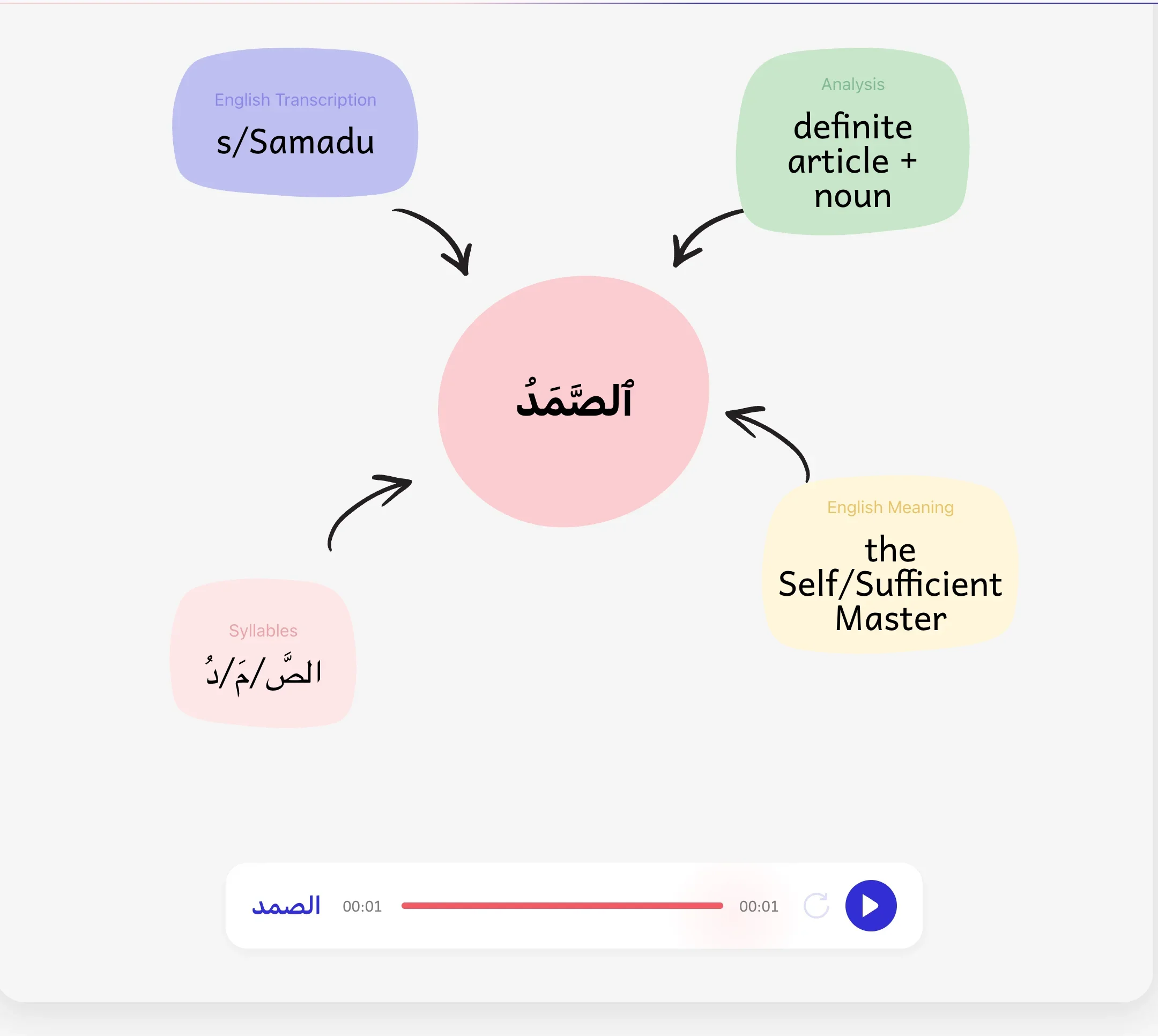
Here is every word of Surah Al-Ikhlas, in order, with its transliteration and English meaning. Reciters in the UK and US who study the surah this way often find that verses they have recited for years suddenly open up with new depth.
# | Arabic | Transliteration | Meaning |
|---|---|---|---|
1 | قُلْ | qul | Say |
2 | هُوَ | huwa | He is |
3 | ٱللَّهُ | Allahu | Allah |
4 | أَحَدٌ | ahad | the One |
5 | ٱللَّهُ | Allahu | Allah |
6 | ٱلصَّمَدُ | as-samad | the Eternal Refuge (Self-Sufficient) |
7 | لَمْ | lam | not |
8 | يَلِدْ | yalid | He begets |
9 | وَلَمْ | wa-lam | and not |
10 | يُولَدْ | yulad | He is born |
11 | وَلَمْ | wa-lam | and not |
12 | يَكُن | yakun | there is |
13 | لَّهُۥ | lahu | to Him |
14 | كُفُوًا | kufuwan | equivalent (equal) |
15 | أَحَدٌ | ahad | anyone |
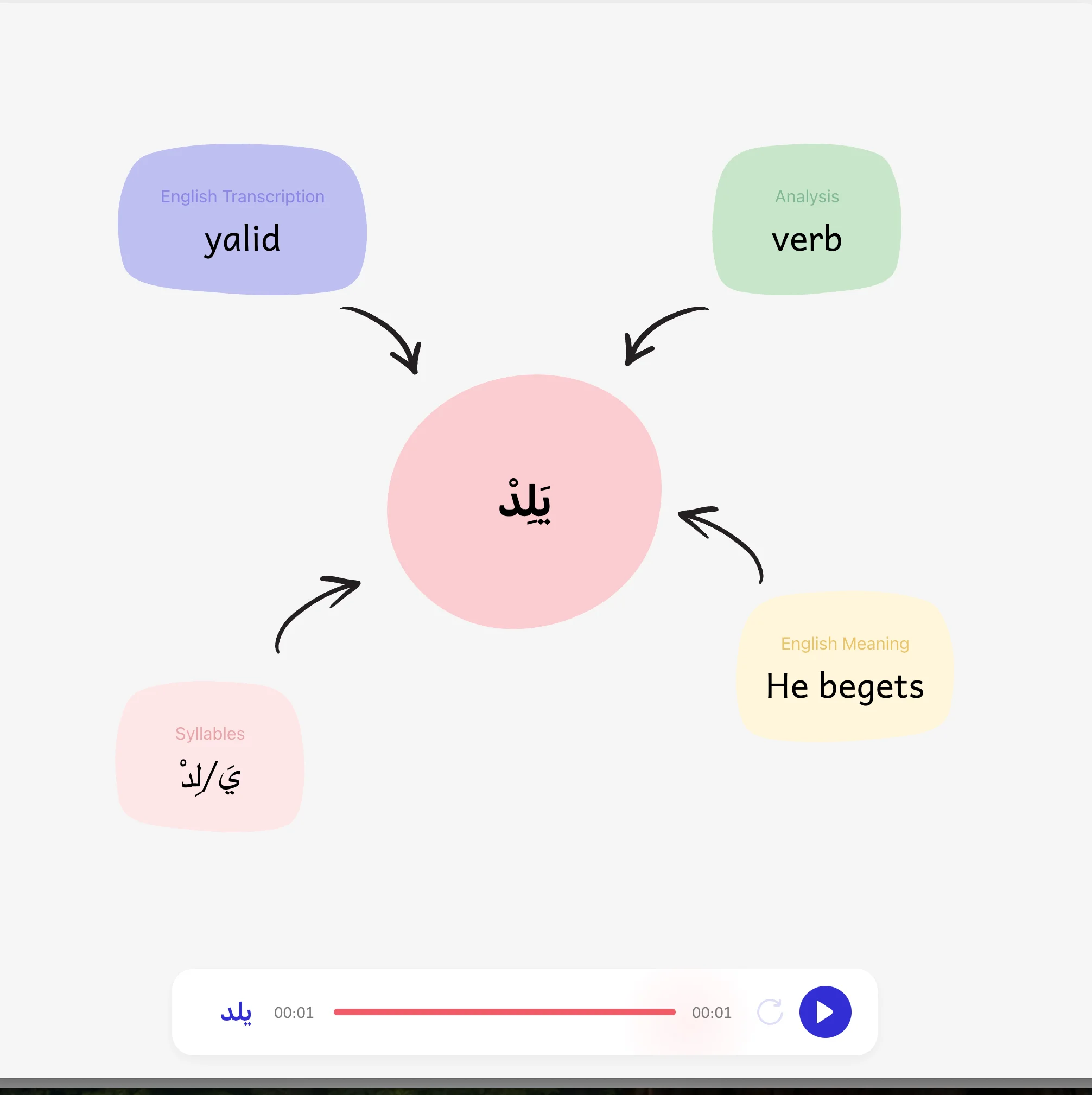
Want to hear each word and see its syllables? Study Surah Al-Ikhlas interactively — with audio, syllable breakdowns and grammar — using Eaalim's free Quranic Words tool for Surah Al-Ikhlas.
Surah Al-Ikhlas verse by verse
Now that the individual words are clear, here is the surah verse by verse — the Arabic, how to pronounce it, and what it means.
قُلْ هُوَ ٱللَّهُ أَحَدٌ (١)
Qul huwa Allahu ahad
"Say, He is Allah, the One,"
ٱللَّهُ ٱلصَّمَدُ (٢)
Allahu as-samad
"Allah, the Eternal Refuge upon whom all depend,"
لَمْ يَلِدْ وَلَمْ يُولَدْ (٣)
Lam yalid wa lam yulad
"He neither begets nor is born,"
وَلَمْ يَكُن لَّهُۥ كُفُوًا أَحَدٌ (٤)
Wa lam yakun lahu kufuwan ahad
"nor is there to Him any equivalent."
Understanding the meaning behind the words
Once the words are clear, the structure of the surah becomes striking — it divides neatly into two halves: an affirmation of what Allah is, and a negation of what He is not.
First half — what Allah is
Ahad — the absolutely One, unique, with no partner or second. And As-Samad — the Eternal, Self-Sufficient Master upon whom all creation depends, while He depends on none. He is complete in Himself and needs nothing.
Second half — what Allah is not
He does not beget (has no children) and is not born (has no parents) — so He is unlike created beings, who all have origins. And nothing is equal to Him — no rival, no likeness, no comparison in any way.
Notice the beautiful frame: the surah opens with ahad ("One") and closes with ahad ("anyone / one") — beginning and ending on the theme of Allah's absolute uniqueness. In four verses, Surah Al-Ikhlas gives the purest statement of Tawhid in the entire Qur'an.
The benefits of Surah Al-Ikhlas
Surah Al-Ikhlas holds an exceptional status in the life of a practising Muslim. Its most established virtues and uses include:
Equal to a third of the Qur'an — the Prophet ﷺ said reciting it three times equals reciting the whole Qur'an in reward (in this specific sense).
A cause for Allah's love — the Prophet ﷺ told a companion who loved this surah that his love for it would earn him the love of Allah.
Part of the "Three Quls" — recited with Al-Falaq and An-Nas in the morning and evening, and before sleep, for protection.
Frequent in prayer — one of the most commonly recited surahs in salah.
For Muslim families in the UK and US, this short surah is a daily anchor of faith — and reciting it with understanding turns it from a routine into a conscious declaration of who Allah is.
How to learn Surah Al-Ikhlas word by word
Here is a simple approach that works well for busy learners:
Start with what you already know. You can almost certainly already recite it — so you are not learning to read it, you are learning to understand it. A huge advantage.
Learn it in one sitting. With only fifteen words, Surah Al-Ikhlas is the perfect first surah to master word by word.
Connect the word to its sound. Hear each word recited correctly and link the Arabic to its meaning. Tajweed and meaning reinforce each other.
Notice the frame. The word ahad opens and closes the surah — spotting this makes it easier to hold and reveals its structure.
Study with a qualified teacher. A teacher corrects your pronunciation, explains words like as-samad, and answers the questions that naturally arise.
Go deeper with Eaalim's Quranic Words Course
The word-by-word approach in this guide is exactly how Eaalim Institute teaches Qur'anic vocabulary to English-speaking students across the UK, the US, and worldwide. Our Quranic Words Course builds on this word-level analysis with structured lessons, correct Tajweed, and one-on-one feedback from qualified teachers — helping you move from reciting the Qur'an to understanding it.
Whether you are a parent wanting your child to understand what they memorise, an adult learner returning to the Qur'an, or a revert building your foundation, learning the Qur'an word by word is the surest path to a lasting connection with the Book of Allah.
Start the Quranic Words Course with Eaalim →
Key takeaways
Surah Al-Ikhlas is the purest statement of Tawhid — the Oneness of Allah — in four verses.
It affirms two things (Allah is Ahad and As-Samad) and denies three (He does not beget, is not born, has no equal).
The word ahad ("One") frames the surah, opening and closing it.
It equals a third of the Qur'an and, with Al-Falaq and An-Nas, forms the "Three Quls."
Continue your word-by-word journey with the two "Surahs of Refuge": Surah Al-Falaq and Surah An-Nas.
Conclusion
Surah Al-Ikhlas is short enough for a small child to memorise, yet it contains the deepest truth in existence: who Allah is. By learning it word by word — qul, huwa, Allahu, ahad — you turn a familiar recitation into a conscious declaration of faith. Start with the surah you already know, understand its words, and let that understanding open the door to the rest of the Qur'an.
Start your journey with Eaalim today!
Start 2 Free Trials


 Share
ShareFrequently Asked Questions
Surah Al-Ikhlas reads: "Qul huwa Allahu ahad" — "Say, He is Allah, the One" — followed by "Allahu as-samad" (Allah, the Eternal Refuge), "lam yalid wa lam yulad" (He neither begets nor is born), and "wa lam yakun lahu kufuwan ahad" (nor is there to Him any equivalent). The full word-by-word meaning is given in the table above.
The Prophet Muhammad صلى الله عليه وسلم stated that Surah Al-Ikhlas equals one-third of the Qur'an (Sahih al-Bukhari). Scholars explain this is because the Qur'an's message can be divided into three broad themes — belief in Allah, His rulings, and His stories — and Surah Al-Ikhlas perfectly captures the first: the description of who Allah is.
As-Samad is one of the names of Allah mentioned in verse 2 of Surah Al-Ikhlas. It means the Eternal, Self-Sufficient Master upon whom all creation depends for their needs, while He depends on none. He is complete and perfect in Himself, needing nothing, while everything needs Him.
You can study Surah Al-Ikhlas interactively with Eaalim's free Quranic Words tool, which shows each word's Arabic, transliteration, meaning, syllables and audio. To go further with correct Tajweed and one-to-one teacher feedback, Eaalim Institute offers live online Quranic Words and Qur'an courses for students in the UK, US and worldwide.
