

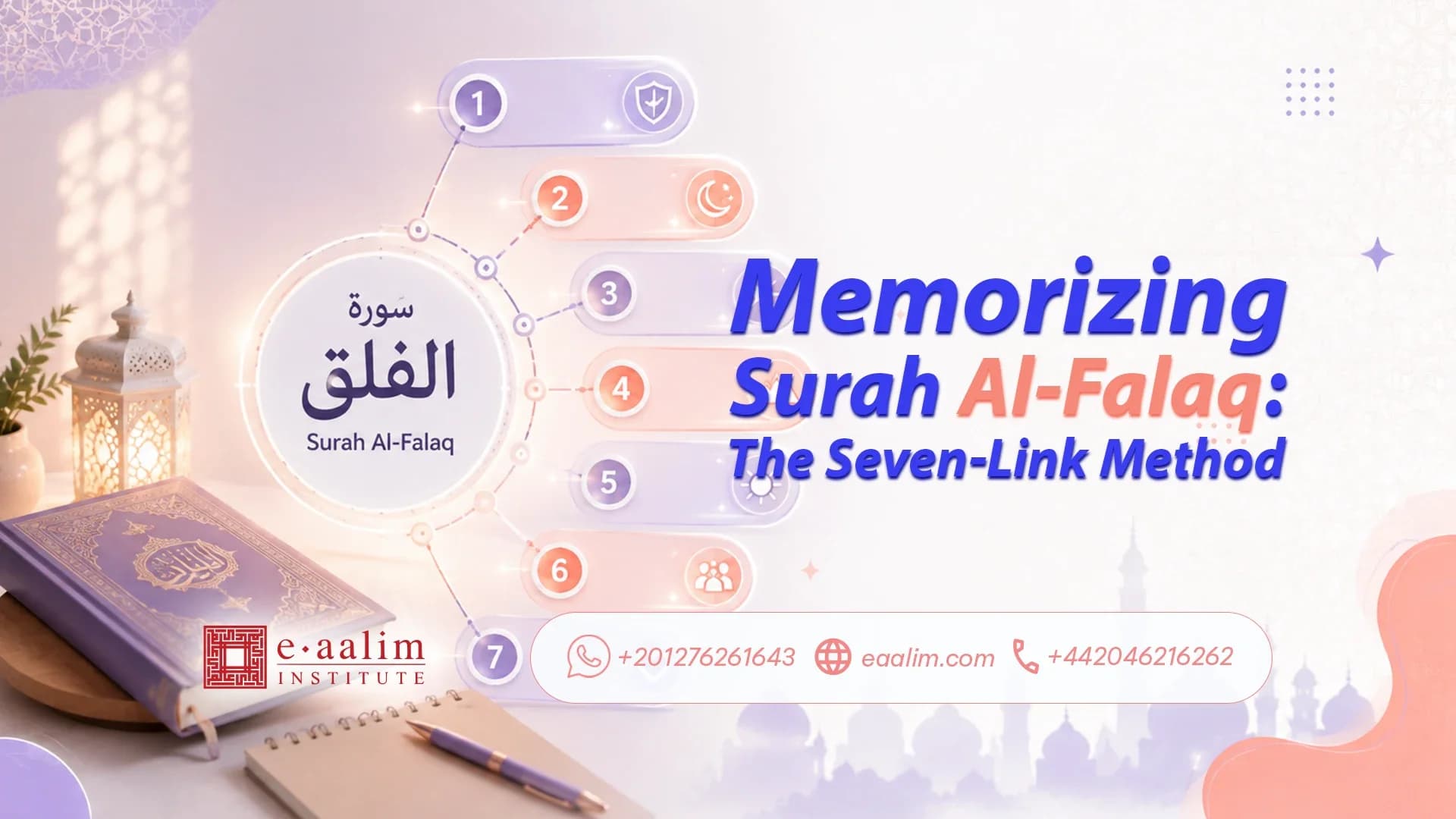
Memorizing Surah Al-Falaq: The Seven-Link Method
By Eaalim Institute on 6/3/2026 · 23 min read
Memorizing Surah Al-Falaq: The Seven-Link Method
Surah Al-Falaq and Surah An-Nas are paired together in the Islamic tradition as the Mu'awwidhatayn — the Two Refuge Surahs. They are recited together in the morning and in the evening adhkar, blown over in cupped hands and rubbed on the body before sleep. they are recommended by the Prophet ﷺ as one of the most powerful forms of protection available to the believer. They are also, for many learners, a source of confusion: the two surahs begin with the same phrase, share a similar structure, and are so closely associated that the mind easily blends their contents.
This article applies the Seven-Link Method to Surah Al-Falaq — the method introduced in the relevant article on Surah Al-Ikhlas — using verbal, phonetic, thematic, narrative, visual, numerical, and similar-verse links to fix each of the surah's five verses in memory with precision. The goal is not merely to memorise the words but to understand the structure of the surah well enough that confusing its verses, scrambling their order, or blending them with Surah An-Nas becomes structurally impossible.
For adult Muslim learners in the United Kingdom — people returning to Quranic study after years away, or converts building their Juz 'Amma memorisation from scratch — this kind of structured approach is far more durable than repetition alone. By the end of this article, you will have had seven distinct types of anchor for every verse of Surah Al-Falaq, a four-rule quick-recall summary, and a five-scene visual film that can be replayed whenever the verbal memory is uncertain.
Surah Al-Falaq & Surah Al-An-Nas (Quran.com)
The Text of the Surah
{Say, "I seek refuge with the Lord of the daybreak — from the evil of what He has created — and from the evil of darkness when it settles — and from the evil of those who wickedly blow onto knots — and from the evil of an envier when he envies."}
(Al-Falaq 113:1–5)
Five verses. A command to seek refuge. One general evil. Three specific evils. And a structure so clean that once understood, the surah essentially is memorised by itself. E-aalim is an online educational platform and institute. E-aalim teaches the holy Quran, Arabic and Islamic studies online.
The Seven Link Types: A Brief Recap
The Seven-Link Method uses seven categories of mental connection to build a multi-layered memory of a Quranic surah. Each category harps on a different dimension of human memory — verbal, auditory, conceptual, contextual, visual, numerical, and comparative — so that the text is held by multiple anchors simultaneously.
Verbal links (1) are formed by the repetition or derivation of specific words across verses. Phonetic links (2) are formed by sound — rhyme, rhythm, and the distinctive endings of verses. Thematic links (3) are formed by the logical or theological relationship between ideas. Narrative or contextual links (4) are formed by the story or occasion behind a verse. Visual links (5) are formed by mental imagery that encodes the verse's meaning spatially or scenically. Numerical links (6) are formed by counts, quantities, and structural numbers. Similar-verse links (7) are formed by noting features of a verse that are unique in the Qur'an, or by noting how easily confused verses can be distinguished.
In Surah Al-Falaq, the strongest links are the verbal column (the four-time repetition of "from the evil of") and the thematic structure (one general evil followed by three specific ones). Every other link type supports and reinforces these two primary anchors.
Overall Structure: The Golden Rule
Before examining the verses individually, the thematic structure of the surah needs to be internalised as the governing framework — the backbone that holds everything else in place.
Surah Al-Falaq has a simple but powerful structure:
Verse 1: The refuge formula — who you are seeking refuge with (the Lord of the daybreak).
Verse 2: General evil — the comprehensive umbrella covering all evil in creation ("the evil of what He has created").
Verses 3–5: Three specific evils — listed in sequence, from the most general of the three to the most specific: darkness / sorcery / envy.
The golden rule for this surah is: one general, then three specific. If you ever lose your place in the surah, this rule tells you exactly where you are. If you are in the general evil, you are in verse 2. If you are in one of the three specific evils, you are in verses 3, 4, or 5. The three specific evils have their own internal order (night darkness → sorcery → envy), which we will anchor with visual and verbal links below.
The Verbal Column: "From the Evil of" Four Times
The most prominent structural feature of Surah Al-Falaq is the repetition of the phrase min sharri — "from the evil of" — four times across verses 2 through 5. This repetition is the verbal column of the surah: the spine that holds the four evils in sequence and provides an auditory signal for each new verse.
There is one critical detail in this column that must be fixed precisely in memory:
Verse 2: min sharri ma khalaq — "from the evil of what He has created." No waw (no "and") before it.
Verse 3: wa min sharri ghasiqin — with waw.
Verse 4: wa min sharri'n-naffathati — with waw.
Verse 5: wa min sharri ḥasidin — with waw.
The rule is: the first "from the evil of" has no waw; the remaining three all have waw. This is a verbal link (1) because the presence or absence of the waw is an intrinsic feature of the text itself. Once this rule is fixed, you have a reliable signal: if you begin a "from the evil of" phrase with a waw, you know you are in verses 3, 4, or 5. If there is no waw, you are in verse 2. The four "from the evil of" phrases are your mile-markers through the surah.
Verse 1: "Say, I Seek Refuge with the Lord of the Daybreak"
Similar-verse link (7): The opening phrase of Surah Al-Falaq — qul a'udhu bi-Rabbi'l-falaq — is structurally identical to the opening of Surah An-Nas: qul a'udhu bi-Rabbi'n-nas. Both surahs begin with "Say, I seek refuge with the Lord of…" This similarity is the most significant source of potential confusion between the two surahs, and fixing the distinction here is the single most important similar-verse link in the entire Mu'awwidhatayn.
The distinction is this: Al-Falaq (the daybreak) is a single attribute. An-Nas (the people) is the first of three attributes that follow in succession — Lord of the people, King of the people, God of the people. When you hear "Lord of the daybreak," you know you are in Al-Falaq. When three attributes follow in sequence, you are in An-Nas. Falaq = one attribute; Nas = three attributes.
Phonetic link (2): The verse ends with al-falaq, establishing the "-q" (qaf) sound as the first verse-ending rhyme.
Thematic link (3): The one seeking refuge is identified with the source of refuge: the Lord of the daybreak (rabb al-falaq). The word falaq refers to the splitting of dawn from darkness — the moment when light breaks through and the night's threats recede. The protection being sought is from the One who creates the very light that dispels darkness. There is a thematic connection between the protection sought (from darkness, sorcery, and envy) and the protector invoked (the Lord who splits dawn from night).
Narrative link (4): The occasion of revelation recorded in many hadith collections is the incident of the sorcery performed against the Prophet ﷺ by Labid ibn al-A'sam. The Prophet ﷺ fell ill, and the two refuge surahs were revealed as a means of seeking Allah's protection and removing the harm. Reciting Al-Falaq as a protective act is not abstract: it is standing in the same position the Prophet ﷺ stood in, calling on the Lord of the daybreak for protection from exactly the kinds of evil named in the surah.
Transition to verse 2: Having established the refuge-seeker and the one sought — "I seek refuge with the Lord of the daybreak" — the surah now addresses what the refuge is sought from. The transition is the natural completion of the sentence: I seek refuge from what?
Verse 2: "From the Evil of What He Has Created"
Verbal link (1): The first min sharri — "from the evil of" — appears here, without the waw. This is the opening of the verbal column that will repeat four times through the surah. Fixing this as the first, no-waw instance is essential.
Phonetic link (2): The verse ends with khalaq — matching the "-laq" sound of al-falaq in verse 1. The first two verses share a rhyme (-laq), connecting them aurally and marking the transition from the refuge formula to the first evil.
Thematic link (3): This verse is the general evil — the comprehensive umbrella. "What He has created" (ma khalaq) means: everything in creation that contains potential evil. This is not a list; it is a blanket. Every specific evil named in the following verses is already covered by this verse. The specific evils (verses 3–5) are not additions to the protection — they are emphases within it, spotlighting three particular categories of harm that warrant specific mention.
Transition to verse 3: The general is stated. Now the three specific evils begin — each introduced by "and from the evil of" with a waw.
Verse 3: "And from the Evil of Darkness When It Settles"
Verbal link (1): The second min sharri — this time with waw. The first of the three specific evils begins here.
Visual link (5): The most powerful memory tool for this verse is visual. Imagine night falling — not a gentle evening, but a deep, thick darkness advancing and settling over everything, swallowing the light. The Arabic word ghasiq describes darkness in its most engulfing form, and idha waqab — "when it settles" — describes the moment of full enclosure, when the darkness has covered everything completely. Picture a black curtain being drawn slowly across a scene until all light is extinguished.
Thematic link (3): The first specific evil is the evil of night darkness — the cover under which many forms of harm operate. Sorcerers work by night; predators emerge by night; fears are intensified by night. The mention of night darkness as a specific evil to seek refuge from is not merely about physical darkness; it encompasses everything that flourishes when the light of day is removed.
Similar-verse link (7): The grammatical structure of this verse — ghasiqin idha waqab (darkness when it settles) — mirrors the structure of verse 5: hasidin idha hasad (an envier when he envies). Both use the pattern: noun + "when" + verb. This parallel structure is the single most frequent source of transposition in this surah. The rule for distinguishing them: waqab (settles, enters) belongs to ghasiq (darkness/night); hasad (envies) belongs to hasid (envier). Night settles; an envier envies. Each verb belongs to its noun.
Transition to verse 4: From the evil of night → to the evil of sorcery, which typically operates under cover of night.
Verse 4: "And from the Evil of Those Who Blow onto Knots"
Verbal link (1): The third min sharri — with waw. The second of the three specific evils.
Visual link (5): This verse produces one of the most vivid images in the surah. Close-up: hands tying knots in a length of cord, fingers working quickly in the dark. Then — a breath, a blow directed into each knot. Al-naffathāt fi'l-'uqad — "those who blow on knots" — is the Quranic image of sorcery: the tying of physical objects combined with the blowing of breath as an act of harmful magic. The image is sensory: you can visualise the hands, hear the breath, see the knot being tied. This sensory vividness makes the verse easy to retain.
Thematic link (3): The second specific evil is sorcery — the active human attempt to direct harm against another person through supernatural means. The word naffathat is the plural feminine form of an intensive root, suggesting people who blow repeatedly and forcefully — the act of sorcery performed with deliberate, sustained effort. The seeking of refuge from sorcery in this surah is directly connected to the occasion of revelation: the Prophet ﷺ sought Allah's protection from exactly this harm.
Phonetic link (2): The verse ends with al-'uqad — "the knots" — introducing the "-d" sound at the verse ending, transitioning the rhyme from the "-q" endings of verses 1–2 and the "-b" ending of verse 3 towards the "-d" ending that will close the surah in verse 5.
Transition to verse 5: From the evil of sorcery → to the evil of envy, which is the third and final specific evil and the one that closes the surah. The online teachers and tutors at E-aalim are dedicated, hardworking, efficient, experienced, highly qualified Arabic native speaker al-Azhar graduates.
Verse 5: "And from the Evil of an Envier When He Envies"
Verbal link (1): The fourth and final min sharri — with waw. The surah's verbal column is now complete. Additionally, this verse contains its own internal verbal link: hasidin idha hasad — "an envier when he envies" — uses two forms of the same root (-h-s-d): the active participle hasid (envier) and the verb hasad (envied). This paronomasia — a word and a verb from the same root placed next to each other — mirrors the structure of verse 3's ghāsiqin idhā waqab.
Phonetic link (2): The verse ends with hasad — matching the "-d" ending of al-'uqad in verse 4. The surah ends on a "-d" sound, echoing the shift introduced in the previous verse.
Similar-verse link (7): As noted in the analysis of verse 3, this verse shares the grammatical pattern noun + idhā + verb with verse 3. The distinction to fix: verse 3 is darkness that settles (waqab); verse 5 is an envier who envies (hasad). The motion in verse 3 is environmental — darkness moves over the landscape. The motion in verse 5 is personal — a human being acts from jealousy. Night → person.
Thematic link (3): The third specific evil is envy (hasad) — the desire for another's blessing to be removed, and the harm that can flow from that desire. The scholars of Islam have given considerable attention to the evil eye and envy as real causes of harm, grounded in multiple authenticated hadiths. The surah closes with this evil because envy is the most intimate of the three specific harms: darkness is a natural phenomenon, sorcery is an external act, but envy begins in the human heart and radiates outward.
Links That Span the Whole Surah
Verbal column (1): Min sharri — "from the evil of" — appears four times. First occurrence: no waw (verse 2). Remaining three: with waw (verses 3, 4, 5). The rule is fixed: count four, the first without and, the rest with and.
Numerical link (6): Five verses. One structure: one refuge formula + four evils. Or, at the level of the three specific evils: 1 (general) + 3 (specific) = 4 "from the evil of" phrases after the opening verse. The number five is fixed by counting the five phrases: "I seek refuge" (1) + four repetitions of "from the evil of" (2, 3, 4, 5).
Thematic method (3): The golden rule that governs the whole surah: one general evil then three specific evils. If you lose your place, ask: am I in the general evil (verse 2) or one of the specific three? If you are in the specific three, ask: which one — darkness (verse 3), sorcery (verse 4), or envy (verse 5)?
Visual sequence (5): The visual film runs in a clear progression: dawn splits darkness (1) → panorama of all creation (2) → darkness advancing and settling (3) → hands tying knots in the dark, breath blowing into them (4) → an envier's eye lighting up in the moment of envy (5). Notice the progression: from light (dawn, protection) to three advancing evils — night, sorcery operating in that night, and finally the most human evil of all, envy.
The Visual Film: Five Scenes
The core concept of the visual film is a single metaphor: you are taking refuge in a fortress of light — the dawn — and four evils are advancing towards it. The camera begins in light and moves through the approaching threats.
Scene 1 — Verse 1: Darkness. Then, suddenly, a crack of light splitting the black sky — the moment of dawn breaking through. You step into the fort of light on the side of this dawn-break and hold tight to the Lord who created it. The fortress gate opens toward the light.
Key image: A crack of dawn splitting darkness = the gate of the fortress opening.
Scene 2 — Verse 2: From inside the fortress, you look out through a wide window at a panoramic view — all of creation, stretching in every direction. People, animals, forces seen and unseen. This vast scene is the general evil: everything in creation that could cause harm. You are seeking protection from all of it at once.
Key image: A wide panorama of all creation = the comprehensive evil from which protection is sought.
Scene 3 — Verse 3: The camera begins to darken. From the edges of the panorama, night advances — thick, heavy darkness moving inward and settling over everything. The scene is gradually swallowed until only blackness remains. The darkness has entered and occupied the space.
Key image: Darkness advancing and settling over everything = the first specific evil.
Scene 4 — Verse 4: Close-up within the darkness: a pair of hands working quickly. Fingers tying knots in a length of thread. Then a face leans down and blows into each knot with deliberate force. The scene is intimate and purposeful — this is not random darkness but a directed, intended act of harm.
Key image: Hands tying knots; breath blown into them = the second specific evil (sorcery).
Scene 5 — Verse 5: The camera lifts from the knotted thread and finds a pair of eyes. They are fixed on someone else's blessing — a house, a success, a family — and they light up with the intensity of envy at the moment it crystallises. The gaze sharpens. This is the most human of the three evils: not a natural force and not a deliberate magical act but a feeling in a human heart that becomes an active harm.
Key image: Eyes lighting up with envy in the moment of envying = the third and final specific evil.
Overall visual movement: Dawn breaks → fortress gate opens (1) → panorama of all creation (2) → darkness sweeps in (3) → knots tied in the dark (4) → eyes glow with envy (5). Notice the progression from light to deeper and deeper forms of darkness: natural night → occult darkness → the darkness within the human heart. The online learners and students at E-aalim are kid, adult, male and female Arabic non-native speaker Muslims living mainly in Europe and the USA.
Distinguishing Al-Falaq from An-Nas
The most common memorisation error in Juz 'Amma is the blending of Al-Falaq and An-Nas. Since both surahs are the Mu'awwidhatayn — the Two Refuge Surahs — they are always used together and their opening phrase is identical. Fixing the distinctions clearly is essential for accurate recitation in prayer.
Here is the complete comparison:
Al-Falaq:
One attribute of the Lord: the daybreak (al-falaq)
Five verses
"From the evil of" appears four times (one general + three specific)
The evils are external: natural darkness, sorcery, envy
Visual theme: outdoor, environmental threats approaching from outside
An-Nas:
Three attributes of the Lord: Lord of people / King of people / God of people
Six verses
One central evil: the whisperer (al-waswās) who whispers in the chests of people
The evil is internal: it is whispered from within, hidden in the heart
Visual theme: something invisible that enters and whispers inside the self
The single most useful rule for distinguishing them: Al-Falaq = one attribute + external evils; An-Nas = three attributes + internal evil. The moment you identify whether the Lord is described by one attribute or three, you know which surah you are in. And the moment you identify whether the evils are outside you (night, sorcery, envy) or inside you (the whisper in the chest), you confirm which surah you are reciting.
Practical Memorisation Summary for UK Learners
Here is the complete quick-recall toolkit for Surah Al-Falaq:
The opening: "Lord of the daybreak" — one attribute, not three. You are in Al-Falaq, not An-Nas.
The verbal column: Count four "from the evil of" phrases. The first has no wāw; the remaining three have wāw. Count them as you recite.
The structure: One general evil (what He has created) → three specific evils (darkness / sorcery / envy). Golden rule: one general, then three specific.
The three specific evils in order: Night darkness (natural) → those who blow on knots (sorcery, deliberate) → an envier (human, internal). The order moves from the most impersonal to the most personal.
The similar-verse trap: Both verse 3 and verse 5 use the pattern noun + idhā + verb. Fix the pairs: ghāsiq / waqab (darkness / settles) and ḥāsid / ḥasad (envier / envies). They do not swap.
The visual film: Dawn breaks (1) → panorama of creation (2) → darkness settles (3) → knots blown (4) → eyes of envy (5). Run it twice before sleeping and twice after Fajr.
Deepen Your Hifz with Eaalim's Qur'an Memorisation Course
The Two Refuge Surahs — Al-Falaq and An-Nas — are two of the most recited surahs in the Muslim's daily life. After the Fatiha and Al-Ikhlas, they are the surahs most commonly used in salah. Knowing them accurately, knowing how to distinguish them, and knowing how to correct yourself in prayer when your recitation slips — this is practical knowledge that affects the quality of every prayer you perform.
For Muslims in the United Kingdom building their memorisation of Juz 'Amma — or returning to Quranic study after years without systematic guidance — Eaalim Institute's Hifz Course provides one-to-one, live online sessions with qualified scholars who guide each student through the Qur'an at their own pace. The course covers memorisation technique, revision structures, and the recitation standards that ensure accuracy over time.
Whether you are beginning with the final Juz or continuing a memorisation that has stalled, the Hifz Course meets you where you are. E-aalim have their own online courses of Islamic studies. Among their online Islamic studies courses, E-aalim courses include Quran Tafseer and Tajweed. Join the E-aalim online courses for Quran Tafseer and Tajweed and learn how to read the Holy Quran in exactly the same way prophet Mohammad recited it when it was revealed to him.
Enrol in Eaalim's Hifz Course →
Frequently Asked Questions
What does al-falaq mean?
Al-falaq means the daybreak — specifically the splitting of the sky at dawn, when light breaks through the darkness. The word comes from the root f-l-q, meaning to split or crack open. The scholars of Arabic describe it as the moment of dawn's first appearance, when the night is literally split open by the incoming light. This is the attribute of Allah invoked in the surah's opening: the Lord who splits dawn from darkness is also the Lord who splits the seeker of refuge from the evils that seek to harm them.
Who or what are "those who blow on knots"?
Al-naffāthāt fi'l-'uqad — "those who blow on knots" — is the Quranic description of sorcery. The image is of a person tying knots in a thread or cord and then blowing into each knot as part of a magical act intended to harm another. The connection between this verse and the occasion of revelation (the sorcery performed against the Prophet ﷺ using knotted threads) is well attested in the books of hadith and seerah. The blowing in this context is the act of directing harmful intent through breath — the opposite of the Prophetic Sunnah of blowing over the body with the two refuge surahs as a form of healing and protection.
Is seeking refuge from envy (hasad) the same as believing in the evil eye?
The Islamic tradition treats envy (ḥasad) and the evil eye ('ayn) as related but distinct phenomena. Ḥasad is the desire for another's blessing to be removed, and the harm that can flow from this desire in ways that include but are not limited to the evil eye. The Prophet ﷺ explicitly confirmed the reality of the evil eye in multiple authenticated hadiths (Sahih Bukhari 5740, Sahih Muslim 2187). Seeking refuge from the envier in this surah is therefore not merely psychological but a recognition of a real harm that the Prophetic tradition takes seriously.
How should I use the Mu'awwidhatayn in daily life?
The Prophet ﷺ described several contexts for reciting Al-Falaq and An-Nas: reciting them three times each in the morning and evening (Abu Dawood 5082), blowing them over the body before sleep (Sahih Bukhari 5017), reciting them after each obligatory prayer (Abu Dawood 1523, authenticated by Al-Albani), and using them specifically for healing — blowing into the cupped hands and passing them over the body. The Prophet ﷺ himself used these surahs in this way when he was ill (Sahih Bukhari 5735). For a UK Muslim building a daily adhkar practice, the morning and evening recitation of the Mu'awwidhatayn is among the most strongly attested and practically manageable Sunnahs to establish.
Conclusion
Surah Al-Falaq is five verses of extraordinary concentration: a refuge formula, one comprehensive shield against all created evil, and three precisely chosen specific evils — night's darkness, the work of sorcerers, and the harm of the envier — arranged in order from the most impersonal to the most human. The surah does not merely list threats; it builds a case for why the protection of the Lord of the daybreak is needed, and why seeking that protection is the correct and complete response to each of these threats.
The Seven-Link Method gives the UK learner the tools to hold all five verses with precision: the verbal column of four "from the evil of" phrases (first without wāw, remaining three with wāw); the thematic golden rule (one general + three specific); the visual film that runs from dawn's light through three forms of deepening darkness; and the similar-verse distinctions that prevent Al-Falaq and An-Nas from blending into each other.
Memorise the surah. Understand its architecture. And recite it every morning and evening, as the Prophet ﷺ taught — from the evil of what He has created, from the darkness when it settles, from those who blow on knots, and from the envier when he envies.
Start your journey with Eaalim today!
Start 2 Free Trials


 Share
ShareFrequently Asked Questions
Al-falaq means the daybreak — specifically the splitting of the sky at dawn, when light breaks through the darkness. The word comes from the root f-l-q , meaning to split or crack open. The scholars of Arabic describe it as the moment of dawn's first appearance, when the night is literally split open by the incoming light. This is the attribute of Allah invoked in the surah's opening: the Lord who splits dawn from darkness is also the Lord who splits the seeker of refuge from the evils that seek to harm them.
Al-naffāthāt fi'l-'uqad — "those who blow on knots" — is the Quranic description of sorcery. The image is of a person tying knots in a thread or cord and then blowing into each knot as part of a magical act intended to harm another. The connection between this verse and the occasion of revelation (the sorcery performed against the Prophet ﷺ using knotted threads) is well attested in the books of hadith and seerah. The blowing in this context is the act of directing harmful intent through breath — the opposite of the Prophetic Sunnah of blowing over the body with the two refuge surahs as a form of healing and protection.
The Islamic tradition treats envy ( ḥasad ) and the evil eye ( 'ayn ) as related but distinct phenomena. Ḥasad is the desire for another's blessing to be removed, and the harm that can flow from this desire in ways that include but are not limited to the evil eye. The Prophet ﷺ explicitly confirmed the reality of the evil eye in multiple authenticated hadiths (Sahih Bukhari 5740, Sahih Muslim 2187). Seeking refuge from the envier in this surah is therefore not merely psychological but a recognition of a real harm that the Prophetic tradition takes seriously.
The Prophet ﷺ described several contexts for reciting Al-Falaq and An-Nas: reciting them three times each in the morning and evening (Abu Dawood 5082), blowing them over the body before sleep (Sahih Bukhari 5017), reciting them after each obligatory prayer (Abu Dawood 1523, authenticated by Al-Albani), and using them specifically for healing — blowing into the cupped hands and passing them over the body. The Prophet ﷺ himself used these surahs in this way when he was ill (Sahih Bukhari 5735). For a UK Muslim building a daily adhkar practice, the morning and evening recitation of the Mu'awwidhatayn is among the most strongly attested and practically manageable Sunnahs to establish.
