

Surah Al-Masad Word by Word Meaning (with Full Translation)
By Eaalim Institute on 7/28/2026 · 10 min read
Surah Al-Masad is one of the shortest chapters in the Qur'an — five short verses, twenty-three words in total — and it is the one surah that most Muslim children in the UK and the United States memorise without ever being told what it actually says. It is also the most unusual chapter in the Book: the only surah that names a specific opponent of the Prophet Muhammad ﷺ and announces his fate while he was still alive to hear it. This guide gives you the complete word-by-word meaning of Surah Al-Masad — every Arabic word, its transliteration and exactly what it means — so that a familiar recitation becomes a passage you genuinely understand.
At a glance
Surah: Al-Masad (المسد, "The Palm Fibre") — number 111
Also called: Surah Al-Lahab, or simply Tabbat, after its opening word
Length: 5 verses (ayaat) — 23 words in total
Revealed: Makkah (Makki), during the first years of open preaching
Theme: wealth, status and lineage cannot save a person who rejects the truth
Did you know?
Surah Al-Masad is the only place in the entire Qur'an where an opponent of the Prophet ﷺ is condemned by name while still living. Abu Lahab went on to live for years after these verses were revealed, and he could have cast doubt on them at any moment simply by professing Islam outwardly. He never did — and scholars have long pointed to that as a remarkable feature of this short surah.
What is Surah Al-Masad?
Surah Al-Masad (سُورَةُ المسد) is the 111th surah of the Qur'an. Its name comes from the very last word of the very last verse — masad, the twisted fibre of a palm tree, which in Arabia was used to make coarse, cheap rope. The surah is also widely known as Surah Al-Lahab and, in many classrooms across Britain and America, simply as Tabbat.
It was revealed in Makkah, in the period when the Prophet ﷺ had just been commanded to preach openly to his own tribe. Its five verses address one man — Abu Lahab, the Prophet's own paternal uncle — together with his wife. And they establish a principle that runs through the whole Qur'an: being related to a prophet, inheriting status, and owning wealth are worth nothing at all without faith.
The full text and translation
"May the hands of Abu Lahab be ruined, and ruined is he. His wealth will not avail him or that which he gained. He will burn in a Fire of blazing flame. And his wife as well — the carrier of firewood. Around her neck is a rope of twisted fibre."
(Surah Al-Masad 111:1–5)
Read straight through, the surah sounds severe. Read word by word, its architecture appears: a judgement is passed, the one thing Abu Lahab trusted in is dismissed, the consequence is named, and then the same fate is extended to the person who shared in his hostility.
Surah Al-Masad: word by word
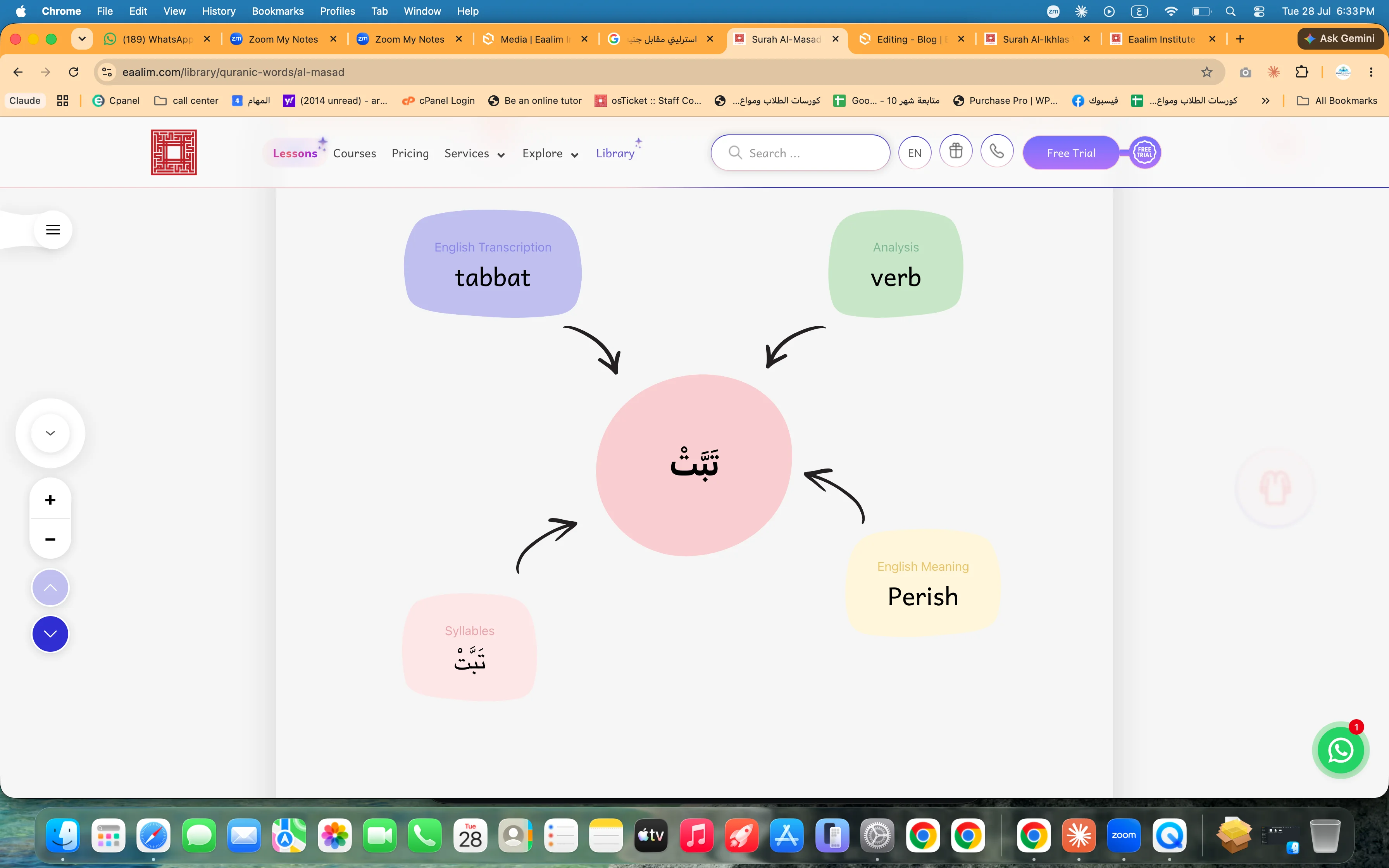
Here is every word of Surah Al-Masad in order, with its transliteration and English meaning. Learners across the UK and the US who study the surah this way often find that verses they raced through as children suddenly carry real weight.
# | Arabic | Transliteration | Meaning |
|---|---|---|---|
1 | تَبَّتْ | tabbat | may they be ruined / perish |
2 | يَدَآ | yadā | the two hands of |
3 | أَبِي | abī | the father of (Abu) |
4 | لَهَبٍ | lahab | Flame — i.e. Abu Lahab |
5 | وَتَبَّ | wa tabb | and ruined is he |
6 | مَآ | mā | not |
7 | أَغْنَىٰ | aghnā | availed / protected |
8 | عَنْهُ | 'anhu | him |
9 | مَالُهُۥ | māluhu | his wealth |
10 | وَمَا | wa mā | and what |
11 | كَسَبَ | kasab | he earned |
12 | سَيَصْلَىٰ | sayaslā | he will burn in |
13 | نَارًا | nāran | a Fire |
14 | ذَاتَ | dhāta | possessing / of |
15 | لَهَبٍ | lahab | blazing flame |
16 | وَٱمْرَأَتُهُۥ | wamra'atuhu | and his wife |
17 | حَمَّالَةَ | hammālata | the carrier of |
18 | ٱلْحَطَبِ | al-hatab | the firewood |
19 | فِي | fī | around / in |
20 | جِيدِهَا | jīdihā | her neck |
21 | حَبْلٌ | hablun | a rope |
22 | مِّن | min | of |
23 | مَّسَدٍ | masad | twisted palm fibre |
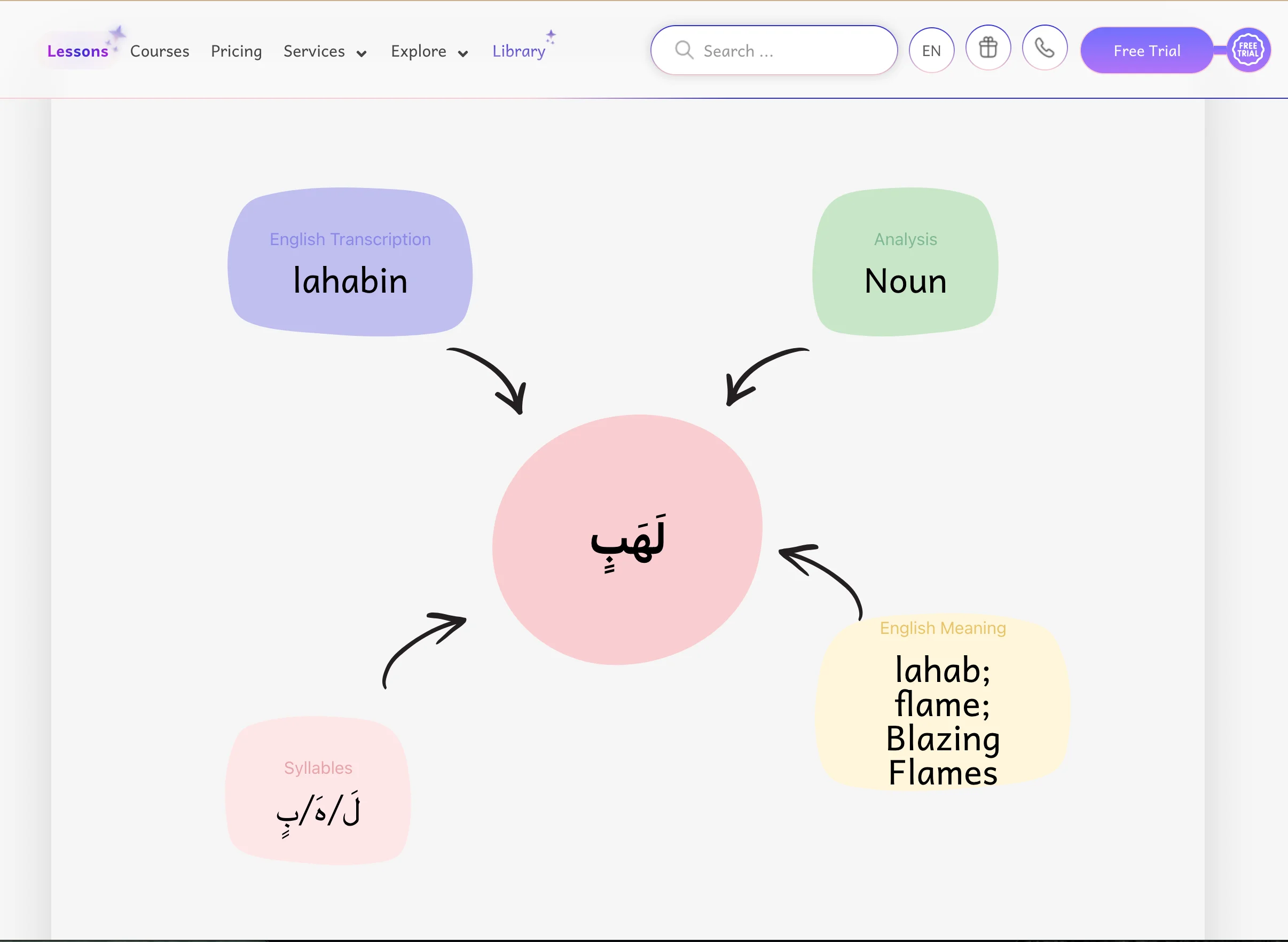
Want to hear each word and see its syllables and grammar? Study Surah Al-Masad interactively — with audio and word analysis — using Eaalim's free Quranic Words tool for Surah Al-Masad.
Surah Al-Masad verse by verse
Now that the individual words are clear, here is the surah verse by verse — the Arabic, how it is pronounced, and what it means.
تَبَّتْ يَدَآ أَبِى لَهَبٍ وَتَبَّ ﴿١﴾
Tabbat yadā abī lahabin wa tabb
"May the hands of Abu Lahab be ruined, and ruined is he."
مَآ أَغْنَىٰ عَنْهُ مَالُهُۥ وَمَا كَسَبَ ﴿٢﴾
Mā aghnā 'anhu māluhu wa mā kasab
"His wealth will not avail him, nor what he earned."
سَيَصْلَىٰ نَارًا ذَاتَ لَهَبٍ ﴿٣﴾
Sayaslā nāran dhāta lahab
"He will burn in a Fire of blazing flame,"
وَٱمْرَأَتُهُۥ حَمَّالَةَ ٱلْحَطَبِ ﴿٤﴾
Wamra'atuhu hammālata-l-hatab
"and his wife as well — the carrier of firewood."
فِى جِيدِهَا حَبْلٌ مِّن مَّسَدٍ ﴿٥﴾
Fī jīdihā hablun min masad
"Around her neck is a rope of twisted fibre."
The moment behind the revelation
Very few surahs have their occasion recorded as precisely as this one. Ibn Abbas ﷺ narrated that when Allah revealed "And warn your closest kindred" (Ash-Shu'ara 26:214), the Prophet ﷺ climbed the hill of As-Safa and called out to the clans of Quraysh. When they had gathered, he asked whether they would believe him if he warned them that cavalry were advancing on them from behind the mountain. They answered that they had never known him to lie. He then warned them of a severe punishment to come — and his uncle Abu Lahab replied, "May you perish! Is this why you gathered us?" Surah Al-Masad was revealed in response (Sahih al-Bukhari 4971).
Abu Lahab — whose given name was 'Abd al-'Uzza ibn 'Abd al-Muttalib — was the Prophet's own paternal uncle and a neighbour in Makkah. His wife, known as Umm Jamil, was the sister of Abu Sufyan and belonged to one of the most powerful families of the city. Between them they had everything Arabian society valued: lineage, wealth and influence. The surah answers all of it in five verses.
Understanding the meaning behind the words
Four words carry most of the weight of this surah, and each rewards a closer look.
Tabbat / tabb — the root t-b-b carries the sense of loss, ruin and coming to nothing. The surah opens and closes the first verse with it, applying it first to Abu Lahab's hands — the Arabic image for a person's work and effort — and then to the man himself. His efforts are ruined, and so is he.
Lahab — this is the surah's most striking piece of word choice. Lahab means flame, and it appears twice: once in his nickname, and once in the fire that awaits him. The name he was known by in this life becomes the description of his end.
Hammālata-l-hatab — "the carrier of firewood." Classical scholars offer two complementary explanations. The first is literal: she carried thorns and branches and scattered them in the Prophet's path to injure him. The second is figurative, since carrying firewood was an Arabic expression for carrying tales between people — spreading slander that feeds hostility the way fuel feeds a fire. Both readings describe someone who actively worked to cause harm.
Masad — the twisted palm-fibre rope of the final verse. It is a deliberately humble material: coarse, cheap and used for the roughest work. For a woman of her standing in Makkah, the image is a complete reversal of the status she held.
What Surah Al-Masad teaches
This is a short surah with unusually direct lessons — and they apply as much in Birmingham or Boston today as they did in Makkah:
Lineage does not save anyone. Abu Lahab was the Prophet's own uncle. Family connection to guidance is not the same as accepting it.
Wealth is not protection. Verse 2 dismisses in six words the one thing he was most confident in.
Actions are what count. The surah does not condemn him for who he was, but for what he chose to do — and the same is true of his wife.
Truth does not depend on popularity. The Prophet ﷺ was opposed by his own relatives and neighbours, and continued regardless.
It is worth adding that the surah is a judgement upon two specific people who knowingly opposed the message, revealed by Allah who alone knows what is in hearts. It is not a licence for anyone to pronounce such judgements on others.
How to learn Surah Al-Masad word by word
Here is an approach that works well for busy learners in the UK and the US:
Start from what you already know. You can almost certainly recite this surah from memory already, so you are not learning to read it — you are learning to understand it.
Take it five words at a time. With only twenty-three words, one verse per day makes the whole surah yours inside a week.
Anchor each word to its sound. Hear the word recited correctly, then attach the meaning. Tajweed and vocabulary reinforce each other far better than either does alone.
Follow the repeated words. Tabbat and tabb, lahab and lahab — spotting the repetition makes the surah easier to hold and reveals how it is built.
Learn the context alongside the words. This surah in particular becomes far clearer once you know the incident at As-Safa.
Study with a qualified teacher. A teacher corrects pronunciation, explains a word like masad properly, and answers the questions that naturally come up.
Go deeper with Eaalim's Quranic Words Course
The word-by-word method used in this guide is exactly how Eaalim Institute teaches Qur'anic vocabulary to English-speaking students across the UK, the United States and worldwide. Our Quranic Words Course builds on this word-level analysis with structured lessons, correct Tajweed and one-to-one feedback from Al-Azhar certified teachers — taking you from reciting the Qur'an to understanding it.
Whether you are a parent who wants your child to understand what they memorise, an adult learner returning to the Qur'an, or a revert building your foundations, learning the Qur'an word by word is the surest route to a lasting connection with the Book of Allah.
Start the Quranic Words Course with Eaalim →
Key takeaways
Surah Al-Masad is the 111th surah — five verses and twenty-three words, named after masad, twisted palm fibre.
It is the only surah that names a living opponent of the Prophet ﷺ and states his outcome.
The word lahab ("flame") appears twice: in Abu Lahab's name and in the fire described in verse 3.
Hammālata-l-hatab is understood both literally (carrying thorns) and figuratively (carrying slander).
The central lesson is that neither lineage nor wealth can substitute for faith and right action.
Continue your word-by-word journey with Surah Al-Ikhlas and Surah An-Nas, or read our fuller study of the historical background in Surah Al-Masad: the surah that names Abu Lahab.
Conclusion
Surah Al-Masad takes seconds to recite and a lifetime to absorb. Learned word by word — tabbat, yadā, abī, lahab — it stops being a short passage memorised in childhood and becomes what it always was: a clear statement that what a person builds without faith comes to nothing, however much of it there is. Understand the words, and the surah will never sound the same again.
Start your journey with Eaalim today!
Start 2 Free Trials


 Share
Frequently Asked Questions
Surah Al-Masad reads: "Tabbat yada abi lahabin wa tabb" — "May the hands of Abu Lahab be ruined, and ruined is he" — followed by "Ma aghna 'anhu maluhu wa ma kasab" (his wealth will not avail him, nor what he earned), "Sayasla naran dhata lahab" (he will burn in a Fire of blazing flame), "Wamra'atuhu hammalata-l-hatab" (and his wife as well, the carrier of firewood), and "Fi jidiha hablun min masad" (around her neck is a rope of twisted fibre). The surah contains 23 words across its five verses.
Abu Lahab, whose given name was 'Abd al-'Uzza ibn 'Abd al-Muttalib, was a paternal uncle of the Prophet Muhammad صلى الله عليه وسلم and one of his most persistent opponents in Makkah. Ibn Abbas narrated that when the Prophet climbed the hill of As-Safa to warn his relatives openly, Abu Lahab replied, "May you perish! Is this why you gathered us?" — and Surah Al-Masad was revealed in response (Sahih al-Bukhari 4971). It is the only surah in the Qur'an that names a living opponent of the Prophet.
Masad is the twisted fibre of the palm tree, used in Arabia to make coarse, inexpensive rope. It is the final word of the surah and gives the chapter its name. In verse 5 it describes the rope around the neck of Abu Lahab's wife — a deliberately humble image for a woman who held high status among the Quraysh.
You can study Surah Al-Masad interactively with Eaalim's free Quranic Words tool, which shows each word's Arabic, transliteration, meaning, syllables and grammar. To go further with correct Tajweed and one-to-one feedback from qualified teachers, Eaalim's Quranic Words Course teaches Qur'anic vocabulary to English-speaking students in the UK, the United States and worldwide.
