


Surah An-Nasr Word by Word
By Eaalim Institute on 9/2/2026 · 12 min read
Surah An-Nasr is three verses long and takes about fifteen seconds to recite — and it is almost certainly the last complete surah of the Qur'an to be revealed. Muslims across the UK and the United States learn it early precisely because it is short, and then rarely return to it. That is a loss, because these nineteen words carry one of the most unexpected instructions in the Book: at the moment of total victory, celebrate nothing — glorify Allah and ask His forgiveness. This guide gives you the complete word-by-word meaning of Surah An-Nasr and then applies the Seven-Link Method, so that understanding it and memorising it become the same piece of work.
At a glance
Surah: An-Nasr (النصر, "The Divine Help") — number 110
Also called: Idha jaa nasrullahi wal-fath, after its opening words, and Surat at-Tawdi' — the Surah of Farewell
Length: 3 verses — 19 words in total
Revealed: Madinah (Madani), in the final period of the Prophet's life ﷺ
Theme: what to do when you finally win — and it is not what most people expect
Did you know?
When Umar ibn al-Khattab asked the veterans of Badr what this surah meant, most answered that we are commanded to praise Allah and seek His forgiveness when He grants us victory. Ibn Abbas gave a different answer: "It is the approaching death of the Messenger of Allah ﷺ, which Allah informed him of." Umar replied, "I know nothing of it except what you know" (Sahih al-Bukhari 4970). The surah announces a victory and, underneath it, a farewell.
What is Surah An-Nasr?
Surah An-Nasr (سُورَةُ النَّصْر) is the 110th surah of the Qur'an and one of the shortest — three verses, nineteen words. Its name means "the help" or "the divine support", taken from its opening line.
It is a Madani surah, revealed late in the Prophet's life ﷺ, and Ibn Abbas reported that it was the last surah of the Qur'an to be revealed complete, in one piece (reported by Muslim). Many scholars place its revelation around the Farewell Pilgrimage; the Prophet ﷺ passed away not long afterwards, which is why it carries the second name Surat at-Tawdi' — the Surah of Farewell.
For a learner in Britain or America, the surah is worth far more attention than its length suggests. It describes the greatest public success of the Prophet's mission ﷺ — Makkah opened, people entering Islam in crowds — and then tells him to respond with tasbih (glorifying Allah) and istighfar (asking forgiveness). Not a victory speech. That single instruction is the whole surah.
The full text and translation
"When the help of Allah comes and the conquest, and you see the people entering the religion of Allah in crowds — then glorify the praise of your Lord and seek His forgiveness. Indeed, He is ever the Acceptor of repentance."
(Surah An-Nasr 110:1–3)
Grammatically, the whole surah is a single sentence: a condition (when…) that runs across the first two verses, and its answer (then…) in the third. Knowing that one fact makes the surah almost impossible to recite out of order.
Surah An-Nasr: word by word
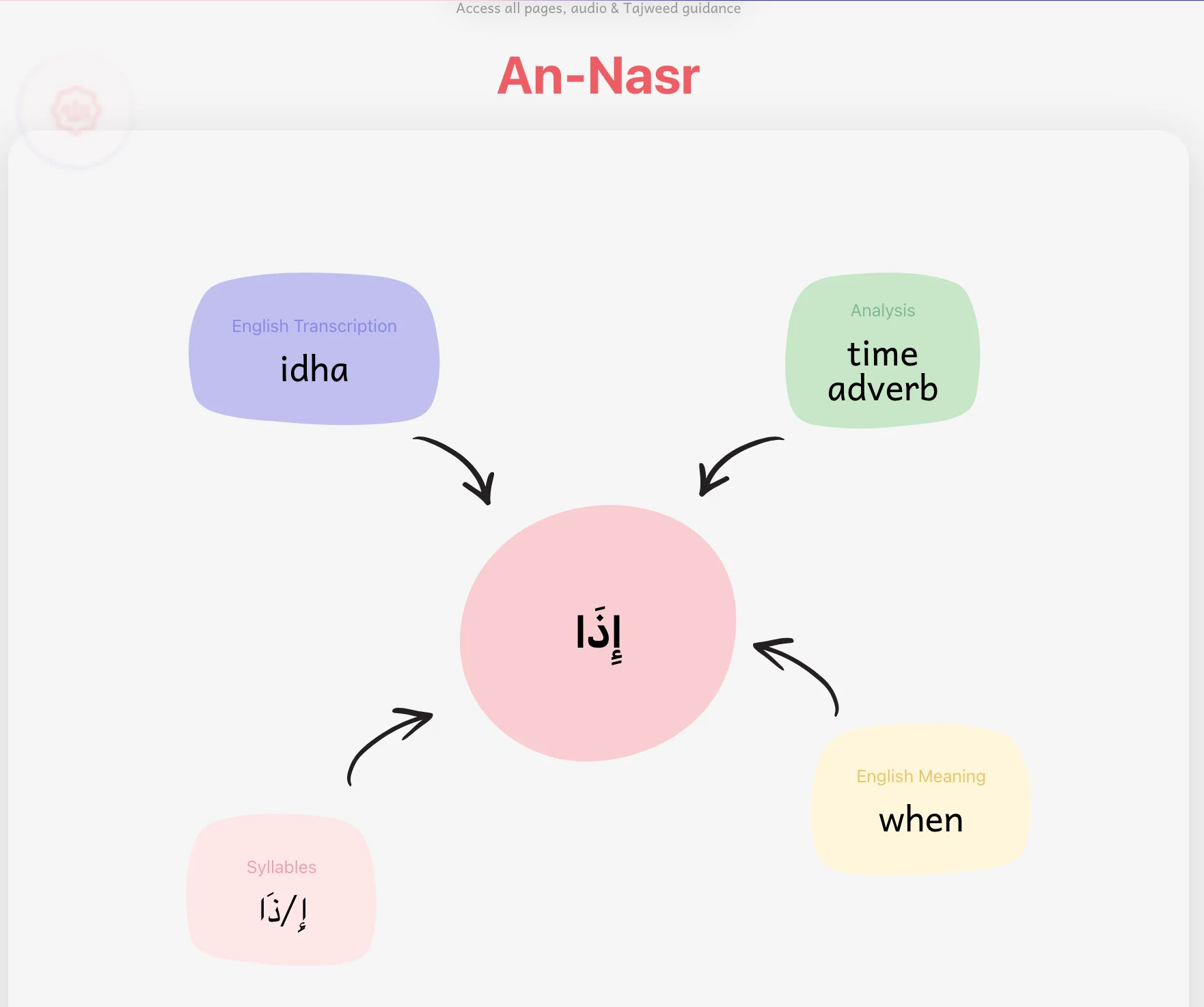
Here is every word of Surah An-Nasr in order, with its transliteration and English meaning.
# | Arabic | Transliteration | Meaning |
|---|---|---|---|
1 | إِذَا | idhā | when |
2 | جَآءَ | jāʾa | comes |
3 | نَصْرُ | naṣru | the help / victory of |
4 | ٱللَّهِ | llāhi | Allah |
5 | وَٱلْفَتْحُ | wal-fatḥu | and the conquest |
6 | وَرَأَيْتَ | wa raʾayta | and you see |
7 | ٱلنَّاسَ | n-nāsa | the people |
8 | يَدْخُلُونَ | yadkhulūna | entering |
9 | فِي | fī | into |
10 | دِينِ | dīni | the religion of |
11 | ٱللَّهِ | llāhi | Allah |
12 | أَفْوَاجًا | afwājā | in crowds / multitudes |
13 | فَسَبِّحْ | fa-sabbiḥ | then glorify |
14 | بِحَمْدِ | bi-ḥamdi | with the praise of |
15 | رَبِّكَ | rabbika | your Lord |
16 | وَٱسْتَغْفِرْهُ | wa-staghfirhu | and seek His forgiveness |
17 | إِنَّهُۥ | innahu | indeed He |
18 | كَانَ | kāna | is ever |
19 | تَوَّابًا | tawwābā | the Acceptor of repentance |
Want to hear each word and see its syllables and grammar? Study Surah An-Nasr interactively — with audio for every word — using Eaalim's free Quranic Words tool for Surah An-Nasr.
Learn this surah with a teacher, not just a table
Reading the meanings is the first half. Hearing your own recitation corrected is the other. Eaalim gives new students two free trial lessons — one-to-one on Zoom with an Al-Azhar certified teacher, never a group class — booked around your own time zone in the UK, the United States or anywhere else. Paid plans start at £9 per hour.
Surah An-Nasr verse by verse
إِذَا جَآءَ نَصْرُ ٱللَّهِ وَٱلْفَتْحُ ︑١︒
Idhā jāʾa naṣru llāhi wal-fatḥ
"When the help of Allah comes, and the conquest."
Note the possession: it is naṣru llāh — Allah's help, not the believers' achievement. Al-fatḥ literally means "the opening", and is understood by the great majority of scholars as the opening of Makkah.
وَرَأَيْتَ ٱلنَّاسَ يَدْخُلُونَ فِى دِينِ ٱللَّهِ أَفْوَاجًا ︑٢︒
Wa raʾayta n-nāsa yadkhulūna fī dīni llāhi afwājā
"And you see the people entering the religion of Allah in crowds."
Afwāj is the plural of fawj — a troop or a throng. After years in which people came one and two at a time, they now arrive in groups. The verb yadkhulūna is in the present tense: you can see it happening.
فَسَبِّحْ بِحَمْدِ رَبِّكَ وَٱسْتَغْفِرْهُ ۚ إِنَّهُۥ كَانَ تَوَّابًۢا ︑٣︒
Fa-sabbiḥ bi-ḥamdi rabbika wa-staghfirhu innahu kāna tawwābā
"Then glorify the praise of your Lord and seek His forgiveness. Indeed, He is ever the Acceptor of repentance."
The answer to the condition — and the surprise. Sabbiḥ is to declare Allah free of every imperfection; istaghfir is to ask forgiveness. Victory is met with humility, not celebration. Tawwāb is an intensive form: the One who accepts repentance again and again.
Understanding the meaning behind the words
Four words carry most of the weight of this surah, and each rewards a closer look.
Naṣr — help given to someone against an opponent, and specifically the help that decides the outcome. It is attached here to Allah's name: the victory was never the believers' own work. The same root gives Ansar, the Helpers of Madinah.
Al-fatḥ — literally "the opening". Arabic does not say a city was "conquered" but that it was opened, and the choice of word matters: Makkah was opened without a battle for it, and the Prophet ﷺ entered it with his head lowered on his mount.
Afwājā — in crowds. A fawj is a group moving together. The word quietly measures how much had changed: the same city that had driven the believers out was now sending its people in, group after group.
Tawwāb — an intensive form of the one who accepts repentance: not once, but again and again, however often a person returns. It is the surah's final word, and it explains the command before it. You are told to seek forgiveness precisely because He is the One who keeps accepting.
The moment behind the revelation
Two narrations frame this surah, and together they explain why it reads the way it does.
The first is the exchange between Umar ibn al-Khattab and Ibn Abbas quoted above, in which Ibn Abbas read the surah as an announcement of the end of the Prophet's mission ﷺ — the work is complete, and so is the life (Sahih al-Bukhari 4970).
The second is what the Prophet ﷺ actually did afterwards. Aisha reported that he would frequently say in his bowing and prostration: "Subhanaka Allahumma Rabbana wa bi-hamdika, Allahumma-ghfir li" — "Glory be to You, O Allah, our Lord, and with Your praise; O Allah, forgive me" — acting upon what the Qur'an had commanded him (Sahih al-Bukhari 794; Sahih Muslim 484). The surah gave an instruction, and the response was immediate and lifelong.
The Seven-Link Method applied to Surah An-Nasr
With only three verses, most people assume Surah An-Nasr needs no method at all — until they confuse its third verse with a nearly identical verse elsewhere in the Qur'an. The Seven-Link Method builds seven independent holds on the surah, so that a slip in one is caught by another.
Verbal link (1) — Allah's name, twice
Allāh appears twice, once in each of the first two verses: naṣru llāhi (the help of Allah) and dīni llāhi (the religion of Allah). Victory belongs to Him and the religion belongs to Him. Learn the two phrases as a pair and you have half the surah.
Phonetic link (2) — two endings that almost match
The verse endings are al-fatḥ, afwājā and tawwābā. The last two rhyme almost exactly — same rhythm, same long ā, differing only in one letter (ج / ب). Verse 1 stands apart in sound. That gives you two independent checks: the meaning groups verses 1–2 together as the condition, while the sound groups verses 2–3. If both groupings hold in your recitation, nothing is missing.
Thematic link (3) — condition, sight, command
Three verses, three movements: something arrives (help and conquest), something is seen (people entering in crowds), something is ordered (glorify, seek forgiveness). Ask yourself which of the three you are in and the next words follow.
Narrative link (4) — the grammar is the story
Idhā (when) in verse 1 opens a condition that is not answered until the fa- (then) of verse 3. The surah is one sentence, and a sentence cannot be recited out of order. This is the strongest single link in a surah this short.
Visual link (5) — three scenes
A city's gates opening; crowds streaming through them; and one man, at the centre of it all, bowing and asking forgiveness. The camera moves from the wide public scene to a single private act.
Numerical link (6) — small numbers, easy checks
Three verses, nineteen words, two mentions of Allah's name, two commands in the final verse (fa-sabbiḥ and wa-staghfirhu), and one closing statement about Him. If your final verse has fewer than two commands, a word has gone missing.
Similar-verse link (7) — the one real trap
The phrase fa-sabbiḥ bi-ḥamdi rabbika occurs elsewhere in the Qur'an, and this is where reciters slip:
• An-Nasr 110:3 — fa-sabbiḥ bi-ḥamdi rabbika wa-staghfirhu
• Al-Hijr 15:98 — fa-sabbiḥ bi-ḥamdi rabbika wa kun mina s-sājidīn
Same seven syllables, different continuation. Anchor it by meaning: in An-Nasr the command is to ask forgiveness, because the surah ends on Allah being Tawwāb. Related wordings also appear in Ta-Ha 20:130, Qaf 50:39 and At-Tur 52:48 — each with wa-sabbiḥ rather than fa-sabbiḥ.
How to learn Surah An-Nasr word by word in three days
Day 1 — the condition. Verses 1–2, twelve words. Learn naṣr, fatḥ and afwāj properly; all three recur across the Qur'an.
Day 2 — the answer. Verse 3, seven words. Drill it against Al-Hijr 15:98 deliberately, out loud, until the two endings stop competing.
Day 3 — join and check. Recite the whole surah as one sentence: when… then… Then run the three-scene film once, and recite it a final time thinking only about what the words mean.
Afterwards: use it. Say subhanallahi wa bi-hamdih, astaghfirullah the next time something goes well for you. That is the surah doing its work.
A qualified teacher makes the difference here: correct pronunciation of wa-staghfirhu, the ikhfa in tawwābā, and honest feedback on the verses you think you know.
Studying Surah An-Nasr from the UK or the United States
Most people reading this guide are not learning Arabic in an Arabic-speaking country. They are fitting the Qur'an around school runs in Birmingham, shift work in Manchester, or an evening after the commute home in Chicago or Toronto — and the practical problem is rarely motivation. It is finding a teacher who will correct one surah properly, at a time that actually exists in your week.
That is the gap Eaalim Institute was built for. We are a London-based institute teaching English-speaking Muslims across Britain, the United States, Canada and Europe:
One-to-one, never group. Every lesson is private on Zoom, so the whole session is spent on your recitation rather than waiting your turn in a halaqa.
Al-Azhar certified teachers. Male and female teachers, matched to the student — which matters for families booking for children.
Scheduled around your time zone. Evening and weekend slots, arranged around school hours and prayer times rather than against them.
Two free trial lessons before you pay anything, and plans from £9 per hour after that.
If you have read this far into a word-by-word guide, you are already doing the hard part. A teacher simply makes it faster — and stops you memorising a mistake.
Book 2 free Quran lessons with Eaalim → | See plans and pricing →
Learn it properly with Eaalim
The two halves of this guide match two Eaalim courses. Our Quranic Words Course teaches Qur'anic vocabulary word by word to English-speaking students across the UK, the United States and worldwide. Our Qur'an Memorisation (Hifz) Course applies the Seven-Link Method surah by surah with Al-Azhar certified teachers, one to one.
Start with 2 free trial lessons → | Explore the Quranic Words Course →
Key takeaways
Surah An-Nasr is three verses and nineteen words — and, by Ibn Abbas's report, the last complete surah revealed.
It is one grammatical sentence: when (verses 1–2) → then (verse 3).
Its instruction at the moment of victory is tasbih and istighfar, not celebration.
The one memorisation trap is fa-sabbiḥ bi-ḥamdi rabbika, which continues differently in Al-Hijr 15:98.
Umar accepted Ibn Abbas's reading that the surah signalled the end of the Prophet's mission ﷺ (Sahih al-Bukhari 4970).
Continue with Surah Al-Fatiha word by word + the Seven-Link Method, or read our fuller UK guide to this surah in Surah An-Nasr: The Farewell Surah of Victory.
Conclusion
Nineteen words, fifteen seconds, and a lesson most people spend a lifetime learning: that the right response to success is not to stand taller but to bow lower. Learned word by word — naṣru, llāhi, wal-fatḥu — and held by seven links rather than one, Surah An-Nasr stops being the short surah you recite when you are in a hurry, and becomes the one you reach for when things finally go your way.
Start your journey with Eaalim today!
Start 2 Free Trials


 Share
ShareFrequently Asked Questions
Surah An-Nasr is nineteen words across three verses. "Idha jaa nasru llahi wal-fath" means "when the help of Allah comes, and the conquest"; "wa ra'ayta n-nasa yadkhuluna fi dini llahi afwaja" means "and you see the people entering the religion of Allah in crowds"; and "fa-sabbih bi-hamdi rabbika wa-staghfirhu innahu kana tawwaba" means "then glorify the praise of your Lord and seek His forgiveness; indeed He is ever the Acceptor of repentance." Grammatically the whole surah is one sentence: a condition in verses 1-2 and its answer in verse 3.
It is a Madani surah revealed late in the Prophet's life, and Ibn Abbas reported that it was the last surah of the Qur'an revealed complete in one piece. When Umar ibn al-Khattab asked the veterans of Badr about its meaning, Ibn Abbas answered that it signalled the approaching death of the Messenger of Allah, and Umar agreed with him (Sahih al-Bukhari 4970). Because of this it is also known as Surat at-Tawdi', the Surah of Farewell.
Build seven separate holds on the surah rather than relying on repetition: the verbal link (Allah's name appears twice - the help of Allah, the religion of Allah), the phonetic link (afwaja and tawwaba rhyme almost exactly), the thematic link (condition, sight, command), the narrative link (idha in verse 1 is only answered by fa- in verse 3), the visual link (gates opening, crowds entering, one man bowing), the numerical link (3 verses, 19 words, 2 commands in the last verse), and the similar-verse link (see the next question).
Because the phrase "fa-sabbih bi-hamdi rabbika" appears in more than one place. In Surah An-Nasr 110:3 it continues "wa-staghfirhu" (and seek His forgiveness), while in Surah Al-Hijr 15:98 the identical phrase continues "wa kun mina s-sajidin" (and be of those who prostrate). Related wordings also appear in Ta-Ha 20:130, Qaf 50:39 and At-Tur 52:48, each with "wa-sabbih" rather than "fa-sabbih". Anchor An-Nasr by its meaning: the surah ends on Allah being Tawwab, the Acceptor of repentance, so the command before it is to seek forgiveness.
