


Surah Al-Fatiha Word by Word with memorization by seven links method UK
By Eaalim Institute on 9/2/2026 · 14 min read
Surah Al-Fatiha is the one chapter of the Qur'an that every Muslim in the UK and the United States recites at least seventeen times a day — and it is also the chapter most of us learned purely by sound, long before anyone explained what its words actually mean. This guide does two things at once. First it gives you the complete word-by-word meaning of Surah Al-Fatiha — all twenty-nine words, with transliteration and English. Then it applies the Seven-Link Method, the memorisation approach Eaalim uses for Hifz, so that understanding and memorising reinforce each other instead of competing for your time.
At a glance
Surah: Al-Fatiha (الفاتحة, "The Opening") — number 1
Also called: Umm al-Kitab (Mother of the Book), Umm al-Qur'an, As-Sab' al-Mathani (the Seven Oft-Repeated), Ash-Shifa (the Cure)
Length: 7 verses — 29 words in the word-by-word count used here
Revealed: Makkah (Makki), in the earliest period of revelation
Recited: in every single rak'ah of every prayer, without exception
Theme: praise, then pledge, then petition — a conversation with Allah in seven verses
Did you know?
Surah Al-Fatiha is the only surah described in an authentic narration as a dialogue. In a hadith qudsi, the Prophet ﷺ reported that Allah said: "I have divided the prayer between Myself and My servant into two halves, and My servant shall have what he asks for" — and then the narration quotes the surah verse by verse with Allah's reply to each one (Sahih Muslim 395). Once you know this, the structure of the surah becomes almost impossible to forget — which is exactly why it anchors the memorisation method below.
What is Surah Al-Fatiha?
Surah Al-Fatiha (سُورَةُ الفَاتِحَة) is the first surah of the Qur'an and the opening of the Book — which is what its name means. It is seven short verses long, and no prayer is valid without it: the Prophet ﷺ said, "There is no prayer for the one who does not recite the Opening of the Book" (Sahih al-Bukhari 756; Sahih Muslim 394).
It also carries a status no other chapter is given in quite the same words. When Abu Sa'id ibn al-Mu'alla was taught it, the Prophet ﷺ called it "the greatest surah in the Qur'an" and identified it as As-Sab' al-Mathani — the seven oft-repeated verses (Sahih al-Bukhari 4474).
For learners in Britain and America, that daily repetition is the opportunity. You already recite these words more often than any other passage you will ever memorise. Learning what they mean costs you almost nothing in extra practice time — and it changes every prayer you pray afterwards.
A note on the counting: the word list below begins with the Basmalah, following the recitation of Hafs 'an 'Asim — the reading used across the UK, the US and most of the Muslim world — in which "Bismillahi r-Rahmani r-Rahim" is counted as the first verse of the surah. Some other schools count the seven verses without it. Both positions are long-established among the scholars.
The full text and translation
"In the name of Allah, the Most Gracious, the Most Merciful. All praise is due to Allah, Lord of all the worlds. The Most Gracious, the Most Merciful. Master of the Day of Judgement. You alone we worship, and You alone we ask for help. Guide us to the straight path — the path of those upon whom You have bestowed favour, not of those who earned Your wrath, nor of those who went astray."
(Surah Al-Fatiha 1:1–7)
Read straight through, it is a prayer. Read word by word, it is a structure — and that structure is what makes it stay in the memory.
Surah Al-Fatiha: word by word
Here is every word of Surah Al-Fatiha in order, with its transliteration and English meaning. Take one verse at a time rather than trying to absorb the whole table at once.
# | Arabic | Transliteration | Meaning |
|---|---|---|---|
1 | بِسْمِ | bismi | in the name of |
2 | اللهِ | llāhi | Allah |
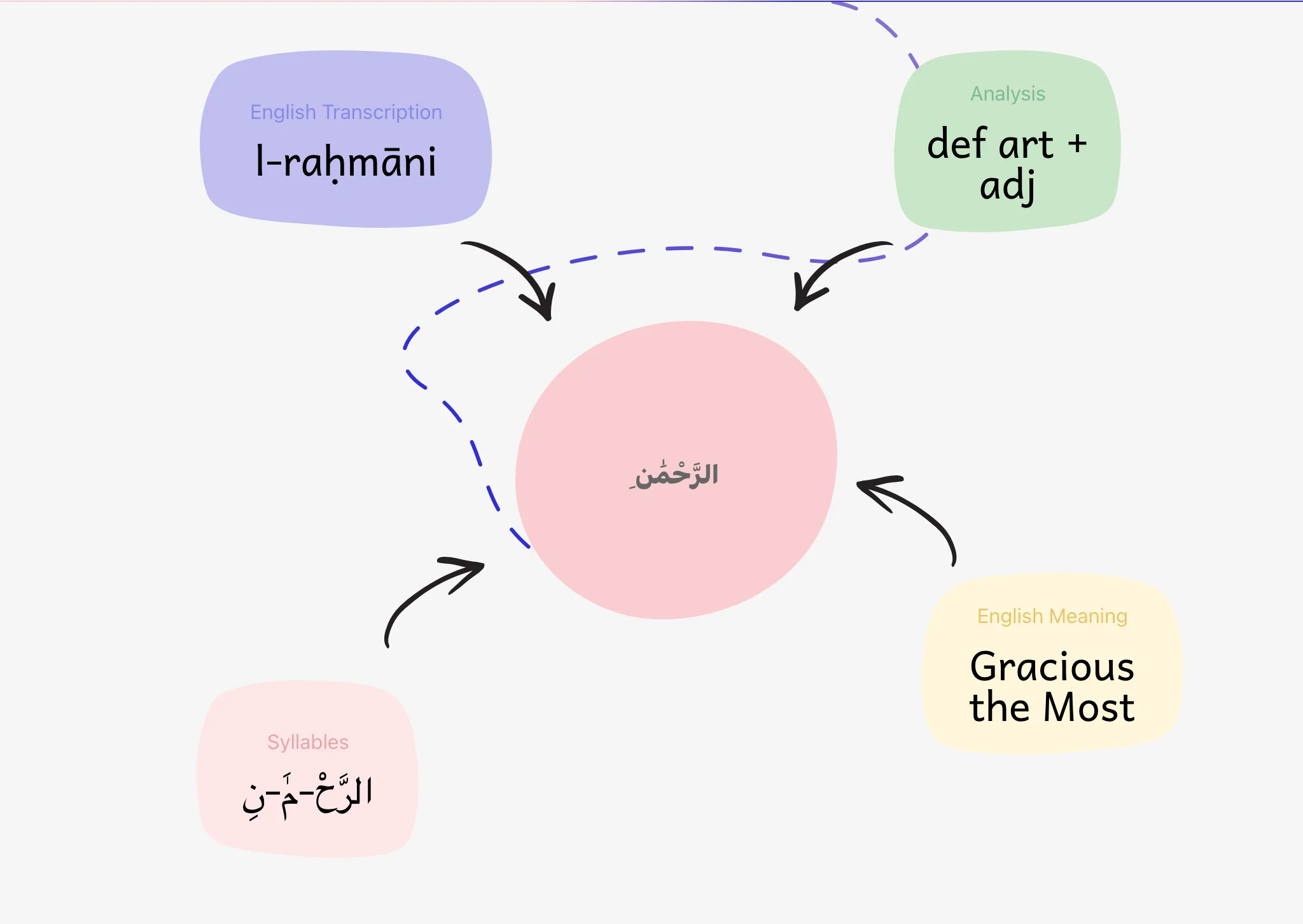
3 | الرَّحْمَٰنِ | r-raḥmāni | the Most Gracious |
4 | الرَّحِيمِ | r-raḥīmi | the Most Merciful |
5 | الْحَمْدُ | al-ḥamdu | all praise and thanks |
6 | لِلَّهِ | lillāhi | belong to Allah |
7 | رَبِّ | rabbi | the Lord / Sustainer of |
8 | الْعَالَمِينَ | l-ʿālamīna | all the worlds |
9 | الرَّحْمَٰنِ | r-raḥmāni | the Most Gracious |
10 | الرَّحِيمِ | r-raḥīmi | the Most Merciful |
11 | مَالِكِ | māliki | Master / Owner of |
12 | يَوْمِ | yawmi | the Day of |
13 | الدِّينِ | d-dīni | Judgement / Recompense |
14 | إِيَّاكَ | iyyāka | You alone |
15 | نَعْبُدُ | naʿbudu | we worship |
16 | وَإِيَّاكَ | wa-iyyāka | and You alone |
17 | نَسْتَعِينُ | nastaʿīnu | we ask for help |
18 | اهْدِنَا | ihdinā | guide us |
19 | الصِّرَاطَ | ṣ-ṣirāṭa | to the path |
20 | الْمُسْتَقِيمَ | l-mustaqīma | the straight |
21 | صِرَاطَ | ṣirāṭa | the path of |
22 | الَّذِينَ | alladhīna | those whom |
23 | أَنْعَمْتَ | anʿamta | You have favoured |
24 | عَلَيْهِمْ | ʿalayhim | upon them |
25 | غَيْرِ | ghayri | not of |
26 | الْمَغْضُوبِ | l-maghḍūbi | those who earned wrath |
27 | عَلَيْهِمْ | ʿalayhim | upon them |
28 | وَلَا | wa-lā | and not |
29 | الضَّالِّينَ | ḍ-ḍāllīna | of those who went astray |
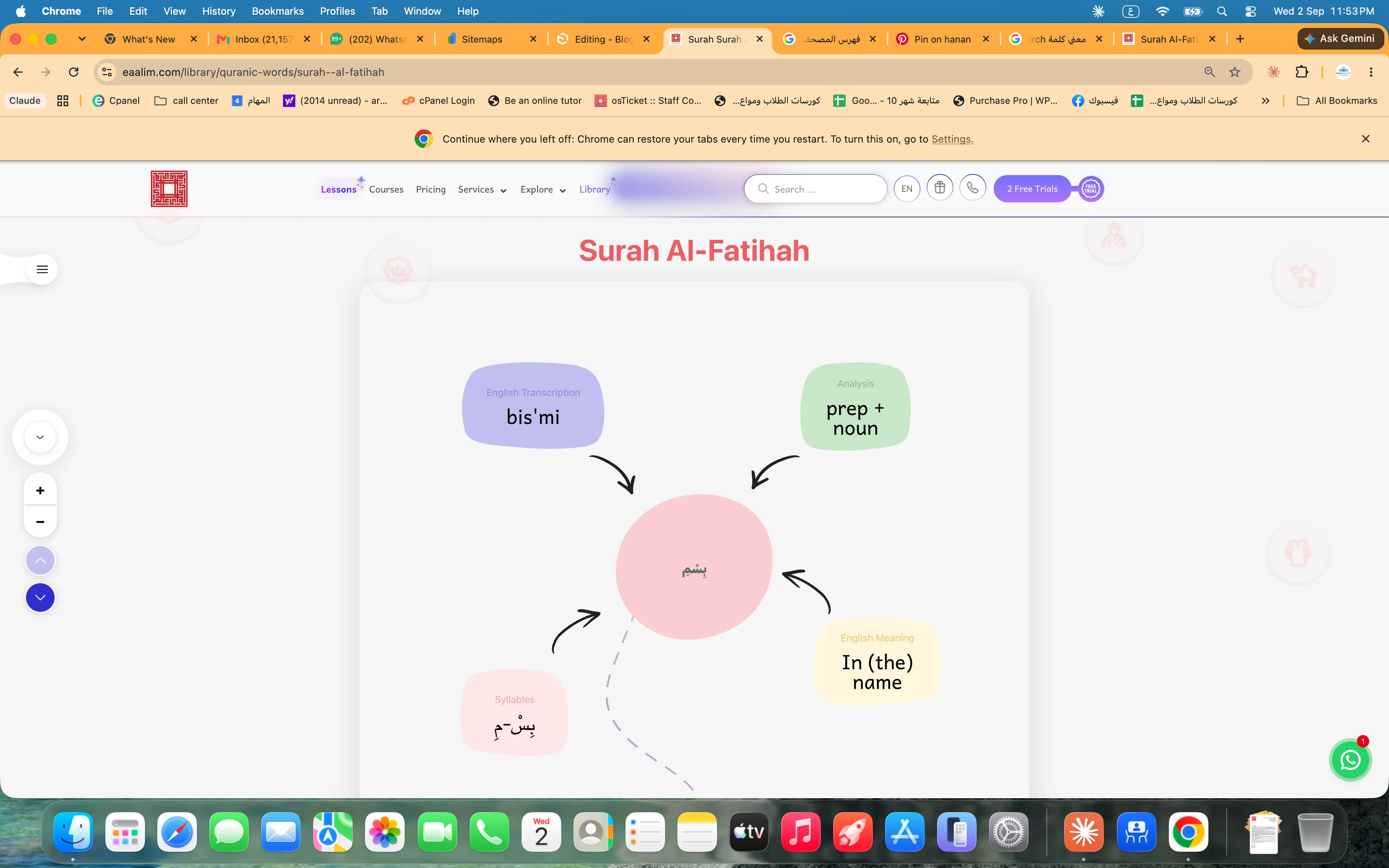
Want to hear each word and see its syllables and grammar? Study Surah Al-Fatiha interactively — with audio for every word — using Eaalim's free Quranic Words tool for Surah Al-Fatiha.
Learn this surah with a teacher, not just a table
Reading the meanings is the first half. Hearing your own recitation corrected is the other. Eaalim gives new students two free trial lessons — one-to-one on Zoom with an Al-Azhar certified teacher, never a group class — booked around your own time zone in the UK, the United States or anywhere else. Paid plans start at £9 per hour.
Surah Al-Fatiha verse by verse
بِسْمِ اللهِ الرَّحْمَٰنِ الرَّحِيمِ ︑١︒
Bismillāhi r-Raḥmāni r-Raḥīm
"In the name of Allah, the Most Gracious, the Most Merciful."
You begin by naming the One you are about to speak to — and you name Him by mercy twice before anything else is said.
الْحَمْدُ لِلَّهِ رَبِّ الْعَالَمِينَ ︑٢︒
Al-ḥamdu lillāhi Rabbi l-ʿālamīn
"All praise is due to Allah, Lord of all the worlds."
Al-ḥamd is praise joined with gratitude and love — not merely compliment. Rabb means the One who owns, sustains and brings to completion.
الرَّحْمَٰنِ الرَّحِيمِ ︑٣︒
Ar-Raḥmāni r-Raḥīm
"The Most Gracious, the Most Merciful."
The two names return, now as a description of the Lord of the worlds. Absolute power has just been paired with absolute mercy.
مَالِكِ يَوْمِ الدِّينِ ︑٤︒
Māliki yawmi d-dīn
"Master of the Day of Judgement."
Mercy is followed immediately by accountability. Note that both مَٰلِكِ (Mālik, Master/Owner) and مَلِكِ (Malik, King) are established recitations; the Hafs reading used in the UK and US has Mālik.
إِيَّاكَ نَعْبُدُ وَإِيَّاكَ نَسْتَعِينُ ︑٥︒
Iyyāka naʿbudu wa iyyāka nastaʿīn
"You alone we worship, and You alone we ask for help."
The exact centre of the surah, and the moment it turns from speaking about Allah to speaking to Him. Placing iyyāka first is what carries the word "alone" in the Arabic.
اهْدِنَا الصِّرَاطَ الْمُسْتَقِيمَ ︑٦︒
Ihdinā ṣ-ṣirāṭa l-mustaqīm
"Guide us to the straight path."
After all that praise, the single request is guidance — asked in the plural, us, never me.
صِرَاطَ الَّذِينَ أَنْعَمْتَ عَلَيْهِمْ غَيْرِ الْمَغْضُوبِ عَلَيْهِمْ وَلَا الضَّالِّينَ ︑٧︒
Ṣirāṭa lladhīna anʿamta ʿalayhim ghayri l-maghḍūbi ʿalayhim wa lā ḍ-ḍāllīn
"The path of those upon whom You have bestowed favour, not of those who earned Your wrath, nor of those who went astray."
The path is then defined by the people on it: those guided, those who knew and refused, and those who meant well but lost the way.
The Seven-Link Method applied to Surah Al-Fatiha
Most people memorise Al-Fatiha by sheer repetition. The Seven-Link Method works differently: instead of one weak thread running through the surah, you build seven independent links, so that if one fails mid-prayer another one catches you. Here is each link, applied to this surah.
Verbal link (1) — the repeated words
Four words or phrases appear twice, and each repetition is a free memory hook: ar-Raḥmāni r-Raḥīm (verses 1 and 3), iyyāka (verse 5), ṣirāṭ (verses 6 and 7) and ʿalayhim (twice inside verse 7). Learn them as pairs, not as separate words.
Phonetic link (2) — one rhyme across all seven verses
Every verse of Al-Fatiha ends on a long vowel followed by m or n: ar-Raḥīm, al-ʿālamīn, ar-Raḥīm, ad-dīn, nastaʿīn, al-mustaqīm, aḍ-ḍāllīn. No other short surah is this consistent. If a verse ending in your recitation does not rhyme, you have lost a word — the sound itself tells you.
Thematic link (3) — three, one, three
The hadith qudsi in Sahih Muslim 395 divides the surah into halves: verses 1–3 belong to Allah (praise), verses 5–7 belong to the servant (the request), and verse 4 — iyyāka naʿbudu wa iyyāka nastaʿīn — is shared between them. Praise → pledge → petition. If you lose your place, ask yourself which of the three you are standing in.
Narrative link (4) — it is a conversation, in order
Nothing in the surah can be moved. You name the One you are addressing, you praise Him, you recall the Day you will stand before Him, you declare that He alone is worshipped, and only then do you ask. Reversing any two steps breaks the logic — which is precisely what makes the order easy to hold.
Visual link (5) — the seven-scene film
Give each verse one image and run them in sequence (the full film is below). Visual memory recovers a lost verse far faster than trying to force the words back.
Numerical link (6) — the numbers that check your recitation
Seven verses (As-Sab' al-Mathani), twenty-nine words, three verses of praise, three of request, one at the centre, two mentions of ar-Raḥmāni r-Raḥīm, two mentions of ṣirāṭ, and three groups of people in the final verse. Numbers give you something to count when the words wobble.
Similar-verse link (7) — the three places people slip
These are the mutashabihat of Al-Fatiha, and knowing them is worth more than another hundred repetitions:
• The second ar-Raḥmāni r-Raḥīm (verse 3) often pulls a reciter back to verse 1. Anchor it: the first is inside the Basmalah, the second stands alone as a whole verse.
• The two ʿalayhim in verse 7 sit either side of ghayri l-maghḍūbi — the first follows favour, the second follows wrath.
• الصِّرَاطَ then صِرَاطَ — verse 6 has the definite article, verse 7 does not. The path is named first, then described.
The visual film: seven scenes
Run this sequence in your mind twice after Fajr and twice before sleep. Each scene belongs to one verse:
Verse 1 — a door opening, and a name spoken before you step through it.
Verse 2 — the view widens: every world, every creature, all of it sustained by One.
Verse 3 — that same immense scene, now covered in mercy.
Verse 4 — the scene narrows to a single Day, and one Owner of it.
Verse 5 — you step forward and speak directly: You, and no one else.
Verse 6 — a straight road appears ahead of you.
Verse 7 — three groups of travellers — one on the road, two off it, on either side.
Notice the movement: the camera widens across verses 1–3, narrows to a single Day in verse 4, turns to face Allah directly in verse 5, and then looks forward down a road for the last two verses.
How to learn Surah Al-Fatiha word by word in one week
A practical plan for busy learners in the UK and the US — and one that uses prayers you are already praying:
Days 1–2: verses 1–3. Nine words, and two of them repeat. Read the table row by row, then listen to each word in the Quranic Words tool.
Day 3: verse 4. Learn mālik, yawm and dīn properly — three words that appear across the whole Qur'an.
Day 4: verse 5, the centre. Say it in English in your own words before you recite it in Arabic.
Days 5–6: verses 6–7, and drill the three mutashabihat above deliberately.
Day 7: run the seven-scene film, then recite the surah once thinking only of meaning — not of the next word.
Every day, all week: in each prayer, choose one verse to actually understand as you say it. That is seventeen free repetitions a day with meaning attached.
A qualified teacher shortens all of this. Tajweed corrections, the difference between ḍ-ḍāllīn and a mispronounced ẓ, and the questions that come up once you start understanding — these are things a recording cannot answer.
Studying Surah Al-Fatiha from the UK or the United States
Most people reading this guide are not learning Arabic in an Arabic-speaking country. They are fitting the Qur'an around school runs in Birmingham, shift work in Manchester, or an evening after the commute home in Chicago or Toronto — and the practical problem is rarely motivation. It is finding a teacher who will correct one surah properly, at a time that actually exists in your week.
That is the gap Eaalim Institute was built for. We are a London-based institute teaching English-speaking Muslims across Britain, the United States, Canada and Europe:
One-to-one, never group. Every lesson is private on Zoom, so the whole session is spent on your recitation rather than waiting your turn in a halaqa.
Al-Azhar certified teachers. Male and female teachers, matched to the student — which matters for families booking for children.
Scheduled around your time zone. Evening and weekend slots, arranged around school hours and prayer times rather than against them.
Two free trial lessons before you pay anything, and plans from £9 per hour after that.
If you have read this far into a word-by-word guide, you are already doing the hard part. A teacher simply makes it faster — and stops you memorising a mistake.
Book 2 free Quran lessons with Eaalim → | See plans and pricing →
Learn it properly with Eaalim
The two halves of this guide match two Eaalim courses. Our Quranic Words Course teaches Qur'anic vocabulary word by word to English-speaking students in the UK, the United States and worldwide, so that what you recite becomes what you understand. Our Qur'an Memorisation (Hifz) Course applies the Seven-Link Method surah by surah with Al-Azhar certified teachers, one to one.
Whether you are a parent who wants your child to understand what they recite in every prayer, an adult learner returning to the Qur'an, or a revert building your foundations — Al-Fatiha is the right place to begin, because you will recite it more than any other passage for the rest of your life.
Start with 2 free trial lessons → | Explore the Quranic Words Course →
Key takeaways
Surah Al-Fatiha is seven verses and twenty-nine words, recited in every rak'ah of every prayer.
Its structure is praise (1–3), pledge (4), petition (5–7) — the division reported in Sahih Muslim 395.
All seven verses rhyme on –īm or –īn, which makes a missing word audible.
The three places reciters slip are the second ar-Raḥmāni r-Raḥīm, the two ʿalayhim, and الصِّرَاطَ followed by صِرَاطَ.
Understanding the words and memorising them are the same task, not two — each one makes the other faster.
Continue your word-by-word journey with Surah Al-Ikhlas and Surah An-Nas, or see the Seven-Link Method applied in full to Surah An-Nas.
Conclusion
You have recited Surah Al-Fatiha thousands of times. Learned word by word — al-ḥamdu, lillāhi, rabbi, l-ʿālamīn — and held together by seven links rather than one, it stops being a sound you produce from memory and becomes what it always was: a conversation you are having, seventeen times a day, with the Lord of all the worlds. Understand the words, and the next prayer you pray will not feel the same.
Start your journey with Eaalim today!
Start 2 Free Trials


 Share
ShareFrequently Asked Questions
Surah Al-Fatiha is twenty-nine words across seven verses. It opens with "Bismillahi r-Rahmani r-Rahim" (in the name of Allah, the Most Gracious, the Most Merciful), then "Al-hamdu lillahi Rabbi l-'alamin" (all praise is due to Allah, Lord of all the worlds), "Ar-Rahmani r-Rahim", "Maliki yawmi d-din" (Master of the Day of Judgement), "Iyyaka na'budu wa iyyaka nasta'in" (You alone we worship, and You alone we ask for help), "Ihdina s-sirata l-mustaqim" (guide us to the straight path), and finally the path defined as that of "those upon whom You have bestowed favour, not of those who earned Your wrath, nor of those who went astray."
Because the Prophet Muhammad صلى الله عليه وسلم said, "There is no prayer for the one who does not recite the Opening of the Book" (Sahih al-Bukhari 756; Sahih Muslim 394). A hadith qudsi also reports that Allah divided the prayer between Himself and His servant into two halves, quoting Al-Fatiha verse by verse with His reply to each one (Sahih Muslim 395) — which is why the surah is described as a conversation rather than only a recitation.
Instead of relying on repetition alone, the Seven-Link Method builds seven separate memory links through the surah: the verbal link (repeated words such as ar-Rahmani r-Rahim and sirat), the phonetic link (every verse ends in -im or -in), the thematic link (three verses of praise, one shared verse, three of request), the narrative link (the fixed order of a conversation), the visual link (one image per verse), the numerical link (7 verses, 29 words, 3 groups of people), and the similar-verse link (the mutashabihat that catch reciters out). If one link fails mid-prayer, another one holds.
Three places. The second "ar-Rahmani r-Rahim" in verse 3 pulls many reciters back to verse 1 — remember the first sits inside the Basmalah while the second stands alone as a complete verse. The two occurrences of "'alayhim" in verse 7 sit either side of "ghayri l-maghdubi": the first follows favour, the second follows wrath. And verse 6 has الصِّرَاطَ with the definite article while verse 7 has صِرَاطَ without it — the path is named first, then described.
